


'Just One Case': Fears Coronavirus May Spread Like Wildfire in World's Refugee Camps

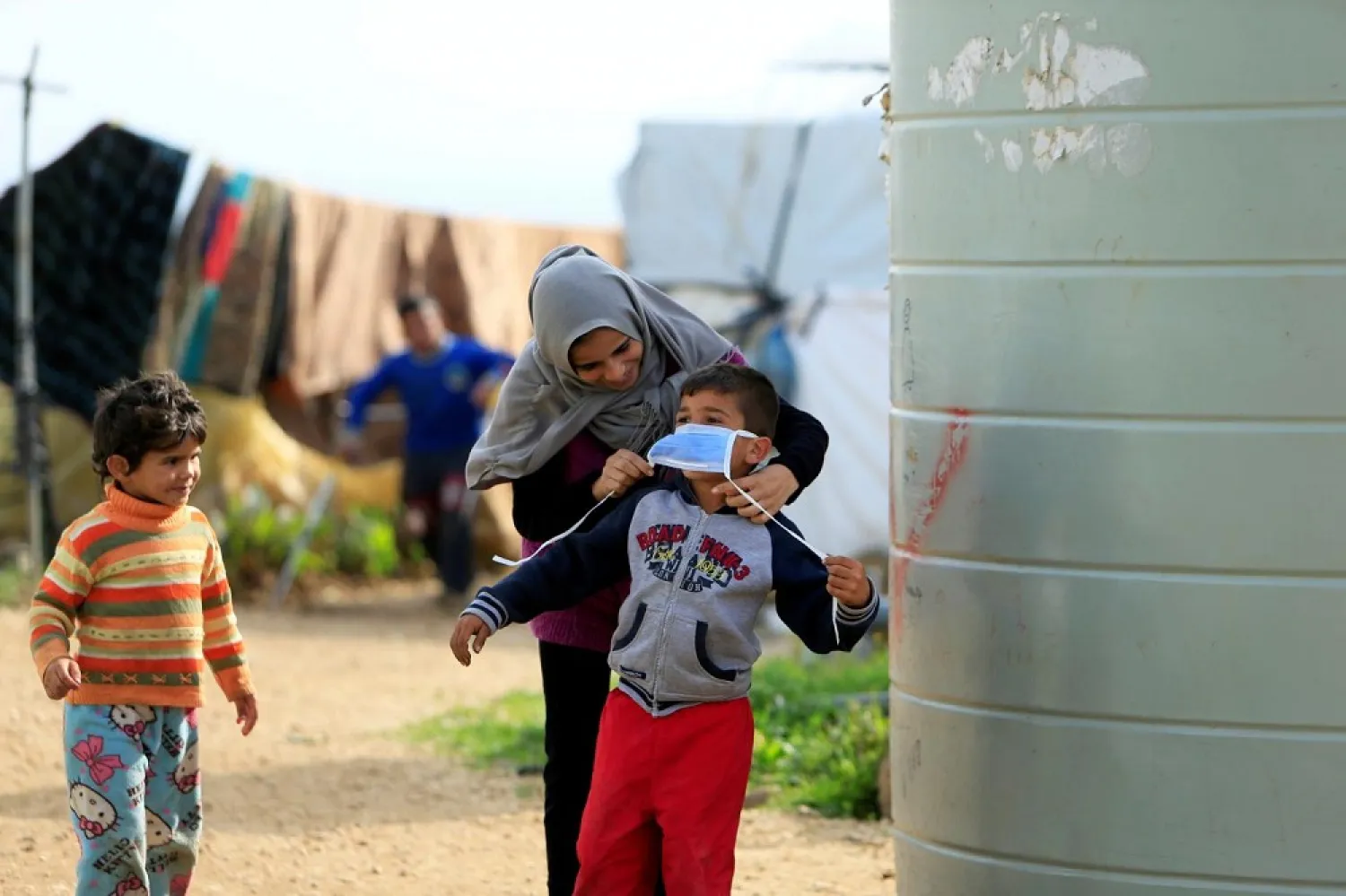
A Syrian refugee helps a child put on a face mask in al-Wazzani, southern Lebanon on March 14, 2020. (Reuters)
TT

'Just One Case': Fears Coronavirus May Spread Like Wildfire in World's Refugee Camps

A Syrian refugee helps a child put on a face mask in al-Wazzani, southern Lebanon on March 14, 2020. (Reuters)

In the world’s largest refugee settlement in Bangladesh, filmmaker Mohammed Arafat has been making public safety videos to warn about the dangers of coronavirus.

The 25-year-old is worried that the disease will devastate the vast, crowded camps that house more than one million Rohingya, members of a mostly Muslim minority who fled a brutal military crackdown in Myanmar.

“We are living in tiny, crowded shelters, we are sharing toilets,” he told Reuters. “It is very difficult to protect ourselves, it’s too crowded, people can’t breathe well.”

Bangladesh, which has reported 48 cases of the virus and five deaths, imposed a lockdown on Tuesday, the same day it confirmed the first case in Cox’s Bazar, the coastal district where the Rohingya camps are located. A family of four Rohingya have been quarantined after returning from India.

As the coronavirus forces the world’s big cities and wealthiest countries into lockdown, a potential humanitarian catastrophe threatens tens of millions of people crowded into refugee camps and makeshift settlements for displaced people from Bangladesh to Syria and across Africa, where healthcare and clean water is often scarce, sanitation is poor, illnesses are rife and social distancing is almost impossible.

“God forbid, if the virus gets into the camps, it would have a catastrophic effect,” Mahbub Alam Talukder, Bangladesh’s refugee relief and repatriation commissioner, told Reuters.

The United Nations says almost 70 million people uprooted by war and persecution around the world are in acute danger.

“We must come to the aid of the ultra-vulnerable – millions upon millions of people who are least able to protect themselves,” said UN Secretary-General António Guterres this week.

UNHCR, the UN agency charged with protecting refugees, is looking to raise $255 million from member states to tackle the problem, part of a wider UN response plan seeking $2.01 billion.

To be sure, camps in Bangladesh and elsewhere have experienced outbreaks of measles, diphtheria and other respiratory infections, and the SARS (Severe Acute Respiratory Syndrome) and Ebola epidemics did not lead to large-scale infections or mass deaths of refugees.

However, the latest coronavirus has exceeded all previous outbreaks, infecting almost 600,000 people globally and killing more than 27,000, according to a Reuters tally.

‘Just one case’

The mazy hills around Cox’s Bazar in Bangladesh are more densely populated than the most crowded cities on earth, with 60,000 to 90,000 people jammed into each square kilometer where as many as a dozen people share single small shelters and many more use the same water well and toilet.

Arafat, who fled violence in Myanmar eight years ago, urges people in his short videos to wash their hands and keep their distance from one another. But he cannot share the videos as mobile networks in the area have been curtailed by the government since last year on unspecified security grounds. As a result, both he and aid workers are struggling to educate the population about the spread of the virus.

In recent days volunteers have been blasting public health messages from radios and loudspeakers, but Arafat said rumors and misinformation persist, with some pinning their hopes on prayer, eating leaves and exposure to heat to ward off the virus.

“It needs just one case and it would be really critical,” said Haiko Magtrayo, a Cox’s Bazar-based aid worker from the International Committee of the Red Cross. Further spread would be “uncontrollable,” he added.

The closest hospital with an intensive care unit is in the town of Cox’s Bazar. The UN refugee agency says it is trying to expand the capacity to 10 beds and to improve healthcare services inside the camps, but as rumors spread, some are panicking.

“What is happening!” Mohammed Junaid, 21, said in a message to Reuters. “If something happens, where will we go for treatment?”

Middle East, Africa at risk

Similar fears are spreading in regions torn by war and natural disasters in the Middle East and Africa.

In Syria, where nearly a decade of war has uprooted 6.1 million people and forced some 5.3 million to flee to neighboring states, the coronavirus is a new threat for communities ill-equipped to deal with it.

“We don’t wash our hands much because water is in short supply,” said Nayef al-Ahmad, 33, who has lived for five years in a camp for displaced people on muddy ground near the town of Azaz, which houses about 150 families in grimy tents. “Gloves and masks are not available and if they are available, they are very expensive,” said al-Ahmad, who lives with his wife and seven children.

At another camp in nearby Idlib province, families have been moved from several large communal tents into individual tents, an effort to preempt the spread of the virus, though no cases have been recorded in the opposition-held northwest yet.

“We’ve split them up as much as we can,” said Ibrahim Sahhari, an administrator at the camp near Maarat Misrin.

Idlib has received around 1,500 coronavirus testing kits in the last few days. Its population is close to 3 million.

“Isolation is so difficult,” said Mohamed Tennari, a doctor and medical coordinator in the Idlib region. “Some people are still living in schools or in mosques. So, all of this, if we have corona patients, will help the virus to spread very widely.”

Similar overcrowding worries rage in neighboring countries hosting Syrian refugees. Lebanon has recorded around 350 cases so far, though none in refugee camps. “Whenever someone breathes, their neighbor can feel it,” said Syrian refugee Hamda Hassan, describing her camp in northern Lebanon.

‘Perfect storm’

In Burkina Faso in western Africa, the Barsalogho camp houses about 75,000 people fleeing an extremist insurgency, many in wood-framed tents covered with straw mats and white tarpaulin, pitched close together. Medical charities warn residents of the dangers of coronavirus, which has already spread across the capital Ouagadougou, infecting over 150 and killing eight.

But shortages of water and sanitary supplies are making it difficult.

Families of up to 10 people share about 20 liters of water a day, or about five gallons, said Manenji Mangundu, who leads operations for the Norwegian Refugee Council in Burkina Faso, well below the 35 liters per person that the NRC says is enough for a proper response to the coronavirus.

“The situation in densely populated camps such as Barsalogho with poor healthcare is the perfect storm for a devastating outbreak. Facilities are shared, shelters are shared. If one case is reported in the site, it can spread like wildfire,” Mangundu said.

Wendkouni Sawadogo, 27, lives at the camp with his family and shares a tent with 10 people.

“I know we should wash our hands all the time and not greet people in the normal way,” he said, adding that he was aware of the growing number of cases from television news reports, but sometimes he has no water.

In central Mozambique, where more than 90,000 victims of last year’s Cyclone Idai are still living in resettlement camps, large families of more than 10 people cram into one tent, with shared water sources and latrines, often open air with only plastic sheets for privacy. In some cases, thousands of people share one water source, or they have to walk hours to one used by nearby communities.

Espinola Caribe, the World Food Program’s head of sub-office in Beira, the port city where the cyclone made landfall and displaced tens of thousands of people, said any virus outbreak would be a disaster for those with immune systems weakened by the effects of extreme poverty.

Hand-washing sites are being installed in the camps and posters printed to raise awareness as aid workers try to spread the message face to face. Many camp residents do not have phones, and when they do, there is no guarantee they have power.

Even when the message gets across, Caribe said conditions make it very difficult for people to comply: tents become unbearably hot in the daytime and families are forced to mix at water points, where there might be a shared bucket for collection, and conditions can be unsanitary.

Not the first

In Somalia, where violence and natural disasters have displaced 2.6 million of the country’s 15 million people, tens of thousands of families are dotted around the capital Mogadishu under makeshift tents of rags stretched over a frame of sticks. Lucky ones may have a plastic tarpaulin. The seasonal rains have just begun.

Somali telecom companies are sending text messages about the importance of washing hands. But many have no soap and very little water, so simply use sand and ashes. Many do not have vessels to store water: several families might share one 20-liter container.

“We are already living in bad conditions and if coronavirus visits us, then there is no hope for life,” said Hawa Ali Ibrahim, a 50-year-old mother. She lives with her husband, three children and grandchildren in the capital’s Alafuuto Camp, where there is no soap. “We use sand and ashes to wash our hands.”

Neighboring Kenya is home to nearly half a million registered refugees, about 217,000 of those living in one sprawling camp called Dadaab, near the Somali border, according to the UN.

UNHCR is training health workers – some of whom are refugee community leaders – and running a multilingual hotline for refugees to report symptoms. They are increasing the distribution of soap and creating more hand-washing stations.

There have been no reported coronavirus cases in East Africa camps, said UNHCR East Africa spokeswoman Dana Hughes.

“These are not the first pandemics that we’ve dealt with,” Hughes told Reuters. “We’ve dealt with Ebola. We’ve dealt with SARS.”



Japan PM Takaichi Reappointed Following Election

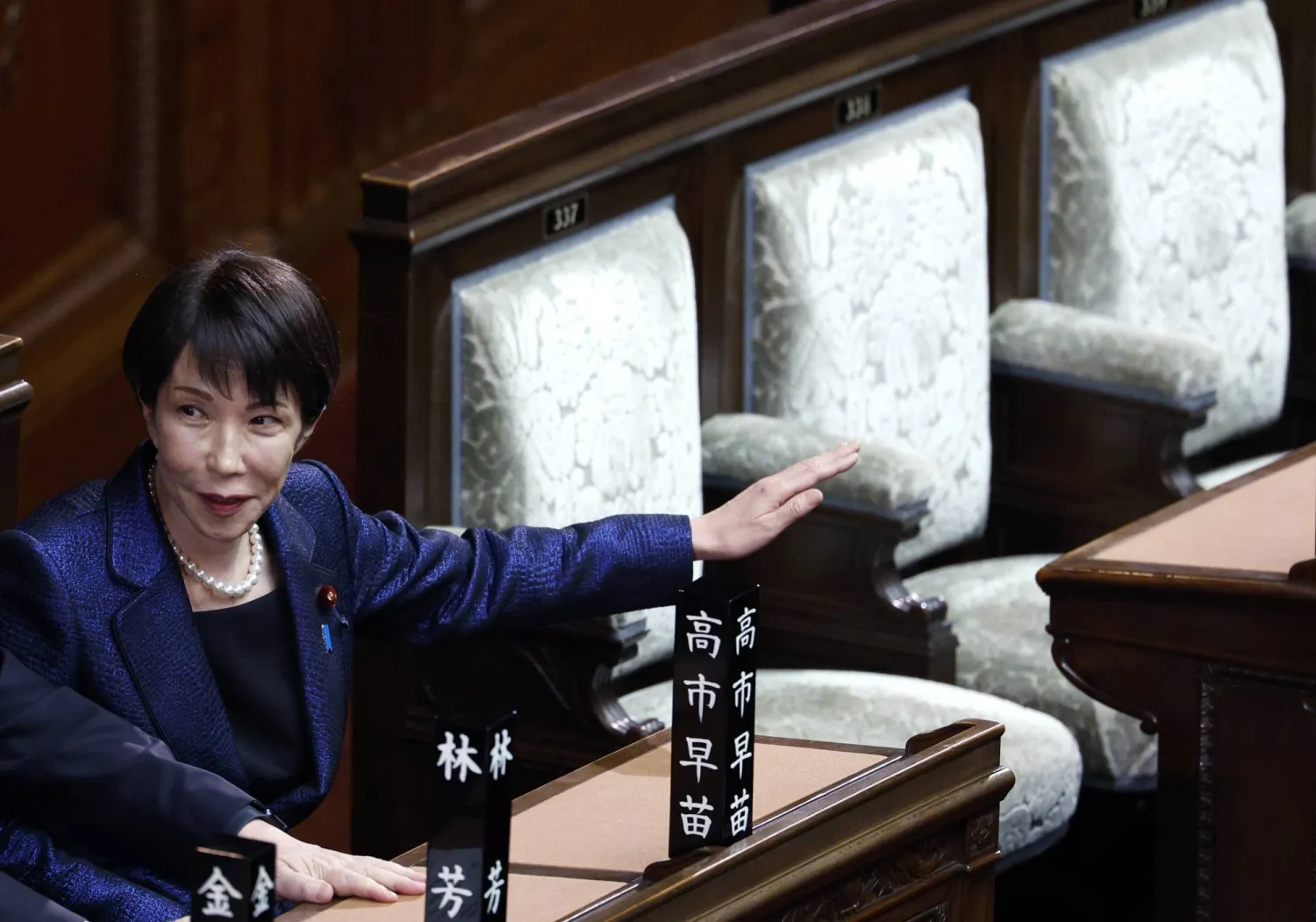
Sanae Takaichi gestures at the Lower House of the Parliament in Tokyo, Japan, 18 February 2026. EPA/FRANCK ROBICHON
TT

Japan PM Takaichi Reappointed Following Election

Sanae Takaichi gestures at the Lower House of the Parliament in Tokyo, Japan, 18 February 2026. EPA/FRANCK ROBICHON

Japan's lower house formally reappointed Sanae Takaichi as prime minister on Wednesday, 10 days after her historic landslide election victory.

Takaichi, 64, became Japan's first woman premier in October and won a two-thirds majority for her party in the snap lower house elections on February 8.

She has pledged to bolster Japan's defenses to protect its territory and waters, likely further straining relations with Beijing, and to boost the flagging economy.

Takaichi suggested in November that Japan could intervene militarily if Beijing sought to take Taiwan by force.

China, which regards the democratic island as part of its territory and has not ruled out force to annex it, was furious.

Beijing's top diplomat Wang Yi told the Munich Security Conference on Saturday that forces in Japan were seeking to "revive militarism".

In a policy speech expected for Friday, Takaichi will pledge to update Japan's "Free and Open Indo-Pacific" strategic framework, local media reported.

"Compared with when FOIP was first proposed, the international situation and security environment surrounding Japan have become significantly more severe," chief government spokesman Minoru Kihara said Monday.

In practice this will likely mean strengthening supply chains and promoting free trade through the Trans-Pacific Partnership (CPTPP) that Britain joined in 2024.

Takaichi's government also plans to pass legislation to establish a National Intelligence Agency and to begin concrete discussions towards an anti-espionage law, the reports said.

Takaichi has promised too to tighten rules surrounding immigration, even though Asia's number two economy is struggling with labor shortages and a falling population.

On Friday Takaichi will repeat her campaign pledge to suspend consumption tax on food for two years in order to ease inflationary pressures on households, local media said, according to AFP.

This promise has exacerbated market worries about Japan's colossal debt, with yields on long-dated government bonds hitting record highs last month.

Rahul Anand, the International Monetary Fund chief of mission in Japan, said Wednesday that debt interest payments would double between 2025 and 2031.

"Removing the consumption tax (on food) would weaken the tax revenue base, since the consumption tax is an important way to raise revenues without creating distortions in the economy," Anand said.

To ease such concerns, Takaichi will on Friday repeat her mantra of having a "responsible, proactive" fiscal policy and set a target on reducing government debt, the reports said.

She will also announce the creation of a cross-party "national council" to discuss taxation and how to fund ageing Japan's ballooning social security bill.

But Takaichi's first order of business will be obtaining approval for Japan's budget for the fiscal year beginning on April 1 after the process was delayed by the election.

The ruling coalition also wants to pass legislation that will outlaw destroying the Japanese flag, according to the media reports.

It wants too to accelerate debate on changing the constitution and on revising the imperial family's rules to ease a looming succession crisis.

Takaichi and many within her Liberal Democratic Party (LDP) oppose making it possible for a woman to become emperor, but rules could be changed to "adopt" new male members.


Türkiye: Ocalan Announces ‘Integration Phase’

Members of the Kurdish community take part in a protest calling for the release of convicted Kurdistan Worker's Party (PKK) leader Abdullah Ocalan in Diyarbakir on February 15, 2026. (Photo by Ilyas AKENGIN / AFP)
TT

Türkiye: Ocalan Announces ‘Integration Phase’

Members of the Kurdish community take part in a protest calling for the release of convicted Kurdistan Worker's Party (PKK) leader Abdullah Ocalan in Diyarbakir on February 15, 2026. (Photo by Ilyas AKENGIN / AFP)

The jailed leader of the Kurdistan Workers Party, Abdullah Ocalan, has said that the Ankara-PKK peace process has entered its “second phase,” as the Turkish parliament sets the stage to vote on a draft report proposing legal reforms tied to peace efforts.

A delegation from the pro-Kurdish Peoples' Equality and Democracy Party (DEM Party), including lawmakers Pervin Buldan, Mithat Sancar, and Ocalan’s lawyer Ozgur Faik, met with the jailed PKK leader on Monday on the secluded Imrali island.

Sancar said that the second phase will be focused on democratic integration into
Türkiye’s political system.

According to the lawmaker, the PKK leader considered the first phase the “negative dimension” concerned with ending the decades-old conflict between the armed group and Ankara.

“Now we are facing the positive phase,” Ocalan said, “the integration phase is the positive phase; it is the phase of construction.”

For the second phase to be implemented, Ocalan called on Turkish authorities to provide conditions that would allow him to put his “theoretical and practical capacity” to work.

The 60-page draft report on peace with the PKK was completed by a five-member writing team, which is chaired by Parliament Speaker Numan Kurtulmuş, and is scheduled for a vote on Wednesday.

The report is organized into seven sections.

In July last year, Ocalan said the group's armed struggle against Türkiye has ended and called for a full shift to democratic politics.


Iranians Chant Slogans Against Supreme Leader at Memorials for Slain Protesters

An Iranian man holds the Iranian national flag during a memorial ceremony for those killed in anti-government protests earlier last month, at the Mosalla mosque in Tehran, Iran, 17 February 2026. (EPA)
TT

Iranians Chant Slogans Against Supreme Leader at Memorials for Slain Protesters

An Iranian man holds the Iranian national flag during a memorial ceremony for those killed in anti-government protests earlier last month, at the Mosalla mosque in Tehran, Iran, 17 February 2026. (EPA)

Iranians shouted slogans against Supreme Leader Ali Khamenei on Tuesday as they gathered to commemorate protesters killed in a crackdown on nationwide demonstrations that rights groups said left thousands dead, according to videos verified by AFP.

The country's clerical authorities also staged a commemoration in the capital Tehran to mark the 40th day since the deaths at the peak of the protests on January 8 and 9.

Officials acknowledge more than 3,000 people died during the unrest, but attribute the violence to "terrorist acts", while rights groups say many more thousands of people were killed, shot dead by security forces in a violent crackdown.

The protests, sparked by anger over the rising cost of living before exploding in size and anti-government fervor, subsided after the crackdown, but in recent days Iranians have chanted slogans from the relative safety of homes and rooftops at night.

On Tuesday, videos verified by AFP showed crowds gathering at memorials for some of those killed again shouting slogans against the theocratic government in place since the 1979 revolution.

In videos geolocated by AFP shared on social media, a crowd in Abadan in western Iran holds up flowers and commemorative photos of a young man as they shout "death to Khamenei" and "long live the shah", in support of the ousted monarchy.

Another video from the same city shows people running in panic from the sounds of shots, though it wasn't immediately clear if they were from live fire.

In the northeastern city of Mashhad a crowd in the street chanted, "One person killed, thousands have his back", another verified video showed.

Gatherings also took place in other parts of the country, according to videos shared by rights groups.

- Official commemorations -

At the government-organized memorial in Tehran crowds carried Iranian flags and portraits of those killed as nationalist songs played and chants of "Death to America" and "Death to Israel" echoed through the Khomeini Grand Mosalla mosque.

Iranian President Masoud Pezeshkian attended a similar event at the Imam Reza shrine in Mashhad.

Authorities have accused sworn enemies the United States and Israel of fueling "foreign-instigated riots", saying they hijacked peaceful protests with killings and vandalism.

Senior officials, including First Vice President Mohammad Reza Aref and Revolutionary Guards commander Esmail Qaani, attended the ceremony.

"Those who supported rioters and terrorists are criminals and will face the consequences," Qaani said, according to Tasnim news agency.

International organizations have said evidence shows Iranian security forces targeted protesters with live fire under the cover of an internet blackout.

The US-based Human Rights Activists News Agency (HRANA) has recorded more than 7,000 killings in the crackdown, the vast majority protesters, though rights groups warn the toll is likely far higher.

More than 53,500 people have been arrested in the ongoing crackdown, HRANA added, with rights groups warning protesters could face execution.

Tuesday's gatherings coincided with a second round of nuclear negotiations between Iran and the United States in Geneva, amid heightened tensions after Washington deployed an aircraft carrier group to the Middle East following Iran's crackdown on the protests.