


Egypt Begins Repatriating 3,000 Citizens Stranded in Qatar

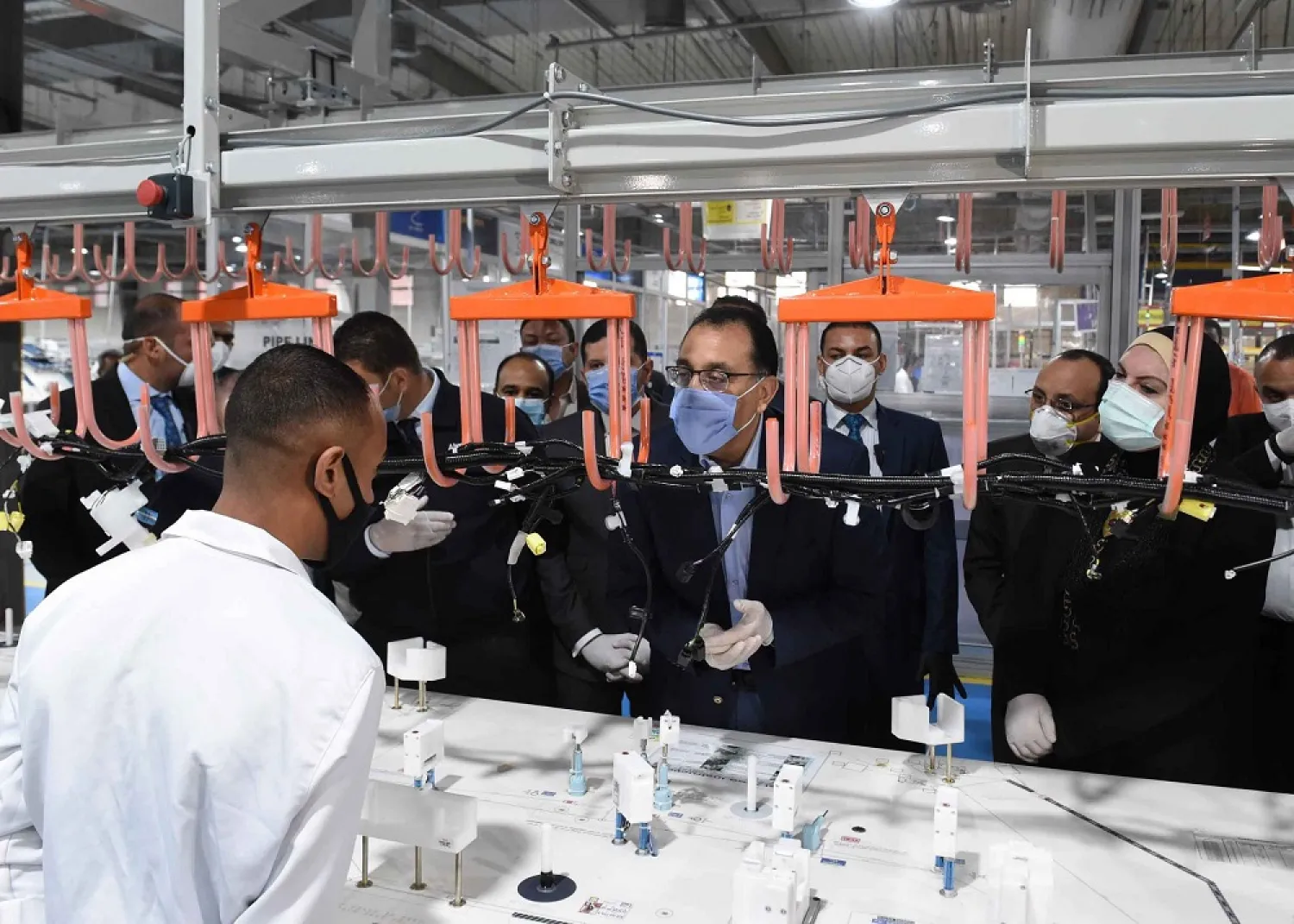
Egyptian Prime Minister Mostafa Madbouly during a visit to a factory in Cairo on Saturday, June 13, 2020. (Egyptian government)
TT

Egypt Begins Repatriating 3,000 Citizens Stranded in Qatar

Egyptian Prime Minister Mostafa Madbouly during a visit to a factory in Cairo on Saturday, June 13, 2020. (Egyptian government)

The Egyptian Ministry of Civil Aviation has started operating 18 special flights via the Omani capital, Muscat, to bring back around 3,000 Egyptian citizens stranded in Qatar.

Egyptians stuck in Qatar would be repatriated via a company from Doha to Muscat, from where they would be flown to Cairo International Airport, the ministry said in a statement.

Despite suspending flights mid-March, the government has recently repatriated tens of thousands of stranded citizens from various world countries.

It has pledged to repatriate all its citizens who want to return to Cairo.

Meanwhile, Minister of Health Hala Zayed dismissed director of El Mataria Teaching Hospital in Cairo from his post over his dereliction of duty.

The director was also referred to an investigative panel after the death of a Sudanese patient at the hospital.

Zayed took her decision after a video went viral on social media, documenting the death of the Sudanese patient.

Each patient has the right to access health services, the minister said, adding that no leniency will be shown in this regard.

A committee uncovered some technical and administrative violations by the hospital, and it will continue its work to identify the shortcomings and refer the negligent officials to the judiciary.

A woman published a video on social media showing a patient who had died inside the hospital and who was still in his bed alongside other patients who are still receiving treatment.

“Directly after the incident, Zayed directed opening an urgent and immediate probe,” the statement read, adding that the results will be presented to the Minister of Health and Population to be referred later to competent authorities.

Separately, in line with the government’s efforts to resume various activities, Egyptian Prime Minister Mustafa Madbouly visited Saturday a number of factories in the 6th of October City.

He was accompanied by Minister of Trade and Industry Nevine Gamea and Executive Director of the General Authority for Investment and Free Zones Mohamed Abd El Wahab.



Guterres Marks End of UN Mission in Iraq

This handout picture released by the office of Iraq's Prime Minister Mohammed Shia al-Sudani shows him shaking hands with United Nations Secretary-General Antonio Guterres during a meeting in Baghdad. (Handout / Iraqi Prime Minister’s Press Office/AFP)
TT

Guterres Marks End of UN Mission in Iraq

This handout picture released by the office of Iraq's Prime Minister Mohammed Shia al-Sudani shows him shaking hands with United Nations Secretary-General Antonio Guterres during a meeting in Baghdad. (Handout / Iraqi Prime Minister’s Press Office/AFP)

UN Secretary General Antonio Guterres on Saturday marked in Baghdad the end of the United Nations' political mission in Iraq, which supported the country's transition following the US-led invasion.

At Baghdad's request, the United Nations Assistance Mission for Iraq (UNAMI) will shut down its operations after 22 years of assisting the country in its transition following the 2003 invasion and occupation that toppled longtime ruler Saddam Hussein.

"UNAMI was honored and humbled to walk side-by-side with the Iraqi people," Guterres said at the mission's closing ceremony.

But "while a mission may conclude, the United Nations will always walk alongside the people of Iraq on the path toward peace, sustainable development and human rights," he added.

UN agencies and programs will continue to operate in Iraq.

During a press conference earlier with Iraq's Prime Minister Mohammed Shia al-Sudani, Guterres said "there is one thing the world must understand, Iraq is now a normal country.

"Relations between the UN and Iraq will become normal relations with the end of UNAMI."

Sudani meanwhile said that the end of the UNAMI mandate "marks the beginning of a new chapter of cooperation".

"Our relationship with the United Nations through UNAMI was pivotal and effective in meeting Iraq's needs and supporting it until it reached the stage of full self-reliance," he added.

UNAMI was established by a UN Security Council resolution at the request of the Iraqi government before being expanded four years later.

Shortly after it was formed, a truck bomb struck the UN headquarters in Baghdad on August 19, 2003, killing the UN's first special representative in Iraq, Sergio Vieira de Mello, along with 21 others.

UNAMI's tasks included advising the government on political dialogue and reconciliation, as well as helping with elections and security sector reform.

But with Iraq regaining a sense of normalcy in recent years, authorities say there are no longer grounds for a UN political mission.


Türkiye Says SDF Has No Option but to Integrate into Syrian Army

Turkish Land Forces Commander Metin Tokel and Syrian Defense Minister Murhaf Abu Qasra meet in Damascus on December 11. (Turkish Defense Ministry)
TT

Türkiye Says SDF Has No Option but to Integrate into Syrian Army

Turkish Land Forces Commander Metin Tokel and Syrian Defense Minister Murhaf Abu Qasra meet in Damascus on December 11. (Turkish Defense Ministry)

Türkiye said on Friday that the Syrian Democratic Forces (SDF) have no alternative but to implement a March 10 agreement requiring their integration into the Syrian army, accusing Israel of encouraging the group to stall the deal through its actions in Syria.

In a statement, the Turkish Ministry of National Defense said the SDF, whose backbone is the Kurdish People’s Protection Units (YPG), is acting in violation of the agreement signed in Damascus between Syrian President Ahmad al-Sharaa and SDF commander Mazloum Abdi.

Ankara considers the YPG an extension of the Kurdistan Workers’ Party (PKK), which it designates as a terrorist organization.

Ministry spokesperson Zeki Akturk said the SDF’s continued activities, instead of integration despite the March 10 accord, undermine stability and security in Syria. He stressed that SDF members must join the Syrian army as individuals, not as an autonomous bloc.

He accused unnamed countries of encouraging the SDF through actions and rhetoric, to reject integration and disarmament, calling such efforts futile attempts to buy time.

He also said Turkish forces have destroyed 732 kilometers of SDF tunnels in areas of operations across northern and northeastern Syria, including four kilometers in Manbij.

Separately, Turkish Foreign Minister Hakan Fidan linked the SDF’s reluctance to implement the March 10 agreement to Israeli moves in Syria.

He said the SDF would reach an understanding with Damascus on integration the day Israel finds common ground with Syria, arguing that the SDF’s stance is not solely its own decision but influenced by Israel.

Fidan stressed that the agreement initially enjoyed support from Türkiye, the United States, and Syria, but that progress has stalled as the YPG/SDF refrains from taking required steps.

Expressing hope for a negotiated solution between Damascus and the SDF, Fidan said dialogue would reassure all communities, Arabs and Kurds alike. He warned that conflict would harm civilians and benefit no one, noting plans to unify armed factions under a single national army.

Meanwhile, Türkiye’s Defense Ministry announced a visit to Damascus by Land Forces Commander Metin Tokel, who met Syrian Defense Minister Murhaf Abu Qasra and Chief of Staff Ali Noureddine al-Naasan. Tokel also toured the joint Turkish-Syrian operations center.


Lebanese State Formally Launches Reconstruction Effort with Modest Public Funding

A member of the Civil Defense stands on the rubble of a house hit by an Israeli airstrike in the town of Jbaa in South Lebanon. (Reuters)
TT

Lebanese State Formally Launches Reconstruction Effort with Modest Public Funding

A member of the Civil Defense stands on the rubble of a house hit by an Israeli airstrike in the town of Jbaa in South Lebanon. (Reuters)

More than a year after the end of the war between Israel and Hezbollah, which caused widespread destruction in South Lebanon, the Lebanese state has formally launched its reconstruction effort, albeit with very limited public funding.

Within the framework of the 2026 state budget, Parliament’s Finance and Budget Committee approved allocations for the Council for Development and Reconstruction (CDR), the Council of the South, and the Higher Relief Committee.

It also endorsed the transfer of funds from the emergency reserve for shelter and repairs, a move committee chairman Ibrahim Kanaan described as “a positive signal from the Lebanese state to our people, within the limits of the budget.”

Committee sources said a total of $90 million was transferred from the reserve: $67 million to the Council of the South and $24 million to the Higher Relief Committee.

With the approval of these allocations, the state has effectively begun the reconstruction process with what lawmakers themselves describe as a very modest sum, after waiting for more than a year for foreign aid that never materialized. This marks the first direct state funding for reconstruction since the war ended in November 2024.

Foreign envoys have told Lebanese officials in recent months that international support for reconstruction is contingent on Lebanon implementing a package of financial reforms and, crucially, achieving exclusive state control over weapons. Lebanese officials believe the issue has since become even more complex, tied in particular to the trajectory of agreements with Israel.

The fate of a reconstruction conference spearheaded by France remains uncertain, especially as Paris has recently prioritized plans for a conference to support the Lebanese army, expected early next year.

Meanwhile, political divisions in parliament over expatriate voting have stalled legislative work, derailing the approval of World Bank loans linked to reconstruction that could total up to $500 million, according to Kanaan. He warned that the loans could be withdrawn if parliament fails to ratify them before the end of the year.

Parliamentary sources said lawmakers from the so-called Shiite duo — Hezbollah and the Amal Movement — insisted on reallocating part of the relatively large budget reserve toward reconstruction, arguing that the state must send a positive signal to citizens who have been neglected for over a year.

According to the sources, many lawmakers went along with the proposal under pressure, amid fears they would otherwise be held accountable by residents, especially given the risk of building collapses threatening lives.

Ali Hassan Khalil, an MP from Amal’s Liberation and Development Bloc, called on the government to issue the regulatory framework for reconstruction, saying the approved funds, while limited, would help address urgent shelter needs and serve as a starting point for a major national effort.

MP Hassan Fadlallah, of Hezbollah's Loyalty to the Resistance Bloc, said reconstruction requires large sums but stressed that the state cannot remain idle waiting for foreign funds, while welcoming any non-politicized, unconditional assistance.

Researcher Mohammad Shamseddine of Information International estimated total direct war damage at $8.5 billion, with reconstruction costs of about $2.3 billion. He told Asharq Al-Awsat the approved funding represents only a fraction of what is needed and confirms the state’s limited capacity, noting that foreign aid is unlikely before a definitive settlement and lasting peace with Israel.

The move drew objections from the Lebanese Forces party. MP Ghada Ayoub, a member of the Strong Republic Bloc and the Finance Committee, criticized what she called pressure to divert public funds to reconstruction, arguing that financing should come through a dedicated, internationally supervised fund and external assistance.

She said the priority should instead be strengthening the Lebanese army to ensure stability and enable the safe return of residents.