

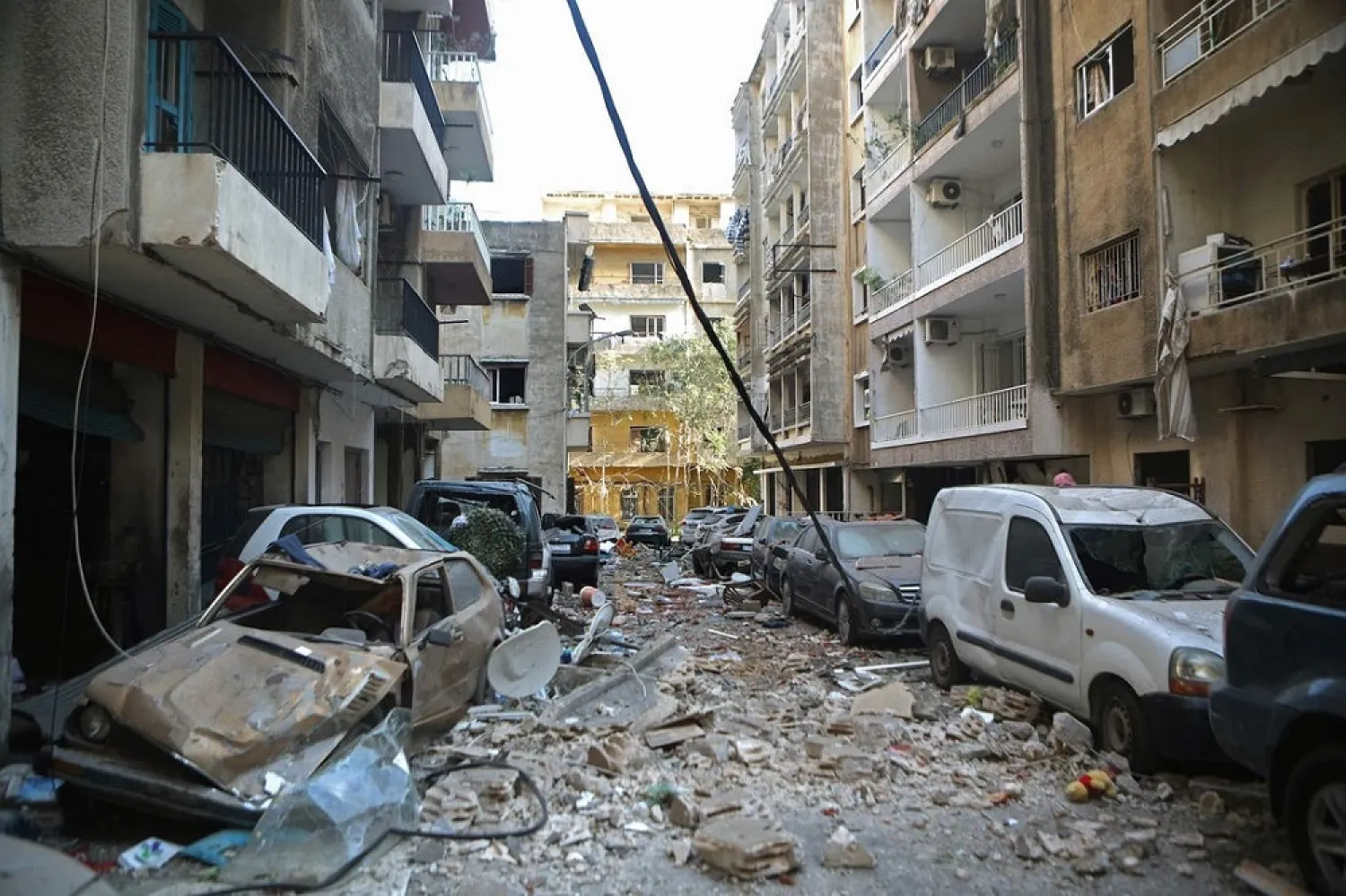

Furious Lebanese Count their Losses from Blast, Plan Demonstration

A view of the damaged Beirut neighborhood of Mar Mikhael on Wednesday in the aftermath of the explosion. (Getty Images)
TT

Furious Lebanese Count their Losses from Blast, Plan Demonstration

A view of the damaged Beirut neighborhood of Mar Mikhael on Wednesday in the aftermath of the explosion. (Getty Images)

As Beirut mourns its dead and grapples with the scale of rebuilding after this week's massive blast, some Lebanese activists planned to demonstrate in the city on Saturday, angered by the government's response to the disaster.

Tuesday's port explosion, the biggest in Beirut's history, killed 154 people, injured 5,000 and destroyed a swathe of the city.

Some residents, struggling to clean up shattered homes, complain the state they see as corrupt - there had been months of protests against the government's handling of a deep economic crisis before this week's disaster - has let them down again.

The demonstration was planned for Saturday afternoon.

"The people are doing your work, shame," someone wrote on the dust covering a car window, referring to Lebanese leaders.

The prime minister and presidency have said 2,750 tons of highly explosive ammonium nitrate, which is used in making fertilizers and bombs, had been stored for six years without safety measures at the port warehouse.

President Michel Aoun said on Friday an investigation would also examine whether it was caused by a bomb or other external interference. Aoun said the investigation would also weigh if the blast was due to negligence or an accident. Twenty people had been detained so far, he added.

'We can't afford to rebuild'
Some residents wondered how they would ever rebuild their lives.

Tearing up, Bilal Hassan used his bare hands to try to remove debris from his home located a few hundred meters from where the port blast hit. He has been sleeping on a dusty couch besides pieces of splintered glass.

When his three wounded teenage children ran for their lives they left blood stains on the staircase and walls.

"There is really nothing we can do. We can't afford to rebuild and no one is helping us," he said, standing beside a large teddy bear that was blown across his home, and a damaged photograph of him and his wife.

Bulldozers ploughed through the wreckage of mangled homes and long rows of flattened cars as soldiers stood by. Volunteers with shovels streamed through streets.

Danielle Chemaly said her charity organization, whose headquarters was destroyed, had provided assistance to 70 families who were left homeless by the explosion.

"We have given people initial help but we don't know what we can do for families in the future. It requires major projects," she said.

Officials have said the blast could have caused losses amounting to $15 billion. That is a bill that Lebanon cannot pay after already defaulting on a mountain of debt - exceeding 150% of economic output - and with talks stalled on a lifeline from the International Monetary Fund.

43 Syrians among victims
Syria’s state TV said 43 Syrian citizens were killed in the blast.

The TV quoted the Syrian embassy in Lebanon as saying that the number is not final as search operations for dozens of missing are still ongoing.

Lebanon is home to more than a million Syrians many of them refugees who fled civil war in their country.

The wife of the Dutch ambassador to Lebanon died on Saturday after being seriously injured in the massive explosion, the Dutch Foreign Ministry said.

Hedwig Waltmans-Molier, 55, was injured by the explosion as she stood next to her husband, ambassador Jan Waltmans, in the living room of their house in Beirut, the ministry said.

Tuesday’s blast caused extensive damage to the Dutch embassy, injuring four other people connected to it.

Aid from abroad
France and other countries have rushed emergency aid to Lebanon, including doctors, and tons of health equipment and food. The blast destroyed Lebanon's only major grain silo and UN agencies are helping provide emergency food and medical aid.

US President Donald Trump said on Friday he would join a conference call with Lebanon's president and other world leaders on Sunday to discuss aid to the country.

For ordinary Lebanese, the scale of destruction is overwhelming.

"It felt like a mini atomic bomb," said George Rohana, sitting beside a supermarket that was demolished.

A few onions were left in the debris of the blast that tore a huge hole through the shop into an adjacent apartment.

"Now we have a situation where people are stealing metals and other items from the destruction," said Rohana. "The other day someone walked away with a broken toaster."



Thousands of Animals, Rare Specimens Stolen from Sudan Museum

Skulls of several mammals before the destruction (Asharq Al-Awsat)
TT

Thousands of Animals, Rare Specimens Stolen from Sudan Museum

Skulls of several mammals before the destruction (Asharq Al-Awsat)

“Everything is over.” With that short and painful phrase, a Sudanese government official summed up the loss of nearly a century and a half of history after war destroyed the headquarters of the Sudan Natural History Museum in central Khartoum, stripping the country of thousands of taxidermied and live endangered animals, as well as rare reference specimens.

In the first days after fighting erupted in April 2023, activists on social media called for food and water to be provided to save the live animals. When that proved impossible, cages were opened, and the animals fled, even though some of the reptiles were venomous snakes.

The museum, officially affiliated with the University of Khartoum, lies about one kilometer from the Sudanese army’s general command headquarters in central Khartoum.

Its close proximity led to severe damage from clashes and shelling between the Sudanese army and the Rapid Support Forces, which later took control of the surrounding area for more than a year.

Dr. Othman Ali Haj Al-Amin, Dean of the Faculty of Science at the University of Khartoum, said: “We lost thousands of taxidermied animals, birds, and reptiles that are more than 150 years old.”

“It is most likely that the live animals were stolen or looted and did not die,” he added. “We did not find remains or skeletons of those animals inside the museum.”

Al-Amin broke down in tears as he described to Asharq Al-Awsat the scale of devastation inflicted on one of the world’s oldest natural history museums.

“We lost about 2,000 taxidermied animal specimens, in addition to more than 600 endangered reference specimens that were on display, and nearly all geological records, including animal, plant, and rock fossils,” he said.

“The greatest loss was around 100 species representing all families of animals, birds, and reptiles that had been cared for and preserved for decades.”

Among them were fossil bird specimens collected between 1885 and 1945 that cannot be replaced, as well as a Kordofan giraffe, an endangered subspecies.

The war also claimed “the oldest crocodile, which had lived in the museum for many years and had been cared for since it was an egg,” along with numerous reptiles, including venomous snakes, scorpions, and a Nile monitor lizard.

A taxidermied lioness was recovered and transferred to the university’s veterinary faculty.

Asharq Al-Awsat learned that the International Committee of the Red Cross attempted in those early days to evacuate civilians, including university students who were trapped inside the museum for weeks, as well as to move live and taxidermied animals. The effort failed due to intense fighting in the heart of Khartoum.

According to the Sudanese official, the preserved specimens were collected in the mid-19th century by British army officers.

During World War II, they were transferred from the Sudan National Museum to the Natural History Museum next to the University of Khartoum, which has managed them since its establishment in 1929.

Al-Amin said the museum housed specimens illustrating biodiversity from across Sudan, including South Sudan before its secession, as well as samples gifted to Sudan by international museums.

The Sudan Natural History Museum included multiple sections, among them halls displaying rare bird species, another devoted to animal skulls preserved for decades, a section for medicinal and aromatic plants, geological rock samples collected from ancient eras and environments, and enclosures for live animals.

The dean said restoring the museum to its original state would require many years of work and significant funding. He voiced pessimism about recovering the rare animals, historical specimens, and old records lost during the war.

Many live animals were likely deliberately killed or died of hunger and thirst, he said, while taxidermied animals and rare rock and herb specimens — painstakingly collected, sorted, and classified over many years by researchers — were looted.

The Natural History Museum was a scientific and cultural institution dedicated to the study of biodiversity and natural specimens, and one of the oldest museums in Sudan.


Nissan CEO to Asharq Al-Awsat: Saudi Arabia Is ‘Golden Jewel’ Driving Regional Growth 

Nissan Chief Executive Ivan Espinosa. (Asharq Al-Awsat)
TT

Nissan CEO to Asharq Al-Awsat: Saudi Arabia Is ‘Golden Jewel’ Driving Regional Growth 

Nissan Chief Executive Ivan Espinosa. (Asharq Al-Awsat)

Nissan Chief Executive Ivan Espinosa has singled out Saudi Arabia as a cornerstone of the automaker’s global ambitions, calling the kingdom and the wider Middle East a “golden jewel” in the company’s international portfolio, driven by strong brand equity, steady profitability, and a deep, loyal customer base.

Speaking to Asharq Al-Awsat, Espinosa said Nissan has long enjoyed a solid foothold in Saudi Arabia and across the region, noting that Middle Eastern markets contribute a significant share of the company’s global earnings.

“We have a large base of supporters and loyal customers in the region, which makes it a pivotal market for both our present and our future,” he stressed.

Speaking during his first visit to the region as Nissan’s president, Espinosa said the company will continue investing in products tailored to local needs.

He cited the Nissan Patrol as a model born and developed to suit Gulf markets, particularly in its latest generations, which benefited from in-depth studies of user behavior and expectations.

He revealed that his visit was not limited to attending the recent Formula E event, but also aimed at gaining a deeper understanding of the Saudi market and strengthening Nissan’s position there. The company is working to expand its lineup and introduce more diverse products to serve a wider range of customers, he added.

Saudi visit

Espinosa described Saudi Arabia as “a wonderful place” where he continues to discover new facets reflecting the depth of its culture and the vibrancy of its society. The positive energy he sensed in the country reflects an ambitious and optimistic spirit, he said.

The Formula E event in which Nissan participated is a clear example of the Kingdom’s dynamism and its growing role in launching globally influential initiatives, underscoring its rising presence and confidence in shaping the future, he remarked.

Espinosa said Saudi Arabia’s ambitions under Vision 2030 intersect strongly with Nissan’s future vision, particularly in autonomous driving, artificial intelligence, and vehicles powered by new energy sources. The company sees promising opportunities for cooperation in the coming years.

With a long history and broad customer base in the Kingdom, Nissan aims to continue meeting expectations with innovative products, he said, noting that Saudi Arabia is a growing market with significant potential in technology and mobility solutions, reinforcing the company’s commitment to long-term investment in the region.

Strategic hub

Espinosa said Nissan is currently implementing its recovery plan, Re:Nissan, while preparing a strategic vision for the next phase. Regions have been classified according to growth priorities, with the Middle East among those given high priority.

He said describing the region as a “golden jewel” reflects the strength of the brand, the company’s long history there, and its solid profitability. Nissan aims to expand its market share through sustainable organic growth, he added.

Formula E

On Nissan’s participation in the Formula E World Championship, which concluded in Jeddah, Espinosa said it reflects the company’s competitive heritage and serves as a platform to showcase its electric vehicle technologies.

The championship serves as a real-world laboratory for transferring technology from race cars to production models.

He pointed to expertise in battery management and traction control derived from the Nissan Leaf, as well as the movement of engineers from the Formula E program into the development of future performance models, strengthening knowledge exchange between the track and the production line.

Three pillars

Espinosa said Nissan’s three-to-five-year plan rests on three pillars.

The first is completing the recovery plan by recalibrating the cost structure. So far, the company has achieved savings of about 160 billion yen, roughly $1 billion, in fixed costs, and launched more than 5,000 initiatives to reduce variable costs with potential savings of up to 240 billion yen, or about $1.5 billion.

Third-quarter results showed operating profit of 17 billion yen, or $114 million, despite tariff-related pressures, reflecting the company’s resilience and improved operational efficiency, he said.

The second pillar focuses on products and technology to accelerate the rollout of new models. The third aims to cement Nissan’s position as a leader in smart vehicles, he added.

Espinosa said the industry's future requires automakers to embrace technology without losing their core identity. Artificial intelligence has become central to design processes, with generative AI significantly shortening early design phases while enhancing creativity without replacing designers.

In autonomous driving, he cited Nissan’s partnership with a British software company that provides self-driving algorithms, while Nissan leverages its vehicle engineering expertise to deliver a natural driving experience that mimics human behavior.

He outlined a longer-term ambition for vehicles to learn their owners' driving styles and adapt their autonomous mode accordingly, whether dynamic or conservative, thereby enhancing trust and reducing anxiety.

Reshaping the industrial base

As part of the Re:Nissan plan, Espinosa said restructuring the industrial base is a key element of the transformation. The company will reduce the number of global plants from 17 to 10 to improve capacity utilization and boost profitability.

Among the most notable steps was the agreement to sell Nissan’s South Africa plant to Chery South Africa. The process was carried out with a high degree of responsibility and precision, he said, stressing that protecting jobs and ensuring employment continuity were core conditions of the deal.

A similar approach was adopted in Japan when the Oppama plant was closed. Nissan began early talks with employees and offered multiple options, including transfers to future operations in Kyushu, opportunities within other group units, and voluntary separation programs with attractive terms when necessary.

Plant reductions are being handled with great care while maintaining uniform global quality standards across production sites, supported by standardized control systems and specialized teams to ensure supply chain stability, particularly for semiconductors and electronic chips, said Espinosa.

Espinosa said the Re:Nissan plan is progressing on schedule, with clear signs of performance improvement paving the way for a smarter and more sustainable growth phase in global markets, led by the Middle East and Saudi Arabia.

Strategic flexibility

On hybrid and electric powertrains, Espinosa said Nissan is keeping pace with customer preferences while maintaining the view that electric vehicles will gradually become the dominant option.

The company offers a range of technologies, including internal combustion engines, e-Power systems, and fully electric vehicles, while shortening model development cycles to improve responsiveness to market demand.

The e-Power technology is expanding globally after its launch in Japan and Europe and is nearing entry into the US market, he went on to say. It will reach the Middle East in due course, particularly in mid-size segments.

Hybrid solutions for larger vehicles are also under study to meet regional towing requirements, he said.


Saudi Intervention Ends Socotra Power Crisis

Socotra power generators restarted after Saudi intervention (X)
TT

Saudi Intervention Ends Socotra Power Crisis

Socotra power generators restarted after Saudi intervention (X)

Electricity has returned to Yemen’s Socotra archipelago after urgent Saudi intervention ended days of outages that disrupted daily life and crippled vital institutions, including the general hospital, the university and the technical institute.

The breakthrough followed a sudden shutdown of the power plants after the operating company withdrew and disabled control systems, triggering widespread blackouts and deepening hardship for residents.

The Saudi Program for the Development and Reconstruction of Yemen said its engineering and technical teams moved immediately after receiving an appeal from local authorities. Specialists were dispatched to reactivate operating systems that had been encrypted before the company left the island.

Generators were brought back online in stages, restoring electricity across most of the governorate within a short time.

The restart eased intense pressure on the grid, which had faced rising demand in recent weeks after a complete halt in generation.

Health and education facilities were among the worst affected. Some medical departments scaled back services, while parts of the education sector were partially suspended as classrooms and laboratories were left without power.

Socotra’s electricity authority said the crisis began when the former operator installed shutdown timers and password protections on control systems, preventing local teams from restarting the stations. Officials noted that the archipelago faced a similar situation in 2018, which was resolved through official intervention.

Local sources said the return of electricity quickly stabilized basic services. Water networks resumed regular operations, telecommunications improved, and commercial activity began to recover after a period of economic disruption linked to the outages.

Health and education rebound

In the health sector, stable power, combined with operational support, secured the functioning of Socotra General Hospital, the archipelago’s main medical facility.

Funding helped provide fuel and medical supplies and support healthcare staff, strengthening the hospital’s ability to receive patients and reducing the need to transfer cases outside the governorate, a burden that had weighed heavily on residents.

Medical sources said critical departments, including intensive care units and operating rooms, resumed normal operations after relying on limited emergency measures.

In education, classes and academic activities resumed at Socotra University and the technical institute after weeks of disruption.

A support initiative covered operational costs, including academic staff salaries and essential expenses, helping curb absenteeism and restore the academic schedule.

Local authorities announced that studies at the technical institute would officially restart on Monday, a move seen as a sign of gradual stabilization in public services.

Observers say sustained technical and operational support will be key to safeguarding electricity supply and preventing a repeat of the crisis in a region that depends almost entirely on power to run its vital sectors.