

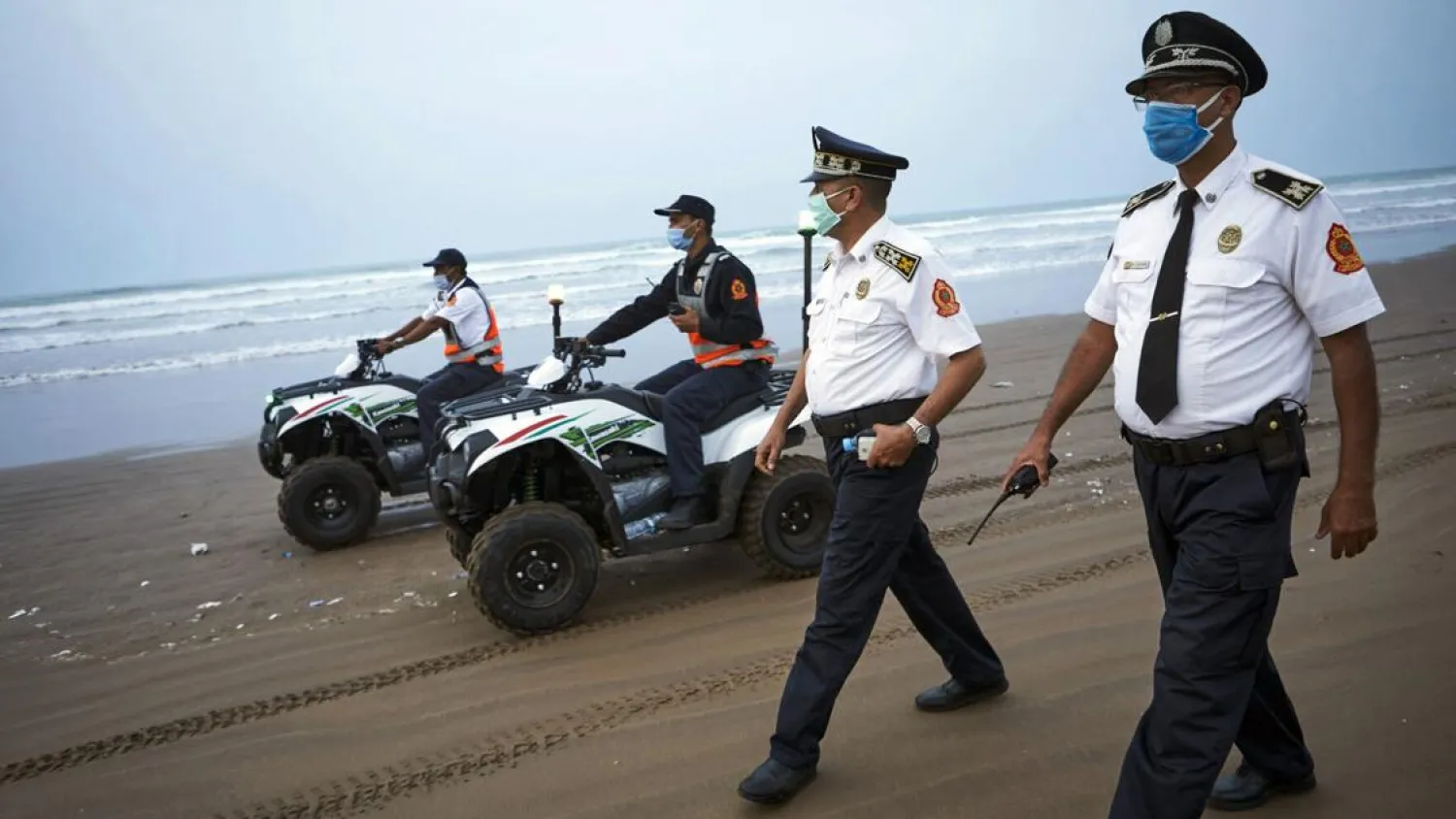

Morocco Faces Down COVID Spread With Tough Rules

Moroccan police officers wearing face masks patrol Ain Diab beach in Casablanca, Morocco, Wednesday, Sept.23, 2020. (AP Photo/Abdeljalil Bounhar)
TT

Morocco Faces Down COVID Spread With Tough Rules

Moroccan police officers wearing face masks patrol Ain Diab beach in Casablanca, Morocco, Wednesday, Sept.23, 2020. (AP Photo/Abdeljalil Bounhar)

With air and sea borders closed for months and eight cities barring people from entering or leaving, Morocco has been pulling out the stops to stanch the spread of coronavirus.

Still, the kingdom on the Atlantic coast, a magnet for tourists in better times, has registered more than 110,000 positive cases since March and has a death toll of 2,041 - the highest among its North African neighbors.

Morocco first decreed lockdown measures on March 20, but has been gradually easing restrictions. A recent upsurge in infections, however, has forced targeted measures.

Marrakech, a major tourist destination, is at a standstill, while police checks are part of the scenery in hard-hit Casablanca, the country´s economic powerhouse. Police are out in the markets, streets, drug-dealers´ haunts, and closed-off beaches, with military vehicles occasionally rolling by. They are a no-nonsense signal for citizens to respect the country's strict orders to contain the virus.

In the northern city of Tangiers, military vehicles were deployed last month to help enforce measures there. Movement between the city and others was stopped, as it was in Casablanca, barring exceptional authorizations.

In Casablanca, tough measures to keep people from leaving town are in place. Police at blockades focus on taxis, buses, freight trucks and private ambulances, vehicles known to be used by those trying to sneak out of town, said Karim El Idrani, commander of the Al Fida police district.

In Rabat, the political capital and site of the main palace of King Mohamed VI, police are posted at entrances and exits - although the city is not closed. Still, occupants of vehicles venturing into town are asked to show proof of residency, or provide authorization if traveling in from elsewhere, especially closed-off cities, or risk fines.

The director of epidemiology at the Health Ministry, Mohamed Lyoubi, conceded during a webinar that he expects the situation to worsen over winter as the flu season overlaps with the COVID-19 pandemic.

"Many hospitals and test sites for the coronavirus are expected to reach capacity," Lyoubi said. "The situation will also affect the ability of health authorities to carry out case investigations and ensure contact follow-up and monitoring of patients treated at home."

Morocco´s testing program is increasingly overwhelmed. Long lines for testing are now common outside hospitals and laboratories in Moroccan cities.

With a rise in cases, hospitals have been struggling to keep up with the growing influx of patients, and some intensive care units are reaching full capacity. Last month, health workers staged a protest outside Ibn Zohr Hospital in Marrakech to demand better working conditions. Photos showing COVID-19 patients lining the corridors of the overcrowded hospital, with some lying on the floor, caused an uproar on social media.

Medical professionals held similar protests elsewhere, claiming that some health facilities are understaffed and lack protective equipment for workers. The Health Ministry has sought to remedy the situation by setting up field hospitals.

The rise in cases has come as a blow to Morocco, which had been phasing out lockdown measures. On July 19, it began a third phase of gradually lifting its lockdown and foreign business visitors were allowed to enter the kingdom starting Sept. 10.

But Casablanca doubled down after its infection rate began climbing. The city hosts 42% of the daily reported cases, 40% of the serious cases and 38% of the deaths recorded at the national level, according to Health Minister Khalid Ait Taleb. To counter the surge, schools were forced to close again, with the adoption of remote education. Markets, cafes, shops, and restaurants were ordered to close early. The city enacted a curfew between the hours of 10 p.m. and 5 a.m. Police set up roadblocks and patrols to enforce compliance.

The Moroccan monarch said last month that "if figures continue to increase, the COVID-19 Scientific Committee may recommend another (full) lockdown, perhaps with even tighter restrictions."



Australia Won’t Repatriate 34 Women and Children from Syria 

Australia's Prime Minister Anthony Albanese stands outside the entrance to his office at Parliament House in Canberra on February 11, 2026. (AFP)
TT

Australia Won’t Repatriate 34 Women and Children from Syria 

Australia's Prime Minister Anthony Albanese stands outside the entrance to his office at Parliament House in Canberra on February 11, 2026. (AFP)

The Australian government will not repatriate from Syria a group of 34 women and children with alleged ties to the ISIS group, Prime Minister Anthony Albanese said Tuesday.

The women and children from 11 families were supposed to fly from the Syrian capital Damascus to Australia but Syrian authorities on Monday turned them back to Roj camp in northeast Syria because of procedural problems, officials said.

Only two groups of Australians have been repatriated with government help from Syrian camps since the fall of the ISIS group in 2019. Other Australians have also returned without government assistance.

Albanese would not comment on a report that the latest women and children had Australian passports.

“We’re providing absolutely no support and we are not repatriating people,” Albanese told Australian Broadcasting Corp. in Melbourne.

“We have no sympathy, frankly, for people who traveled overseas in order to participate in what was an attempt to establish a ‘caliphate’ to undermine, destroy, our way of life. And so, as my mother would say, ‘You make your bed, you lie in it,’” Albanese added.

Albanese noted that the child welfare-focused international charity Save the Children had failed to establish in Australia’s courts that the Australian government had a responsibility to repatriate citizens from Syrian camps.

After the federal court ruled in the government's favor in 2024, Save the Children Australia chief executive Mat Tinkler argued the government had a moral, if not legal, obligation to repatriate families.

Albanese said if the latest group made their way to Australia without government help, they could be charged.

It was an offense under Australian law to travel to the former ISIS stronghold of al-Raqqa province without a legitimate reason from 2014 to 2017. The maximum penalty was 10 years in prison.

“It’s unfortunate that children are impacted by this as well, but we are not providing any support. And if anyone does manage to find their way back to Australia, then they’ll face the full force of the law, if any laws have been broken,” Albanese added.

The last group of Australians to be repatriated from Syrian camps arrived in Sydney in October 2022.

They were four mothers, former partners of ISIS supporters, and 13 children.

Australian officials had assessed the group as the most vulnerable among 60 Australian women and children held in Roj camp, the government said at the time.

Eight offspring of two slain Australian ISIS fighters were repatriated from Syria in 2019 by the conservative government that preceded Albanese’s center-left Labor Party administration.

The issue of ISIS supporters resurfaced in Australia after the killings of 15 people at a Jewish festival at Bondi Beach on Dec. 14. The attackers were allegedly inspired by ISIS.


‘Jerusalem After the West Bank’: Israel Effectively Erases the Land of a Palestinian State

The Neve Yaakov settlement north of East Jerusalem, with the Israeli wall visible separating the Palestinian neighborhood of al-Ram in the West Bank (AFP). 
TT

‘Jerusalem After the West Bank’: Israel Effectively Erases the Land of a Palestinian State

The Neve Yaakov settlement north of East Jerusalem, with the Israeli wall visible separating the Palestinian neighborhood of al-Ram in the West Bank (AFP). 

A day after an unprecedented Israeli decision allowing the seizure of land in the occupied West Bank, Hebrew-language reports revealed a settlement plan that would, in effect, extend Jerusalem’s boundaries beyond the pre–1967 lines.

According to a report published by Yedioth Ahronoth, a housing plan being promoted in the settlement of Adam (also known as Geva Binyamin), in the Binyamin region, is formally presented as an expansion of the settlement bloc.

In practice, however, it would push Jerusalem’s municipal boundaries beyond the lines that existed before the June 1967 war. Such a move would amount to the imposition of de facto sovereignty over the city and a further expansion of Israel’s occupation of Jerusalem.

The Palestinian Authority (PA), backed by international resolutions, demands East Jerusalem as the capital of the hoped-for Palestinian state on the basis of the pre-1967 borders, within the framework of a two-state solution.

Limited Options for the Palestinian Authority

Israeli efforts to seize Palestinian land are effectively undermining the prospects of statehood, while the PA appears to have few tools at its disposal to confront the occupation.

The Palestinian presidency rejected the Israeli decisions, saying it does not recognize them and that they “do not change reality in any way.” It described the moves as a threat to security and stability and as an annulment of signed agreements.

A well-informed Palestinian source told Asharq Al-Awsat that the PA’s options are limited to “the steadfastness of Palestinians on their land and confronting this Israeli encroachment by relying on and adhering to international law and international legitimacy resolutions, turning to the UN Security Council, relevant institutions, international courts, and diplomatic channels.”

The source acknowledged that the PA’s tools are confined to resisting on the ground and rejecting Israeli decisions on the basis that they neither create nor negate rights and do not alter the status of the West Bank as occupied territory.

The PA is also betting on a global rejection of these measures and on pressure by influential states on Israel and the United States to halt them.

He added that the PA has instructed its apparatuses and ministries not to deal with any situation imposed by Israel in the West Bank and is relying on public awareness among Palestinians to avoid engaging with Israeli attempts to create new facts on the ground.

In parallel, the international community, the Security Council, and all legal and international bodies have been urged to confront these unilateral steps and take urgent action.

The PA is also awaiting the outcome of US President Donald Trump’s plan for Gaza, hoping it will lead to a political process toward statehood.

It remains committed to the plan’s provisions and pins hopes on potential changes in Israel’s upcoming elections that could unseat the current right-wing government in favor of a less extreme coalition.

Trump’s “Peace Council” is scheduled to hold its first meeting in Washington on Thursday, as the US president speaks of achieving what he calls “global peace.”

The Jerusalem Plan

The plan for Jerusalem calls for the construction of hundreds of housing units on land located some distance from the Adam settlement, currently without direct access from it, despite earlier discussions about building a bridge to link the two areas.

Construction in the designated zone would create geographic contiguity within Jerusalem and effectively expand the Neve Yaakov neighborhood. According to the plan, the housing units are intended for the Haredi (ultra-Orthodox) community.

Advancing the plan through the West Bank planning system has become significantly easier following sweeping changes introduced by Finance Minister Bezalel Smotrich within the Civil Administration, including the creation of a new settlement authority.

Approval is expected to proceed rapidly, and under procedures adopted in recent years, the project could be implemented within a few years. Smotrich has reshaped the government’s approach to settlement construction by replacing lengthy bureaucratic processes with fast-track approval channels.

A “Misleading Cover”

The Jerusalem Governorate said Israel’s Ministry of Construction and Housing plans to build around 2,780 settlement units to expand the Adam settlement, describing this as a misleading cover aimed at extending Jerusalem’s municipal boundaries beyond the Green Line—the demarcation between territories occupied in 1948 and those occupied in 1967—as part of a calculated policy to impose new sovereign realities without an official declaration.

In a statement issued Monday, the governorate said promoting what is called the “expansion of Adam” is an attempt to obscure the truth.

The plan shows that the new settlement neighborhood would, in practice, be administered as part of Jerusalem’s municipality, despite being formally presented as part of the settlement, an open attempt to conceal annexation behind deceptive planning labels.

Israeli Opposition

Knesset member Gilad Kariv, from the opposition Democrats party warned that the planned step would exacerbate friction between Israelis and Palestinians and inflame unnecessary tensions.

He added that the plans contradict Israel’s international commitments, including those toward Trump, and reflect Prime Minister Benjamin Netanyahu’s complete submission to his extremist partners.

The Israeli peace group Peace Now sharply criticized the move, saying that for the first time since 1967, the government is clandestinely annexing land under the pretext of establishing a new settlement.

In a message to Trump, the group warned: “Netanyahu is deceiving you. You said you would not allow annexation, yet he is carrying it out before your eyes.”

The Jerusalem plan comes amid a series of controversial decisions by the Israeli government regarding the West Bank. On Sunday, the government approved the reopening of land registration in the West Bank for the first time since 1967, endorsing a proposal to register vast areas in the name of the state—effectively granting legal cover to the seizure of Palestinian land.


Will Libya’s Haftar Sever Alleged Association with Sudan’s RSF? 

LNA commander Khalifa Haftar meets with Egypt’s chief of intelligence Hassan Rashad on Sunday. (LNA General Command)
TT

Will Libya’s Haftar Sever Alleged Association with Sudan’s RSF? 

LNA commander Khalifa Haftar meets with Egypt’s chief of intelligence Hassan Rashad on Sunday. (LNA General Command)

Senior Egyptian officials have been flocking to eastern Libya, the stronghold of the Libyan National Army (LNA), in what observers have said was increasing alarm in Cairo over the LNA’s support to Sudan’s paramilitary Rapid Support Forces (RSF).

The officials have sought to persuade LNA commander Khalifa Haftar to end support to the RSF, which is pitted against the Sudanese army in a civil war that erupted in April 2023 over a power struggle during the country’s transition to democratic rule. Egypt is concerned that the fallout of the conflict in Sudan will impact its own national security.

Egyptian intelligence chief Hassan Rashad was the latest official to visit Libya’s Benghazi on Sunday. He was welcomed by Haftar’s son Khaled, who is the LNA chief of staff.

In a brief statement, the LNA said Rashad’s meeting with Haftar “discussed local and regional developments. They underlined the importance of maintaining communication and coordination to serve the common interests of their countries.”

Days earlier, Chief of Staff of the Egyptian Armed Forces Ahmed Khalifa also visited Benghazi.

Cairo has previously said that the violation of Sudan’s unity was a “red line”. Observers say that this red line demands that Khalifa Haftar align his stances with Egypt when it comes to Sudan.

Recent international reports have published satellite images that show noticeable RSF military activity in the southern Libya desert. The LNA has also been accused of providing the RSF with logistic support.

The LNA often dismisses such accusations.

A former military official from western Libya said Haftar needs to sever his ties with the RSF.

Libyan political analyst Hussam Al-Fnish said: “The issue of providing support to the RSF has become a burden given the geo-security vacuum in Libya.”

“The vacuum is being exploited by several parties to pursue their own agendas,” he told Asharq Al-Awsat.

“Greater cooperation and coordination with Haftar and his son” are needed to address the situation, he added.

Khaled Haftar has previously suggested that securing the border should be shouldered by authorities in eastern and western Libya in coordination with the Tripoli-based Government of National Unity, Fnish remarked.

Libyan military expert Adel Abdulkafi said the alleged ties between Haftar and the RSF “definitely harm Egypt’s national security.”

The frequent visits by Egyptian officials to eastern Libya are aimed at pressuring Khalifa Haftar to end his support to the RSF, he told Asharq Al-Awsat.

They are also seeking to greater secure the porous border through which supplies are being sent to the RSF, he added.

Abdelkafi predicted that Haftar will sever his ties with the RSF if he comes under enough Egyptian and Turkish pressure.

Reuters had reported in December that a remote airstrip in southeastern Libya helped “reshape Sudan's civil war by providing a lifeline to the RSF”, according to more than a dozen military, intelligence and diplomatic officials.

“Military supplies sent via the airstrip in Kufrah, about 300 km from Sudan's border, helped the RSF revive its fortunes after the Sudanese army retook the capital Khartoum in March,” the officials said.

“The supply route was central to the RSF’s brutal capture of the city of el-Fashir in October, which allowed the paramilitary group to consolidate its control over Darfur and preceded a series of victories in Sudan’s south,” said the report.

A former eastern Libya military source said the LNA’s backing of the RSF is tied to international interests.

Speaking to Asharq Al-Awsat on condition of anonymity, he stressed that the “LNA has no strategic interest in supporting the RSF against the Sudanese army.”

“Such separatist actions primarily harm Libya’s unity and stability,” he warned.

Justin Lynch, managing director of the Conflict Insights Group analysis firm, said he identified at least 105 cargo plane landings at Kufrah between April 1 and November 1 by correlating satellite images with flight tracking data, continued the Reuters report. Reuters was not able to confirm his figure independently.

Sudan's army has repeatedly accused the RSF of securing military cargoes via Libya and in September submitted a complaint to the United Nations that alleged Colombian mercenaries had traveled via Kufrah to support the RSF.

To determine the scale of the Kufrah operation, Reuters spoke to 18 diplomatic, military, intelligence and other officials from Western and African countries, and 14 experts on regional and military affairs.

The former security source said: “There are international and Arab countries that are pushing the LNA command to deliver supplies to the RSF.”

Since the eruption of the war in Sudan, the LNA has denied involvement in the conflict, saying it stands at an equal distance from all parties, the source told Asharq Al-Awsat.

Egypt and Libya have often had intense military and security coordination, especially with Haftar, aimed at supporting stability in Libya, confronting terrorist threats and cross-border crime and securing their joint border.