


Satellite Photos Show Construction at Iran Nuclear Site

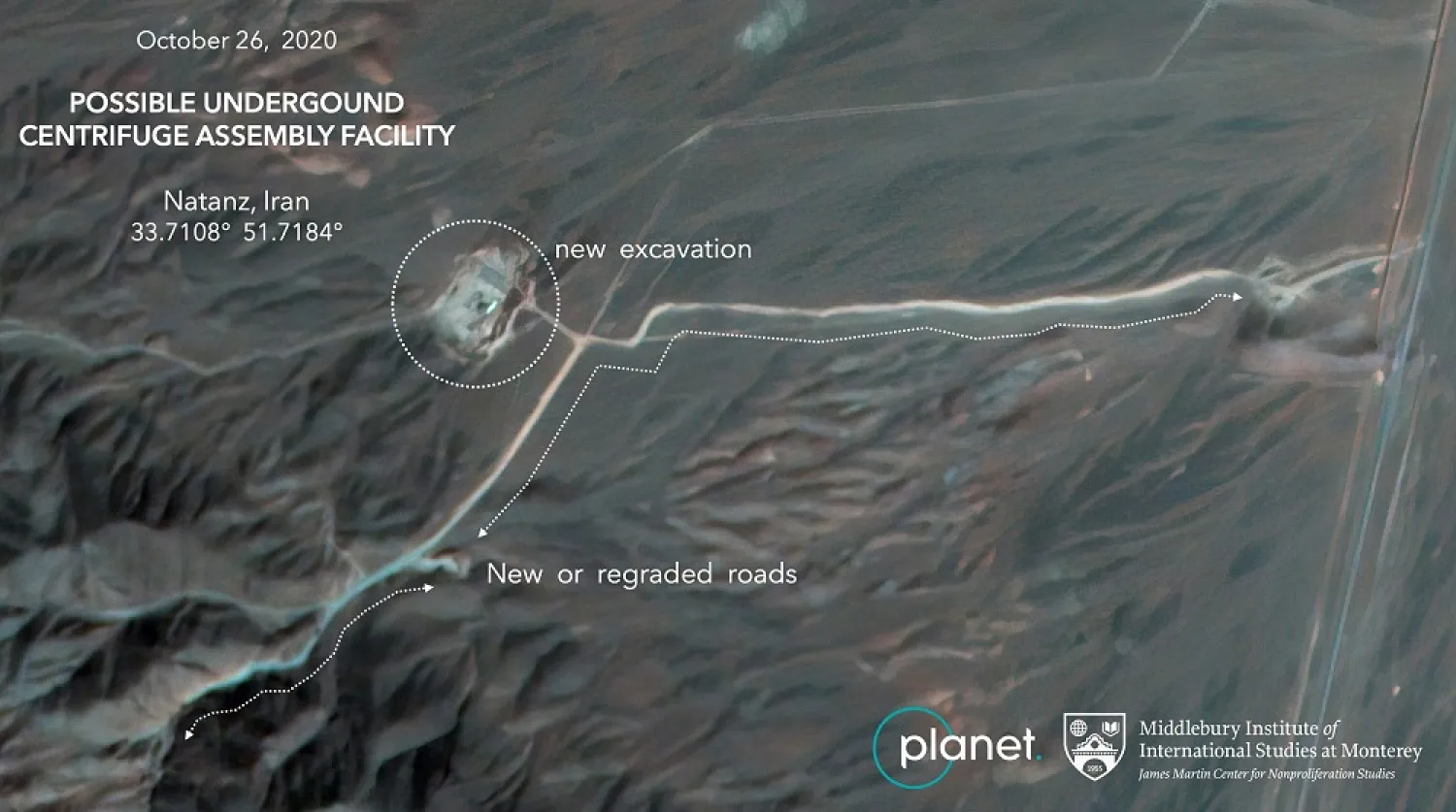
This Oct. 26, 2020, satellite image that has been annotated by experts at the James Martin Center for Nonproliferation Studies at Middlebury Institute of International Studies shows construction at the Natanz nuclear facility. (Planet Labs Inc. via AP)
TT

Satellite Photos Show Construction at Iran Nuclear Site

This Oct. 26, 2020, satellite image that has been annotated by experts at the James Martin Center for Nonproliferation Studies at Middlebury Institute of International Studies shows construction at the Natanz nuclear facility. (Planet Labs Inc. via AP)

Iran has begun construction at its Natanz nuclear facility, satellite images released Wednesday show, just as the UN nuclear agency acknowledged Tehran is building an underground advanced centrifuge assembly plant after its last one exploded in a reported sabotage attack last summer.

The construction comes as the US nears Election Day in a campaign pitting President Donald Trump, whose maximum pressure campaign against Iran has led Tehran to abandon all limits on its atomic program, and Joe Biden, who has expressed a willingness to return to the accord. The outcome of the vote likely will decide which approach America takes. Heightened tensions between Iran and the US nearly ignited a war at the start of the year.

Since August, Iran has built a new or regraded road to the south of Natanz toward what analysts believe is a former firing range for security forces at the enrichment facility, images from San Francisco-based Planet Labs show. A satellite image Monday shows the site cleared away with what appears to be construction equipment there.

Analysts from the James Martin Center for Nonproliferation Studies at the Middlebury Institute of International Studies say they believe the site is undergoing excavation.

“That road also goes into the mountains so it may be the fact that they’re digging some kind of structure that’s going to be out in front and that there’s going to be a tunnel in the mountains," said Jeffrey Lewis, an expert at the institute who studies Iran's nuclear program. "Or maybe that they’re just going to bury it there.”

Iran's mission to the United Nations did not immediately respond to an Associated Press request for comment. Ali Akbar Salehi, the head of the Atomic Energy Organization of Iran, last month told state television the destroyed above-ground facility was being replaced with one “in the heart of the mountains around Natanz.”

Rafael Grossi, the director-general of the International Atomic Energy Agency, told the AP on Tuesday that his inspectors were aware of the construction. He said Iran had previously informed IAEA inspectors, who continue to have access to Iran's sites despite the collapse of the nuclear deal.

“It means that they have started, but it’s not completed. It’s a long process," Grossi said.

Trump in 2018 unilaterally withdrew the US from Iran's nuclear deal with world powers, in which Tehran agreed to limit its uranium enrichment in exchange for the lifting of economic sanctions. When the US ramped up sanctions, Iran gradually and publicly abandoned those limits as a series of escalating incidents pushed the two countries to the brink of war at the beginning of the year.

Iran now enriches uranium to up to 4.5% purity, and according to the last IAEA report, had a stockpile of 2,105 kilograms (2.32 tons). Experts typically say 1,050 kilograms (1.15 tons) of low-enriched uranium is enough material to be re-enriched up to weapons-grade levels of 90% purity for one nuclear weapon.

Iran’s so-called “breakout time” — the time needed for it to build one nuclear weapon if it chose to do so — is estimated now to have dropped from one year under the deal to as little as three months. Iran maintains its nuclear program is for peaceful purposes, though Western countries fear Tehran could use it to pursue atomic weapons.

Natanz, built underground to harden it against airstrikes, long has been at the center of those fears since its discovery in 2002. Centrifuges there still spin in vast halls under 7.6 meters (25 feet) of concrete. Air defense positions surround the facility in Iran's central Isfahan province.

Despite being one of the most-secure sites in Iran, Natanz was targeted by the Stuxnet computer virus — believed to be the creation of the US and Israel — before the nuclear deal.

In July, a fire and explosion struck its advanced centrifuge assembly facility in an incident Iran later described as sabotage. Suspicion has fallen on Israel, despite a claim of responsibility by a previously unheard-of group.

There have been tensions with the IAEA and Iran even at Natanz, with Tehran accusing one inspector of testing positive for explosives last year. However, so far inspectors have been able to maintain their surveillance. something Lewis described as very important.

“As long as they declared to the IAEA in the proper time frame, there’s no prohibition on putting things underground,” he said. “For me, the real red line would be if the Iranians started to stonewall the IAEA."

For now, it remains unclear how deep Iran will put this new facility. And while the sabotage will delay Iran in assembling new centrifuges, Lewis warned the program ultimately would regroup as it had before and continue accumulating ever-more material beyond the scope of the abandoned nuclear deal.

“We buy ourselves a few months," he said. "But what good is a few months if we don’t know what we’re going to use it for?”



Iran’s President Says Answer to Attack Would Be Harsh in Apparent Response to Trump Warning

Masoud Pezeshkian, the President of Iran, attends the United Nations General Assembly at United Nations headquarters, on Sept. 25, 2025. (AP)
TT

Iran’s President Says Answer to Attack Would Be Harsh in Apparent Response to Trump Warning

Masoud Pezeshkian, the President of Iran, attends the United Nations General Assembly at United Nations headquarters, on Sept. 25, 2025. (AP)

Iranian President Masoud Pezeshkian on Tuesday said his country’s answer to an attack would be harsh, which appeared to be in response to a warning by US President Donald Trump over reconstruction of Iran’s nuclear program.

Iran’s answer “to any cruel aggression will be harsh and discouraging,” Pezeshkian said on the social media platform X.

Pezeshkian did not elaborate, but his statement came a day after Trump suggested the US could carry out military strikes if Iran attempts to reconstitute its nuclear program. Trump made the comment during wide-ranging talks with Israeli Prime Minister Benjamin Netanyahu at Trump's Mar-a-Lago estate in Florida.

“Now I hear that Iran is trying to build up again,” Trump said during a news conference with Netanyahu after their meeting. “And if they are, we’re going to have to knock them down. We’ll knock them down. We’ll knock the hell out of them. But hopefully that’s not happening.”

The two leaders discussed the possibility of renewed military action against Tehran months after a 12-day air war in June that killed nearly 1,100 Iranians including senior military commanders and scientists. Iran’s retaliatory missile barrage killed 28 people in Israel.

Trump suggested Monday that he could order another US strike against Iran.

“If it’s confirmed, they know the consequences, and the consequences will be very powerful, maybe more powerful than the last time,” Trump said.

Pezeshkian said Saturday that tensions between the sides already had risen.

“We are in a full-scale war with the US, Israel and Europe; they don’t want our country to remain stable,” he said.

Iran has insisted it is no longer enriching uranium at any site in the country, trying to signal to the West that it remains open to potential negotiations over its atomic program.

US intelligence agencies and the International Atomic Energy Agency assessed Iran last had an organized nuclear weapons program in 2003, though Tehran had been enriching uranium up to 60%, which is a short, technical step away from weapons-grade levels of 90%.

Meanwhile, some of the largest protests in three years entered a third day Tuesday after the country’s currency plummeted to a record low against the US dollar. The head of the Central Bank resigned on Monday.

According to witnesses and videos on social media, rallies took place in Tehran and other cities and towns. Police fired tear gas in some places. Near a market in downtown Tehran, footage showed people pushing back police and security forces and throwing stones at them.

University students also rallied inside campuses on Tehran University and other major universities, witnesses said.

Pezeshkian met a group of businessmen to listen to their demands, media reported.

"The administration will not spare any effort for solving problems and improving situation of the society,” Pezeshkian said. He also assigned Interior Minister Eskandar Momeni for talks with protesters.

The head of the country’s tax department, Mohammad Hadi Sobhanian, also said the government will revise its tax arrangement in favor of businesses, dropping penalties for delay in paying taxes.

The government announced the closure of offices and banks on Wednesday for managing energy consumption during the winter days, to be followed by weekly holidays on Thursday and Friday. Saturday also is a religious holiday in the country.


Ukraine Says No Evidence It Attacked Putin Residence

28 December 2025, US, Palm Beach: Ukraine's President Volodymyr Zelensky attends a joint press conference with US President Donald Trump following their talks at the Mar-a-Lago club in Palm Beach. (Ukrainian Presidency/dpa)
TT

Ukraine Says No Evidence It Attacked Putin Residence

28 December 2025, US, Palm Beach: Ukraine's President Volodymyr Zelensky attends a joint press conference with US President Donald Trump following their talks at the Mar-a-Lago club in Palm Beach. (Ukrainian Presidency/dpa)

Ukraine said Tuesday there was no "plausible" evidence it launched a drone attack on one of Russian President Vladimir Putin's residences, accusing Moscow of peddling falsehoods to manipulate talks on ending the war.

Ukraine's allies have expressed skepticism about Russia's claim.

German Chancellor Friedrich Merz called for "transparency", while a French presidential source described the Kremlin's statements as an "act of defiance" against US President Donald Trump's efforts to broker peace.

Ukrainian President Volodymyr Zelensky, who has called Russia's claim a "complete fabrication", said he would meet with leaders of Kyiv's allies on January 6 in France in a bid to renew peace efforts.

In comments to journalists on Tuesday, the Ukrainian leader repeated his assertion that the attack was faked and called on partners to verify this.

"Our negotiating team connected with the American team, they went through the details, and we understand that it's fake," he said.

The Kremlin said Tuesday it considered the alleged drone attack on Putin's secluded residence in the Novgorod region to be a "terrorist act" and a "personal attack against Putin".

But it said it could not provide evidence for its claim as the drones were "all shot down".

It also said the Russian army had chosen "how, when and where" to retaliate against Ukraine, and that Moscow would now "toughen" its negotiating position in talks to end Europe's worst conflict since World War Two.

Russia has hit Ukraine with an almost daily barrage of drones and missiles for almost four years, killing thousands.

- European leaders rally around Ukraine -

European leaders rallied around Ukraine following Moscow's allegation. Zelensky said a summit of the so-called "coalition of the willing" -- a group of Western countries that have pledged further support for Ukraine -- would take place on January 6 in France.

The summit would be preceded by a meeting of security advisors from the allied countries, Zelensky said on X, adding: "We are planning it for January 3 in Ukraine."

Germany's Merz said on social media that Kyiv's allies were "moving the peace process forward. Transparency and honesty are now required from everyone -- including Russia."

But US President Donald Trump -- who spoke to Putin on Monday -- directed criticism at Kyiv on Monday, despite Ukraine calling the incident staged.

"You know who told me about it? President Putin, early in the morning, he said he was attacked. It's no good," Trump said.

"It's one thing to be offensive because they're offensive. It's another thing to attack his house," the US leader said.

Moscow has not said where Putin was at the time.

The longtime Russian leader's residences are shrouded in secrecy in Russia -- as is much of his private life.

- Secretive residence -

The late Russian opposition leader Alexei Navalny, who died in an Arctic prison last year, had published investigations into Putin's luxury lake-side residence in the Novgorod region.

Putin had been increasingly using the residence since the Ukraine war began, as it is more secluded and better protected by air defense installations, according to an investigation by RFE/RL.

Moscow's allegation comes at a pivotal moment for diplomacy to end the war.

Ukraine has said it has agreed to 90 percent of a US-drafted peace plan, but Russia has been hesitant to accept a deal that does not meet its maximalist demands.

Putin has repeatedly said that Russia intends to seize the rest of Ukrainian land he has proclaimed as Russian if diplomacy fails.

Russia's advance in eastern Ukraine picked up pace in autumn, with Moscow's troops seizing more villages with every week since.

Ukraine's navy on Tuesday blamed Russia for drone attacks on two civilian vessels in the Odesa region that Russia has been battering with strikes in the past weeks.

Ukraine on Tuesday also ordered the mandatory evacuation of several villages in the northern Chernigiv region, which borders Moscow-allied Belarus, due to intense Russian shelling.


Thousands of Somalis Protest Israeli Recognition of Somaliland

This picture taken on November 7, 2024 shows a general view of the city of Hargeisa, capital and largest city of the self-proclaimed Republic of Somaliland. (Photo by LUIS TATO / AFP)
TT

Thousands of Somalis Protest Israeli Recognition of Somaliland

This picture taken on November 7, 2024 shows a general view of the city of Hargeisa, capital and largest city of the self-proclaimed Republic of Somaliland. (Photo by LUIS TATO / AFP)

Large protests broke out in several towns and cities across Somalia on Tuesday in opposition to Israel's recognition of the breakaway region of Somaliland.

Israel announced on Friday that it viewed Somaliland -- which declared independence in 1991 but has never been recognized by any other country -- as an "independent and sovereign state".

Somali President Hassan Sheikh Mohamud has condemned the move as a threat to stability in the Horn of Africa. He travelled Tuesday to Türkiye, a close ally, to discuss the situation, AFP reported.

Thousands of protesters marched through the streets of Somali capital Mogadishu and gathered at a stadium, waving placards with anti-Israeli slogans alongside Somali and Palestinian flags.

"We will never allow anyone to violate our sovereignty," one attendee, Adan Muhidin, told AFP, adding that Israel's move was "a blatant violation of international law".

Demonstrations also took place in Lascanod in the northeast, Guriceel in central Somalia, and Baidoa in the southwest.

"There is nothing we have in common with Israel. We say to the people of Somaliland, don't bring them close to you," said Sheikh Ahmed Moalim, a local religious leader, in Guriceel.

Somaliland has long been a haven of stability and democracy in the conflict-scarred country, with its own money, passport and army.

It also has a strategic position on the Gulf of Aden that makes it an attractive trade and military partner for regional and international allies.

But Israel's decision to recognize its statehood has brought rebukes from across the Muslim and African world, with many fearing it will stoke conflict and division.

There have been celebrations in Somaliland's capital Hargeisa, with the rare sight of Israeli flags being waved in a Muslim-majority nation.