Algeria to Vote on a Constitution Dismissed by Protest Movementhttps://english.aawsat.com/home/article/2593331/algeria-vote-constitution-dismissed-protest-movement
Algeria to Vote on a Constitution Dismissed by Protest Movement
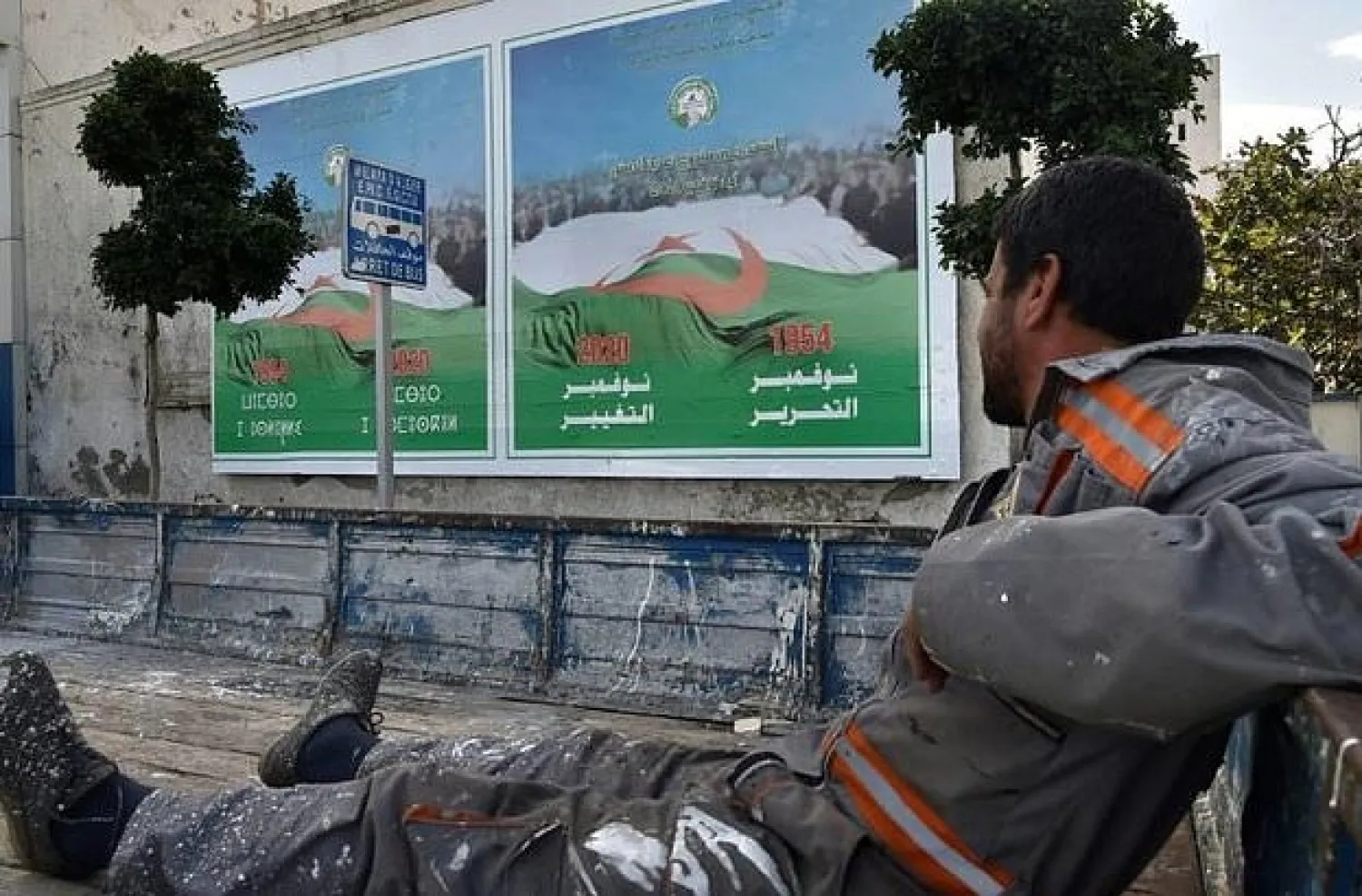
Algerians are set to vote in a constitutional referendum on November 1, with the "Yes" campaign promoting the slogan "November 1954: Liberation. November 2020: Change" - AFP
Algeria to Vote on a Constitution Dismissed by Protest Movement
Algerians are set to vote in a constitutional referendum on November 1, with the "Yes" campaign promoting the slogan "November 1954: Liberation. November 2020: Change" - AFP
Algerians are set to vote Sunday in a constitutional referendum the government touts as heralding a "new republic", but a long-running protest movement rejects the exercise as window-dressing.
Observers see the constitution as the centerpiece of now-hospitalized President Abdelmadjid Tebboune's strategy to neutralize the Hirak movement, which staged vast demonstrations last year and forced his predecessor from office.
Despite Abdelaziz Bouteflika's fall from power, the Hirak has failed to achieve its goal of a full overhaul of Algeria's sclerotic political system, in place since independence from France in 1962, AFP reported.
In a key setback for the protest movement, Tebboune, widely seen as the army's preferred candidate, was elected in a December 2019 presidential poll, despite the Hirak urging root-and-branch reform ahead of any elections.
Then it was forced to suspend its protests in March as the coronavirus pandemic struck.
But Tebboune, who took power after a poll marred by record low turnout, has sought legitimacy by ostensibly reaching out to the Hirak.
He has promised a new constitutional settlement he presents as meeting the movement's demands. But the lack of radical change in the document, which strengthens the president and the army, has left many skeptical.
"The referendum will have no impact in terms of offering a political alternative or a change in how the country is governed," said Louisa Dris-Ait Hamadouche, a political science professor at the University of Algiers.
Algeria, with a population of 44 million on the doorstep of Europe, has escaped the violence and severe repression triggered by most of the 2011 Arab uprisings.
But with its oil-reliant economy in crisis and its young people desperate for work, the government is under pressure, also exacerbated by the coronavirus pandemic.
Tebboune himself was transferred from hospital in Algiers to Germany on Wednesday, officials said, days after the 74-year-old went into self-isolation following reports of suspected Covid-19 cases among his staff.
Politically, Tebboune was already "in a delicate situation", said Algeria expert Hasni Abidi, pointing to the army's resurgent political role since Bouteflika´s departure after two decades in power.
"Even if (Tebboune) is tempted to gain more legitimacy via the ballot box, he is far from having full room to manoeuvre," Abidi said.
According to AFP, the proposed constitutional changes refer to a string of rights and freedoms, including guaranteeing the right to form parties and unions, while even praising the Hirak in a preamble.
But Zaid al-Ali, an expert on constitutions in the Arab world, has warned that the document "lengthens the list of rights while at the same time making sure that most of those rights are devoid of meaning."
And counter to the Hirak movement's goals, the constitution would further enshrine a presidential system and bolster the army's powers.
Since taking power, Tebboune has vowed to push through a revision that would rein in his own powers.
But despite limiting the president to two five-year terms, the revised constitution would still mandate the head of state to appoint an array of key officials including the prime minister, regional governors, judges and security service chiefs.
A vaguely worded article extending the role of the military has also rung alarm bells.
"It's a genuine invitation for the army to get involved in politics, but also a poke in the eye for the Hirak, which has demanded a civilian rather than military state," said constitutional law expert Massensen Cherbi.
The document has been carefully marketed by the government, which has led a campaign to "explain" the constitutional reform and how it lays the foundations of a "new republic".
Few, if any, voices from the "No" camp have been heard in state media outlets.
The date of the vote is highly symbolic: November 1 was when Algeria's eight-year war for independence from France began.
"November 1954: Liberation. November 2020: Change," runs the slogan of the official "Yes" campaign.
If it passes, the constitution will be another serious blow for the Hirak, which has faced a slew of arrests and trials in recent months.
Activists and journalists have been handed heavy prison sentences, all in a context where the coronavirus pandemic has made it very difficult to maintain pressure against the authorities.
Amnesty International has welcomed the constitution's inclusion of stronger language on women's rights and economic and social rights.
But, the rights group warned in June: "The Algerian authorities' relentless campaign of mass arbitrary arrests and a crackdown on activists and protesters risk undermining the credibility of Algeria's constitutional reform process."
Petraeus Hands Washington 'Executive Plan' to Disarm Iraq's Armed Factionshttps://english.aawsat.com/features/5275874-petraeus-hands-washington-executive-plan-disarm-iraqs-armed-factions
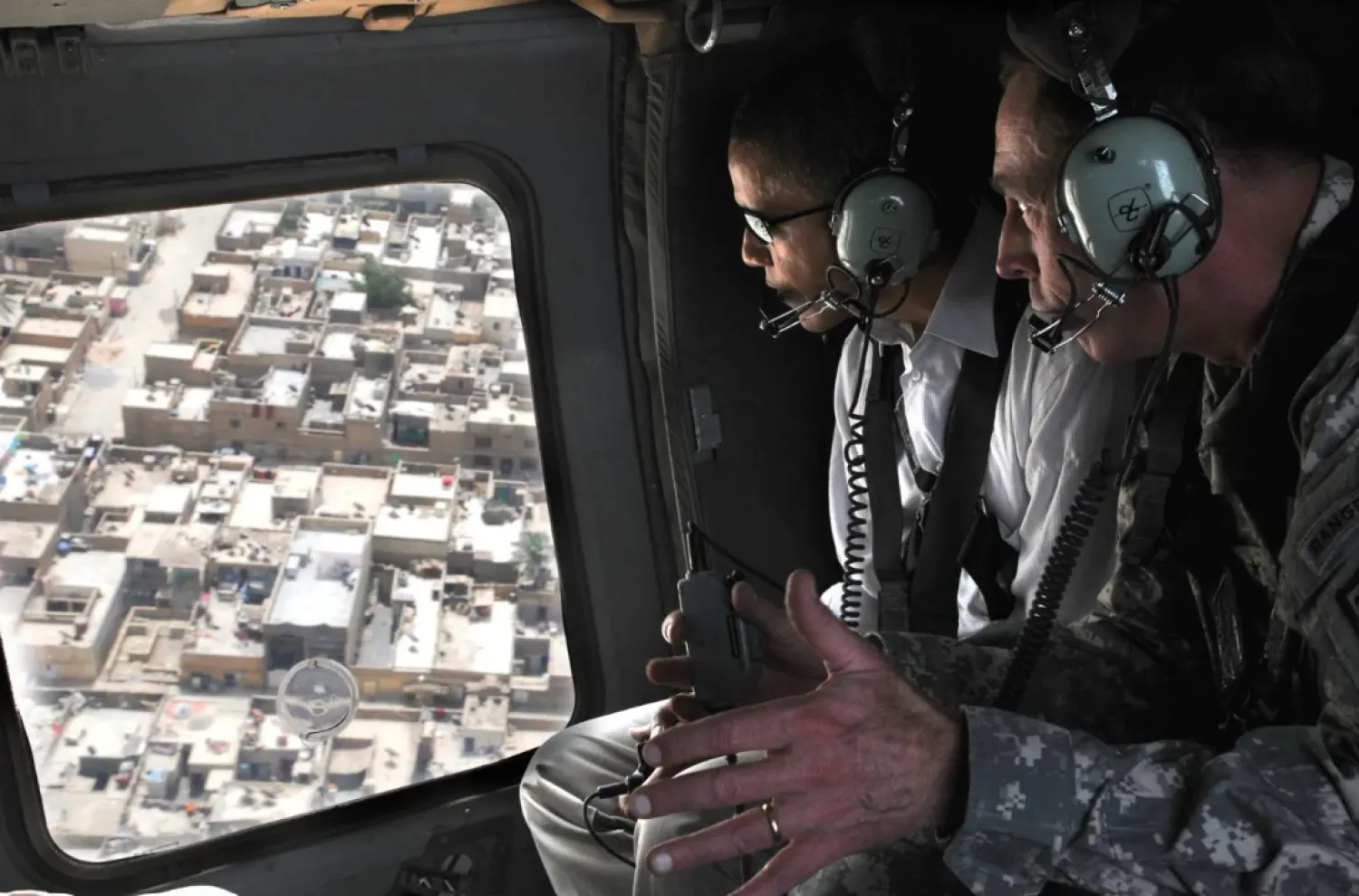
A 2008 photo released by the Pentagon shows David Petraeus briefing Barack Obama, then a US senator, on a plan to secure Sadr City in eastern Baghdad during an aerial tour over the area.
Petraeus Hands Washington 'Executive Plan' to Disarm Iraq's Armed Factions
A 2008 photo released by the Pentagon shows David Petraeus briefing Barack Obama, then a US senator, on a plan to secure Sadr City in eastern Baghdad during an aerial tour over the area.
Iraqi officials said the United States has conditioned the integration of the Popular Mobilization Forces (PMF) on disarming armed factions, sidelining their leaders, and appointing professional officers to oversee the PMF’s infrastructure, a step Washington says is necessary because the force remains a major obstacle to restoring normal relations with Baghdad.
But Shiite groups said implementing the “bold plan,” which remains under discussion, would place Prime Minister Ali al-Zaidi’s government in an unequal confrontation with Iran and the factions linked to it, amid a lack of guarantees, warning of “internal divisions and unrest.”
What did Petraeus do in Baghdad?
The information disclosed by officials involved in technical and political discussions on the future of the PMF coincided with a visit by retired US General David Petraeus to Baghdad last week in his capacity as an “independent expert” providing advisory services to the White House.
After leaving Baghdad, Petraeus wrote on LinkedIn on May 17, 2026, that Iraqi officials he met “recognized the importance of ensuring that the Iraqi Security Services have a monopoly on the use of force in Iraq.” He added that he left Iraq “encouraged by what I heard, while also realistic about the dynamics with Iran.”
Asharq Al-Awsat learned that Petraeus spent five days in Baghdad, where he met senior Iraqi officials. The fate of PMF fighters was at the center of “serious discussions,” according to sources.
A US State Department spokesperson told Asharq Al-Awsat that Petraeus visited Baghdad as “a private citizen, nothing more.”
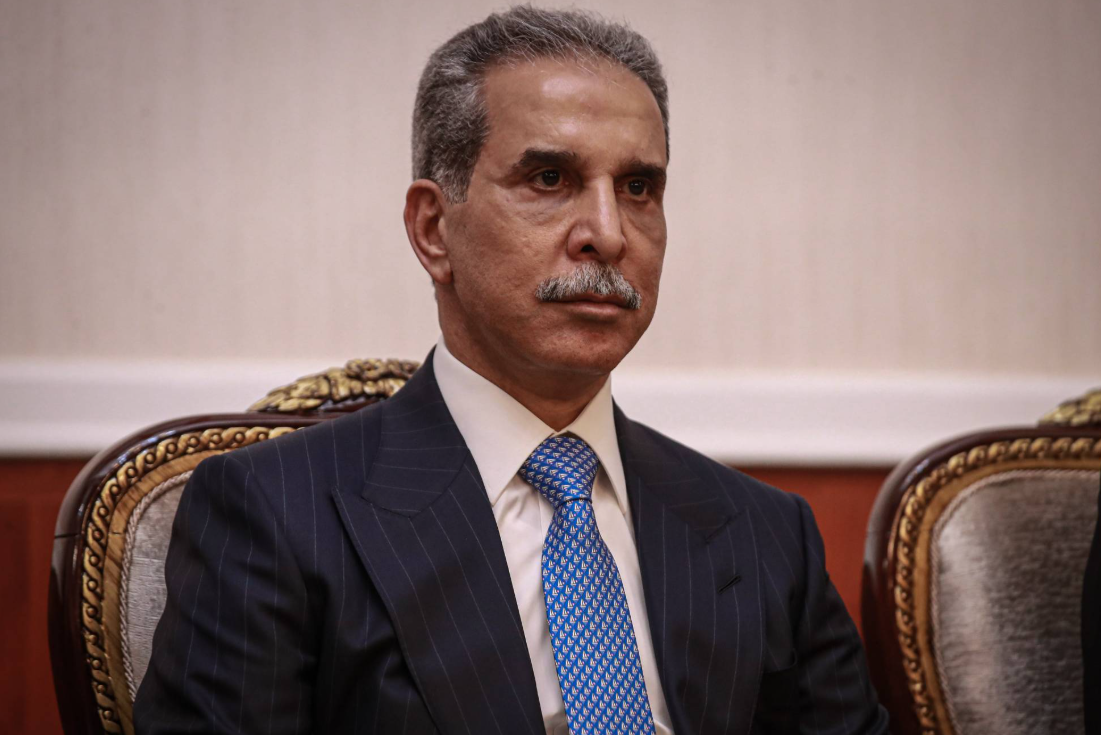
However, the level of meetings he held there, including with Iraq’s Chief Justice Faiq Zidan, Prime Minister Ali al-Zaidi, Parliament Speaker Haibat al-Halbousi, and Counter Terrorism Service chief Staff Lieutenant General Karim al-Tamimi, went beyond the nature of a personal visit.
An informed Iraqi source told Asharq Al-Awsat that “Petraeus’s meetings revolved around a single objective: reforming the military institution and ending the current PMF structure, while discussing realistic and practical mechanisms for integrating its members into the security institutions.”
Petraeus is among the most prominent commanders associated with the Iraq war after 2003. He gained experience through a range of field and strategic roles, most notably commanding the 101st Airborne Division during the invasion that toppled Saddam Hussein’s regime.
Petraeus now serves as partner and chief operating officer at KKR, a global investment management firm. Information available on the company’s website indicates that its activities are expanding across Middle Eastern countries, with no reference to Iraq.
KKR did not respond to Asharq Al-Awsat’s requests for comment on the nature of Petraeus’s visit to Baghdad or whether the White House had assigned him an advisory mission there.
However, three government and political figures told Asharq Al-Awsat that the US general “has been tasked with drafting an actionable executive paper to be submitted to the White House at a later stage through US envoy to Syria Tom Barrack.”
People close to the new prime minister in Baghdad told Asharq Al-Awsat that “Ali al-Zaidi will discuss this sensitive issue with US President Donald Trump if a planned visit to the White House takes place.”
An Iraqi official who declined to be identified said that “the preliminary date could be set after Eid al-Adha in June,” noting that “the timing could be affected by the course of negotiations between Washington and Tehran.”
General David Petraeus began his visit to Baghdad with a meeting with Iraq’s Chief Justice, Faiq Zidan (DPA).
“A Danger That Could Blow Up in Your Face”
A person familiar with the discussions held during Petraeus’s meetings said that “some Iraqi officials spoke to the US general as though they were speaking directly to President Trump. They displayed unusual candor about their concerns over the potential consequences of plans for the Popular Mobilization Forces that remain largely theoretical at this stage.”
Another source said that “the US general listened more than he spoke during his meetings with Iraqi officials, but he was clear about what Washington wants: eliminating the source of the regional threat.” Nevertheless, “the general left Baghdad without complete confidence in Baghdad’s ability to resolve the problem in line with the US vision.”
Two Western diplomats, who spoke to Asharq Al-Awsat on condition of anonymity, said that “US confidence declined sharply during the final months of Sudani’s government because of what was viewed as leniency toward attacks by armed factions during the war. The current prime minister may now pay the price when he is asked to provide stronger security and political guarantees regarding the enforcement of state sovereignty.”
As attacks on Gulf states continued, and with the United States accusing the previous Iraqi government of providing official cover for these groups, the Popular Mobilization Forces and the armed factions associated with them have become “a knot that is difficult to untangle.” An Iraqi official said the issue is “a danger that must be dealt with, but when you get close to it, it could blow up in your face.”
Washington hopes that the new prime minister, Ali al-Zaidi, a businessman whose commercial activities are rumored to have prospered under the shadow of politics, will be able to distance his government from Iranian influence. It sees the issue of weapons outside state control as a test of whether trust can be maintained and support resumed, but the task will not be easy, according to a person close to him.
A person familiar with political consultations concerning the Popular Mobilization Forces said that “Petraeus did not answer questions raised by Iraqi officials about whether there would be sufficient backing to confront Iran if the Popular Mobilization Forces were dissolved.”
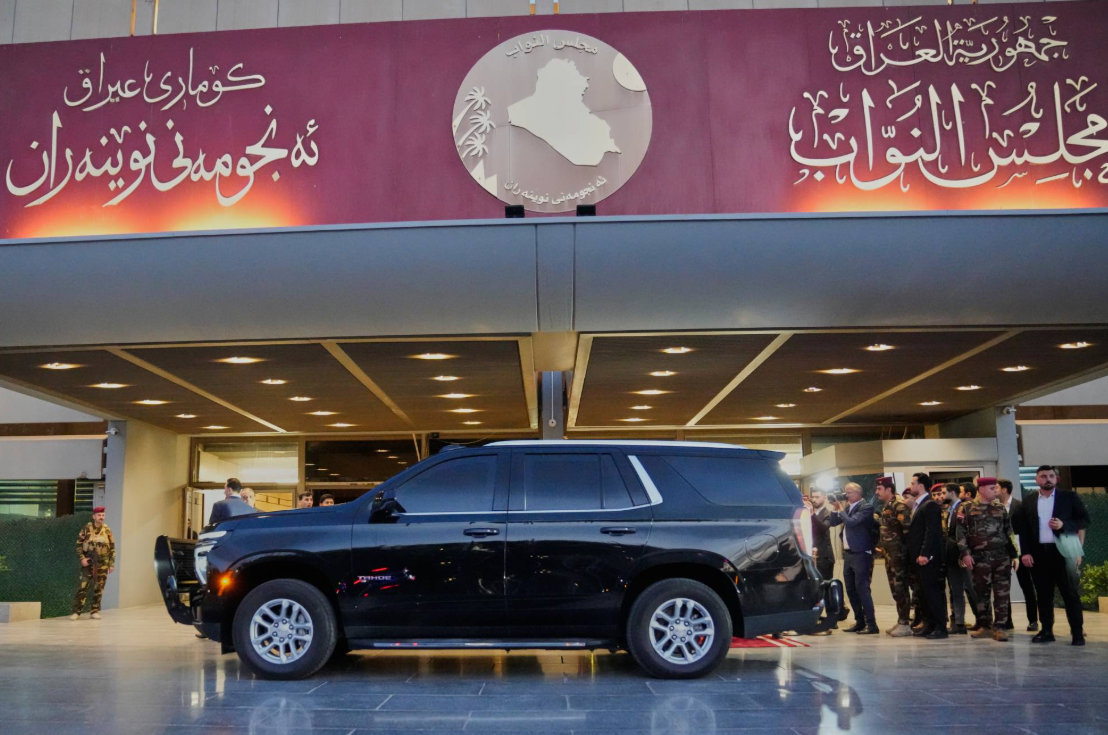
Shiite forces are pushing to refer the future of the Popular Mobilization Forces to parliament for discussion rather than addressing it under US pressure (AP).
Baghdad ‘Buys Time’
For Shiite leaders in Iraq, the Popular Mobilization Forces (PMF) are “a matter of destiny” and “a red line that cannot be crossed,” according to officials close to the factions. But the organization has become caught in intense regional polarization since the events of Oct. 7, 2023, and has been directly involved in the recent conflict between the United States and Iran.
Figures close to the armed factions have appeared on television warning of “retaliation against any government or political official who participates in a project to integrate or dissolve the PMF.”
A leader of an armed faction told Asharq Al-Awsat that “Iran recently urged them to resist the US effort aimed at dismantling the largest military force safeguarding its interests in the region.”
He added: “Generals from the Revolutionary Guards who play supervisory roles within Shiite factions, including those who run the Islamic Resistance in Iraq operations room, will put obstacles in the way if moves are made toward dissolving the PMF.”
According to an Iraqi lawmaker close to Kataib Hezbollah, the PMF is an institution operating under a law passed by the Iraqi parliament in 2016, and dissolving it would now require a parliamentary vote.
Shiite armed groups maintain influential political wings in the Iraqi parliament. Estimates suggest they hold around 80 seats, while the ruling Shiite alliance, the Coordination Framework, enjoys a comfortable majority of about 180 seats in the 329-member legislature, giving it substantial influence over the legislative process.
Two members of the Coordination Framework told Asharq Al-Awsat that “most leaders of the Shiite alliance informed the prime minister that they agree on the risks posed by the factions, but resolving the issue requires national dialogue and an incentives plan as part of a broader strategy involving the religious authority in Najaf, given the sensitivity of the political and security balances associated with it.”
A Western adviser working in Iraq told Asharq Al-Awsat that “Washington has come to view such ideas as attempts to buy time, and warnings about the risks of dissolving the PMF are being used as a form of counterpressure against the United States.”
An Iraqi official also said that “US officials who held discussions with local officials before Petraeus’s talks in Baghdad made it clear that overlooking the PMF issue carries an extremely high cost.”
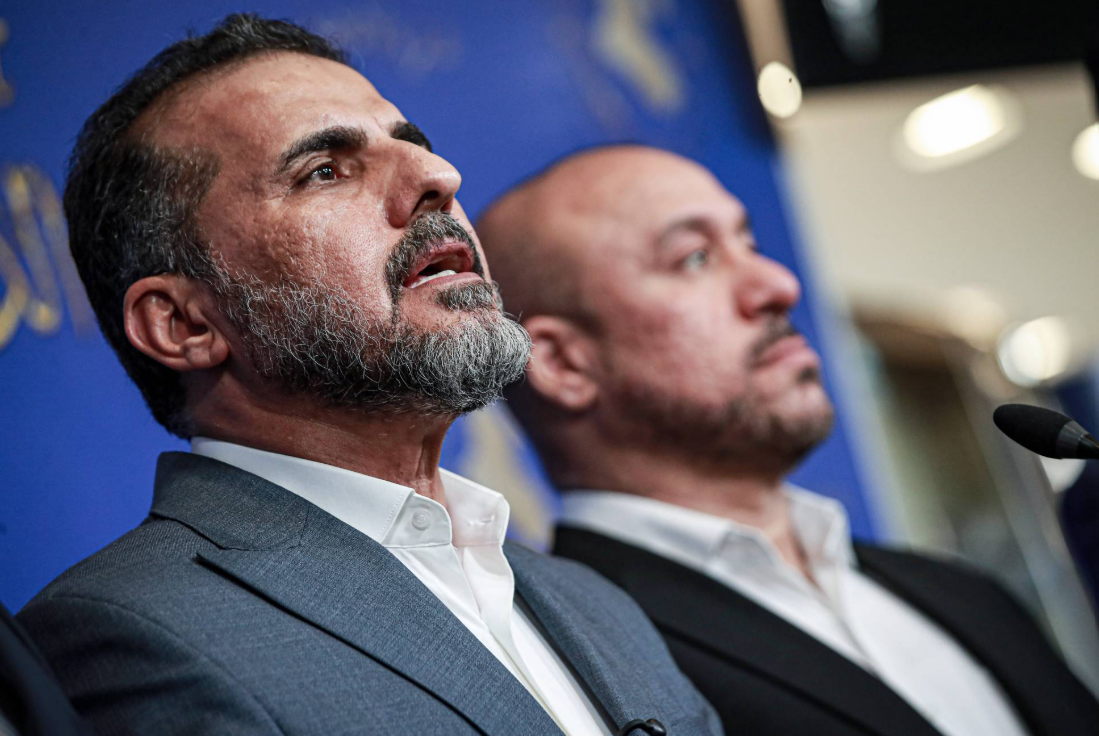
Hussein Mounes (left), head of the Huqooq Movement affiliated with Kataib Hezbollah, speaks to journalists in Baghdad on May 14, 2026, to announce his opposition to Ali al-Zaidi’s government (DPA).
“Fell on Deaf Ears”
On that basis, according to sources, the United States dismissed Iraqi proposals it viewed as cosmetic measures to integrate the Popular Mobilization Forces (PMF), restructure the organization, or change its leadership.
The Iraqi government, in its program approved by parliament, pledged to “define the responsibilities of the PMF within the military and security system.”
Al-Zaidi’s office declined to answer Asharq Al-Awsat’s questions about how the government intends to implement its program regarding the PMF and whether it has participated with the United States in any executive plans related to the issue.
According to five Iraqi and Western figures who spoke to Asharq Al-Awsat, proposals put forward by members of the Coordination Framework aimed at elevating the PMF and other factions into a new ministry or restructuring them within an administrative framework under the supervision of the prime minister “fell on deaf ears” in Washington.
Over the past week, figures close to Shiite groups appeared on local television channels promoting a proposal to establish a “Federal Security Ministry,” claiming it would serve as an umbrella for the PMF and other security formations, including the Rapid Response Forces and the Border Guards.
Informed sources told Asharq Al-Awsat that the United States is seriously focused on ensuring full Iraqi sovereignty over political and security decision-making and eliminating sources of threat that it describes as terrorist, so that Baghdad can live in peace with its neighbors.
It is widely believed in Baghdad that the recent attacks against Saudi Arabia and the United Arab Emirates are part of a dual-track campaign within the Revolutionary Guards’ regional strategy: linked to the ongoing conflict on one hand, and on the other an attempt at deterrence aimed at protecting the PMF’s position and preventing any reduction in its influence.
On May 18, 2026, Abu Mujahid al-Assaf, a security official in Kataib Hezbollah, said in a press statement that the faction was “prepared to respond to the United States on all fronts if leaders of the resistance and the Popular Mobilization Forces are targeted.”
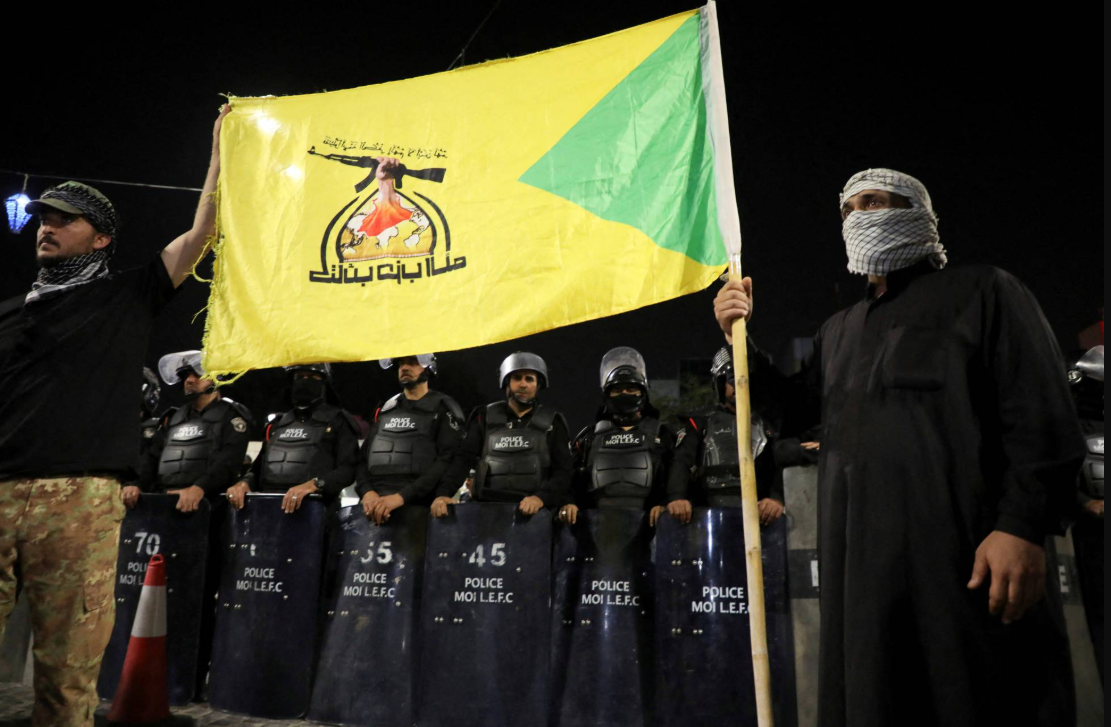
Two members of the Kataib Hezbollah faction carry the group’s flag in front of a riot police checkpoint in Baghdad (Reuters).
What Comes Next in Baghdad?
Nevertheless, two Iraqi figures said they expect “an initial phase to begin in the coming period,” involving the transfer of heavy and medium weapons to a trusted Iraqi security body agreed upon by the Iraqi government and the United States.
According to one of the two figures, the first phase would also include removing figures involved in attacks against the United States and its allies in the region, and appointing Iraqi generals to oversee the infrastructure associated with the Popular Mobilization Forces.
Asharq Al-Awsat learned that armed groups with political wings represented in parliament are negotiating to regain their share of positions in the Iraqi government after surrendering their weapons, but are seeking firm guarantees that they will be removed from the list of groups barred from participating in government.
Several ministerial posts in Ali al-Zaidi’s government remain vacant because of disputes within the Coordination Framework. However, some positions have been postponed indefinitely because of a US veto on election winners who maintain armed wings and have ties to Iran.
Timeline of Recent US-Cuba Relations amid Heightened Tensions in Trump's Second Termhttps://english.aawsat.com/features/5275621-timeline-recent-us-cuba-relations-amid-heightened-tensions-trumps-second-term
FILE - Former Cuban President Raul Castro looks at the Cuban flag during his speech at the event celebrating the 65th anniversary of the triumph of the revolution in Santiago, Cuba, Jan. 1, 2024. (AP Photo/Ismael Francisco, File)
Timeline of Recent US-Cuba Relations amid Heightened Tensions in Trump's Second Term
FILE - Former Cuban President Raul Castro looks at the Cuban flag during his speech at the event celebrating the 65th anniversary of the triumph of the revolution in Santiago, Cuba, Jan. 1, 2024. (AP Photo/Ismael Francisco, File)
Wednesday's US indictment of former Cuban President Raúl Castro is the latest salvo in the Trump administration’s months-long pressure campaign against the Caribbean island's socialist-controlled government.
Castro was charged for his alleged role in the 1996 shootdown of two planes operated by the Miami-based exile group Brothers to the Rescue. Castro was defense minister at the time.
President Donald Trump has been escalating talk on regime change in Cuba after the military action in Venezuela early this year resulted in the capture of President Nicolás Maduro. In addition, a White House-ordered economic blockade has led to blackouts, food shortages and a collapse in economic activity across Cuba.
The indictment comes amid rising tensions between Trump's administration and Cuba’s government. Meanwhile, the US is in the midst of an uneasy ceasefire in the US war against Iran.
Here’s a closer look at developments over the year between Cuba and the US.
Jan. 4 A day after the operation in Venezuela that captured Maduro, Secretary of State Marco Rubio declared Cuba's government was “in a lot of trouble," as the president renewed calls for an American takeover of the Danish territory of Greenland.
Jan. 11 Trump fired off a warning to the government of Cuba as the close ally of Venezuela braced for potential unrest after Maduro was deposed. Trump called for the Cuban government “to make a deal BEFORE IT IS TOO LATE."
Cuba’s president, Miguel Díaz-Canel, responded, “Those who turn everything into a business, even human lives, have no moral authority to point the finger at Cuba in any way, absolutely in any way.”
Jan. 30 Trump signed an executive order to impose a tariff on any goods from countries that sell or provide oil to Cuba, a move that could further cripple the island.
Feb. 27 A day before the war in Iran began, Trump said the US was in talks with Havana and raised the possibility of a “friendly takeover of Cuba,” though he didn't offer any details.
Trump said Rubio was in discussions with Cuban leaders “at a very high level.”
Trump didn’t clarify his comments but seemed to indicate that the situation with Cuba, among Washington’s bitterest adversaries for decades, was coming to a critical point.
Sometime in February Raúl Guillermo Rodríguez Castro, the grandson of Castro known as "Raúlito," secretly met with Rubio on the sidelines of a Caribbean Community summit in St. Kitts in February.
March 13 Díaz-Canel said Cuba and the US held talks, marking the first time the Caribbean country confirmed widespread speculation about discussions with the Trump administration amid an energy crisis.
He said the talks “were aimed at finding solutions through dialogue to the bilateral differences between our two nations. International factors facilitated these exchanges.”
March 31 A sanctioned Russian oil tanker arrived in Cuba, the first time in three months fuel reached the island.
April 9 Diaz-Canel said he would not resign.
April 10 Two senior State Department officials — Jeremy Lewin, who is in charge of all US foreign assistance, and Michael Kozak, the top US diplomat for Latin America — led a delegation to Havana and met with Rodríguez Castro, according to one US official familiar with the meetings.
April 12 Díaz-Canel said in an interview he would not step down and that the US has no valid reason to carry out a military attack against the island or to attempt to depose him.
Speaking in the interview on NBC's “Meet the Press,” the president said an invasion of Cuba would be costly and affect regional security.
April 16 Díaz-Canel spoke during a rally that drew hundreds of people to commemorate the 65th anniversary of the declaration of the Cuban Revolution’s socialist essence.
“The moment is extremely challenging and calls upon us once again, as on April 16, 1961, to be ready to confront serious threats, including military aggression. We do not want it, but it is our duty to prepare to avoid it and, if it becomes inevitable, to defeat it,” Díaz-Canel said.
April 17 News emerged that an American delegation recently met with Cuban government officials, marking a renewed diplomatic push. This was at least the third meeting with Rodríguez Castro.
A senior State Department official met with Rodríguez Castro earlier in the month, according to a department official, who was not authorized to comment publicly and spoke on condition of anonymity to discuss the sensitive matter.
The official did not say who from the US met with Rodríguez Castro, whose grandfather is believed to play an influential role in the Cuban government despite not holding an official post. A second US official said Rubio was not part of the delegation that visited Havana.
April 23 A Cuban diplomat speaking at the United Nations said Havana will not abide by any American “ultimatums” to release political prisoners as part of new talks.
In an interview with The Associated Press, Cuban Ambassador to the UN Ernesto Soberón Guzmán said internal issues regarding detainees “are not on the negotiating table.” The release of political prisoners was a key US demand as the longtime adversaries held discussions in Cuba for the first time in a decade.
April 28 Senate Republicans rejected legislation from Democrats that would have required Trump to end the US energy blockade on Cuba unless he receives approval from Congress.
The vote on the war powers resolution showed how Republicans continue to stand behind Trump as he acts unilaterally to exert American force in a range of global conflicts, including Venezuela, Iran and Cuba — one of the US’s closest neighbors.
May 7 US officials said the United States was not looking at imminent military action against Havana despite Trump’s repeated threats that “Cuba is next” and that American warships deployed in the Middle East for the Iran conflict could return by way of the island.
The officials involved in preliminary discussions with Cuban authorities also told the AP that they are not optimistic the communist government will accept an offer for tens of millions of dollars in humanitarian aid, two years of free Starlink internet access for all Cubans, agricultural assistance and infrastructure support.
But they said Cuba had not yet outright refused the offer, which came with conditions that the government has long resisted, even after the Trump administration imposed new sanctions on Havana.
May 14 US and Cuban officials said CIA Director John Ratcliffe met with Cuban officials including Raúl Castro’s grandson during a high-level visit to the island.
Ratcliffe met with Rodríguez Castro, Interior Minister Lázaro Álvarez Casas and the head of Cuban intelligence services, and discussed intelligence cooperation, economic stability and security issues. A CIA official confirmed the meetings to the AP.
May 15 The Justice Department was preparing to seek an indictment against Castro, three people familiar with the matter told the AP.
One of the people said the potential indictment was connected to Castro’s alleged role in the 1996 shootdown of two planes operated by the Miami-based exile group Brothers to the Rescue. Castro was defense minister at the time.
All three people spoke on the condition of anonymity because they weren’t authorized to discuss an ongoing investigation. The Cuban government did not respond to a request for comment on the potential indictment, which was reported earlier by CBS.
May 18 The State Department imposed a new layer of sanctions on several Cuban government agencies, including the Interior Ministry and National Police and Intelligence Directorate, as the Trump administration continued to ratchet up pressure against the island.
May 20 Federal prosecutors announced a grand jury indictment against Castro in connection with the shootdown of the two Brothers to the Rescue planes in 1996.
Report: Early War Goal Was to Install Ahmadinejad as Iran’s Leaderhttps://english.aawsat.com/features/5275568-report-early-war-goal-was-install-ahmadinejad-iran%E2%80%99s-leader
Former Iranian President Mahmoud Ahmadinejad (AFP)
TT
TT
Report: Early War Goal Was to Install Ahmadinejad as Iran’s Leader
Former Iranian President Mahmoud Ahmadinejad (AFP)
Washington: By Mark Mazzetti, Julian E. Barnes, Farnaz Fassihi and Ronen Bergman
Days after Israeli strikes killed Iran’s supreme leader and other top officials in the opening salvos of the war, President Trump mused publicly that it would be best if “someone from within” Iran took over the country.
It turns out that the United States and Israel went into the conflict with a particular and very surprising someone in mind: Mahmoud Ahmadinejad, the former Iranian president known for his hard-line, anti-Israel and anti-American views.
But the audacious plan, developed by the Israelis and which Mr. Ahmadinejad had been consulted about, quickly went awry, according to the US officials who were briefed on it.
Mr. Ahmadinejad was injured on the war’s first day by an Israeli strike at his home in Tehran that had been designed to free him from house arrest, the American officials and an associate of Mr. Ahmadinejad said. He survived the strike, they said, but after the near miss he became disillusioned with the regime change plan.
He has not been seen publicly since then and his current whereabouts and condition are unknown.
To say that Mr. Ahmadinejad was an unusual choice would be a vast understatement. While he had increasingly clashed with the regime’s leaders and had been placed under close watch by the Iranian authorities, he was known during his term as president, from 2005 to 2013, for his calls to “wipe Israel off the map.” He was a strong supporter of Iran’s nuclear program, a fierce critic of the United States and known for violently cracking down on internal dissent.
How Mr. Ahmadinejad was recruited to take part remains unknown.
The existence of the effort, which has not been previously reported, was part of a multistage plan developed by Israel to topple Iran’s theocratic government. It underscores how Mr. Trump and Prime Minister Benjamin Netanyahu of Israel went into the war not only misjudging how quickly they could achieve their objectives but also gambling to some degree on a risky plan for leadership change in Iran that even some of Mr. Trump’s aides found implausible. Some American officials were skeptical in particular about the viability of putting Mr. Ahmadinejad back into power.
“From the outset, President Trump was clear about his goals for Operation Epic Fury: destroy Iran’s ballistic missiles, dismantle their production facilities, sink their navy, and weaken their proxy,” Anna Kelly, a White House spokeswoman, said in response to a request for comment about the regime change plan and Ahmadinejad. “The United States military met or exceeded all of its objectives, and now, our negotiators are working to make a deal that would end Iran’s nuclear capabilities for good.”
A spokesperson for Mossad, the Israeli foreign intelligence agency, declined to comment.
US officials spoke during the early days of the war about plans developed with Israel to identify a pragmatist who could take over the country. Officials insisted that there was intelligence that some within the Iranian regime would be willing to work with the United States, even if those people couldn’t be described as “moderates.”
Mr. Trump was enjoying the success of the raid by US forces to capture Venezuela’s leader, Nicolas Maduro, and the willingness of his interim replacement to work with the White House — a model that Mr. Trump appeared to think could be replicated elsewhere.
In recent years, Mr. Ahmadinejad has clashed with regime leaders, accusing them of corruption, and rumors have swirled about his loyalties. He was disqualified from numerous presidential elections, his aides were arrested and Mr. Ahmadinejad’s movements were increasingly restricted to his home in the Narmak section of eastern Tehran.
That American and Israeli officials saw Mr. Ahmadinejad as a potential leader of a new government in Iran is further evidence that the war in February was launched with the hopes of installing more pliable leadership in Tehran. Mr. Trump and members of his cabinet have said that the goals of the war were narrowly focused on destroying Iran’s nuclear, missile and military capabilities.
There are many unanswered questions about how Israel and the United States planned to put Mr. Ahmadinejad in power, and the circumstances surrounding the airstrike that injured him. American officials said that the strike — carried out by the Israeli Air Force — was meant to kill the guards watching over Mr. Ahmadinejad as part of a plan to release him from house arrest.
On the first day of the war, Israeli strikes killed Ali Khamenei, Iran’s supreme leader. The strike at Khamenei’s compound in central Tehran also blew up a meeting of Iranian officials, killing some officials whom the White House had identified as more willing to negotiate over a change in government than their bosses.
There were also initial reports at the time in the Iranian media that Mr. Ahmadinejad had been killed in the strike on his home.
The strike did not significantly damage Mr. Ahmadinejad’s house at the end of a dead-end street. But the security outpost at the entrance to the street was struck. Satellite imagery shows that building was destroyed.
In the days that followed, official news agencies clarified that he had survived but that his “bodyguards” — in actuality Revolutionary Guard Corps members who were both guarding him and holding him under house arrest — were killed.
An article in The Atlantic in March, citing anonymous associates of Mr. Ahmadinejad, said that the former president had been freed from government confinement after the strike at his house, which the article described as “in effect a jailbreak operation.”
After that article, an associate of Mr. Ahmadinejad confirmed to The New York Times that Mr. Ahmadinejad saw the strike as an attempt to free him. The associate said the Americans viewed Mr. Ahmadinejad as someone who could lead Iran, and had the capability to manage “Iran’s political, social and military situation.”
Mr. Ahmadinejad would have been able to “play a very important role” in Iran in the near future, the associate said, suggesting that the United States saw him as similar to Delcy Rodriguez, who took power in Venezuela after American forces seized Mr. Maduro and has since worked closely with the Trump administration, the person said.
During his presidency, Mr. Ahmadinejad was known both for his hard-line policies and his often outlandish fundamentalist pronouncements, such as his declaration that there was not a single gay person in Iran and his denial of the Holocaust. He spoke at a conference in Tehran called “A World Without Zionism.”
Western satirists lampooned these views, and Mr. Ahmadinejad became something of an unwitting pop culture curiosity, even the subject of Saturday Night Live parodies.
He also presided over the country at a time when Iran was accelerating the enrichment of uranium it could one day use for making a nuclear bomb should it choose to weaponize its program. An American intelligence assessment in 2007 concluded that Iran had, years earlier, frozen its work on building a nuclear device but was continuing the enrichment of nuclear fuel it could use for a nuclear weapon if it changed its mind.
After Mr. Ahmadinejad left office he gradually became something of an open critic of the theocratic government, or at least at odds with Khamenei.
Three times — 2017, 2021, and 2024 — Mr. Ahmadinejad tried to run for his previous job, but each time Iran’s Guardian Council, a group of civilian and Islamic jurists, blocked his presidential campaign. Mr. Ahmadinejad has accused senior Iranian officials of corruption or bad governance and become a critic of the government in Tehran. While he never was an overt dissident, the regime began to treat him as a potentially destabilizing element.
Mr. Ahmadinejad’s ties to the West are far murkier.
In a 2019 interview with The New York Times, Mr. Ahmadinejad praised President Trump and argued for a rapprochement between Iran and the United States.
“Mr. Trump is a man of action,” Mr. Ahmadinejad said. “He is a businessman and therefore he is capable of calculating cost-benefits and making a decision. We say to him, let’s calculate the long-term cost-benefit of our two nations and not be shortsighted.”
People close to Mr. Ahmadinejad have been accused of having too close ties to the West, or even spying for Israel. Esfandiar Rahim Mashai, Mr. Ahmadinejad’s former chief of staff, was put on trial in 2018 and the judge in the case publicly asked about his links to British and Israeli spy agencies, an accusation publicized by state media.
In the past few years Mr. Ahmadinejad has made trips out of Iran that further fueled speculation.
In 2023, he traveled to Guatemala and in 2024 and 2025 he went to Hungary, trips detailed by New Lines magazine. Both countries have close ties to Israel.
The Hungarian prime minister at the time, Viktor Orban, has a close relationship with Mr. Netanyahu. During the trips to Hungary, Mr. Ahmadinejad spoke at a university connected to Mr. Orban.
He returned from Budapest just days before Israel began attacking Iran last June. When that war broke out, he kept a low public profile and posted only few statements on social media.
His relative silence about a war with a country that Mr. Ahmadinejad had long viewed as Iran’s main enemy was noted by many on Iranian social media.
Discussion of Mr. Ahmadinejad on Iranian social media picked up after reports of his death, according to an analysis by FilterLabs, a company that tracks public sentiment. But the discussion declined in the weeks following, mainly amounting to confusion about his whereabouts.
At the outset, Israel envisioned the war unfolding in several phases, starting with air assaults by the United States and Israel plus the killing of Iran’s supreme leaders and the mobilization of Kurds to fight Iranian forces, according to two Israeli defense officials familiar with the operational planning.
Then, the Israeli plan foresaw a combination of influence campaigns carried out by Israel and the Kurdish invasion creating political instability in Iran and a sense that the regime was losing control. In a third stage, the regime, under intense political pressure and the weight of damage to key infrastructure like electricity, would collapse, allowing for what the Israelis referred to as an “alternative government” to be established.
Other than the air campaign and the killing of the supreme leader, little of the plan played out as the Israelis had hoped, and much of it appears in retrospect to have profoundly misjudged Iran’s resilience and the capacity of the United States and Israel to exert their will.
But even after it became clear that Iran’s theocratic government had survived the first months of the war, some Israeli officials continued to express belief in their vision of imposing regime change in Tehran.
David Barnea, Mossad’s chief, told associates in several discussions that he still thought that the agency’s plan, based on decades of intelligence collection and operational activity in Iran, had a very good chance of succeeding had it received approval to move forward.
The New York Times
لم تشترك بعد
انشئ حساباً خاصاً بك لتحصل على أخبار مخصصة لك ولتتمتع بخاصية حفظ المقالات وتتلقى نشراتنا البريدية المتنوعة