Consultations Set for Jordan in 2nd Phase of Prisoner Swap between Yemen Govt., Houthis

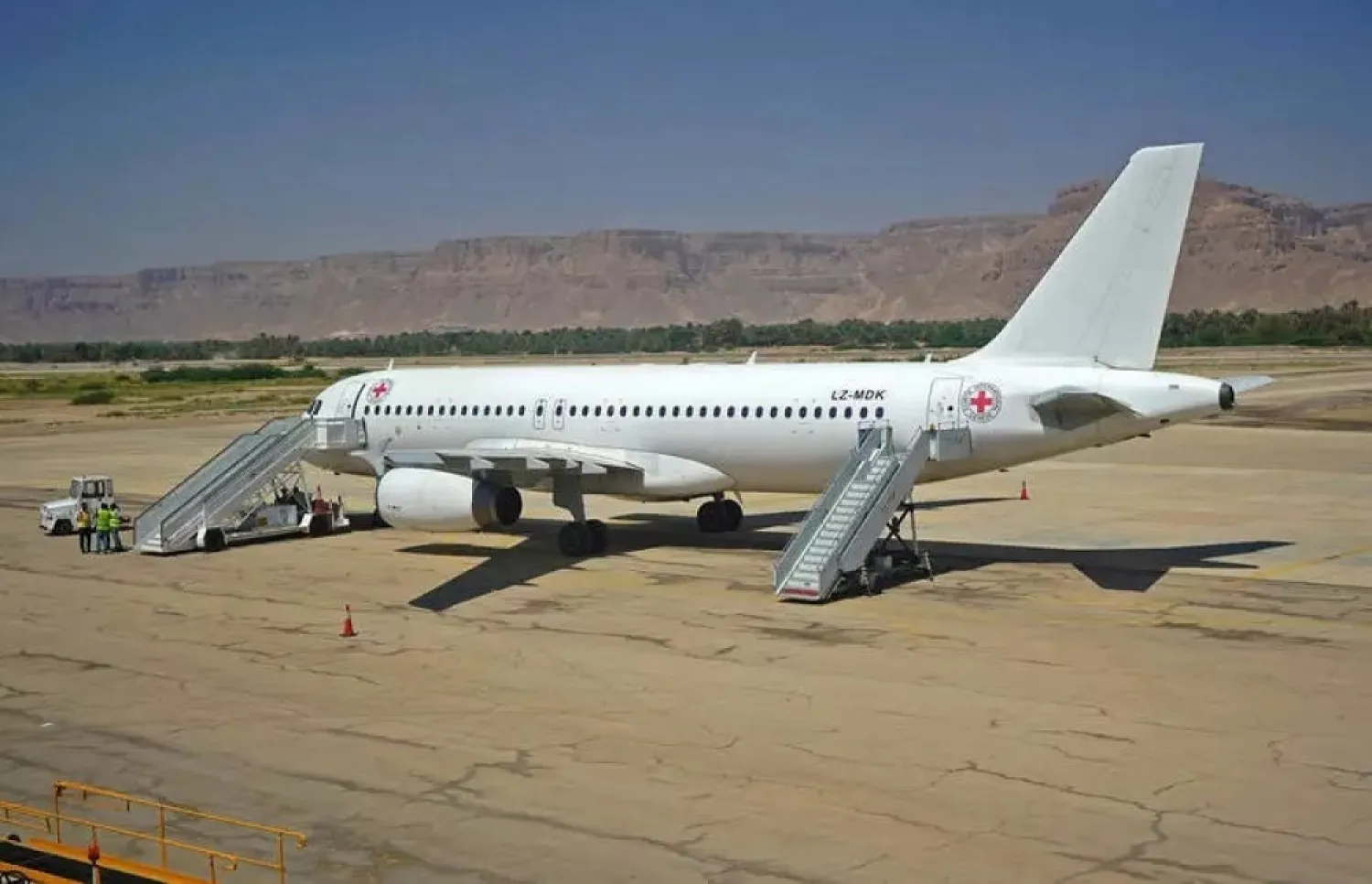
A Red Cross plane sits on the tarmac in Seiyun city to ferry home prisoners as part of sway between the government and Houthis in October. (AFP)
TT

Consultations Set for Jordan in 2nd Phase of Prisoner Swap between Yemen Govt., Houthis

A Red Cross plane sits on the tarmac in Seiyun city to ferry home prisoners as part of sway between the government and Houthis in October. (AFP)

Yemeni official sources said representatives of the legitimate government and Iran-backed Houthi militias have received an invitation from the office of UN Special Envoy to Yemen, Martin Griffiths, to hold a new meeting in the Jordanian capital, Amman, to complete discussions on the implementation of the second phase of the prisoner exchange agreement.

Undersecretary of Human Rights Ministry and a member of the team negotiating the prisoner swap, Majed Fadael accused the Houthis of seeking to avoid the implementation of the second phase of the Swiss agreement.

He added, however, that he was optimistic about the success of the meeting, which has been scheduled for Thursday.

“We agree to engage in a round of consultations to increase the number of prisoners, including the four included in the UN Security Council Resolution,” Fadael told Asharq Al-Awsat on Sunday.

The four prisoners are Nasser Mansour Hadi, brother of the Yemeni president, former Defense Minister Mahmoud Al-Sabhihi, Military Commander Faisal Rajab and al-Islah Party member Mohammed Qahtan.

“We are ready for this round and are fully prepared to carry out an inclusive swap deal on condition that the Houthis are committed to what they signed,” he said.

Fadael added that he was optimistic that the Amman meeting would produce a win-win outcome for both sides.

Meanwhile, chairman of the Houthi committee for prisoner affairs, Abdulqadir Al-Murtada confirmed the militias received an official invitation from the UN to attend the Jordan consultations.

He claimed that the militias are ready to implement the second part of the Amman agreement on prisoners that calls for swapping 200 Houthi prisoners in exchange of 100 legitimate government prisoners, including the brother of president Abdrabbuh Mansur Hadi. He neglected to mention the three other Yemeni officials.

Murtada’s comments prompted criticism from the government. Fadael posted a tweet reminding the militias of their previous commitment during the recent Switzerland consultations.

“We would like to remind you of what has been signed in Montreux, Switzerland, in the third paragraph, which stipulates your commitment to release all prisoners and detainees, including the four prisoners covered in the UN Security Council resolution. Enough lies.”

Last month, the International Committee of the Red Cross (ICRC) completed a prisoner exchange deal of 1,061 captives, considered the largest between the Yemeni legitimate government and Houthi militias since the coup in late 2014.

The exchange is the result of negotiations that took place over the last few months in Switzerland under UN sponsorship and based on the Stockholm Agreement, a deal signed between the Yemeni government and Houthis in 2018.


Israeli Gunfire Kills Two People in South Lebanon

The rubble of a collapsed building is pictured following Israeli bombardment, in Nabatieh in southern Lebanon on June 21, 2026. (AFP)
TT

Israeli Gunfire Kills Two People in South Lebanon

The rubble of a collapsed building is pictured following Israeli bombardment, in Nabatieh in southern Lebanon on June 21, 2026. (AFP)

Israeli gunfire killed two people in southern Lebanon on Tuesday, Lebanon's Civil Defense and state media said, the first reported fatalities resulting from Israeli fire in Lebanon in three days. 

A ceasefire between Iran-backed Hezbollah and Israeli forces in southern Lebanon has largely held since Sunday, the longest lull yet in the war that spilled over from the conflict between the ‌United States ‌and Iran. 

Israeli soldiers opened fire ‌at ⁠a group of ⁠people near a bulldozer clearing a road in the al-Deir neighborhood of Nabatieh al-Fawqa in southern Lebanon, Lebanon's state news agency NNA reported. 

The Israeli military said it was checking the report. 

Iran insisted Israel cease fire in Lebanon ⁠as part of an interim agreement with ‌the United States ‌signed last week. 

A joint statement issued on Monday ‌at the end of US-Iranian talks mediated by ‌Pakistan and Qatar in Switzerland said the parties had agreed to create "a de-confliction cell" to ensure adherence to the termination of hostilities in Lebanon. 

Since Hezbollah ‌opened fire on Israel in support of Iran on March 2, Israeli ⁠attacks ⁠in Lebanon have killed more than 4,100 people, including 773 women, children and healthcare workers, according to the Lebanese health ministry. The toll does not say how many combatants are among the dead. 

Israeli attacks have forced some 1.2 million people from their homes in Lebanon, according to Lebanese authorities. 

Israel's death toll from this round of hostilities with Hezbollah includes at least 32 soldiers and four Israeli civilians.  


UN Probe: Israel's 'Deliberate Targeting' of Children Part of Ongoing Gaza 'Genocide'

Mourners carry the body of Palestinian Raghad Hassan Ashour, 16, during her funeral at Al-Shifa Hospital after she was killed in an Israeli airstrike, in Gaza City, Monday June 22, 2026. (AP Photo/Jehad Alshrafi)
TT

UN Probe: Israel's 'Deliberate Targeting' of Children Part of Ongoing Gaza 'Genocide'

Mourners carry the body of Palestinian Raghad Hassan Ashour, 16, during her funeral at Al-Shifa Hospital after she was killed in an Israeli airstrike, in Gaza City, Monday June 22, 2026. (AP Photo/Jehad Alshrafi)

Israel is deliberately targeting Palestinian children in what has become a key factor in an ongoing "genocide" in Gaza, United Nations investigators charged on Tuesday, in a report slammed by Israel.

According to AFP, the UN Independent International Commission of Inquiry said it had found evidence that "Palestinian children have been deliberately targeted and killed by Israeli security forces.”

This, it said, was a key factor in establishing "the genocidal intent of the Israeli authorities and security forces to destroy the larger Palestinian group in Gaza.”

The three-member investigative team, which does not speak for the UN itself, first determined in a report last September that Israel had committed "genocide" in the war in Gaza -- a finding Israel flatly rejected.

In Tuesday's follow-up report, they said the intense scale and systematic nature of Israeli military operations had continued, resulting in the "unprecedented" death, injury and trauma of Palestinian children.

There were "reasonable grounds" to conclude that Israel's authorities and security forces "have continued to commit the crime of genocide" in Gaza, they said.

Israel, which has long been harshly critical of the commission, slammed the report as "defamatory" and a "libelous sham.”

It accused the investigators of ignoring "the brutal tactics of Hamas, which ruthlessly attacks Israeli children and uses Palestinian children as human shields.”

The commission, which was established by the UN Human Rights Council in 2021, examined for its latest report crimes affecting Palestinian children, and how living conditions imposed by Israel in Gaza were "resulting in preventable mortality of children.”

"Israeli authorities and security forces have deliberately targeted Palestinian children resulting in genocide, crimes against humanity and war crimes in the Gaza Strip, and war crimes in the West Bank," the team said in a statement.

The commission said that severe physical and mental injuries, mass trauma, orphanhood, separation, disability, repeated displacements, starvation, and the collapse of education and healthcare had "erased childhood" in Gaza and would continue to affect the territory's children throughout their lives.

"By targeting children, Israel is attacking the very capacity of the Palestinian people to exist and to determine their future," said Indian judge Srinivasan Muralidhar, who chairs the inquiry.

"Even after the October 2025 ceasefire, children continue to be killed and seriously injured."

The report comes days after the UN children's agency UNICEF said at least 265 children had been killed and hundreds more wounded in Gaza since the ceasefire between Israel and Hamas took effect.

UNICEF said children had been shot, bombed and struck by quadcopters, killed in tents, in schools and while playing football or fishing.

The Hamas October 7, 2023 attack on Israel resulted in the deaths of 1,221 people, according to an AFP tally based on official Israeli figures.

Israel's retaliatory response in Gaza has killed more than 72,800 people, according to the Hamas-run territory's health ministry.

The UN inquiry said that during the first two years of the war at least 20,179 children were killed and 44,143 injured "as a direct result of the hostilities in Gaza.”

The killing and maiming of Palestinian children "was part of a strategy to destroy the biological continuity and future existence of the Palestinian group in Gaza", it said.

By targeting children, the report said, "Israel is eroding the foundational structure of Palestinian society, weakening the demographic vitality.”

Israel was responsible for causing a "severe orphan crisis,” while wounded youngsters "face a lifetime of disability" -- now "a defining demographic reality" among Gaza's children, it said.

The siege of Gaza "directly undermined reproductive and newborn health,” while the collapse of public health programs "eroded the conditions necessary for a healthy next generation.”

The report listed Israeli divisions, brigades and units that may be responsible for killing children, in specific incidents in Gaza and the West Bank.

Besides Gaza, the commission also documented a sharp increase in violence by Israeli settlers against Palestinian children in the West Bank, which Israel has occupied since 1967.

The commission urged all UN member states, including Israel, to ensure accountability for crimes committed.


Russian Delegation, Libya’s GNA Discuss Investment Opportunities

The visit aimed to review the economic and investment potential offered by the free zone and the opportunities available for cooperation and partnership. Photo: Misurata Free Zone
TT

Russian Delegation, Libya’s GNA Discuss Investment Opportunities

The visit aimed to review the economic and investment potential offered by the free zone and the opportunities available for cooperation and partnership. Photo: Misurata Free Zone

Libyan officials have discussed with a high-ranking Russian economic delegation mechanisms to strengthen investment and trade cooperation, as well as the reactivation of the Libyan-Russian joint committee.

Chairman of the Management Committee of the Misurata Free Zone (MFZ) in Libya Mohsen Al-Suqutri met on Monday with Russia’s Ambassador to Libya, Aydar Aganin, in the presence of Libya’s ambassador to Moscow, Emhemed Almaghrawi.

The visit aimed to review the economic and investment potential offered by the free zone and the opportunities available for cooperation and partnership.

The Russian delegation included several businessmen, as well as heads and representatives of companies and institutions active in industrial, commercial, investment, and scientific research sectors.

The Russian ambassador praised the strategic geographic location of the Misurata Free Zone, considering it an important hub connecting regional and international markets, and highlighting its attractiveness for investment in light and heavy industries and other sectors.

Both sides discussed opportunities for economic and investment cooperation and the possibility of establishing partnerships and projects that would contribute to boosting economic development and expanding areas of collaboration between the two countries.

The Minister of Transport and financial adviser to the prime minister in the Government of National Unity (GNA), Mohamed Al-Shahoubi, met with the Russian economic delegation in Tripoli.

The meeting was attended by several ministry officials, the Libyan and Russian ambassadors, as well as representatives from the ministry of foreign affairs and international cooperation.

The meeting addressed several issues of mutual interest, particularly in the sectors of transportation, infrastructure, and logistics services. It also explored opportunities for economic and investment cooperation that would serve shared interests and strengthen the partnership between the two countries.

The two sides also discussed mechanisms for reviving the Libyan-Russian joint committee, in a way that would help advance cooperation and activate agreements and memoranda of understanding previously signed between Libya and Russia.

The conferees stressed the importance of continued coordination, consultation, and exchange of expertise in support of development efforts, and to enhance the transport sector and economic relations between the two states.