
How Shows Resumed Filming in Pandemic N.Y.C.

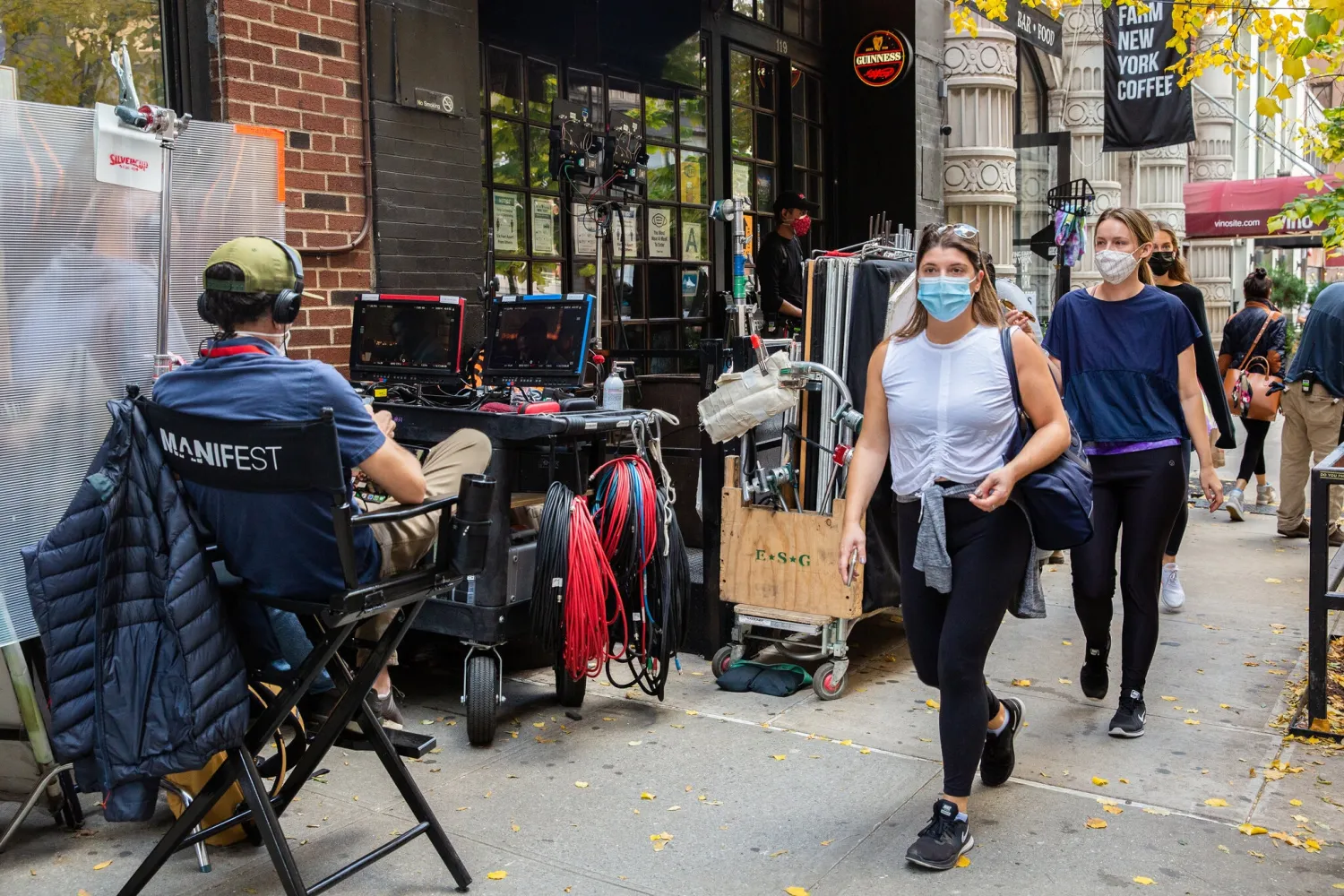
Pedestrians passing through a set for the TV series “Manifest” in Manhattan.Credit...Sarah Stacke for The New York Times
TT

How Shows Resumed Filming in Pandemic N.Y.C.

Pedestrians passing through a set for the TV series “Manifest” in Manhattan.Credit...Sarah Stacke for The New York Times

Across from Bellevue Hospital in Manhattan recently, dozens of crew members in yellow safety vests filmed a scene for the TV medical drama, “New Amsterdam," as real doctors and nurses skirted past them. A few blocks away, the television series “Manifest” wrapped up a morning shoot inside a cozy bar, then set up a crane to light a night shoot at a Midtown playground.

With Broadway dark, concert venues closed and live performances strictly limited, New York’s powerhouse arts and entertainment industry has been devastated by the coronavirus pandemic. But amid the downturn, film production has been a bright spot, with television and streaming series again filling the city’s sound stages and, increasingly, the city’s streets, despite a rise in virus cases in New York and across the nation.

The film and television industry, which brought $60 billion to the city in the year before the pandemic, is not yet back to its old heights. Of the nearly 80 series that were filming or planning to film in New York City in the 2019-2020 season, 35 were back at work by early November — including popular shows like “Younger and “Blue Bloods” — with another five expected back by the end of the year, according to the Mayor’s Office of Media and Entertainment.

A virus surge could threaten that recovery, particularly if Gov. Andrew M. Cuomo declares New York a “red zone” and orders all nonessential businesses closed again.

Still, in a pandemic-weary Manhattan, whose streetscapes are pockmarked by boarded-up storefronts and “for rent” signs, the sight of dozens of shiny production trucks and the hum of workers rolling equipment on and off film sets is giving the city a glimpse of its former self. It is also getting thousands of people back to work, and burnishing the image of New York as a resilient metropolis to the millions who watch New York-based television shows worldwide.

The city’s major studios — Kaufman Astoria Studios in Queens, Steiner Studios in the Brooklyn Navy Yard and Silvercup Studios in Long Island City — all report that they are full, though each stage can only function at 50 percent of its regular occupancy under state rules.

“It’s a very mobile industry; they don’t have to be in New York,” said Hal Rosenbluth, the president of Kaufman Astoria Studios in Queens, of his studio being full again. “The thing that made me feel good, is that the executives that make these decisions were still confident to come back to New York, and that is the best statement you can say.”

The overlapping safety protocols of the industry’s labor unions, the Hollywood parent companies and the New York state and city government have led to robust safety protections, at least for major studio projects. While near daily virus testing is turning up coronavirus cases among the crew and actors, the productions, for the most part, have continued with few delays. To satisfy homebound audiences eager for new content, studios been willing to pay big for safety measures, with production costs ballooning by around 30 percent.

“Just the Covid division alone for each production could be up to 40 people,” said Doug Steiner, the chief executive of Steiner Studios, where seven series, including Amazon’s “The Marvelous Mrs. Maisel” and Showtime’s “City on a Hill," are back in business.

About one person every week or two test positive somewhere on the lot, Mr. Steiner said. But so far, he said, the productions have managed to isolate cases and their contacts, and continue filming. Studios pay for testing, and their coronavirus teams do their own contact tracing.

The city said that at least one production had shut down for two weeks because of virus cases, while others have shut down for a day or two.

It’s impossible to get a complete picture of how often the coronavirus is appearing on set, as no one is tracking that number fully. Daniel Hank, a New York producer and a member of the Directors Guild of America, cited informal numbers put out by the organization internally, which reported a total of 113 virus “events”— which could include anything from a false positive to multiple positive tests — on film and television sets across North America, 59 of which resulted in a pause in production. The Directors Guild said that those numbers were anecdotal and not intended for public release.

Projects have found a way to keep filming because it is too costly just to stop, said Mr. Hank, who leads a weekly call for producers to share advice on filming during a pandemic. “It adds a level of complexity that’s one more challenge to overcome in an industry filled with challenges,” he said.

On-location shooting in New York has been slower to return, with the logistical puzzle of filming in a busy city made even more difficult by new social distancing requirements and increased demands on outdoor space. Outdoor dining structures, for example, now cover many sidewalks and parking spots.

(Filming in Los Angeles is also recovering, although permit requests remain at about half the levels analysts would expect in a typical year, according to FilmLA, the partner film office for the city of Los Angeles.)

The interplay between the public and the film crew in the city has also been transformed. Film crews are used to dealing with a mix of curious onlookers and “real New Yorkers” who walk right through the set without noticing.

“Now, I see people do a double take and walk the other way,” said Kelly Mahoney, the first assistant director on the set of the NBC series “Manifest,” which was back shooting in Manhattan for the first time in mid-November. “It was really strange to me.”

On set, the most obvious change is that masks are mandatory, as are face shields for the crew closest to the actors. Portable sinks have become a new must-have street accessory. Color-coded bracelets or lanyards mark what zone a crew member is assigned to, in order to limit contact between workers and those allowed near the action. Actors take off their own masks to film scenes, and then put them on again when a crew member yells cut.

“Manifest" has not yet had a virus case on set, said Harvey Waldman, one of the show’s producers, “but it is a little bit like playing Russian roulette, all the time.” At the same time, he said, “you also feel this comradeship, and you feel that people are watching out for each other.”

The productions have mostly stuck to filming inside sound stages, where they can tightly control the environment. Script writers have also made adjustments, limiting intimate scenes, extras and shifting some shoots to more spacious settings outside the city.

Before the pandemic, the Mayor’s Office of Media and Entertainment generally issued about 1,000 permits per month for outdoor filming on public property. After a complete spring shutdown, the numbers began to rebound in September, when film crews of up to 100 were allowed to work. Last month, 559 permits were granted.

“Slow and steady wins the race, and that’s what we are seeing right now,” said Anne del Castillo, the city’s media and entertainment commissioner. “It’s one of the bright spots in the recovery, and I love talking about it.”

But the return to the city streets in the last few weeks has offered a sometimes worrying level of interaction between the crews and the public, with both sides wary.

On the set of “New Amsterdam” on a recent Tuesday, for example, the large crew found it impossible to perfectly socially distance while setting up for the actors in a small park and traffic lane on First Avenue. Bikers kept rolling through the set, and the lighting crane was temporarily stored right next to the active Citi Bike rental station.

“Please stay at least six feet away — we have all been tested,” one crew member warned a lingering pedestrian.

With the extra cost of everything from testing to transportation, many projects, particularly smaller ones or those not yet filming, are pausing until the spring, said Flo Mitchell Brown, the chair of the industry group New York Production Alliance.

Commercials and smaller projects do not have to abide by the same safety protocols agreed to by the major studios, so their virus protections can be more variable. False positives have also caused closures on some sets, to the point where some major studios have stopped using rapid tests, Mr. Hank said.

Inside the city’s live television studios, frequent testing, social distancing and masks have also enabled a return to production, though with huge changes from the pre-pandemic era. Candi Carter, the executive producer of the “Tamron Hall” show, which broadcasts from the Upper West Side, uses an empty green room as her makeshift office, because all the guests and audience on the show are virtual. Everyone who can work from home does.

Though things feel “bizarre, to say the least,” Ms. Carter said, it is an improvement over the many weeks this spring Ms. Hall was filming from her New York City kitchen. Audiences seem to agree, and ratings are up.

“I think people want to see regular TV again,” she said. “Everyone on our staff is completely on board. And that’s how we are able to do it.”

The New York Times


17th Century Wreck Reappears from Stockholm Deep

The remains of a 17th century shipwreck is pictured after resurfacing in Stockholm, Sweden, on February 17, 2026. (Photo by Jonathan NACKSTRAND / AFP)
TT

17th Century Wreck Reappears from Stockholm Deep

The remains of a 17th century shipwreck is pictured after resurfacing in Stockholm, Sweden, on February 17, 2026. (Photo by Jonathan NACKSTRAND / AFP)

A 17th century Swedish Navy shipwreck buried underwater in central Stockholm for 400 years has suddenly become visible due to unusually low Baltic Sea levels.

The wooden planks of the ship's well-preserved hull have since early February been peeking out above the surface of the water off the island of Kastellholmen, providing a clear picture of its skeleton.

"We have a shipwreck here, which was sunk on purpose by the Swedish Navy," Jim Hansson, a marine archeologist at Stockholm's Vrak - Museum of Wrecks, told AFP.

Hansson said experts believe that after serving in the navy, the ship was sunk around 1640 to use as a foundation for a new bridge to the island of Kastellholmen.

Archeologists have yet to identify the exact ship, as it is one of five similar wrecks lined up in the same area to form the bridge, all dating from the late 16th and early 17th centuries.

"This is a solution, instead of using new wood you can use the hull itself, which is oak" to build the bridge, Hansson said.

"We don't have shipworm here in the Baltic that eats the wood, so it lasts, as you see, for 400 years," he said, standing in front of the wreck.

Parts of the ship had already broken the surface in 2013, but never before has it been as visible as it is now, as the waters of the Baltic Sea reach their lowest level in about 100 years, according to the archaeologist.

"There has been a really long period of high pressure here around our area in the Nordics. So the water from the Baltic has been pushed out to the North Sea and the Atlantic," Hansson explained.

A research program dubbed "the Lost Navy" is underway to identify and precisely date the large number of Swedish naval shipwrecks lying on the bottom of the Baltic.


China Has Slashed Air Pollution, but the ‘War’ Isn’t Over 

This picture taken on February 11, 2026 shows pedestrians walking along an overpass as traffic snarls in Beijing. (AFP)
TT

China Has Slashed Air Pollution, but the ‘War’ Isn’t Over 

This picture taken on February 11, 2026 shows pedestrians walking along an overpass as traffic snarls in Beijing. (AFP)

Fifteen years ago, Beijing's Liangma riverbanks would have been smog-choked and deserted in winter, but these days they are dotted with families and exercising pensioners most mornings.

The turnaround is the result of a years-long campaign that threw China's state power behind policies like moving factories and electrifying vehicles, to improve some of the world's worst air quality.

Pollution levels in many Chinese cities still top the World Health Organization's (WHO) limits, but they have fallen dramatically since the "airpocalypse" days of the past.

"It used to be really bad," said Zhao, 83, soaking up the sun by the river with friends.

"Back then when there was smog, I wouldn't come out," she told AFP, declining to give her full name.

These days though, the air is "very fresh".

Since 2013, levels of PM2.5 -- small particulate that can enter the lungs and bloodstream -- have fallen 69.8 percent, Beijing municipality said in January.

Particulate pollution fell 41 percent nationwide in the decade from 2014, and average life expectancy has increased 1.8 years, according to the University of Chicago's Air Quality Life Index (AQLI).

China's rapid development and heavy coal use saw air quality decline dramatically by the 2000s, especially when cold winter weather trapped pollutants close to the ground.

There were early attempts to tackle the issue, including installing desulphurization technology at coal power plants, while factory shutdowns and traffic control improved the air quality for events like the 2008 Olympics.

But the impact was short-lived, and the problem worsened.

- Action plan -

Public awareness grew, heightened by factors like the US embassy in Beijing making monitoring data public.

By 2013, several international schools had installed giant inflatable domes around sport facilities to protect students.

That year, multiple episodes of prolonged haze shrouded Chinese cities, with one in October bringing northeastern Harbin to a standstill for days as PM2.5 levels hit 40 times the WHO's then-recommended standard.

The phrase "I'm holding your hand, but I can't see your face" took off online.

Later that year, an eight-year-old became the country's youngest lung cancer patient, with doctors directly blaming pollution.

As concerns mounted, China's ruling Communist Party released a ten-point action plan, declaring "a war against pollution".

It led to expanded monitoring, improved factory technology and the closure or relocation of coal plants and mines.

In big cities, vehicles were restricted and the groundwork was laid for widespread electrification.

For the first time, "quantitative air quality improvement goals for key regions within a clear time limit" were set, a 2016 study noted.

These targets were "the most important measure", said Bluetech Clean Air Alliance director Tonny Xie, whose non-profit worked with the government on the plan.

"At that time, there were a lot of debates about whether we can achieve it, because (they were) very ambitious," he told AFP.

The policy targeted several key regions, where PM2.5 levels fell rapidly between 2013 and 2017, and the approach was expanded nationwide afterwards.

"Everybody, I think, would agree that this is a miracle that was achieved in China," Xie said.

China's success is "entirely" responsible for a decline in global pollution since 2014, AQLI said last summer.

- 'Low-hanging fruits' gone -

Still, in much of China the air remains dangerous to breathe by WHO standards.

This winter, Chinese cities, including financial hub Shanghai, were regularly among the world's twenty most polluted on monitoring site IQAir.

Linda Li, a running coach who has lived in both Beijing and Shanghai, said air quality has improved, but she still loses up to seven running days to pollution in a good month.

A top environment official last year said China aimed to "basically eliminate severe air pollution by 2025", but the government did not respond when AFP asked if that goal had been met.

Official 2025 data found nationwide average PM2.5 concentrations decreased 4.4 percent on-year.

Eighty-eight percent of days featured "good" air quality.

However, China's current definition of "good" is PM2.5 levels of under 35 micrograms per cubic meter, significantly higher than the WHO's recommended five micrograms.

China wants to tighten the standard to 25 by 2035.

The last five years have also seen pollution reduction slow.

The "low-hanging fruits" are gone, said Chengcheng Qiu from the Center for Research on Energy and Clean Air (CREA).

Qiu's research suggests pollution is shifting west as heavy industry relocates to regions like Xinjiang, and that some cities in China have seen double-digit percentage increases in PM2.5 in the last five years.

"They can't just stop all industrial production. They need to find cleaner ways to produce the output," Qiu said.

There is hope for that, given China's status as a renewable energy powerhouse, with coal generation falling in 2025.

"Cleaner air ultimately rests on one clear direction," said Qiu.

"Move beyond fossil fuels and let clean energy power the next stage of development."


Sydney Man Jailed for Mailing Reptiles in Popcorn Bags 

Investigators recovered 101 Australian reptiles from parcels destined for Hong Kong, South Korea, Sri Lanka and Romania. (AFP file)
TT

Sydney Man Jailed for Mailing Reptiles in Popcorn Bags 

Investigators recovered 101 Australian reptiles from parcels destined for Hong Kong, South Korea, Sri Lanka and Romania. (AFP file)

A Sydney man who tried to post native lizards, dragons and other reptiles out of Australia in bags of popcorn and biscuit tins has been sentenced to eight years in jail, authorities said Tuesday.

The eight-year term handed down on Friday was a record for wildlife smuggling, federal environment officials said.

A district court in Sydney gave the man, 61-year-old Neil Simpson, a non-parole period of five years and four months.

Investigators recovered 101 Australian reptiles from seized parcels destined for Hong Kong, South Korea, Sri Lanka and Romania, the officials said in a statement.

The animals -- including shingleback lizards, western blue-tongue lizards, bearded dragons and southern pygmy spiny-tailed skinks -- were posted in 15 packages between 2018 and 2023.

"Lizards, skinks and dragons were secured in calico bags. These bags were concealed in bags of popcorn, biscuit tins and a women's handbag and placed inside cardboard boxes," the statement said.

The smuggler had attempted to get others to post the animals on his behalf but was identified by government investigators and the New South Wales police, it added.

Three other people were convicted for taking part in the crime.

The New South Wales government's environment department said that "the illegal wildlife trade is not a victimless crime", harming conservation and stripping the state "and Australia of its unique biodiversity".