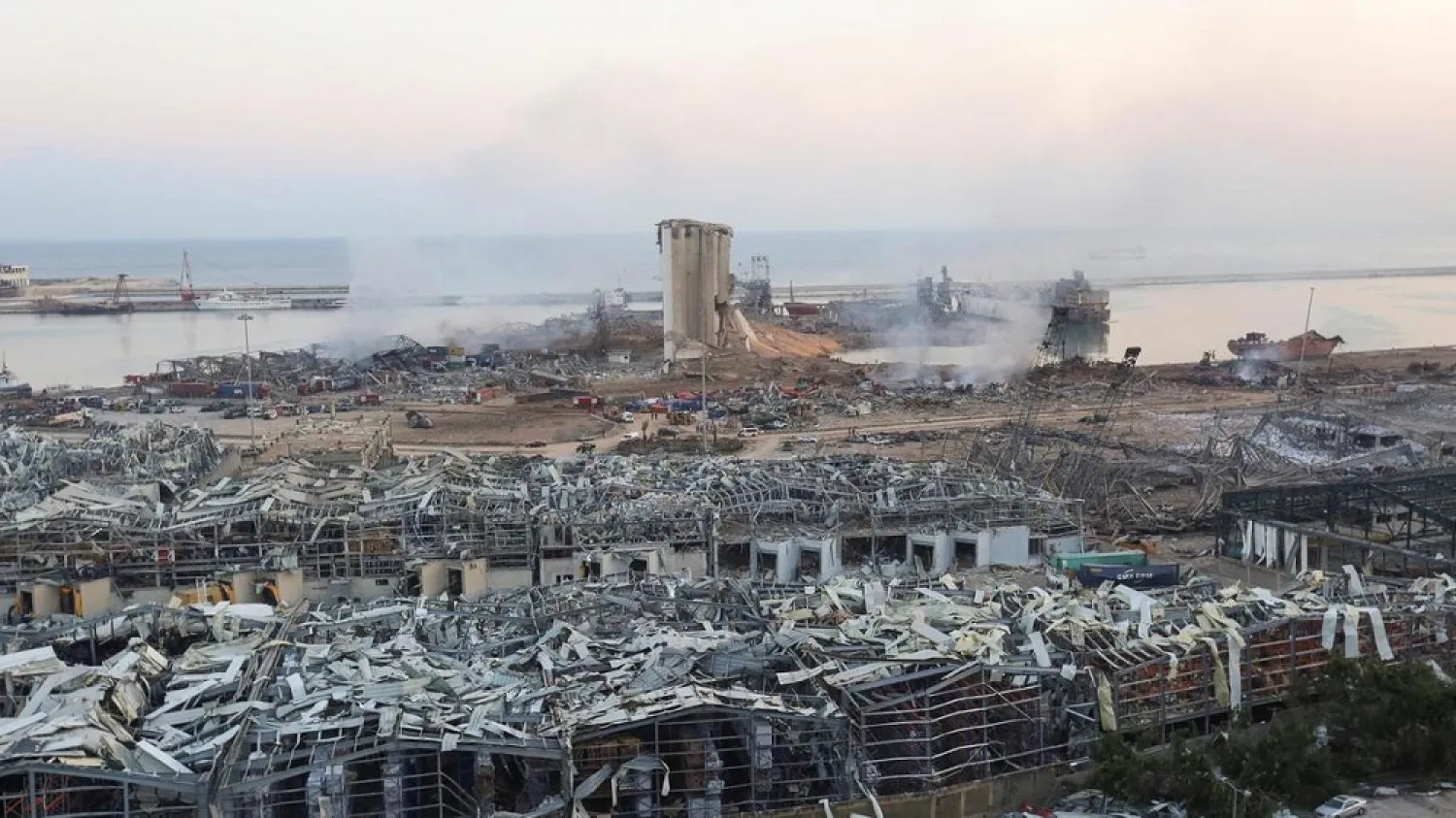

The Blast that Blew Away Lebanon's Faith in Itself

A general view shows the aftermath at the site of August's blast in Beirut's port area. (Reuters)
TT

The Blast that Blew Away Lebanon's Faith in Itself

A general view shows the aftermath at the site of August's blast in Beirut's port area. (Reuters)

They gather in groups, wearing black, in the shadow of buildings gutted by the explosion that shook this city on Aug. 4. Men, women and children from Christian and Muslim sects cradle portraits of their dead.

Beirut has been blown back to the vigils of its 1975-1990 civil war. Then, families demanded information about relatives who had disappeared. Many never found out what happened, even as the country was rebuilt. Today’s mourners know what happened; they just don’t know why.

Four months on, authorities have not held anyone responsible for the blast that killed 200 people, injured 6,000 and left 300,000 homeless. Many questions remain unanswered. Chief among them: Why was highly flammable material knowingly left at the port, in the heart of the city, for nearly seven years?

For me, the port explosion rekindled memories I’ve spent 30 years trying to forget. As a reporter for Reuters, I covered the civil war, the invasion and occupation of Lebanon by Israel and Syria – and the assassinations, air strikes, kidnappings, hijackings and suicide attacks that marked all these conflicts.

But the blast has left me, and many other Lebanese, questioning what has become of a country that seems to have abandoned its people. This time, the lack of answers over the catastrophe is making it difficult for an already crippled nation to rise from the ashes again.

“I feel ashamed to be Lebanese,” said Shoushan Bezdjian, whose daughter Jessica – a 21-year-old nurse – died while on duty when the explosion ripped through her hospital.

False hope
It took 15 years of sectarian bloodletting to destroy Beirut during the civil war. It then took 15 years to rebuild it – with lots of help from abroad. In 1990, billions of dollars poured in from Western and Gulf countries and from a far-flung Lebanese diaspora estimated to be at least three times the size of the country’s 6 million population.

The result was impressive: Beirut was reincarnated as a glamorous city featured in travel magazines as an exciting destination for culture and partying. Tourists came for the city’s nightlife, to international festivals in Graeco-Roman and Ottoman settings, to museums and archaeological sites from Phoenician times.

Many highly educated expatriates – academics, doctors, engineers and artists – returned to take part in the rebirth of their nation. Among them was Youssef Comair, a neurosurgeon who had left Lebanon in 1982 to pursue a specialization in the United States.

Comair had then worked as assistant professor of neurosurgery at UCLA and head of the epilepsy department at the Cleveland Clinic, where he pioneered the use of surgery as a therapy for epilepsy. When he landed back in Beirut to work as head of surgery at the American University of Beirut, Comair believed the country had turned a corner. Prime Minister Rafik al-Hariri, the industrialist-turned-politician who had rebuilt post-war Beirut, was in power and promised a renewed age of prosperity.

“I was yearning for a life and a place ... receptive to all kinds of civilizations. This is what we were in Lebanon before the war,” recalled Comair.

Behind the splendor of Beirut, however, post-civil war Lebanon was being built on shaky political ground.

At the end of the war, militia leaders on all sides took off their fatigues, donned suits, shook hands after the 1989 Saudi-brokered Taif peace accord and largely disarmed. But the nation’s political leaders, it seemed to many here, continued to pay more attention to a revolving door of foreign patrons than to the creation of a stable state.

The country’s Shiites turned to Iran and its Arab ally Syria, whose troops entered Lebanon in 1976 and stayed for three decades. The Sunnis looked to wealthy oil producers in the Gulf. Christians, whose political influence was heavily curtailed in the post-war deal, struggled to find a reliable partner and shifted alliances over the years. Domestic policy was dictated, at different times, by the foreign power with the deepest wallet.

Comair’s return to Beirut was propitious for me, too. While I was covering the US invasion of Baghdad in 2003, I was badly wounded in the head by shrapnel from a US tank shell fired at the Reuters office in the Palestine Hotel. After emergency surgery in Baghdad, I was evacuated by US Marines to neighboring Kuwait and then on to Lebanon for further treatment. Beirut had become a medical center of excellence for the region – and Comair was my doctor. For years, during my sojourns in Dubai and London, I regularly returned to Beirut and Comair to ensure I was healing.

But my country was once again under strain. After the Iranian-backed Hezbollah drove out Israeli forces in south Lebanon in 2000, the group was steadily increasing its military and political influence. In 2005, Hariri was assassinated, once more dealing a blow to those who thought Lebanon had a bright future. Once again, Lebanese top professionals emigrated. Comair took up a position at St. Luke’s Episcopal Hospital in Houston in 2006. I settled in London.

Both of us were determined to return, however. For me, a return home was a way to expose my children, who were in elementary school at the time, to my family and culture. The so-called Arab Spring in 2010 provided the moment. While protests erupted and dictators were toppled in Tunisia, Egypt, Syria, Libya, Bahrain and Yemen, Lebanon seemed like an oasis in a troubled region. Beirut was once again bustling. By 2012, both Comair and I were back in Beirut.

We were lulled into a sense of security: traditional Sunday lunches with family; sunset on the decks of Beirut beaches; music and film festivals; skiing on Mount Lebanon’s slopes. Friends and family began visiting in greater numbers, as Lebanon’s wartime reputation began to be forgotten. Tourism peaked in Lebanon in 2010, when the number of visitors reached almost 2.2 million, a 17% increase from 2009, according to official statistics.

Life stopped
Yet again, however, Lebanon’s foundations were weak. The country was living beyond its means, with successive governments piling up debt, which rose to the equivalent of 170% of national output in March 2020, according to Lebanon’s finance ministry. This time, national banks bore the brunt of the nation’s spending. By early last year, their losses on loans to the state totaled $83 billion, considerably more than Lebanon’s annual gross domestic product. The banks reacted by shutting their doors, freezing all accounts – effectively shutting down Lebanon’s economy.

For more than a year now, people in Lebanon have not been able to transfer money or withdraw more than $500 a week. The closure of the banks blocked another key stream of income for Lebanon’s economy – money from the diaspora.

Even before the coronavirus pandemic, Lebanon’s economic output had shrunk by 6.7% in 2019. In 2020, the economy is projected to shrink by another 20%. More than 50,000 children have left private schooling and enrolled in state education over the past year, government figures show, a trend that underscores the erosion of the country’s middle class. Nearly 700 doctors have left Lebanon over the past year, according to Sharaf Abou Sharaf, head of the doctors’ union.

What many Beirutis didn’t know before August is that an even bigger threat lay in their midst.

In 2013, a ship had docked at the Beirut port with a stash of the highly flammable chemical ammonium nitrate. It wasn’t – and isn’t to this day – clear why the ship had headed to Lebanon. But the arrival and storage of the material was known to a revolving door of port and national security officials – installed by various government factions – who were never able to agree on how to remove the chemical shipment. It lay untouched for more than six years in a warehouse at the Beirut port, a short walk from the busy city center.

When I covered the civil war, I chronicled the deaths of dozens of victims overlooked amidst the bigger events: two sisters who drowned at sea in a desperate attempt to flee shelling; three brothers immolated in a supermarket; young school children hit in shelling that targeted their bus. One morning in 1989 I found myself walking into a morgue with a mask that could not stifle the suffocating stench of 20 army soldiers shot in the head, their hands still tied behind their backs.

But I will never forget the terror in the eyes of my twin children on that afternoon in August when our car was suddenly thrown toward the side of the road as an orange and white mushroom cloud of dust and debris rose over our heads. “Duck and cover,” I yelled, instantly thrown back to the bombs of my conflict-zone reporting days. Glass and bricks from collapsing buildings fell near the car; uprooted trees blocked the roads. People ran everywhere; wailing ambulances struggled to reach the wounded.

“Life stopped on August 4,” said Rita Hitti, whose son Najib was a firefighter who was killed along with two other family members as they battled the flames that ignited the explosives at the port.

“I no longer have any feeling towards anything – my country or anything else.”

After the blast, the government resigned in the face of popular anger. But Lebanon’s different ruling factions remain too divided to create a new government that can help rebuild the city – and Lebanon’s economy. Their loyalties are split between foreign powers, including Europe, the United States, Iran and Syria. Attempts by France’s President Emmanuel Macron to help cobble together a new administration have thus far failed.

A society divided
Today, the split between Lebanon’s elite and the wider population is wide. Lebanese tycoons regularly feature on the Forbes list of the world’s richest people. Among the six listed in 2020 were members of the family of al-Hariri, the assassinated prime minister, and another former premier, Najib Mikati, and his brother Taha. Other leaders, many of them former militia heads, now live in grand villas, surrounded by security, in Beirut’s wealthy suburbs or secluded hilltops.

In 2019, the richest 10% owned about 70% of the country’s personal wealth, according to a report by the United Nations Economic and Social Commission for Western Asia. More than half the population is in poverty, the report added.

Samia Doughan, 48, recently joined a protest at the Beirut port against the nation’s leaders. She sobbed as she held a picture of her dead husband. “Every day, we wake up crying and we sleep crying,” said Doughan, the mother of twin girls. “These leaders should have been toppled a long time ago. They ruled us for 30 years, it’s enough.”

In contrast to the post-civil-war period, when overseas support flowed in, foreign donors say they will not finance Lebanon until a new administration can show that their money will not be squandered.

During the civil war, many Lebanese emigrated. This time, too, people are starting to look for an exit. Information International, a Beirut-based research firm which has done extensive research about migration, said an estimated 33,000 people left in 2018 and 66,000 left in 2019.

Immediately after the August blast, searches in Lebanon for the word “immigration” on Google Trends hit a 10-year peak, and a recent search by the Arab Opinion Index revealed that four out of five Lebanese aged 18 to 24 are considering emigration. Sharaf, head of the doctor’s union, says he receives between five and 10 requests a day for recommendations from doctors seeking jobs in foreign hospitals.

The heart of the capital, ordinarily packed over Christmas, is deserted. Stores and restaurants are closed. Martyrs Square, which during the Civil War was the frontline between Muslim west and Christian east Beirut before being rebuilt, is no longer lit up at night.

Comair and I are both now thinking of leaving Lebanon again. My doctor spends his days trying to rebuild his hospital, which was destroyed during the explosion. But he has little faith in the country’s long-term revival.

“We are witnessing the annihilation of Lebanon,” he told me. “I have no hope that this country can rise up.”

Samia Nakhoul for Reuters


What Syria’s Military Map Looks Like One Year After Assad Ouster

Hama residents set fire to a large banner of Bashar al Assad after armed factions seized the city last December (AFP)
TT

What Syria’s Military Map Looks Like One Year After Assad Ouster

Hama residents set fire to a large banner of Bashar al Assad after armed factions seized the city last December (AFP)

Syria’s map of control has been shaken to its core since late 2024, when the Deterrence of Aggression offensive erupted and the Assad government fell, unleashing a series of security and military shifts that continued to redraw the country’s landscape through 2025.

But this fluid map is unlikely to hold, according to a study by the Syrian research group Jusoor Center for Studies. With regional and international actors working to head off the chaos and potential partition that threaten wider stability, any near term changes in who controls what are expected to come through political and security pressure rather than a return to large scale battles.

Mahmoud Eibo, one of three researchers who worked on a report on territorial influence in Syria in 2025, told Asharq Al-Awsat that the balance of control shifted sharply after the launch of the Deterrence of Aggression battles on November 27, 2024.

In less than two weeks, the Assad government lost the areas it had held since 2020, which covered more than half of the country.

Iranian withdrawal from Syrian territory

With the government’s fall, Iran’s presence also unraveled after more than a decade of entrenchment. Iran backed militias withdrew from rural Damascus, Homs, Aleppo, the southern provinces and from Al-Bukamal and Al-Mayadin.

Eibo said the militias “withdrew completely” after supply lines linking them to Lebanon and Iraq were severed, which effectively ended Iran’s influence and that of its militias across Syria.

The military role of Hezbollah also came to an end. The group had been one of Tehran’s key proxies in Syria since 2013, when its intervention began with the capture of Al-Qusayr.

But the turning point ended in the same town, after factions in the Deterrence of Aggression campaign seized Al-Qusayr in late 2024 and Hezbollah forces pulled out entirely.

The moment marked a definitive end to Hezbollah’s long military presence in Syria, after the group lost one of its most critical geographic links to Iran through Syrian territory.

Many areas that had been under the indirect influence of Hezbollah and Iran backed factions also slipped out of their orbit and reverted to the authority of the new Syrian state and its security and military institutions in the north.

The largest shift in influence last year came at the expense of the Syrian Democratic Forces, known as the SDF, Eibo said. The Dawn of Freedom operation ended the group’s presence in strategically important areas west of the Euphrates, beginning with the fall of Tel Rifaat and surrounding villages and extending toward Manbij, which cost the SDF one of its key cities in the region.

As a result, the SDF’s influence contracted in northern and eastern Aleppo countryside and the group withdrew eastward toward Raqqa, Hasakeh and parts of Deir Ezzor.

Sweida and the south

In the south, a limited but consequential development emerged in Sweida province. Local groups linked to Sheikh Hikmat Al-Hajri seized parts of the province after government forces withdrew, taking advantage of the security vacuum.

Although the area under their control is geographically small, it created a pocket of influence outside the new government’s authority and added another layer of instability to the southern provinces.

In parallel, Israel capitalized on the collapse of the southern front. It pushed beyond the buffer zone and established a presence in select points and strategic hilltops near the disengagement line.

Although the area is small, the symbolic and intelligence value of the chosen positions gives Israel leverage through monitoring and pressure, keeping the south open to volatility.

What the new map shows

Syria’s territorial map at the end of 2025 reflects a new political landscape dominated by four actors: the Syrian government, the SDF, the National Guard forces in Sweida and Israel, each wielding varying degrees of influence.

The Syrian government remains the primary authority. Beyond its broad political and social control, it holds 69.3% of the country’s territory, covering major cities, most administrative structures and key transport routes. It does not, however, control four provincial capitals: Quneitra, Sweida, Hasakeh and Raqqa.

The SDF controls 27.8% of Syria’s territory, concentrated in the north and east. The expanse is significant but uneven in terms of internal stability. The group faces serious political pressure tied to the implementation of the March 10, 2025 agreement, which is expected to reshape its relationship with the Syrian government.

The National Guard forces in Sweida, loyal to Sheikh Hikmat Al-Hajri, control 2.8% of the country. Their influence is small in size but distinct in nature. The significance lies in their location and in the direct support they receive from Israel, which positions them within a broader framework aimed at prolonging instability in the south.

Their presence overlaps with Israel’s incursion into Syrian territory, which covers 0.1% of the country. Despite the small footprint, the choice of elevated positions and small villages with high surveillance value reflects strategic intent.

Israel is not seeking territorial control, but rather an early warning line and a tighter grip over the border zone, while supporting an environment that prevents full stability in the south. This aligns with its indirect role in reinforcing the position of the Sweida National Guard forces.

Change driven by political pressure

According to Eibo, Syria’s map of control has undergone a fundamental rupture since late 2024, ending a geopolitical phase that had been largely settled since 2020.

The country has entered a more fluid and complex period marked by the retreat of traditional actors and the emergence of new, still unsettled zones of influence.

Although limited security and military shifts continued through 2025, it is unlikely that the current map will hold. Regional and international efforts are focused on avoiding chaos and partition.

Any upcoming change in territorial control will most likely be driven by political and security pressure and by reengineering spheres of influence rather than a return to large scale military confrontations.


Assad’s ‘Trap’: A Night That Shook Tehran’s Allies in Baghdad

A defaced portrait of Syria's ousted President Bashar al-Assad hangs on a wall in the capital Damascus on June 2, 2025. (AFP)
TT

Assad’s ‘Trap’: A Night That Shook Tehran’s Allies in Baghdad

A defaced portrait of Syria's ousted President Bashar al-Assad hangs on a wall in the capital Damascus on June 2, 2025. (AFP)

A senior Iraqi security official urged his driver to pick up speed as they raced toward Damascus airport. He needed to catch a flight back to Baghdad, while alerts kept lighting up his phone.

One message stood out: “The Syrian factions are on their way to the capital.”

It was Saturday evening, December 7, 2024, and the official had just wrapped up a routine mission in northeastern Syria to coordinate border security. But Syria itself was on the edge of a dramatic shift, its old order crumbling and a new one taking shape in the ruins.

At the outskirts of Damascus, the official’s convoy halted, waiting for “extraordinary arrangements” with the emerging authorities. A flurry of sudden, unexpected contacts unfolded between the two sides.

A former Syrian official from the Military Operations Directorate said it was “the first time that Hayat Tahrir al-Sham group communicated with an official in the Iraqi government.”

An Iraqi security officer who was present during the arrangements said that “the process went ahead with unexpected ease at the time, and we entered Damascus” alongside members of the group on the morning of December 8, 2024. Then a message arrived like a lightning strike: “Bashar al-Assad has fled.”

Damascus airport was a ghostly stage. Even the officers of the Air Transport Brigade whom the Iraqi official knew had disappeared. No one asked for a ticket or a passport. The diplomatic lane was wide open to the wind. The man boarded a special flight to Baghdad.

As the plane climbed through daylight, the Iraqi security official carried a bag full of questions about the new Syria.

On the same route, but on the ground, Iraqi militias that had been stationed in Syria since 2011 were withdrawing. Convoys moved from the Damascus countryside toward Al-Bukamal near the Iraqi border, making a final one-way journey for hundreds of fighters, leaving behind 15 years of a “Resistance Axis” now collapsing like a mountain of sand.

Exclusive testimonies gathered by Asharq Al-Awsat from Iraqi figures involved in the Syrian file before Assad’s escape reveal how militias withdrew from Syria without coordination or prior arrangements.

The accounts describe what unfolded behind the scenes, including how they viewed the events, and later showed that Tehran, Moscow and Assad had each made separate decisions not to fight in Syria, failing to share essential information with their Iraqi allies until late.

The testimonies also shed light on the reactions of Shiite groups following the collapse of the Assad regime, including calls to strengthen the influence of armed factions in Iraq’s political process and reinforce what became known as “Shiite governance” in Baghdad, in order to “absorb the shock felt by those who had been left behind in Syria.”

Damascus airport after the collapse of the Assad regime. (AFP file)

‘It was not a maneuver... we were deceived’

On November 30, 2024, three days after the launch of Operation Deterrence of Aggression to topple the Syrian regime, Iraqi Prime Minister Mohammed Shia al-Sudani held a phone call with Syrian President Bashar al-Assad.

At that time, Syrian opposition factions had seized control of the Aleppo countryside. Sudani told Assad that “Syria’s security is tied to Iraq’s national security.” The following day, the opposition encircled Hama. Sudani did not call Assad again.

In Nineveh, the northern Iraqi province that borders Syria, Shiite militia leaders attempted to send reinforcements to Syria, since “as the Syrian factions advanced, the number of Iran-aligned fighters was far smaller than in previous years.” A militia official in Nineveh said they told their fighters, “You must protect the Shiites and the shrines in Syria,” and many volunteers were eager to join.

Kadhim al-Fartousi, spokesman for Kataib Sayyid al-Shuhada, which had been active in Syria since 2013, said the group withdrew in late 2023. “Our mission was over,” he said.

Until 2018, Syria was crowded with more than 150,000 fighters from Iran’s Revolutionary Guard, Hezbollah and Iraqi militias, according to Iraqi and Syrian security estimates. The Syrian army under the former regime appeared smaller than the foreign forces operating on its territory. By December 2023, something had changed.

The Revolutionary Guard allowed several Shiite groups to leave after consultations with Assad. It was widely said that a “regional deal” had driven this shift.

As part of the partial withdrawal of Iranian-backed forces from Syria in 2023, Assad was attempting to regain Syria’s seat in the Arab League. It required significant time and diplomatic maneuvering to prepare for an almost impossible reintegration with the Arab world, which ultimately did not materialize.

When Operation Deterrence of Aggression began in November 2024, the number of Iranian groups in Syria had fallen to several thousand, but Assad’s return to the Arab fold was not complete.

As opposition factions advanced toward Damascus, the prevailing belief was that Shiite groups were moving to plug a gap that no one had noticed.

On December 2, 2024, dozens of fighters infiltrated Syria at night via an unofficial military road, but United States aircraft struck their convoys near Al-Bukamal. After that, it became clear that those who had been eager to enter Syria were backing off.

The next morning, Syrian opposition forces seized 14 towns in Hama and turned to the battle for Homs. That day, Iraq’s Kataib Hezbollah said “it is too early to decide on sending military support to Syria.”

A senior member of a Shiite armed group said he asked his superiors in Baghdad about the first days of Operation Deterrence of Aggression. “Do not worry... Syria may fall to the opposition, but Damascus will hold,” they told him, referring to Assad’s grip on the capital.

“A week later,” he added, “we could no longer comprehend what had happened.”

Before the opposition reached Homs, Shiite groups assumed the advance would stop there. A commander said intelligence reports reviewed by officials in Iraq’s National Security Service, the Popular Mobilization Forces leadership and militia commanders indicated that Russia and Iran would halt the opposition’s momentum and that Homs would be the decisive point.

But Russia used its air superiority sparingly. As opposition factions moved from Hama toward Homs on December 6, 2024, aircraft believed to be Russian struck the Al-Rastan bridge linking the two cities with destructive force, but not enough to prevent convoys from crossing.

Later aerial footage showed Sukhoi jets armed with missiles sitting unused at Russia’s Hmeimim airbase as opposition fighters crossed the bridge into Homs, which was fully taken by dawn on December 7.

At this point, many within the so-called Resistance Axis became convinced that the swift advance of the opposition was not a mere maneuver. The militia commander said they realized “the Iranians had given us conflicting signals... maybe they were deceived too.”

Questions about the roles of Tehran and Moscow remained unresolved. Shiite factions had no clear answers in the months following Assad’s escape.

Today, Fartousi, the Kataib Sayyid al-Shuhada spokesman, believes that “the Russian and Iranian position only shifted after the Assad regime retreated, the forces holding the ground collapsed and the battle turned into a confrontation with the people.”

But sources from factions active in Syria since 2013 spoke of “a decision taken early by Iran not to wage a battle in Syria due to far more complex regional calculations.”

According to these sources, “Iran was not confident of favorable outcomes had it confronted the opposition’s advance, because it realized too late that Moscow was acting independently in Syria.”

In the end, the pillars of the alliance between Moscow, Tehran and Assad appeared to be drifting apart, taking separate battlefield decisions that enabled the opposition’s rapid advance and Assad’s even faster escape. What is certain, the Shiite commander said, is that “the Iraqi groups were not central to the discussions that led to what happened.”

By then, more than ten Iraqi factions had spent over a decade on the Syrian front, during which thousands of fighters were drawn into a sea of blood.

Assad shakes hands with Iraqi PM Mohammed Shia al-Sudani in Damascus. (File photo)

‘And the wheel turns’

At six in the morning on December 8, 2024, former Iraqi Prime Minister Adel Abdulmahdi posted on X about how tables turn and the “aggressor” is overtaken by events. Shock swept through Shiite political forces in Baghdad. Assad had fled and the regime had fallen.

Two days after the liberation, all factions had left Syrian territory and Assad was in Moscow. On December 12, 2024, Nouri al-Maliki, leader of the State of Law Coalition and a long-time ally of Assad, declared that “the goal of what happened in Damascus is to stir the street in Baghdad.” Public opinion erupted with questions.

Shiite political circles in Baghdad struggled to absorb the shock. Private discussions intensified around “the future of the Shiites in Iraq,” dominated by deep confusion, according to participants in closed-door meetings held in the weeks following Assad’s escape.

They said Shiite decision-makers found no answers regarding what had happened in Syria or Iran’s role, and many struggled to answer how Iraq and the region would change after Assad.

One participant in a private session held in January 2025 said the crisis in Syria was not about Assad’s escape or the collapse of the Resistance Axis, but for Iraqi Shiites it was about “redefining their role after old alliances and balances had crumbled.”

Secondary effects of this difficult debate emerged within Shiite groups. Many within the resistance environment began promoting the concept of a “Shiite federation” stretching from Iraq’s Samarra to Basra on top of vast oil reserves. The idea faded quickly, like cold ash.

Talk of “Shiite governance” intensified. A militia commander said: “Shiite forces in recent months focused on strengthening the domestic scene and consolidating their presence in political life, which explains their active participation in the elections held on November 11, 2025, and the victory of armed factions in seats in the new parliament.”

It appeared that all those who had fought in Syria won seats in the new legislature. Asaib Ahl al-Haq, led by Qais al-Khazali, secured 28 seats. The Badr Organization, led by Hadi al-Amiri, won 18. The Rights bloc, linked to Kataib Hezbollah, won six. A list affiliated with Kataib Imam Ali won three. The Services Alliance, led by Shibl al-Zaidi, won nine seats.

These groups are now proposing a transitional project built on new Shiite roles, driven by the growing ambition of leaders such as Khazali to craft an umbrella that shields Shiite groups from fragmentation by expanding their influence in both the legislative and executive branches of the state.

In March 2025, Khazali was asked about the new Syria. He said: “It is the duty and interest of the Iraqi state to engage with it, as long as those governments represent their countries.”

A Shiite leader said the moment Assad fled was not a Syrian event as much as “an earthquake in Shiite consciousness inside Iraq,” pushing everyone to reconsider the alliances that had shaped the region for years.

But beneath this transformation lie lingering questions and doubts about “the future of the Iranian doctrine itself,” now facing major disruption after four decades of uninterrupted influence across the region.

“The answer,” the commander said, “has not yet matured.”


New Political, Military Reality in Lebanon a Year after Assad’s Ouster 

People raise the Syrian flag during the one-year anniversary marking the ouster of Bashar al-Assad in Tripoli, Lebanon.
TT

New Political, Military Reality in Lebanon a Year after Assad’s Ouster 

People raise the Syrian flag during the one-year anniversary marking the ouster of Bashar al-Assad in Tripoli, Lebanon.

The collapse of Bashar al-Assad's regime in Syria in December 2024 created major political, security and economic changes in Lebanon. Beirut also rid itself of what remained of Damascus’ influence - after Syria withdrew its forces from Lebanon in 2005 following 30 years of military and political hegemony - through Assad’s allies, namely Hezbollah.

With the ouster Assad, Lebanon became free to make its political decisions away from the influence of Damascus and its allies. Lebanon and Syria can establish mutual official relations, secure their shared border and improve the trade exchange between them.

Tehran-Beirut route severed

Head of Lebanon’s Saydet al-Jabal Gathering, former MP Fares Souaid told Asharq Al-Awsat: “Lebanon has changed. The most important thing that happened was that the new Syria severed the Tehran-Beirut route that used to supply Hezbollah with all of its security, military and financial means.”

Now, the party has to resort to smuggling to get what it needs, he added. “That option is not secured by military units working for Iran, forcing Hezbollah to approach the new situation in Lebanon with a lot more pragmatism than before.”

He said the party has been forced to take a “humble” approach to “critical issues.”

“We saw how Hezbollah did not quit the government even though it objected to cabinet decisions, especially the one related to imposing state monopoly over arms,” he explained. The decision effectively calls on Hezbollah to disarm.

The party was unable to take any steps to counter the decision because the “real route that has been feeding it has been cut,” Souaid stressed.

Developments, past and present, have shown that anything negative or positive taking place in Syria will impact Lebanon, he went on to say. “If Syria is well, then Lebanon is well.”

He said Lebanon still believes that Syria under President Ahmed al-Sharaa has a promising future and relations between Beirut and Damascus will also be promising.

The relations are already on the right track with the establishment of joint security and military committees sponsored by Saudi Arabia, he remarked. Efforts have already been exerted to secure the shared border between them ahead of demarcation starting from the Shebaa Farms.

Such coordination between Lebanese and Syrian security and military agencies “never happened under Assad rule. So, this is a new development for both countries,” he revealed.

Treaties with Syria

The neighbors currently appeared focused on reshaping their relations in a way that preserves their mutual interests. Souaid acknowledged, however, that pending complex issues remain.

He underlined the need to annul all political, security and economic treaties that were signed during Syria’s hegemony over Lebanon.

Lebanon has appointed an ambassador to Damascus, while the latter has yet to name an envoy to Beirut, he noted.

He also said that the Syrians are prioritizing resolving the issue of Syrian detainees held in Lebanese jails.

The issue is a “black mark” in the relations between the two countries. Lebanon’s justice minister must resolve this file so that it does not complicate efforts to forge good ties, Souaid urged.

Pending files

Lebanon has been perceived as dealing “coolly” with Syria’s insistence on resolving the detainee file.

Some Lebanese officials have for years also complained about Syrian refugees in Lebanon and the burden they have on the state. An informed security source told Asharq Al-Awsat that with Assad’s collapse, this issue was no longer a “major crisis”.

It revealed that half of the Syrian refugees who were in Arsal and the northern Akkar region in Lebanon have returned to their home country. This has been felt by the drop in the numbers of Syrian laborers in Lebanon.

The shared border is another issue of pressing concern for the neighbors.

After Assad’s ouster, Lebanon’s northern and eastern borders are no longer open to the regime’s allies and outlaws, especially drug and other smugglers.

The source said: “The most important achievement on the security level has been curbing the smuggling of weapons from Syria to Lebanon and money from Lebanon to Syria.”

“Captagon factories along both sides of the border have also been destroyed, leading to the dismantling of drug smuggling networks and culminating in the arrest of Lebanon’s most wanted drug smuggler, Noah Zeiter, who was seeking refuge in Syria before Assad’s ouster,” added the source.