

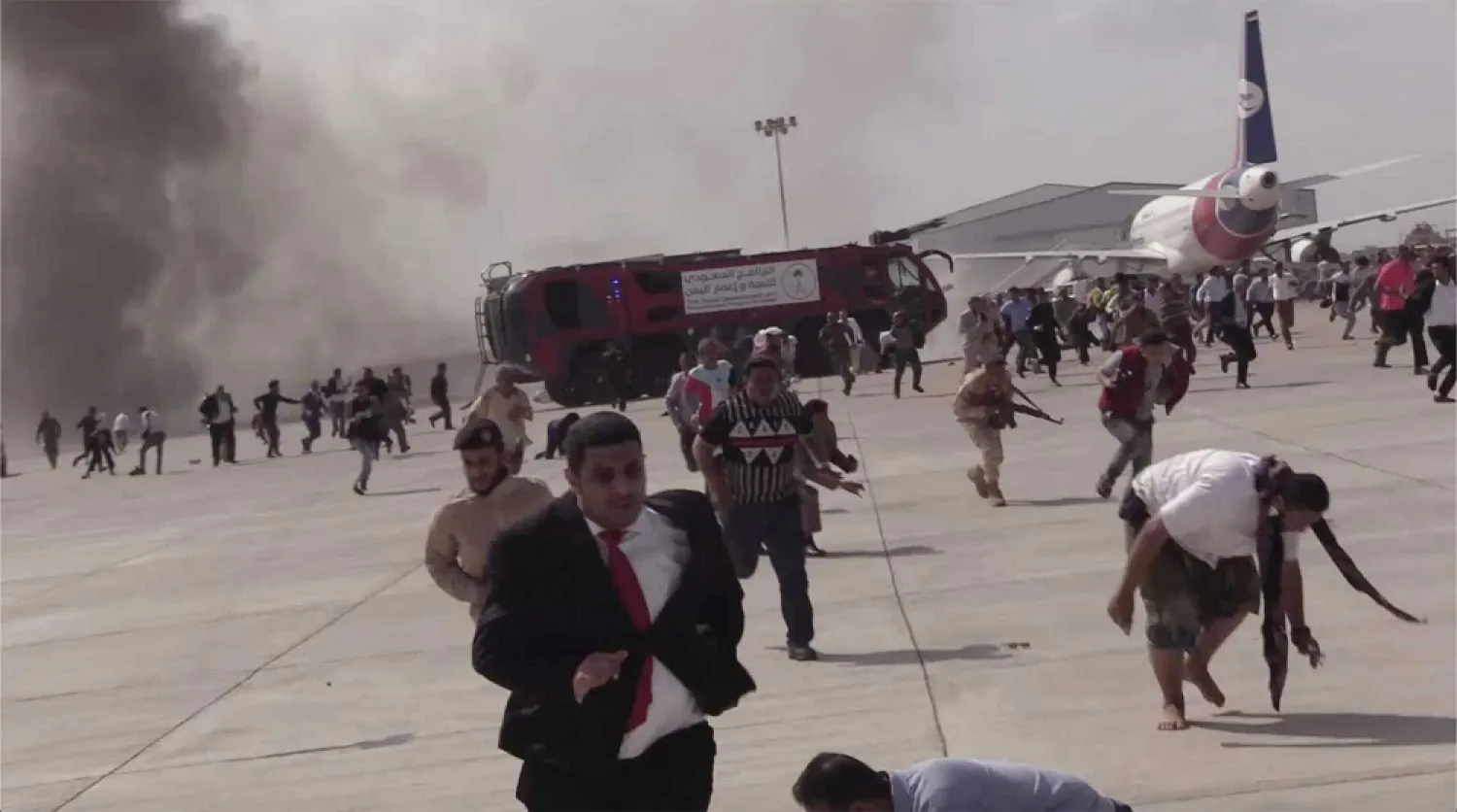

Yemen Govt Defies Terrorism after Surviving Assassination Attempt in Aden

People run following an explosion at the airport in Aden, Yemen, shortly after a plane carrying the newly formed government landed on Wednesday, Dec. 30, 2020. (AP)
TT

Yemen Govt Defies Terrorism after Surviving Assassination Attempt in Aden

People run following an explosion at the airport in Aden, Yemen, shortly after a plane carrying the newly formed government landed on Wednesday, Dec. 30, 2020. (AP)

The Yemeni government vowed that it will continue to forge ahead with its duties until the Iran-backed Houthi coup is defeated and the state is restored.

It made its remarks shortly after a terrorist attack struck Aden international airport on Wednesday moments after a plane landed carrying the newly formed cabinet for government-held parts of Yemen.

At least 22 people were killed and dozens wounded in the attack. Prime Minister Maeen Abdulmalik said all members of the cabinet were “fine”.

Loud blasts and gunfire were heard shortly after the plane arrived from Riyadh. A local security source said three mortar shells had landed on the airport’s hall.

“We and the members of the government are in the temporary capital of Aden and everyone is fine,” Maeen tweeted from Maasheq palace. “The cowardly terrorist act that targeted Aden airport is part of the war that is being waged against the Yemeni state and its great people.”

President Abdrabbuh Mansur Hadi ordered the formation of an investigation team to probe the attack. It is headed by the interior minister and members of security and intelligence agencies. It will operate in coordination with the Saudi-led Arab coalition.

In a telephone call with the premier, Hadi said the Houthi terrorist attacks will not deter the legitimate government from carrying out its duties in the interim capital Aden.

“The forces of good will always prevail over the forces of evil,” he stressed.

Vice President Ali Mohsen al-Ahmar said the cowardly airport attack will not deter the government and coalition from restoring normalcy and the authority of the state in liberated regions, vowing in a telephone call with the PM that the criminals will be held accountable.

Parliament Speaker Sultan al-Barkani said the cowardly airport attack will only increase the determination of parties that are loyal to Yemen.

Information Minister Moammar al-Eryani accused the Houthis of being behind the attack.

Spokesman for the Southern Transitional Council (STC), Nizar Haitham, confirmed the safety of everyone who was on board the government plane.

He told Asharq Al-Awsat that the undersecretary of the ministry of public works, Yasmine al-Awadi, was killed.

“I condemn the cowardly attack on Aden Airport timed to coincide with the arrival of the new government. A despicable attempt to cause carnage and chaos and bring suffering when Yemenis had chosen to move forward together,” tweeted British Ambassador to Yemen Michael Aron.



Sudanese Army Welcomes RSF Defectors

Sudanese Army commander Abdel Fattah al-Burhan receives Major General Al-Nour Qubba, who defected from the Rapid Support Forces. (Sovereignty Council)
TT

Sudanese Army Welcomes RSF Defectors

Sudanese Army commander Abdel Fattah al-Burhan receives Major General Al-Nour Qubba, who defected from the Rapid Support Forces. (Sovereignty Council)

Sudan’s army is increasingly absorbing defectors from the Rapid Support Forces (RSF), betting that growing divisions within the paramilitary group can help consolidate military gains in a civil war that has become one of the world’s worst humanitarian crises.

The latest sign of that strategy came last month when authorities in Khartoum granted a military rank to Ali Rizqallah, a former RSF commander who defected alongside several other senior figures. The army-backed government welcomed the move as evidence of widening cracks within the RSF.

The conflict erupted on April 15, 2023, after a power struggle between the army and RSF spiraled into open warfare. Since then, the war is believed to have killed hundreds of thousands of people, displaced millions, and fueled famine and disease across large parts of the country.

Some of the worst violence has unfolded in Darfur, an RSF stronghold where the force has been accused of committing atrocities. Alleged abuses during the group’s assault on al-Fashir last October were documented in a Reuters investigation.

Halima, a resident of Darfur now living in the town of Tawila, said she was forced to flee repeatedly as RSF fighters raided villages surrounding al-Fashir. She recounted that she witnessed women being raped and was herself whipped by RSF personnel.

Sudanese refugees from Darfur walk amidst a sandstorm at the Touloum refugee camp, amid ongoing conflict in their country, on the outskirts of the town of Iriba in Wadi Fira province, eastern Chad, November 30, 2025. (Reuters)

“My arm is covered in scars all the way down to here,” she said, pointing toward her leg as she described the marks left on her body.

Anger toward the RSF is also widespread in neighboring Kordofan. A merchant in the town of Al-Nuhud revealed that he plans to file a lawsuit over the looting of warehouses and food stores.

Speaking on condition of anonymity for fear of retaliation, he blamed the RSF for the losses. But Mohamed Salah al-Din, a member of the executive council of the Emergency Lawyers group, said such individual cases are unlikely to gain broad traction amid the turmoil of war.

“This issue cannot be addressed piecemeal,” he stated. “It requires transitional justice.”

His comments contrast with efforts already underway to prosecute alleged collaborators. Emergency Lawyers said it has documented 243 cases referred to the courts involving accusations ranging from supplying intelligence to the RSF to cooking for its fighters.

The army is also seeking to exploit tribal tensions within the RSF’s support base. Several of the group’s senior commanders come from the Arab Rizeigat tribe, where rival clans have become increasingly divided, particularly after an RSF raid earlier this year on the hometown of Musa Hilal, a powerful tribal leader aligned with the military.

Hilal belongs to the Mahamid clan, while critics accuse the RSF of operating through a tribal and ethnic hierarchy that disproportionately benefits the family of its commander, Mohamed Hamdan Dagalo, better known as Hemedti.

“The RSF has become the preserve of a specific group and a single family,” critics said. “The project that builds a state must be a Sudanese national project, not one based on tribal loyalties.”

The Sudanese military is hoping those divisions will trigger further defections, replicating the success it achieved in Al Jazirah State, where the 2024 defection of militia commander Abu Aqla Keikal helped shift momentum decisively in the army’s favor.


Hamas Inclined Toward ‘Positive’ Response to Mladenov Amendments Despite Internal Objections

Mourners grieve for Palestinian woman Shahd Ashour, who was killed in an Israeli airstrike on Monday in Gaza City (AP). 
TT

Hamas Inclined Toward ‘Positive’ Response to Mladenov Amendments Despite Internal Objections

Mourners grieve for Palestinian woman Shahd Ashour, who was killed in an Israeli airstrike on Monday in Gaza City (AP). 

Expectations are growing that Hamas and other Palestinian factions will respond positively to revised proposals put forward by Nikolay Mladenov, the senior international mediator for Gaza within the Peace Council framework, despite emerging opposition to the latest amendments he has made to a roadmap first presented to the movement in April.

Hamas and participating factions are reviewing the newest version of Mladenov’s proposals, which are intended to advance a fragile Gaza ceasefire announced in October as part of a plan introduced by US President Donald Trump. Palestinian officials accuse Israel of repeatedly violating the agreement, saying more than 1,000 Palestinians have been killed in Gaza since the truce took effect.

Two Hamas sources and a third source from another Palestinian faction involved in the negotiations criticized the amendments, arguing that they depart from key provisions of the original agreement. Their objections focus on issues including an Israeli withdrawal from Gaza, implementation of the first phase of the deal, the rights of employees affiliated with the Gaza administration, reconstruction guarantees across the enclave, and the broader political framework.

The disagreements have complicated indirect talks between Israel and Palestinian factions over advancing to subsequent stages of the ceasefire agreement. Palestinian negotiators insist that Israel must fulfill first-phase commitments, including withdrawing troops from occupied areas and allowing the entry of aid and commercial goods. Israel, meanwhile, continues to press for the disarmament of Palestinian factions as a central element of the next phase.

A Hamas source based outside Gaza noted that some implementation mechanisms in the roadmap remain unclear. The movement and other factions, he said, will seek additional clarification to ensure Israel fulfills its obligations.

A factional source inside Gaza echoed those concerns, arguing that certain revisions and the removal of previously agreed provisions effectively undermine earlier understandings. “There are attempts to impose a new reality that serves Israel’s interests at the expense of Palestinian rights,” he stated.

Despite the criticism, all three sources said Hamas and the factions are generally inclined to engage constructively with the revised proposal. They are expected to submit comments and additional amendments aimed at strengthening implementation of the original agreement signed in Egypt’s Sharm el-Sheikh in October 2025. A formal response is expected within days.

According to Hamas officials, the movement’s leadership seeks to build on recent understandings reached in Cairo in order to secure a permanent end to the war and alleviate humanitarian suffering in Gaza.

A Hamas source outside the enclave said negotiators are working toward an agreement that would prevent Israel from maintaining long-term security control or creating a security vacuum by limiting weapons while continuing military operations, either directly or through armed groups that Hamas and other factions insist must be dismantled.

Meanwhile, Israeli military operations continued across Gaza. On Monday, Israeli forces killed a paramedic after targeting a vehicle in the al-Mawasi area of Khan Younis in southern Gaza. Six others were wounded.

Earlier, an Israeli strike in Gaza City’s al-Rimal neighborhood targeted a vehicle with four missiles during the busy morning rush hour. The attack killed an 11th-grade student and wounded at least eight others. A local field source said the intended target escaped after abandoning the vehicle following the first missile strike.

According to Gaza’s Health Ministry, the death toll since the ceasefire began has surpassed 1,026, with more than 3,260 people injured. The ministry says more than 73,000 people have been killed in Gaza since October 7, 2023.


New Lebanon-Israel Talks to Begin, in Shadow of US-Iran Deal

This picture taken from a position in northern Israel, near the border with Lebanon shows an Israeli military vehicle driving along a road in southern Lebanon on June 22, 2026. (AFP)
TT

New Lebanon-Israel Talks to Begin, in Shadow of US-Iran Deal

This picture taken from a position in northern Israel, near the border with Lebanon shows an Israeli military vehicle driving along a road in southern Lebanon on June 22, 2026. (AFP)

Lebanon heads into a new round of talks with Israel on Tuesday in Washington, with Beirut determined to press ahead with direct negotiations even as they appear to be overshadowed by Iran's decision to make Lebanon part of its negotiations with the United States.

Lebanese officials have insisted that face-to-face negotiations with Israel are the only way to secure an end to the war raging since March 2, when armed group Hezbollah fired at Israel in support of Iran and triggered Israeli air and ground attacks that have killed more than 4,000 people in Lebanon.

But four rounds of Lebanese-Israeli talks since April failed to produce a durable ceasefire. Instead, the longest lull in fighting came this week after Iran and the US agreed a memorandum of understanding that stipulated fighting would halt across all fronts, including Lebanon.

That deal buoyed Iran-backed ‌Hezbollah and dealt ‌a blow to the Lebanese state, whose leaders including President Joseph Aoun had repeatedly warned ‌that ⁠Tehran cannot negotiate ⁠on Lebanon's behalf.

A Lebanese official and two foreign officials working on Lebanon told Reuters the Iran-US deal had pulled the rug out from the Lebanese state, leaving it in its weakest position yet and throwing into question the utility of its talks with Israel this week.

The Lebanese official was skeptical that any tangible progress would come out of the negotiations, which are set to last for three days.

"There remains a fundamental problem of trust between us and the Israelis in these talks. We cannot fulfill their demands, and they reject all of ours," the official said.

LEBANON TO SEEK ISRAELI WITHDRAWAL TIMELINE

Lebanon has ⁠said that one of its key goals in the talks would be securing an ‌Israeli military withdrawal, but top Israeli officials have said that troops would ‌remain in southern Lebanon indefinitely.

The Lebanese official said that Beirut would demand Israel present a "reasonable" timetable for its withdrawal at the talks.

"This ‌is the only chance we have to generate momentum in these talks, and in this tug-of-war with Iran," ‌the official said.

Israel, meanwhile, sees the purpose of the upcoming talks as "disarming Hezbollah and achieving a genuine peace agreement" with Lebanon, according to a briefing by Israeli government spokesperson David Mencer on the eve of the new negotiations.

Mencer said the only impediment to a deal with Lebanon was Hezbollah, "which is why we believe that they should be disarmed and dismantled."

The Lebanese government has moved ‌carefully since 2025 to disarm Hezbollah without confronting the group directly, fearing it would spark a civil conflict.

Hezbollah has rejected disarming in full and has called on the ⁠government to withdraw from its ⁠direct talks with Israel.

HEZBOLLAH BETS ON IRAN AS NEGOTIATOR

Karim Safieddine, a fellow at the Washington-based Tahrir Institute for Middle East Policy, told Reuters there was a risk that Israel could assume an even more hardline position in the Washington talks given its officials' anger over the US-Iran deal.

While that deal had brought relative calm to Lebanon, there was "no structural change" in the Lebanese and Israeli positions that indicated progress could be made at the negotiating table, Safieddine said.

Aoun first proposed direct talks in March, but they only began in mid-April, after the US announced a ceasefire to enable a diplomatic process that Washington said would ultimately lead to a peace deal.

Israeli air strikes on Beirut's southern suburbs then largely stopped, but fierce fighting continued in southern Lebanon as Israeli troops pushed deeper into Lebanese villages.

The US announced a new ceasefire initiative in early June again as part of the Lebanese-Israeli talks, but it was contingent on Hezbollah halting fire and was rejected by the group.

Hezbollah expects Iran to demand an Israeli withdrawal as it pursues talks with the US on a final deal, and says the Lebanese government should bet on that track instead of its direct negotiations.