


With Lebanon in Freefall, What Comes Next?

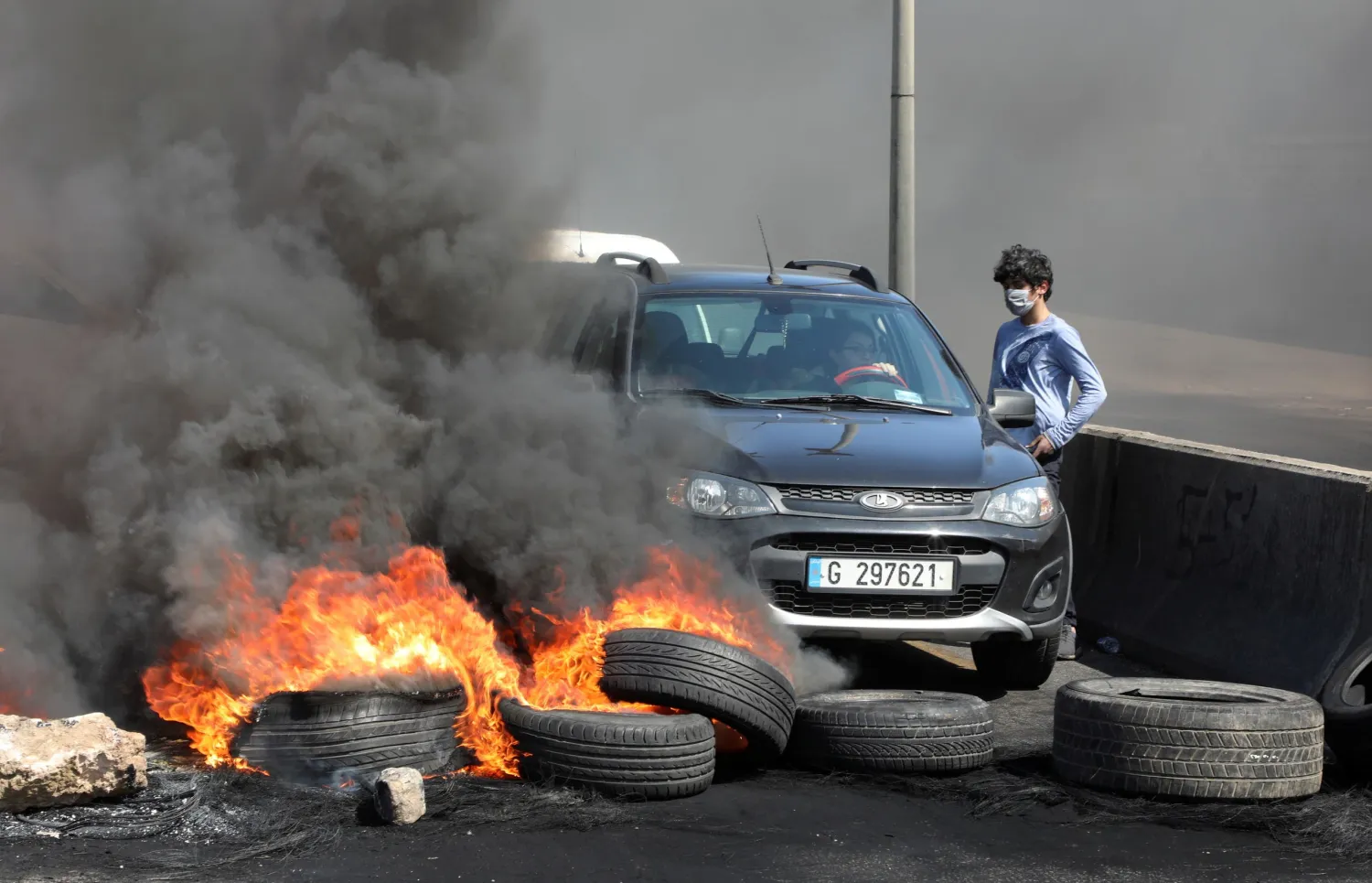
A woman tries to cross a blocked road with burning tires during a protest against the fall in Lebanese pound currency and mounting economic hardships in Khaldeh, Lebanon March 8, 2021. Reuters
TT

With Lebanon in Freefall, What Comes Next?

A woman tries to cross a blocked road with burning tires during a protest against the fall in Lebanese pound currency and mounting economic hardships in Khaldeh, Lebanon March 8, 2021. Reuters

Lebanon's worst economic downturn in decades has pushed a battered population to the brink with no solution in sight as the country's barons wrangle over forming a new government.

In the absence of a fully functioning executive that can spearhead reforms and provide the most basic of services, is a rescue on the horizon?

- Why are protesters back? -

Conditions in Lebanon have deteriorated since the protesters first took to the streets in 2019 demanding the removal of a political leadership deemed inept and corrupt.

The coronavirus pandemic and a powerful August 4 explosion in Beirut port that disfigured the heart of the capital and prompted prime minister Hassan Diab to resign have aggravated the country's economic woes.

The Lebanese pound, officially pegged at 1,507 to the greenback since 1997, has lost almost 90 percent of its value on the black market.

It was changing hands for up to 15,000 to the dollar on Tuesday, an all-time low.

The depreciation has sparked soaring inflation and chipped away at the purchasing power of a population denied full access to their savings by stringent banking controls.

This prompted a new wave of protests across Lebanon in March after the novel coronavirus temporarily snuffed out demonstrations last year.

Activists took aim at the government, which has tried to soften the punch by subsidizing basic goods and prosecuting money exchangers accused of manipulating the market.

But this has done little to stem the currency crisis while central bank reserves diminish by the day.

In March last year, the government defaulted on its foreign debt for the first time.

- What's delaying a new government? -

Spearheaded by France, the international community is piling pressure on authorities to form a new government quickly.

But more than seven months after Diab resigned, politicians have yet to agree on a new line-up.

Prime minister-designate Saad Hariri and President Michel Aoun have accused each other of obstruction.

According to Lebanese media reports, Aoun and the political party he founded are pushing for a big share of cabinet seats -- a demand Hariri has rejected.

Aoun has denied the accusations.

An Arab diplomatic source in Beirut said "the behavior of political parties and their calculations, which don't seem to have changed", suggest "there is obstruction from all sides that could last months".

"We presented many solutions, but they were turned down," the source told AFP on condition of anonymity.

Nasser Yassin of the American University of Beirut accused authorities of being tone deaf.

"As we move towards the abyss, there is a great political crisis, with each side trying to see how to secure gains before total collapse," he told AFP.

Public institutions, meanwhile, are not capable of carrying out "the most basic of tasks".

- A 'failed state'? -

Over the past week, members of Lebanon's outgoing government have sounded the alarm.

Interior minister Mohammad Fahmi said security has "crumbled" as crime rates soar.

Energy minister Raymond Ghajar warned of "total darkness" by the end of the month if funds are not made available to import fuel.

Education minister Tarek Majzoub announced a week-long suspension of teaching in public schools in protest over the lack of state support for pupils and teachers hit by the economic crisis.

The army chief has complained of budget cuts and several professional associations have threatened strikes.

"We have not yet reached the level of a failed state," Yasin said. "But the state's ability to survive is diminishing by the day."

- Any solutions in sight? -

There are no quick fixes but economists argue a turnaround is still possible.

"The problem is that we have yet to start with a rescue plan," said Yasin.

International donors have conditioned aid on the implementation of a reform program that could save the economy.

Diab's government last year announced a rescue roadmap that includes spending cuts, electricity sector reform, restructuring the banking sector and lifting the dollar peg.

But it has yet to be implemented.

"A future government that doesn't meet the standards of the international community... will not likely enact the reforms needed to receive financial support," the Arab diplomatic source warned.

Lebanon began talks with the International Monetary Fund last year but they quickly hit a wall over lack of political consensus over the reforms needed.

Henri Chaoul, who was part of the government's IMF negotiating team befoe he resigned in protest, said officials were to blame for the currency crisis.

"All of this was preventable," he said on Twitter last week when the pound hit 12,000 to the greenback.

"They are responsible for this," he added, referring to politicians and central bankers as well as the commercial banks.


Israeli Minister Says Army will Occupy All Gaza if Hamas Does Not Disarm

Israeli Finance Minister Bezalel Smotrich visits Nariman House to pay his respects to the victims of the 26/11 Mumbai terror attacks, in Mumbai, India, 09 September 2025. EPA/DIVYAKANT SOLANKI
TT

Israeli Minister Says Army will Occupy All Gaza if Hamas Does Not Disarm

Israeli Finance Minister Bezalel Smotrich visits Nariman House to pay his respects to the victims of the 26/11 Mumbai terror attacks, in Mumbai, India, 09 September 2025. EPA/DIVYAKANT SOLANKI

Israeli far-right Finance Minister Bezalel Smotrich said Monday that Palestinian Islamist group Hamas may soon be given a deadline to lay down its weapons.

"We estimate that in the coming days, Hamas will be given an ultimatum to disarm and completely demilitarise Gaza," Smotrich said in an interview with public broadcaster Kan, AFP reported.

Israel invaded the Gaza Strip in 2023, in retaliation for Hamas's unprecedented October 7 attack.

Under the first phase of a US-sponsored ceasefire in Gaza intended to halt two years of war, the Israeli army withdrew to positions behind a so-called Yellow Line, but still controls over half of the territory.

Both Hamas and Israel accuse each other of near-daily ceasefire violations, with the health ministry in Gaza reporting 615 people killed by Israeli forces since the truce started.

The Israeli military says it has lost five of its soldiers during the same period.

If Hamas does not comply with the Israeli ultimatum to disarm, the army "will have international legitimacy and American backing to do it itself, and the (military) is already preparing for this and is making plans", said the minister, who is a member of Israel's security cabinet charged with approving large-scale military operations.

The second ceasefire phase, which officially began last month, calls for a gradual withdrawal of the Israeli army and the disarmament of Hamas, which the militant group has vehemently opposed.

"The (Israeli military) will definitely enter and occupy Gaza if Hamas does not disarm," Smotrich said.

Asked how the military would do this, he said "there are two or three alternatives right now that we are examining".

The peace plan put forward by US President Donald Trump also calls for the establishment of a 20,000-strong peacekeeping force, called the International Stabilisation Force (ISF), to which several countries have committed troops.

Asked how the Israeli army would operate against Hamas when foreign soldiers were deployed on the ground, Smotrich said the latter would "pull out very quickly and allow the (Israeli military) to enter. This is coordinated with the Americans."

"By the way, I don't yet see them going in that fast," he added of the ISF.

A security source in Gaza, meanwhile, said on Monday that Israeli forces shelled Beit Lahia in the north.

The source also said that Israeli tanks opened fire in the south Gaza city of Khan Younis, where at least two air strikes were also conducted.

Israel's military said Monday that Israeli troops "eliminated" a fighter who had crossed the Yellow Line into Israeli-held territory the previous day.


Four Syrian Security Personnel Killed in ISIS Attack

FILE PHOTO: A member loyal to the Islamic State waves an ISIS flag in Raqqa, Syria June 29, 2014. REUTERS/Stringer/Files
TT

Four Syrian Security Personnel Killed in ISIS Attack

FILE PHOTO: A member loyal to the Islamic State waves an ISIS flag in Raqqa, Syria June 29, 2014. REUTERS/Stringer/Files

Four Syrian security personnel were killed in ISIS terrorist group attack in the northern city of Raqa, which was recently taken by Damascus from Kurdish forces, state media reported on Monday.

Syria's interior ministry said in a statement that the "terrorist attack" targeted a checkpoint in the area, adding that one of the assailants was killed, AFP reported.

In its spokesperson's first audio message in two years, ISIS had called on its militants Saturday to fight Syrian authorities.


Israeli Settlers Torch and Deface a West Bank Mosque during Ramadan

People check a fire-damaged area in the Abu Bakr al-Siddiq Mosque following, according to Palestinian authorities, an attack by Israeli settlers on the West Bank village of Tell, near Nablus, Monday, February 23, 2026. (AP Photo/Majdi Mohammed)
TT

Israeli Settlers Torch and Deface a West Bank Mosque during Ramadan

People check a fire-damaged area in the Abu Bakr al-Siddiq Mosque following, according to Palestinian authorities, an attack by Israeli settlers on the West Bank village of Tell, near Nablus, Monday, February 23, 2026. (AP Photo/Majdi Mohammed)

Israeli settlers vandalized a mosque in the Israeli-occupied West Bank early Monday, spray-painting offensive phrases and setting a fire, according to the Palestinian Authority’s Ministry of Religious Affairs.

Worshippers arriving for the day's first prayers found the damage and a smoldering fire that spewed black smoke across the entrance of the Abu Bakr Al-Siddiq Mosque in the town of Tell, near Nablus, and stained the ornate doorway.

“I was shocked when I opened the door," said Munir Ramdan, who lives nearby. "The fire had been burning here in the area, the glass was broken here and the door was broken.”

Security camera footage showed two people walking toward the mosque carrying gasoline and a can of spray paint, and running away a few minutes later, Ramdan said, The AP news reported.

The attackers spray-painted graffiti denigrating the Prophet Muhammad, as well as the words “revenge” and “price tag.” In “price tag” attacks, hard-line Israeli nationalists attack Palestinians and vandalize their property in response to Palestinian militant attacks or perceived efforts by Israeli authorities to limit settlement activity.

The ministry said settlers vandalized or attacked 45 mosques in the West Bank last year.

The latest incident occurred as Muslims observe the holy month of Ramadan.

“The provocation is directed especially at the person who is fasting, because you are fasting and entering a month of mercy and forgiveness from God,” said Salem Ishtayeh, a resident of Tell. “So they like to provoke you with words. It’s not that they are attacking you personally, they are attacking your religion, the Islamic faith.”

The Israeli military and police said they responded to the incident and were searching for suspects. The military said it “strongly condemns” harm done to religious institutions.

Palestinians and rights groups say Israeli authorities routinely fail to prosecute settlers or hold them accountable for violence.

There has been a recent surge in violence by settlers against Palestinians in the West Bank. Last week, settlers killed a Palestinian-American man, Nasrallah Abu Siyam.

According to information released by Israel's military last month, there were 867 attacks by settlers against Palestinians and security forces in 2025, an increase of 27% over 2024.

The number of serious settler attacks including shootings, arson and other violent crimes has increased sharply each year since far-right politician Itamar Ben-Gvir, who spent his law career defending Jews who attacked Palestinians, became national security minister. The number of serious attacks increased from 54 in 2023 to 83 in 2024 and 128 in 2025.
