


Merit Magazine Explores War and Its Effect on Iraqi Story

Merit Magazine Explores War and Its Effect on Iraqi Story
TT

Merit Magazine Explores War and Its Effect on Iraqi Story

Merit Magazine Explores War and Its Effect on Iraqi Story

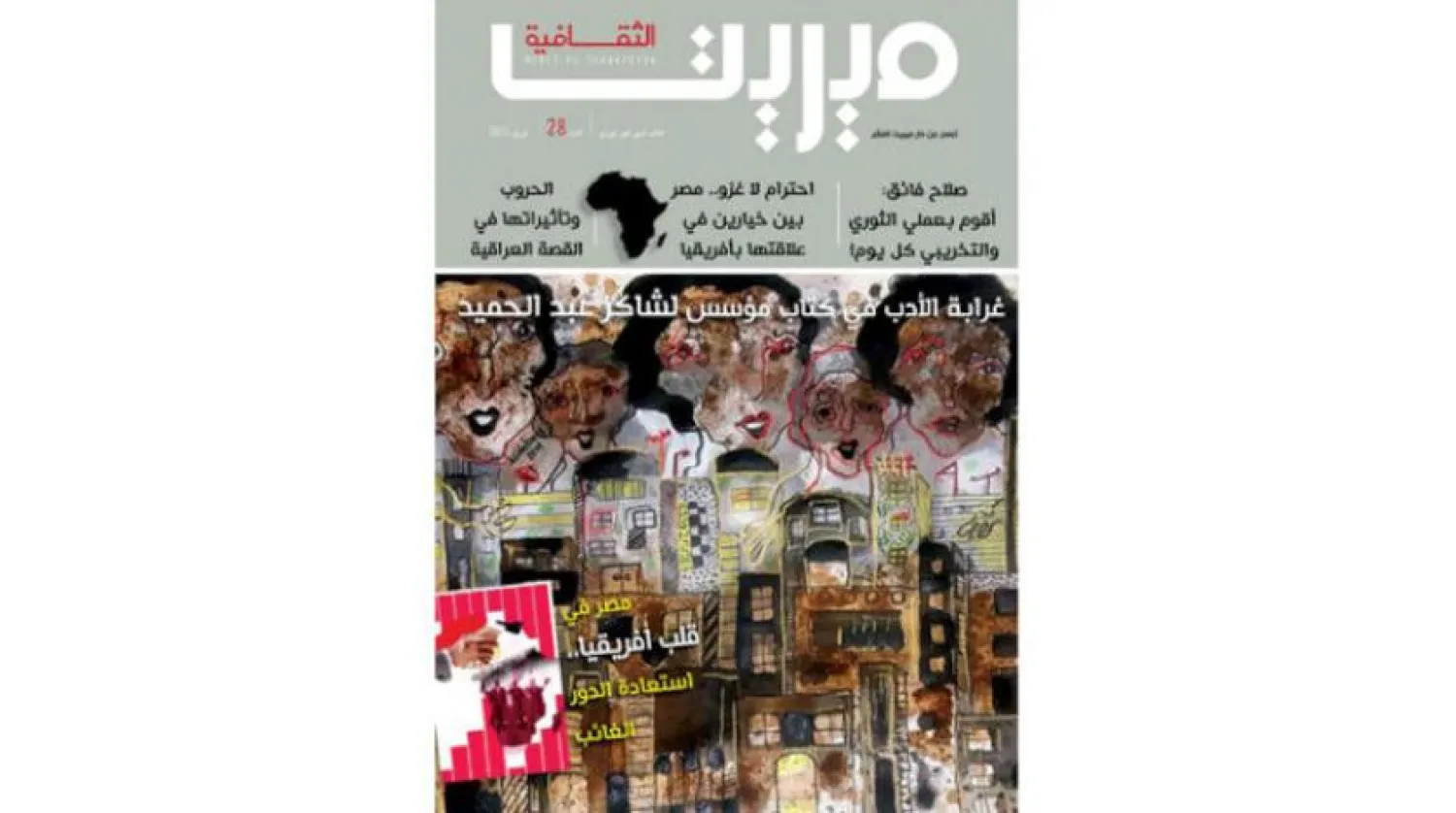
The April issue of the Merit Cultural Magazine published by the Merit publishing house, Cairo, features a series of critical articles, and major literary and artistic contributions.

The "Creation and Creators" section includes an article by Dr. Amani Fouad on Dr. Shaker Abdul Hamid's book "Alienation…Concept, and Expression in Literature", in addition to five other articles by Novelist Tarek Imam on Poet Hamad Yamani's poetry collection "Goodbye in Small Triangle"; "Praise, an Arab Cultural Mark" by Dr. Ahmed Yahia Ali; "The Egyptian Revolution" by Dr. Ahmed Alwani; a reading on Mohamed al-Mansi Kandil's "Doctor of the Countryside" by Poet Rasha al-Fawal; and "Dialectic of the I and the Other in the Arab Novel" by Moroccan researcher Mohammed al-Sahel.

The Poetry Section features ten poems by Najat Ali, Zizi Shoushah, Naji Abdul Latif, Said Abdul Maksoud, Mohammed Tawfik, Rida Ahmad, Dima Mahmoud, Abir Zaki, Mohammed Husni Ibrahim, and Mohammed Ali Azab. The Story Section includes stories, chapters, and novels by Raouf Masa'd, Naim Sabri, Mohsen Youness, Hamdi Abu Jalil, Safaa al-Najjar, Mounir Otaiba, Mostafa al-Balki, Abdullah Al-Salama, and Hatem Mamdouh.

The "Noun Al Neswa" section discusses several African matters in two articles entitled "Women in African Life" by Dr. Inas Hussam al-Dine, and "Women in African Theater…Verse to Express Oneself" by researcher Farida Bendari.

The "Around the World" section includes three translations: "Introduction to Prose Poem" by American poet and novelist Peter Johnson translated by Dr. Adel Dergham; "The Beaudelairean Theater", an article written by French intellect Rolland Barthes translated by Tunisian poet Abdul Wahab al-Melawah; and five poems written by Lebanese-American poet Hayan Charara translated by Palestinian poet Dr. Helmi al-Risha.

The section "Cultures and Arts" offers an interview by Poet Samar Lashin with Iraqi poet Salah Fayeq. It also includes three important articles: "Wars and their Effects on the Iraqi Story" by Dr. Nadia Hinawi (Iraq); "Writing with the Hidden and Obvious Language…Reading on Stories of Mahmoud Abdul'al" by Dr. Hassan Atiah Taman; and "Writing of Academic Research Papers" by Dr. Ali Afifi Ali Ghazi.

In the "Art" section, Dr. Manal Al Boustani (Iraq) wrote "A reading of the Displacement Mural" exploring a mural by Iraqi Artist Mowaffak Ahmed, in addition to two other articles: "Architecture and Cinema" by Alaa Halifi (Morocco) and "Omraniya Youth Embrace Hamlet" by Dr. Fawzi al-Shami discussing the role of actor Mohammed Sobhi in the interaction between the art academy and its surrounding in the Omraniya neighborhood

The "Books" section includes three readings: "Transcendent Text in Works of Hassan al-Nassar" by Dr. Mohammad Ahmad Abdul Radi; "From the pictures of death in the poetry collection of Wadad Nabi's Death as if it was Junk" by Abduallah al-Mutaki (Morocco); and a news story about "The Dry Land and its Interference with the Human Heritage", a book by Iraqi poet Fadel al-Sultani.

The issue also offers studies of six Arabic translations of a famous poem by English poet T.S. Eliot.

The editing board of Merit Cultural Magazine is composed of Publisher Mohammed Hashem, Editor in Chief Poet Samir Darwish, Assistant Editor Adel Samih, and Editor Secretary Sara al-Iskafi. The paintings featured inside the magazine and on its cover are done by Jordanian artist Hilda Hiari..



Diriyah Art Futures to Launch 'Of the Earth: Earthly Technologies to Computational Biologies' Exhibition 

Diriyah Art Futures to Launch 'Of the Earth: Earthly Technologies to Computational Biologies' Exhibition 
TT

Diriyah Art Futures to Launch 'Of the Earth: Earthly Technologies to Computational Biologies' Exhibition 

Diriyah Art Futures to Launch 'Of the Earth: Earthly Technologies to Computational Biologies' Exhibition 

Diriyah Art Futures (DAF) announced on Wednesday the opening date of its fourth major exhibition, titled "Of the Earth: Earthly Technologies to Computational Biologies."

The exhibition will run in Diriyah from January 14 to May 16.

Curated by DAF’s Director of Exhibitions Irini Papadimitriou, the exhibition is organized into four thematic areas. It examines how technology is often viewed as a tool for controlling nature, while also addressing the environmental impact of digital systems on a planet with finite resources. The artworks will showcase how these technologies are constructed from the earth's own materials.

The collaborations between art, technology, and science provide creative ways to address urgent issues and challenge technological power structures. They propose pathways toward caring ecosystems, reimagining technology shaped by interspecies, collective, and planetary intelligence that serves more than just human needs.

A public program featuring panel discussions, practical workshops, and masterclasses will accompany the exhibition.


France's Louvre Museum Remains Shut as Workers Extend Strike

FILED - 07 December 2018, France, Paris: A View of the inner courtyard with the glass pyramid of the Louvre Museum in Paris. Photo: Christian Böhmer/dpa
TT

France's Louvre Museum Remains Shut as Workers Extend Strike

FILED - 07 December 2018, France, Paris: A View of the inner courtyard with the glass pyramid of the Louvre Museum in Paris. Photo: Christian Böhmer/dpa

Staff at France's Louvre museum in Paris on Wednesday unanimously voted in favor of extending a strike over pay and working conditions that began on Monday, leaving the world's most visited museum closed until further notice.

The museum is routinely closed on Tuesdays.

The strike comes after a spectacular jewel heist in October, as well as recent infrastructure problems, including a water leak that damaged ancient books, which have exposed glaring security gaps and revealed the museum's deteriorating state.

Unions have said that staff at the Louvre are overworked and mismanaged, and they are calling for more hiring, pay increases and a redirection of spending.

Louvre director Laurence des Cars, who has faced intense criticism since burglars in October made off with crown jewels worth 88 million euros ($103.14 million), is due to answer questions from the French Senate on Wednesday afternoon. 

Des Cars has acknowledged an “institutional failure” following the heist but has come under renewed scrutiny after admitting she only learned of a critical 2019 security audit after the robbery.

France’s Court of Auditors and a separate administrative inquiry have since criticized delays in implementing a long-promised security overhaul.

The Culture Ministry announced emergency anti-intrusion measures last month and assigned Philippe Jost, who oversaw the Notre Dame restoration, to help reorganize the museum. The move was widely seen as a sign of mounting pressure on Louvre leadership.


New Rome Metro Stations Showcase Ancient Treasures After Years of Delays

People examine artifacts on display during the inauguration of the Colosseo Fori Imperiali stop on Metro Line C in Rome, Italy, 16 December 2025. (EPA)
TT

New Rome Metro Stations Showcase Ancient Treasures After Years of Delays

People examine artifacts on display during the inauguration of the Colosseo Fori Imperiali stop on Metro Line C in Rome, Italy, 16 December 2025. (EPA)

After years of delays and spiraling costs, Rome inaugurated two new metro stations on Tuesday, including one by the Colosseum, showcasing archaeological discoveries that might become tourist attractions in their own right.

The driverless Metro C line now stretches from the Italian capital's eastern suburbs to Porta Metronia and the Colosseum, extending its reach into the historic city center.

Future plans will take it even deeper under Rome's baroque heart, beneath the river Tiber and onto the Vatican, though the next stop at Piazza Venezia is not expected to open before 2032.

Excavations for the new stations revealed remarkable finds, which slowed work as archaeologists painstakingly preserved layers of ancient Rome they hadn't known were there.

At Porta Metronia, drilling rigs uncovered a military barracks dating back 2,000 years, as well as a residential house, complete with frescoed rooms and mosaics, which are preserved in a museum within the station.

During the Colosseum excavations, workers discovered 28 ancient wells and hundreds of everyday artifacts, including hairpins, oil lamps, irrigation pipes, knives, and statues, many of which are on show.

"These two stations will travel around the world," Transport Minister Matteo Salvini said on Tuesday, predicting they would soon flood social media.

"Beyond serving commuters and Romans, anyone who comes here from Italy or from abroad will stop in these stations. They might take the metro even if they don't need it, just to enjoy the ride," he added.

LONG DELAYS, COST HIKES

Rome's Metro C was meant to link the city's two main Basilicas by the year 2000. Instead, the line only reached the imposing San Giovanni Basilica in 2018, and the Vatican station near St. Peter's Basilica won't be ready for at least another decade.

The initial plan to build 24 stations to the Colosseum was priced at 2.23 billion euros ($2.63 billion), but costs have surged past 3 billion euros, and the entire line could exceed 6 billion by the time the final seven stations are completed.

Engineers say Rome is among the most challenging cities in the world for metro construction, due to buried archaeological sites that require safeguarding and concerns that vibrations could damage the heritage above ground.

At the next stop, at Piazza Venezia, a construction team is digging an 85-meter deep (280 feet) ring around the site which will be filled with reinforced concrete to protect the six underground floors of the station that are being dug out.

Rome Mayor Roberto Gualtieri said it was worth the effort.

"Without these major works, we would never have discovered the barracks at Porta Metronia, we would never have found these wells, and today we would have known far less about our extraordinary past," he said.

Metro C is intended to carry 600,000 passengers a day, easing Rome's notorious traffic and speeding tourists between major landmarks. At present it carries 41,000 daily, but the new openings should see numbers climb.