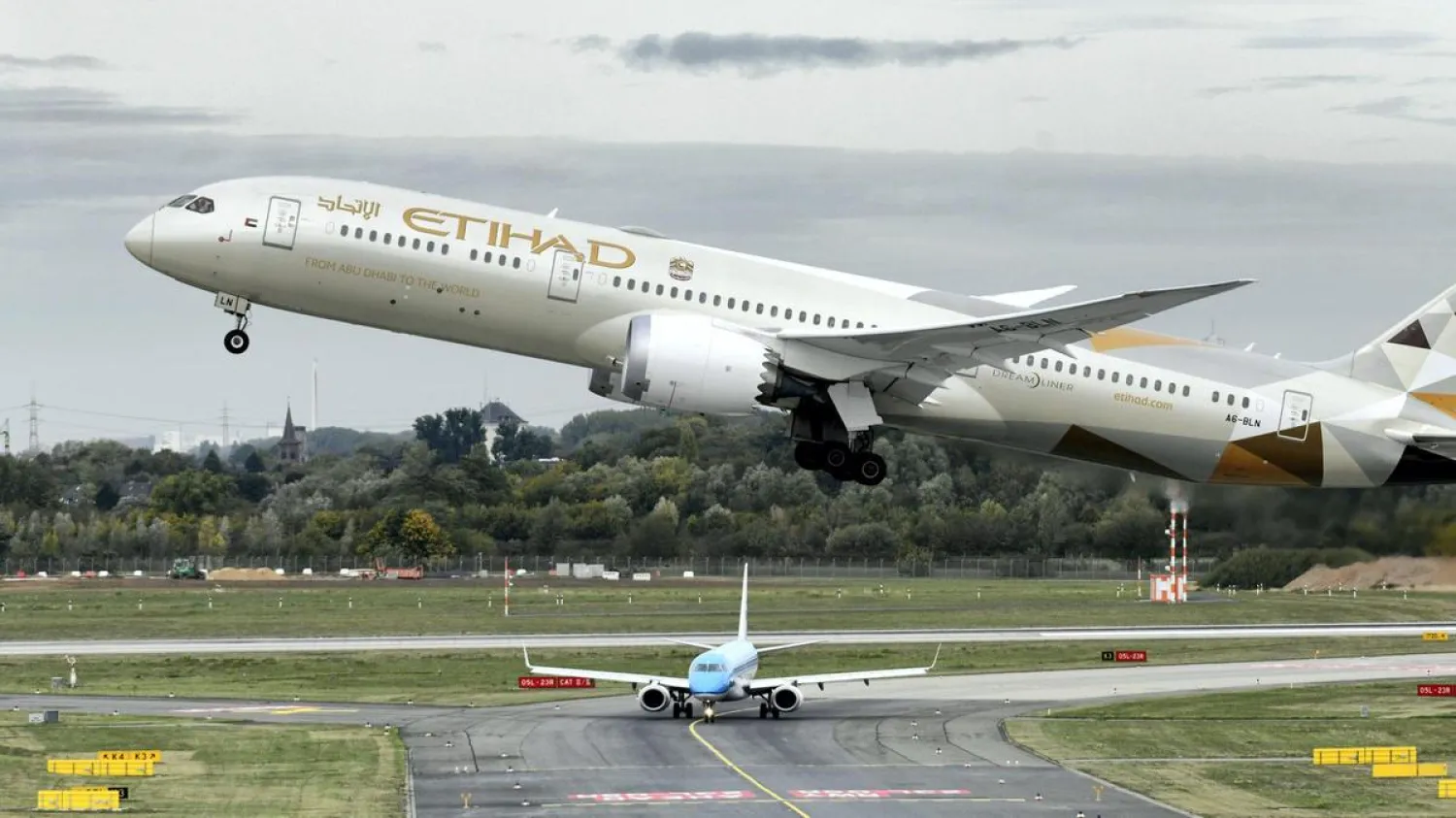
UAE Airlines Etihad, flydubai Cancel Tel Aviv Flights

UAE carriers Etihad Airways and flydubai have canceled flights to Tel Aviv due to escalating hostilities in Israel. (AFP)
TT

UAE Airlines Etihad, flydubai Cancel Tel Aviv Flights

UAE carriers Etihad Airways and flydubai have canceled flights to Tel Aviv due to escalating hostilities in Israel. (AFP)

UAE carriers Etihad Airways and flydubai have canceled flights to Tel Aviv, joining American and European airlines in avoiding Israel due to escalating hostilities there.

Airlines in the UAE, which established diplomatic relations with Israel last year, have only in the past few months launched regular services to Israel.

Abu Dhabi’s Etihad has suspended all passenger and cargo services to Tel Aviv from Sunday, it said on its website, citing the conflict.

“Etihad is monitoring the situation in Israel and continues to maintain close contact with authorities and security intelligence providers,” it said.

Flydubai has also canceled flights from Dubai on Sunday, its website shows, though two flights operated on Saturday. Other flights are scheduled for next week, according to its website.

The airline has recently operated fewer than its scheduled four daily flights, citing a drop in demand.

Armed Palestinian groups have repeatedly shelled the Tel Aviv area during hostilities that erupted on Monday, leading to several airlines canceling flights this week.


Oil Falls More Than 5% and World Shares Gain Over Possible de-escalation of Iran War

A man fills his car with petrol at the petrol station in Port Dickson, Negri Sembilan, Malaysia, 25 March 2026. EPA/FAZRY ISMAIL
TT

Oil Falls More Than 5% and World Shares Gain Over Possible de-escalation of Iran War

A man fills his car with petrol at the petrol station in Port Dickson, Negri Sembilan, Malaysia, 25 March 2026. EPA/FAZRY ISMAIL

Oil prices fell more than 5% and world shares gained on Wednesday over the possibility of a de-escalation of the Iran war and negotiations between the United States and Iran. US futures were up 0.9%.

In early European trading, Britain's FTSE 100 rose 1% to 10,072.60. France's CAC 40 was up 1.4% to 7,855.31, while Germany's DAX was 1.6% higher at 22,989.80.

Tokyo’s Nikkei 225 was up 2.9% to 53,749.62. South Korea’s Kospi gained 1.6% to 5,642.21.

Hong Kong’s Hang Seng rose 1.1% to 25,335.95, while the Shanghai Composite index was 1.3% higher at 3,931.84. Labubu doll maker Pop Mart's Hong Kong-listed shares fell 22.5%, after it announced annual revenue for last year that was largely in line with analysts’ estimates.

Australia’s S&P/ASX 200 climbed 1.9%. Taiwan’s Taiex was up 2.5%.

US President Donald Trump's claims of progress being made from talks with Iran this week and his postponement on Monday of a deadline to “obliterate” Iran’s power plants over the reopening of the Strait of Hormuz have also fueled optimism that an end to the Iran war could come soon.

Trump's administration has offered a 15-point ceasefire plan to Iran, but an Iranian military spokesperson mocked the US’ attempt at a ceasefire deal Wednesday.

With the Strait of Hormuz being a key waterway for crude oil and liquefied natural gas transport, oil and gas prices have spiked and fluctuated in recent days.

Oil prices fell again on growing hopes for a de-escalation. Brent crude, the international standard, fell 5.2% to $94.97 per barrel. It was around $104 on Tuesday.

Benchmark US crude was down 5.3% early Wednesday to $87.44 a barrel.

While Iran has denied negotiations were taking place, and attacks in the Middle East continued, Pakistan has offered to host talks between Washington and Tehran. And as Trump raised optimism of a de-escalation of the war, at least 1,000 more American troops from the 82nd Airborne Division are said to be deployed to the Middle East in the coming days.

On Tuesday, US stocks closed lower. The S&P 500 lost 0.4% to 6,556.37. The Dow Jones Industrial Average edged down 0.2% to 46,124.06, while the Nasdaq composite was 0.8% lower to 21,761.89.

Shares of Estee Lauder sank more than 9%, following confirmation that the US-listed company is in merger talks with Spanish beauty and perfume group Puig.

In other dealings early Wednesday, gold prices resumed its rise after falling earlier. It dropped in part because of rising US Treasury yields over dimming expectations of a Federal Reserve rate cut after the spike in oil prices threatened to fuel global inflation.

The price of gold was up 3.6% early Wednesday to $4,561.90 per ounce. It was above $5,000 earlier this month.

The US dollar was at 158.84 Japanese yen, up from 158.69. The euro was trading at 1.1602, down from $1.1608.


Yanbu Port Secures 4 Million Barrels of Oil Per Day for Global Markets

A satellite image captured by Planet Labs shows oil infrastructure at Yanbu Port on Saudi Arabia’s Red Sea coast on March 4, 2026 (AFP)
TT

Yanbu Port Secures 4 Million Barrels of Oil Per Day for Global Markets

A satellite image captured by Planet Labs shows oil infrastructure at Yanbu Port on Saudi Arabia’s Red Sea coast on March 4, 2026 (AFP)

Yanbu Port on the Red Sea has emerged as a vital hub for international trade, stepping in to stabilize global energy and commodity supplies amid the near-total closure of the Strait of Hormuz due to the Iran conflict and ongoing military tensions.

In a move underscoring Saudi Arabia’s infrastructure readiness, oil exports through the port have surged to nearly 4 million barrels per day, marking a historic increase aimed at easing global shortages and ensuring steady supply to international markets.

At the center of this transformation is the East-West Pipeline, a strategic artery stretching across the Arabian Peninsula. The pipeline transports crude oil from the Kingdom’s vast eastern fields to Yanbu Industrial City, enabling Saudi Arabia to reroute nearly half of the shipments that would normally pass through the Strait of Hormuz. According to Reuters, flows peaked at 4.19 million barrels per day.

The surge has placed operational pressure on Yanbu Port, where around 40 oil tankers are currently waiting offshore, despite the port’s capacity to handle only four supertankers at a time.

Saudi Aramco, the world’s largest oil exporter, is leveraging this route to offset supply disruptions. On March 10, the company confirmed it could pump up to 7 million barrels per day to Yanbu via the pipeline, with roughly 5 million barrels available for export and the remainder allocated to domestic refining.

Data from Kpler shows Saudi crude exports exceeded 7 million barrels per day in February. In March, exports via Yanbu averaged about 2.9 million barrels per day, significantly higher than the 770,000 barrels recorded in January and February. During the week beginning March 16, exports climbed further to nearly 4 million barrels per day, with expectations of continued growth.

Shipping markets have responded swiftly. Freight rates for transporting Saudi crude from the Red Sea to Asia have declined in recent weeks after an initial spike above $450,000 per day. The influx of tankers into Yanbu has increased supply, easing price pressures and improving cost competitiveness.

The steady flow of shipments has also strengthened supply reliability for key Asian importers, including South Korea, Japan, and China, reinforcing confidence in Saudi Arabia’s logistical capabilities.

Beyond energy, Saudi Arabia has expanded its role in safeguarding regional supply chains.

The Transport General Authority has issued additional licenses to Saudi Arabia Railways (SAR), boosting container capacity to over 2,500 units daily. A newly launched land corridor linking Dammam to Sharjah, supported by thousands of trucks, has further enhanced trade flows across the Gulf.

With these measures, Saudi Arabia has positioned itself as a critical lifeline for global trade, ensuring stability amid ongoing geopolitical disruptions.


Türkiye Says its Mideast Oil Dependence Manageable at 10% Amid War

16 March 2026, Türkiye, Istanbul: Oil tankers and cargo ships transit the Bosphorus Strait in Istanbul. Photo: Tolga Ildun/ZUMA Press Wire/dpa
TT

Türkiye Says its Mideast Oil Dependence Manageable at 10% Amid War

16 March 2026, Türkiye, Istanbul: Oil tankers and cargo ships transit the Bosphorus Strait in Istanbul. Photo: Tolga Ildun/ZUMA Press Wire/dpa

Türkiye's dependence on Middle East oil is at a "manageable" level of 10% of overall supplies and there are no supply problems at the moment despite the Iran ⁠war, Energy Minister ⁠Alparslan Bayraktar said on Wednesday.

Speaking on a state-run Anadolu Agency program, he said the ⁠war had caused a crisis in global energy security and supply, adding that Türkiye, a big energy importer that neighbors Iran, had taken protective diversification steps.

Bayraktar ⁠said ⁠that there had been no gas-supply cuts from Iran yet but added it was a possibility.