


At the US Open, that Voice Yelling ‘Out!’ Comes from a Computer

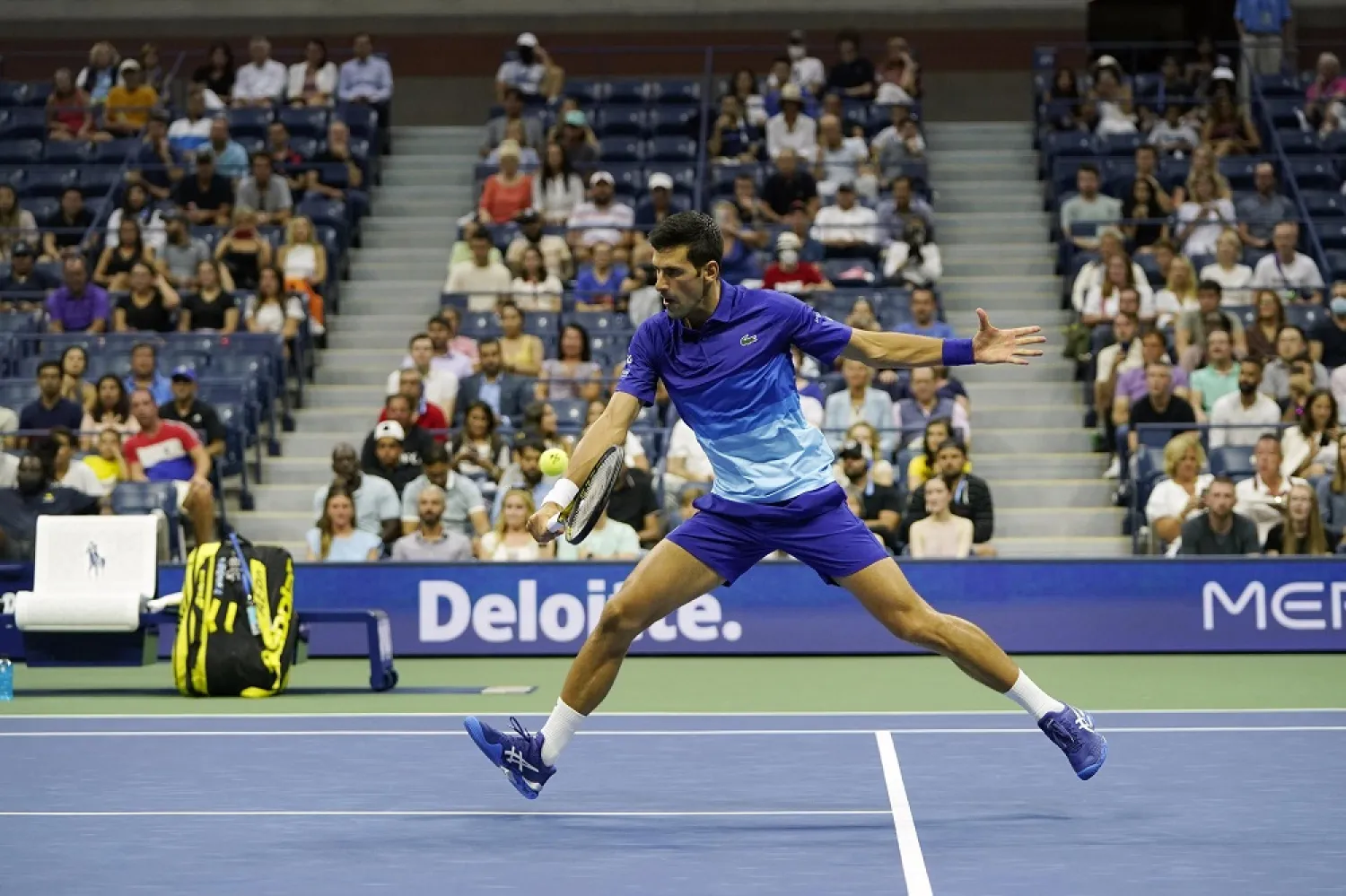
Novak Djokovic, of Serbia, returns a shot during the first round of the US Open tennis championships, Tuesday, Aug. 31, 2021, in New York. (AP)
TT

At the US Open, that Voice Yelling ‘Out!’ Comes from a Computer

Novak Djokovic, of Serbia, returns a shot during the first round of the US Open tennis championships, Tuesday, Aug. 31, 2021, in New York. (AP)

Ash Barty, the No. 1 seed at the US Open, watched on match point as her opponent’s backhand sailed long on Thursday, prompting the familiar sound of a linesman yelling, “Out!”

There was no line judge, however. The call was a recording, triggered after an advanced system of cameras known as “Hawk-Eye Live” tracked the ball until it landed out of bounds.

For the first time, the tennis major has installed electronic line-calling on every court, replacing human judges who were responsible for determining whether, say, a serve travelling at 140 mph touched a line the width of a ruler.

“I didn’t even notice that,” said Chris Foglia, 48, a surgeon from New York, as he and his wife Melissa watched Simona Halep take on Kristina Kucova on Wednesday. “I have very mixed feelings - I like the human element.”

But, a few minutes later, he acknowledged how difficult it was for the naked eye to judge balls struck with the amount of force modern players generate.

“Look at that - it’s ridiculous,” he said, as a replay screen inside Arthur Ashe Stadium showed Kucova had sent a groundstroke long by no more than a few millimeters.

The tournament introduced Hawk-Eye Live on some courts in 2020 partly to reduce on-court personnel due to the coronavirus pandemic, but it kept line judges on its two showcase courts, Ashe and Louis Armstrong Stadium. Prior to that, Hawk-Eye was used only as a replay system when players challenged calls.

Live system
With chair umpires the only on-court officials left, the Open has gone from having a peak of 400 officials to a maximum of around 130, Sean Cary, who oversees officiating for the US Open, said in an interview.

The live system employs a dozen cameras around each court, as well as six additional cameras used solely for foot faults.

“The electronic line-calling is providing a far greater level of accuracy, and therefore it’s providing the players a more equitable playing field,” Cary said.

Hawk-Eye deploys louder, more insistent “out” shouts on close calls, while more obvious ones earn a softer call, mirroring the way human linespeople are trained.

The United States Tennis Association (USTA) recorded judges in a studio making calls, Cary said. Each court can use either male or female voices, ensuring players are not confused by calls made on an adjacent court.

With Hawk-Eye Live in place, players can no longer challenge calls, eliminating one source of dramatic, hold-your-breath moments.

Some fans also pointed out that using the challenges, which were limited, was itself a form of strategy that added a layer of intrigue in tight matches. But others said they approved of the change to avoid bad calls that could alter a match’s outcome.

The system means fewer confrontations between players and officials - a change that left some fans nostalgic for the era when John McEnroe became infamous for his profanity-laced tirades on court.

Human element
“I think it’s awesome because they can’t argue,” said Diane Mace, 65, before her 71-year-old husband, Ed, interjected: “And I think it’s not awesome because they can’t argue.”

“It takes away the human element,” he continued. “Arguing puts some emotion into it.”

But such conflicts can also turn ugly. Last year, three-time champion Novak Djokovic was disqualified from the tournament after smashing a ball in anger and inadvertently striking a line judge.

In a 2009 semi-final, Serena Williams threatened to shove a ball down a line judge’s throat after a foot fault, earning a point penalty on match point that ended the contest.

Other sports have grappled with whether to wield technology to reduce human error, with mixed reviews from fans.

Major League Baseball, for instance, is experimenting with automated ball and strike calls in some minor league games this year. Some fans have clamored for “robot umpires,” much to the horror of traditionalists, who view the home plate umpire as essential to baseball’s charm.

In football, the use of a Video Assistant Referee (VAR) has drawn criticism from fans for a lack of consistency.

Cary said the USTA has not made any decisions about Hawk-Eye Live for 2022, though he acknowledged it might be hard to go back to a less accurate system.



Microsoft to Invest $10 bn for Japan AI Data Centers

Microsoft's Vice Chair and President Brad Smith (4th L) and (L-R) Sakura Internet Inc President and CEO Kunihiro Tanaka, SoftBank Corp. President and CEO Junichi Miyakawa, Microsoft Japan President Miki Tsusaka, hold a meeitng with Japan's Prime Minister Sanae Takaichi (2nd R) and Vice Minister of Economy, Trade and Industry Toshiro Ino (R) at the Prime Minister's Office in Tokyo on April 3, 2026. Kazuhiro NOGI / POOL/AFP
TT

Microsoft to Invest $10 bn for Japan AI Data Centers

Microsoft's Vice Chair and President Brad Smith (4th L) and (L-R) Sakura Internet Inc President and CEO Kunihiro Tanaka, SoftBank Corp. President and CEO Junichi Miyakawa, Microsoft Japan President Miki Tsusaka, hold a meeitng with Japan's Prime Minister Sanae Takaichi (2nd R) and Vice Minister of Economy, Trade and Industry Toshiro Ino (R) at the Prime Minister's Office in Tokyo on April 3, 2026. Kazuhiro NOGI / POOL/AFP

Microsoft said Friday it will invest $10 billion in Japan over the next four years to build artificial intelligence data centers and related infrastructure.

Power-hungry data centers -- warehouse-like facilities that power AI tools from chatbots to image generators -- are springing up worldwide, and the sector is growing particularly fast in Asia.

Microsoft President Brad Smith met Japanese Prime Minister Sanae Takaichi at her office on Friday to announce the investment, said AFP.

Smith said in a statement that it was a "response to Japan's growing need for cloud and AI services".

Businesses in Japan, the world's fourth-largest economy, are keen to get ahead in the fast-moving AI field.

But data centers expansion there is constrained by limited space and relatively expensive electricity.

The US tech giant will collaborate with Japan's SoftBank Group and Sakura Internet to expand domestic tech infrastructure, it said in a press release.

It follows a $2.9 billion two-year investment Microsoft announced in 2024 to bolster the country's push into AI and strengthen its cyber defenses.

The investment unveiled Friday also includes funds to enhance cybersecurity partnerships with Japanese government agencies, and to train one million engineers in cooperation with telecom and tech giants NTT and NEC.

A rush to build data centers in the Asia-Pacific region, especially in India and Southeast Asia, has sparked concerns over the facilities' environmental impact.

That includes increased demand on electricity grids that are often reliant on fossil fuels, and on local water supplies used to cool the hot servers inside.

Microsoft says it has pledged to become carbon negative, zero-waste and "water positive" by 2030.

On Tuesday, the company announced plans to invest more than $1 billion in cloud and AI data center infrastructure and operations in Thailand over the next two years.


Kia to Sell Lower-priced Electric Vehicle in US

A KIA logo on an electric vehicle is seen on display at the Canadian International AutoShow in Toronto, Ontario, Canada, February 13, 2025. REUTERS/Carlos Osorio
TT

Kia to Sell Lower-priced Electric Vehicle in US

A KIA logo on an electric vehicle is seen on display at the Canadian International AutoShow in Toronto, Ontario, Canada, February 13, 2025. REUTERS/Carlos Osorio

Kia said Wednesday it will begin selling a lower-priced electric vehicle in the United States later this year as automakers work to recharge EV sales.

The Korean automaker said at the New York Auto Show it will offer the EV3 in the US market starting later this year, Reuters reported.

Automakers are facing a tougher EV market in the United States after Congress repealed the $7,500 EV tax credit last year but higher gasoline prices in recent weeks has prompted new interest in the EVs.


Passengers Stranded in Moving Traffic after Robotaxi Outage in China

This file photo taken on August 1, 2024 shows a general view of a driverless robotaxi autonomous vehicle developed as part of tech giant Baidu's Apollo Go self-driving project, in Wuhan, in central China's Hubei province. (Photo by PEDRO PARDO / AFP)
TT

Passengers Stranded in Moving Traffic after Robotaxi Outage in China

This file photo taken on August 1, 2024 shows a general view of a driverless robotaxi autonomous vehicle developed as part of tech giant Baidu's Apollo Go self-driving project, in Wuhan, in central China's Hubei province. (Photo by PEDRO PARDO / AFP)

Some robotaxi passengers were left stranded in the middle of fast-moving traffic in a major Chinese city after their driverless vehicles stopped running, according to police and media reports on Wednesday.

A preliminary investigation indicates more than 100 robotaxis came to a halt because of a “system malfunction,” police in the city of Wuhan said in a statement, without elaborating. No injuries were reported.

One passenger told Chinese media that their robotaxi stopped after turning a corner. An instruction on a screen read: “Driving system malfunction. Staff are expected to arrive in 5 minutes.” After no one showed up, the passenger pushed an SOS button and was told that staff were on their way. The car door could be opened, so the passenger got out on their own.

It is the first time a mass shutdown of robotaxis has been reported in China, The Associated Press said. In December, many of Waymo’s self-driving cars came to a stop in San Francisco because of a power outage.

The taxis in Wuhan are operated by Baidu, a major Chinese internet and AI company that is expanding its Apollo Go robotaxi business to overseas locations in Europe and the Mideast.

Baidu did not have any immediate comment.

Police said reports that taxis were coming to a halt started coming in around 9 p.m., while media reports said multiple people were rescued.

While some passengers were able to exit their taxis on their own, others were afraid to get out because their vehicle had stopped in the middle lane of a ring road with other vehicles passing on both sides, the reports said. Ring roads are elevated roads without traffic lights designed to move traffic quickly in urban areas.

Baidu operates hundreds of robotaxis in Wuhan, which hosted an early pilot project for the company.