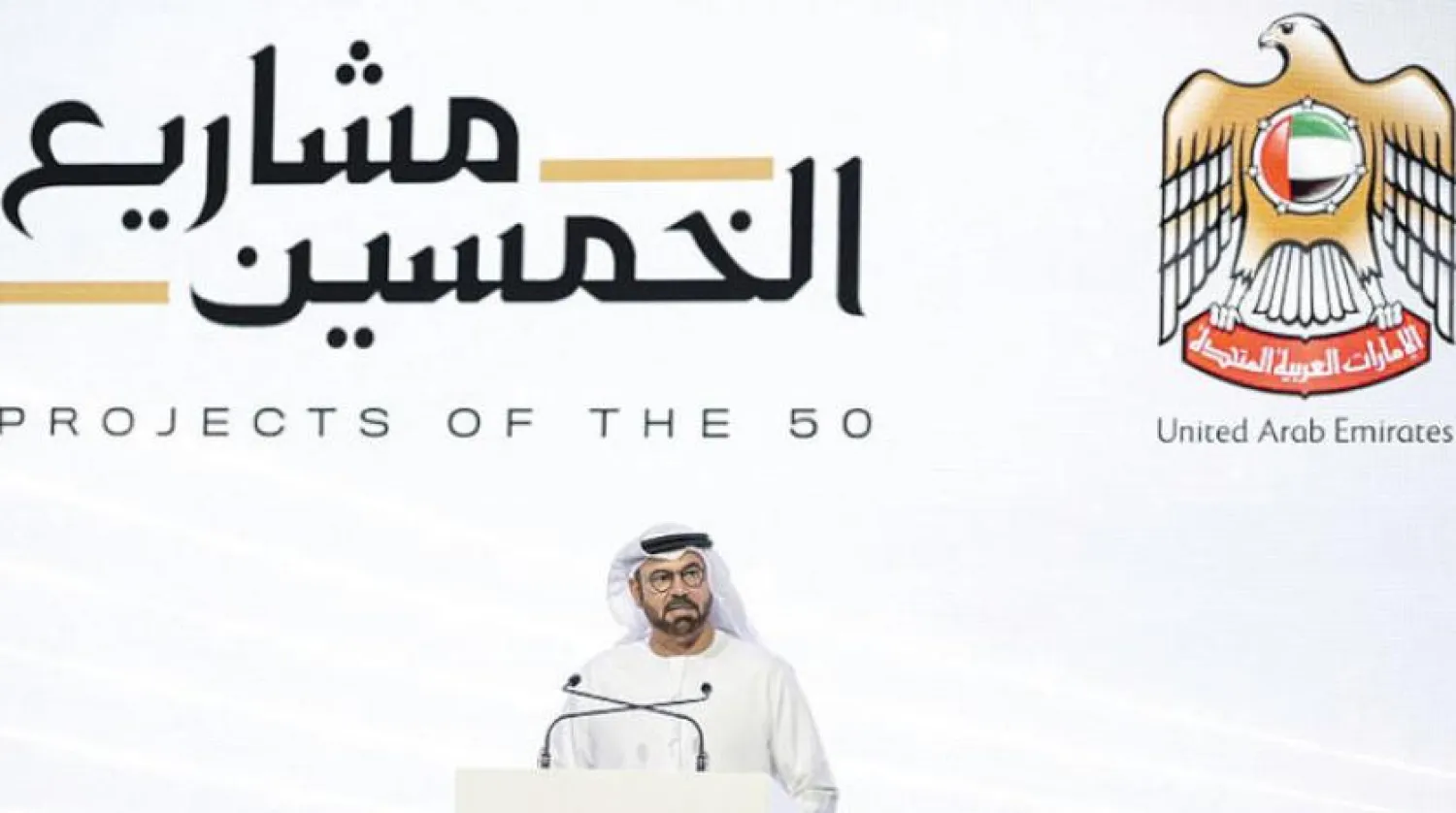
UAE Announces 'Projects of the 50'

Minister of Cabinet Affairs Mohammad Al Gergawi during a press conference Sunday. (Asharq Al-Awsat)
TT

UAE Announces 'Projects of the 50'

Minister of Cabinet Affairs Mohammad Al Gergawi during a press conference Sunday. (Asharq Al-Awsat)

UAE plans to launch 50 new economic initiatives to boost the country's competitiveness and attract 550 billion dirhams ($150 billion) in foreign direct investment in the next nine years, government officials said on Sunday.

The projects, a few of which were unveiled on Sunday, include investing in technology and creating new visas to attract residents and skilled workers.

Among the projects, the UAE and the Emirates Development Bank will invest 5 billion dirhams in industrial technology and technology-heavy sectors, Minister of Industry and Advanced Technology Sultan al Jaber said during a media briefing.

Two new visa categories - one for freelancers and one for entrepreneurs and skilled workers - will be created to attract and retain foreigners with desirable skills, officials said.

The new "green visa" for skilled workers will have more flexibility for sponsoring family members and will allow more time to find a new job after one employment ends, they added.

The 10 x 10 program aims to achieve a 10 percent annual increase in UAE exports to 10 global markets.

Invest.ae is a portal that unites investment-related local entities and 14 economic entities, presenting investment opportunities throughout the UAE.

To boost the UAE’s position as the main gateway for global trade and investment, the government is undertaking comprehensive economic partnership agreements with eight key global markets around the world.

In addition to adopting the National Value Added Program by directing 42 percent of the purchases of federal bodies and major national companies to local markets, it will raise purchases from 35 billion dirhams (9.5 billion dollars) to 55 billion dirhams (14.9 billion dollars) within four years.

The newly launched Project 5Bn will see AED5 billion ($1.3 billion) allocated to support Emirati projects.

The UAE government also launched ‘Tech Drive’, a 5 billion-dirham ($1.3 billion) program to support advanced technology adoption in the industrial sector.

Established in partnership with the Emirates Development Bank, the fund will support the industrial sector’s shift towards the applications of the Fourth Industrial Revolution over the next five years.

Fourth Industrial Revolution Network will seek to grow 500 national companies through the application of advanced technology over five years.

Minister of Cabinet Affairs Mohammad Al Gergawi explained that the vision for the next 50 years is to make the UAE the global capital of investment and economic creativity, an integrated incubator for entrepreneurship and emerging projects, and an advanced laboratory for new economic opportunities.

He stressed how the "Projects of the 50" provides an impetus for investment in the digital and circular economies, and those based on the applications of artificial intelligence and the fourth industrial revolution.

Sarah Al Amiri, Minister of State for Advanced Technology, said that the Smart Industry Readiness Index has been created in partnership with international tech giants and will support the digital transformation of 200 industrial companies after evaluating the efficiency of digital operations.

A leadership strategy has also been created to support industry leaders with 100 business leaders set to receive training initially.

The plan is to create a “smart industry powered by technology”, Amiri said.


Saudi Tourism Development Fund Partnerships Exceed $1.1 Billion  

The view of the Saudi capital, Riyadh. (Asharq Al-Awsat)
TT

Saudi Tourism Development Fund Partnerships Exceed $1.1 Billion  

The view of the Saudi capital, Riyadh. (Asharq Al-Awsat)

The Saudi Tourism Development Fund (TDF) has signed new partnerships with government and private entities with a financial impact exceeding SAR 4 billion ($1.1 billion), as part of its role in expanding financing for small and medium-sized tourism enterprises across the Kingdom.

Speaking to Asharq Al-Awsat, Fahad Al-Ashgar, General Manager of Business Development at TDF, said the fund offers tailored empowerment programs for micro, small, and medium enterprises (MSMEs).

“We have a clear success story,” he said, noting that the fund has financed 2,500 enterprises with the support of its partners in recent years. This financing has helped create and sustain 74,000 jobs in Saudi Arabia’s tourism sector.

Al-Ashgar made these remarks during the Development Finance Conference held last week under the patronage of Crown Prince Mohammed bin Salman, Prime Minister and Chairman of the National Development Fund, as part of the Momentum 2025 platform themed “Leading Development Transformation,” in the Saudi capital.

Empowering tourism

Al-Ashgar added that TDF acts as an enabler of the tourism sector and has signed six agreements under its Tourism Enablement Programs, targeting MSMEs across all regions of the Kingdom.

These initiatives complement the fund’s direct financing, which supports both foreign and domestic investment, in addition to a memorandum of understanding signed with the Small and Medium Enterprises Bank.

Established in 2020, the Tourism Development Fund aims to enable and attract tourism investment and stimulate sectoral development by creating more profitable projects that contribute to developing tourism destinations.

The fund is one of six newly established funds created to support Saudi Vision 2030 goals, according to National Development Fund Governor Stephen Paul Groff in earlier remarks.

TDF CEO Qusai Al-Fakhri said the average annual number of beneficiaries has increased tenfold, while the volume of financing has more than doubled compared to previous years.

The fund goes beyond financing to build an integrated enablement ecosystem that creates new investment opportunities, strengthens development finance, empowers the private sector, and ensures inclusive growth across all regions, enabling MSMEs to contribute to national development, he added.

Partnership details

Recent partnerships include the launch of a new financing program with the Kafalah Program, with a market value estimated at SAR 700 million ($190 million), in cooperation with more than 45 financing entities. Previous collaboration enabled over 2,000 enterprises to obtain financing guarantees exceeding SAR 2 billion ($530 million).

The fund also signed a new SAR 300 million ($80 million) financing agreement with the Arab National Bank, adding to a similar agreement signed last year that benefited 249 enterprises within one year.

TDF confirmed that more than 10,000 enterprises have benefited to date from the Tourism Enablement Programs, as part of broader efforts to increase MSME participation in tourism and diversify projects across the Kingdom, in line with Vision 2030 growth objectives.


Gulf Development Boom Redefines the Consulting Industry

The consulting market in the Gulf is undergoing rapid transformation, driven by rising expectations, intensifying competition, and the pursuit of long-term value (Asharq Al-Awsat). 
TT

Gulf Development Boom Redefines the Consulting Industry

The consulting market in the Gulf is undergoing rapid transformation, driven by rising expectations, intensifying competition, and the pursuit of long-term value (Asharq Al-Awsat). 

The rapid acceleration of development programs across the Gulf, powered by national visions and landmark mega-projects, is transforming not only the region’s economies but also the consulting industry that supports them.

As governments and companies pursue unprecedented scale and ambition, they are increasingly seeking advisory partners capable of delivering measurable impact, practical execution, and long-term capability building, rather than strategies that remain confined to paper.

Recent studies indicate that as investment levels rise and expectations intensify, the central challenge is no longer the formulation of bold strategies, but their translation into tangible economic and institutional outcomes.

This shift has reshaped the consulting landscape, raising the bar for performance at a time when traditional advisory models are no longer sufficient. Clients now demand integrated solutions that generate real change, embed knowledge, and create value that extends well beyond theoretical recommendations.

According to a study by Strategy&, obtained by Asharq Al-Awsat, governments and companies across the region are increasingly prioritizing multidisciplinary expertise that combines global perspective with deep local understanding. In this new environment, a consulting firm’s credibility is defined by its ability to convert recommendations into measurable, on-the-ground results.

Jad Hajj, Managing Director and Regional Leader of Strategy& Middle East, part of the PricewaterhouseCoopers network, said ambitious transformation agendas will remain central to the region’s future.

“What distinguishes the current phase is the growing emphasis on sustainable value,” he said. “Governments and private-sector companies are looking for partners who can deliver outcomes, integrate knowledge transfer across the value chain, and bring a deep understanding of local priorities.”

The sector’s growth has attracted a broader range of players, from specialized local firms and in-house advisory teams within government entities and corporations, to technology companies offering innovative consulting services. This diversification is reshaping the market and intensifying competition. “This environment compels all participants to clearly demonstrate the value they bring,” Hajj added.

Mega-Projects and Integrated Ecosystems

Mega-projects and economic diversification initiatives across the Gulf underscore the importance of value creation in this phase, as they reshape regional economies at scale. The central challenge lies in execution, ensuring that investments translate into lasting economic impact by building integrated ecosystems, strengthening institutional and industrial capabilities, and embedding technology and artificial intelligence to support long-term growth.

These dynamics are most evident in Saudi Arabia, the largest and fastest-growing consulting market in the Gulf. Flagship developments such as the Red Sea destination and Qiddiya continue to advance the Kingdom’s diversification agenda and drive transformation across multiple sectors.

This fast-evolving environment requires consulting firms to strengthen coordination during execution, apply rigorous performance measurement, and deliver targeted insights aligned with national priorities to maximize impact.

“We are experiencing a fundamental transformation across all sectors, and consulting is no exception,” Hajj stated, adding: “Clients now expect a seamless link between strategy and execution, which requires close collaboration with local partners and sustained capability building. At the same time, innovations such as artificial intelligence are reshaping delivery models and governance to ensure lasting results.”

Technology and Gulf Talent

Artificial intelligence sits at the center of the consulting sector’s evolution, offering both efficiency gains and structural change. Hajj noted that AI enables faster and deeper analysis, allowing consultants to devote more time to stakeholder engagement and long-term strategic design.

AI is also narrowing the gap between strategy and execution by overcoming scale and capability constraints and enabling firms to provide practical tools that help clients implement strategies and track outcomes. While AI enhances speed and quality, Hajj emphasized that critical judgment, accountability, and sector insight remain core human responsibilities.

Alongside technological change, firms are investing in local talent development to ensure sustainable impact. Strategy& has launched initiatives such as the 10-month “Qadat Program for Gulf Nationals,” aimed at equipping high-potential graduates with hands-on experience and leadership skills to support national visions.

A Rapidly Evolving Market

The Gulf consulting market is undergoing rapid change, driven by higher expectations, intensifying competition, and a growing focus on long-term value. Success is no longer measured by advice alone, but by the tangible outcomes delivered and the capabilities embedded within organizations after projects conclude.

Hajj underlined: “This region is redefining what it means to be a trusted advisor... Clients expect measurable results, capability building, and sustained engagement. While the journey continues, this is a pivotal moment to contribute meaningfully to the region’s long-term ambitions.”


Innovation Center for Electric Vehicles Inaugurated in Saudi Arabia

The new center, inaugurated in Riyadh, will carry out high-level research into electric vehicle technology (Asharq Al-Awsat) 
TT

Innovation Center for Electric Vehicles Inaugurated in Saudi Arabia

The new center, inaugurated in Riyadh, will carry out high-level research into electric vehicle technology (Asharq Al-Awsat) 

King Abdulaziz City for Science and Technology (KACST) and Lucid Group, the manufacturer of some of the world’s most advanced electric vehicles, announced on Sunday the inauguration of the first Electric Vehicle Innovation Center in the Middle East, located in Saudi Arabia.

The new center, inaugurated in the presence of President of KACST Dr. Munir bin Mahmoud Eldesouki, serves as a key platform bringing together local, regional, and global research expertise.

It reflects KACST’s ongoing commitment to innovation and reinforces Lucid’s leadership in advanced technologies.

The center is also focused on enhancing the efficiency, functionality, and performance across Lucid’s product portfolio, contributing to their accelerated development, strengthening their leadership within their segment, and supporting the growth of the Kingdom’s future mobility sector.

“This new innovation center embodies our ongoing commitment to leading the advancement of electric vehicle technology, and our support toward strengthening Saudi Arabia a hub for technological innovation,” said Interim CEO at Lucid, Marc Winterhoff.

“By combining Lucid’s engineering expertise with KACST’s advanced research capabilities, we will continue to push the boundaries of what’s possible. Our teams are eager to begin the planned work together, recognizing this research will help shape the future of sustainable mobility,” he noted.

Senior Vice President for Research and Development at KACST, Dr. Talal bin Ahmed Alsedairy, emphasized that the center represents a pivotal step in enabling Saudi talent to develop future technologies in electric vehicles, batteries, and smart systems.

“The center enhances local content and bolsters the Kingdom’s capabilities in advanced industries, supporting the goals of Vision 2030 and broader national aspirations,” he said.

Alsedairy said this cooperation contributes to the transfer and localization of advanced, high-impact technologies, the establishment of new industrial value chains, and the strengthening of integration between the research, development, and innovation system, the industrial strategy, and the investment strategy, thereby accelerating the transformation of knowledge into products and technologies that support the future of sustainable mobility and enhance the competitiveness of the national economy.

For his part, President of Lucid Middle East, Faisal Sultan, said the opening of this center is a major step forward in Lucid’s commitment to the Kingdom.

“This collaboration strengthens our regional presence, nurtures local talent, and contributes to building a vibrant technology ecosystem aligned with Vision 2030,” he noted.

The center was developed in collaboration with KACST, one of the Kingdom’s leading research, development, and innovation institutions, forming the second phase of the ongoing strategic partnership between the two parties.

Its purpose is to advance scientific research, support innovation, and develop sustainable technologies by leveraging specialized Saudi expertise.

The center began its operations as a specialized facility for testing and validation and has since evolved to cover all stages of electric vehicle development. It represents a qualitative leap in the collaborative efforts between the two parties and serves as an extension of Lucid's comprehensive network of facilities in the US.

It will dedicate its efforts to advanced research, support the dissemination of the company’s world-leading technologies, and play a pivotal role in developing future products and will serve as a key pillar of the Kingdom’s national research and development infrastructure and actively contribute to the innovation and industrial application of future technologies within the country.