


Palestinians Hail Israel Jailbreak Despite Recaptures

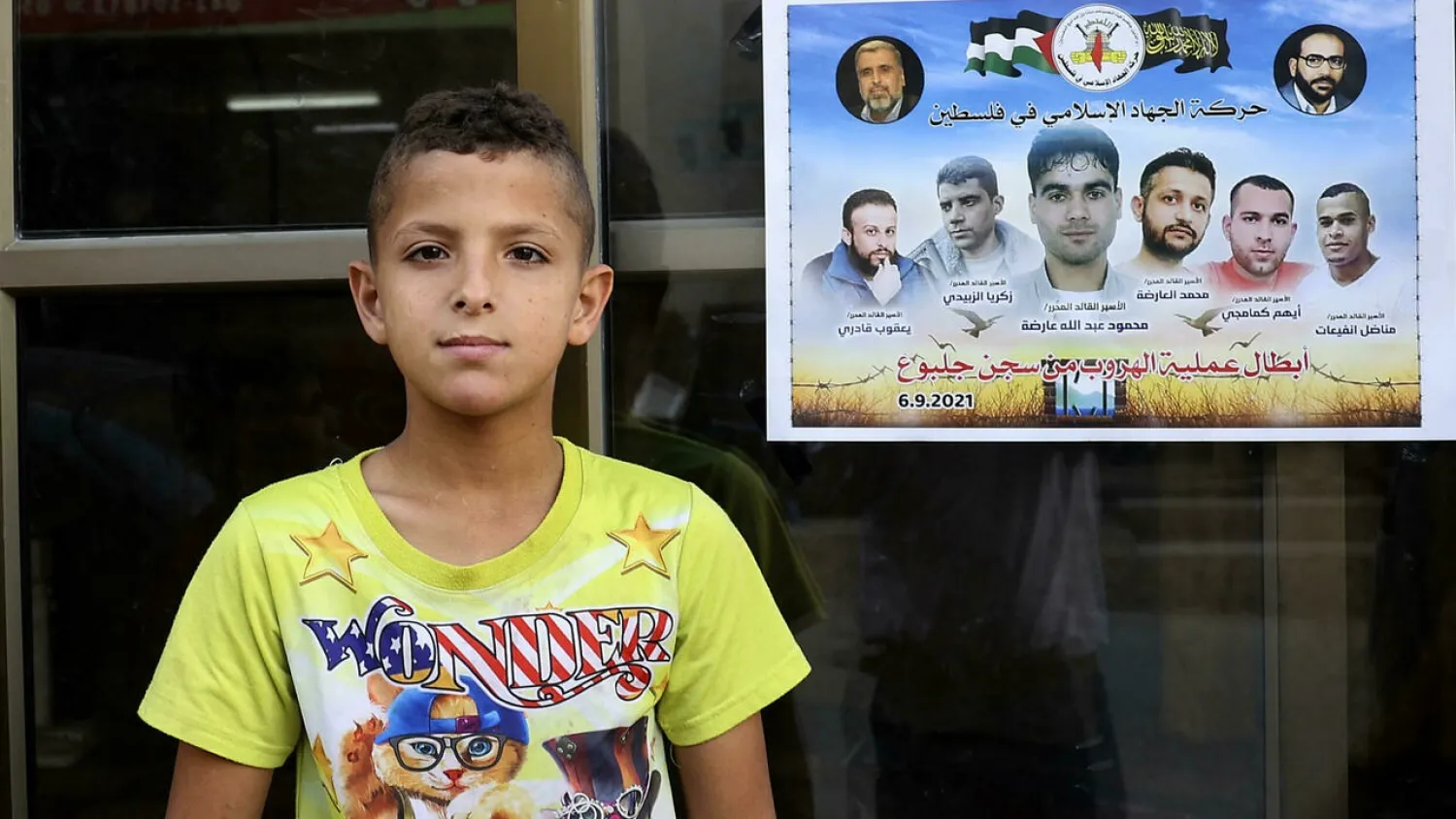
A Palestinian boy stands next to a poster showing the six Palestinian prisoners who escaped from Israel’s Gilboa prison, before four were recaptured, at the Jenin camp for Palestinian refugees in the occupied West Bank. (AFP)
TT

Palestinians Hail Israel Jailbreak Despite Recaptures

A Palestinian boy stands next to a poster showing the six Palestinian prisoners who escaped from Israel’s Gilboa prison, before four were recaptured, at the Jenin camp for Palestinian refugees in the occupied West Bank. (AFP)

Four of the six Palestinians who staged a Hollywood-style escape from an Israeli prison may be back behind bars, but in their home town they are being celebrated as heroes.

When cellphones buzzed last week in Jenin with news of the spectacular jailbreak from a high-security prison, Abu Antoine dreamed his nephew Zakaria Zubeidi might never be caught.

“In the hour after the announcement, we were filled with hope,” Abu Antoine told AFP. “We said to ourselves: ‘If he hasn’t been arrested yet, maybe he’ll be free forever’.”

Zubeidi, 46, was the most prominent of the six who had dug a tunnel underneath a sink and made their way to freedom, embarrassing their captors and sparking a massive manhunt.

Jenin in the occupied West Bank is a historic flashpoint in the Israeli-Palestinian conflict, and Zubeidi is one of the city’s most famous sons.

During the second intifada, or uprising, of 2000-2005 he was the local leader of the Al-Aqsa Martyrs’ Brigade, the armed wing of Palestinian president Mahmud Abbas’s Fatah faction.

He has since run afoul of both Israeli and Palestinian authorities and, after agreeing to lay down his arms more than a decade ago, also dabbled in theater.

He was arrested by Israel in 2019 and was serving time in Gilboa prison, along with the other five escapees, all members of the group “Islamic Jihad”.

The jailbreak marked a high-profile embarrassment for Israel’s vaunted security establishment.

In Palestinian areas, it sparked joy, with supporters handing out sweets in celebration.

There was feverish speculation the six may have escaped to neighboring Jordan or Syria.

Jenin’s resistance iconography was also freshened up, with new posters of the fugitives plastered on concrete walls beside the torn and fading images of the “martyrs” of the intifada.

‘Incomplete victory’
But on Friday night, two of the six escapees were re-arrested by Israeli security forces, in the majority Arab Israeli city of Nazareth.

The next morning, Zubeidi and another fugitive were also picked up, at a lorry park outside Nazareth.

Two members of the group remain at large.

All six of the escapees have been implicated in planning or perpetrating attacks on Israelis, and news of the re-arrests was welcomed across Israel.

Abu Antoine said the “escape remains a victory for Palestinians” but conceded the re-captures had made that victory “incomplete”.

He recalled that Zubeidi’s grandfather had escaped in the summer of 1958 from Israel’s since-closed Shata prison.

Palestinian newspaper clippings from the time, shared this week on messaging apps, noted the “glory” the escape had brought to the family.

A fresh Palestinian effort was underway to bolster the heroic status of the latest jail-breakers.

Shortly after Israel released photos of Zubeidi following his re-arrest, handcuffed and appearing forlorn, a doctored image began circulating on Palestinian social media accounts showing him smiling.

Falestine al-Youm (Palestine Today), the television voice of “Islamic Jihad”, has broadcast tributes to its escapees, highlighting its member Mahmud Abdullah Ardah, 45, who spent 25 years in prison and is considered the mastermind of the jailbreak.

‘Dancing with joy’
A giant poster of Ardah adorns his family home in the village of Arraba, just outside Jenin.

Wearing a white-dotted hijab, Ardah’s mother Fatiha was glued to the rolling TV tributes.

“When he was released, I was dancing with joy,” she told AFP. “I hoped the door of our house would open and he would be there.”

Ardah’s brother Mohammed told AFP he was contacted by an Israeli intelligence officer while his brother was on the run.

“He said to me: ‘If Mahmud comes home, let him kiss his mother then call us and we’ll arrest him’.”

“I told him ‘no, I will not call you,’” Mohammed recounted, although that moment never came.

Ardah was arrested in Nazareth, without putting up resistance, after being pursued by an Israeli helicopter.

“I couldn’t believe it,” Mohammed said.

“But I thought, ‘at least he is still alive’. And I realized that for him five days of freedom are the equivalent of 50 years.”



Jordan Says King Abdullah Received Invitation to Join Gaza Peace Board

Palestinian girls walk past the rubble of residential buildings destroyed during the war, in Gaza City, January 16, 2026. REUTERS/Dawoud Abu Alkas
TT

Jordan Says King Abdullah Received Invitation to Join Gaza Peace Board

Palestinian girls walk past the rubble of residential buildings destroyed during the war, in Gaza City, January 16, 2026. REUTERS/Dawoud Abu Alkas

Jordan's foreign ministry said on Sunday that King Abdullah received an invitation from ‌US President ‌Donald ‌Trump ⁠to join ‌the so-called "Board of Peace" for Gaza.

The foreign ministry said it was ⁠currently reviewing ‌related documents ‍within ‍the country's ‍internal legal procedures.

The board is set to supervise the temporary governance of Gaza, ⁠which has been under a shaky ceasefire since October.

On Friday, the White House announced some members of a so-called "Board of Peace" that is to supervise the temporary governance of Gaza, which has been under a fragile ceasefire since October.

The names include US Secretary of State Marco Rubio, President Donald Trump's special envoy Steve Witkoff, former British Prime Minister Tony Blair and Trump's son-in-law, Jared Kushner. Trump is the chair of the board, according to a plan his White House unveiled in October.

The White House did not detail the responsibilities of each member of the "founding Executive board." The names do not include any Palestinians. The White House said ⁠more members will be announced over the coming weeks.

The board will also include private equity executive and billionaire ‌Marc Rowan, World Bank President Ajay Banga and Robert Gabriel, ‍a Trump adviser, the White House ‍said, adding that Nickolay Mladenov, a former UN Middle East envoy, will be the ‍high representative for Gaza.

Army Major General Jasper Jeffers, a US special operations commander, was appointed commander of the International Stabilization Force, the White House said. A UN Security Council resolution, adopted in mid-November, authorized the board and countries working with it to establish that force in Gaza.

The White House also named an 11-member "Gaza Executive Board" that will include Turkish Foreign Minister Hakan Fidan, the UN special coordinator for the Middle East ⁠peace process, Sigrid Kaag, the United Arab Emirates minister for international cooperation, Reem Al-Hashimy, and Israeli-Cypriot billionaire Yakir Gabay, along with some members of the executive board.

This additional board will support Mladenov's office and the Palestinian technocratic body, whose details were announced this week, the White House said.


Türkiye’s Kurdish Leader Calls Syria Clashes 'Sabotage'

American soldiers from the U.S.-led coalition against the ISIS organization stand on alert during a meeting with the Syrian Democratic Forces in Deir Hafir, Syria, the day before yesterday (AP).
TT

Türkiye’s Kurdish Leader Calls Syria Clashes 'Sabotage'

American soldiers from the U.S.-led coalition against the ISIS organization stand on alert during a meeting with the Syrian Democratic Forces in Deir Hafir, Syria, the day before yesterday (AP).

Recent deadly clashes in Syria between government forces and Kurdish fighters seek to "sabotage" the peace process between Türkiye and the Kurdistan Workers' Party (PKK), the jailed leader of the Kurdish militant group said.

Abdullah Ocalan, who has led the unfolding Turkish peace process from prison, "sees this situation (in Syria) as an attempt to sabotage the peace process" in Türkiye, a delegation from the pro-Kurdish DEM party said after visiting him in jail on Saturday.

The PKK leader last year called for the group to lay down its weapons and disband, after more than four decades of conflict that claimed at least 50,000 lives.

The delegation that visited him at Imrali prison island near Istanbul, where he has been held in solitary confinement since 1999, said he had "reaffirmed his commitment to the process of peace and democratic society" and called to "take the necessary steps to move forward".

The PKK made a similar warning earlier this month, saying the Syria clashes "call into question the ceasefire between our movement and Türkiye ".

The clashes in Syria erupted after negotiations stalled on integrating the Kurds' de facto autonomous administration and forces into the country's new government, which took over after the fall of longtime ruler Bashar al-Assad in 2024.

The Syrian army has seized swathes of the country's north, dislodging Kurdish forces from territory where they had held effective autonomy for more than a decade.

Türkiye, which views Kurdish fighters in Syria as a terror group affiliated with the PKK, has praised Syria's operation as fighting "terrorist organizations".


Aidarous al-Zubaidi Faces Corruption, Land-Grabbing Investigations

 Aidarous al-Zoubaidi (AFP) 
 Aidarous al-Zoubaidi (AFP) 
TT

Aidarous al-Zubaidi Faces Corruption, Land-Grabbing Investigations

 Aidarous al-Zoubaidi (AFP) 
 Aidarous al-Zoubaidi (AFP) 

Yemen’s Attorney General, Qaher Mustafa, has ordered the formation of a judicial committee to investigate allegations of corruption, illicit enrichment, and related crimes attributed to Aidarous al-Zubaidi, according to a decision issued on Saturday. The committee has been instructed to proceed in accordance with the law.

The probe will examine accusations including abuse of power, land seizures, illicit oil trading, and involvement in commercial companies. Observers say these practices have deepened political and social divisions in Yemen’s southern governorates, fueling public anger over financial and administrative corruption.

Dr. Fares al-Bayl, head of the Future Center for Yemeni Studies, told Asharq Al-Awsat that al-Zubaidi “lacks political capital and administrative experience,” but rose to senior positions amid Yemen’s worst economic and political crisis. He alleged that al-Zubaidi exploited these posts to seize public funds, undermine state institutions, and conspire with external actors.

Al-Bayl said al-Zubaidi diverted large budgets - estimated at 10 billion Yemeni riyals monthly - under the name of the Southern Transitional Council, without legal authorization. He accused him of withholding revenues from the Port of Aden, customs, and taxes from the Central Bank, and channeling funds to armed formations outside state control.

Additional claims include the imposition of illegal levies on traders and citizens, the creation of multiple revenue-collection checkpoints, and the failure to transfer taxes on qat, fuel, cement, transport, tourism projects, and private investments to the state treasury.

Administratively, al-Bayl alleged that al-Zubaidi dismantled state institutions, replaced qualified personnel with loyalists, paralyzed essential services such as electricity, water, and the judiciary, and established parallel security bodies, creating administrative chaos and a lack of accountability. He also cited documented allegations of secret prisons, torture, enforced disappearances, and unlawful detentions of political opponents and journalists.

Security analyst Ibrahim Jalal described the alleged corruption as a reflection of power dominance and the monopolization of wealth and authority, often through illegal means and at the expense of citizens’ livelihoods.

Economist Adel Shamsan said the swift move by the Attorney General to open investigations carries important political and legal implications, reinforcing accountability and the rule of law. He noted that the action could help contain political fallout, ease polarization, and reassure markets and donors, supporting financial stability and reducing uncertainty.

According to documents reviewed by Asharq Al-Awsat, al-Zubaidi allegedly seized vast tracts of land in Aden. Many of these properties were reportedly registered in the names of relatives or close associates.

Additional allegations include oil shipments through Qena Port in Shabwa and corruption cases involving exchange and furniture companies based in Aden.