Syria Receives Around Two Million Covid Vaccines in One Week

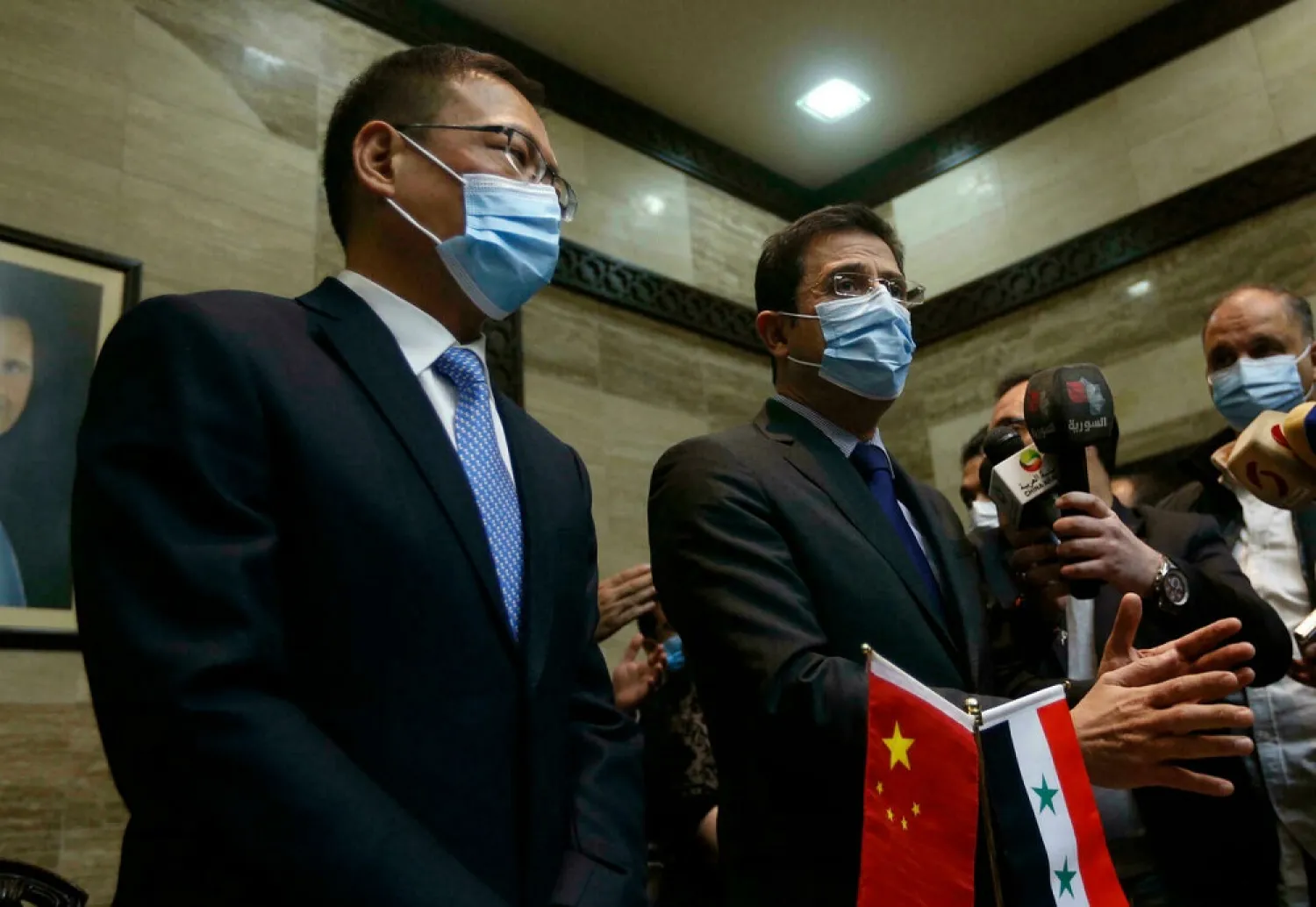
Syrian Health Minister Hassan al-Ghabash (R) and Chinese ambassador Feng Biao (L) take part in a ceremony upon the arrival of Sinopharm Covid-19 vaccine doses, in the capital Damascus. (AFP)
TT

Syria Receives Around Two Million Covid Vaccines in One Week

Syrian Health Minister Hassan al-Ghabash (R) and Chinese ambassador Feng Biao (L) take part in a ceremony upon the arrival of Sinopharm Covid-19 vaccine doses, in the capital Damascus. (AFP)

China donated 500,000 Covid-19 vaccines to Syria on Sunday.

Damascus last week received more than 1.3 million doses of the China's Sinovac under the global Covax program.

Syrian Health Minister Hassan al-Ghabash said China provided 500,000 doses of the Chinese Sinopharm vaccine.

Speaking to journalists on Sunday, he added that health authorities have vaccinated more than 600,000 people and urged more Syrians to come forward to receive the jabs.

Chinese ambassador Feng Biao said Sunday's donation raised to 800,000 the number of Sinopharm doses provided by Beijing.

Head of Mission and WHO Representative to Syria Akjemal Magtymova tweeted: “Pleased with the arrival of the significant Covax shipment to Syria this week and hope for more deliveries soon to meet the vaccination targets to combat the pandemic.”

More than 46,000 cases, including 2,661 deaths, have been officially registered in the war-torn country, but medics and activist groups believe the actual figure is much higher.

The opposition-held northwestern region of Idlib, which has recorded more than 90,000 cases, including 2,000 deaths, says it has received almost 690,000 vaccine doses under the Covax scheme. Some 77,000 people have been inoculated.

The Kurdish administration in the northeast that receives vaccines from Damascus has registered 1,500 Covid deaths from 37,000 cases, Around 40,000 people have been vaccinated.

The medical teams and international organizations fear that the health situation may worsen with the beginning of winter, especially in the refugee camps and in regions not under the government’s control.

Under-Secretary-General for Humanitarian Affairs and Emergency Relief Coordinator Martin Griffiths warned last month that less than two percent of Syria’s population have been vaccinated and infections are surging.


Putin, Sharaa Talks Focus on Strengthening Bilateral Ties

Russian President Vladimir Putin receives Syrian President Ahmed al-Sharaa at the Kremlin (DPA)
TT

Putin, Sharaa Talks Focus on Strengthening Bilateral Ties

Russian President Vladimir Putin receives Syrian President Ahmed al-Sharaa at the Kremlin (DPA)

The second meeting in three months between Syrian President Ahmed al-Sharaa and Russian President Vladimir Putin signaled an apparent rise in confidence and a shared push to fast-track the rebuilding of ties between Damascus and Moscow.

Unlike their first meeting in October, which focused on the historical legacy of bilateral ties and the need to review relations during the era of the ousted president, Bashar al-Assad, the two leaders appeared more at ease during Sharaa’s second visit to Moscow.

Putin received the Syrian president at the Kremlin alongside a high-level Russian delegation and praised what he described as the Syrian leadership’s successes in rebuilding a new Syria, unifying the country, and extending government control across its territory.

Sharaa responded by commending Russia’s active role in maintaining stability in Syria.

The Russian delegation included Defense Minister Andrey Belousov, Deputy Prime Minister Alexander Novak, Foreign Minister Sergey Lavrov, Finance Minister Anton Siluanov, Construction and Housing Minister Irek Faizullin, presidential aide Yuri Ushakov, Deputy Chief of the Presidential Administration Maxim Oreshkin, First Deputy Defense Minister Yunus-Bek Yevkurov, and Dmitry Shugaev, head of the Federal Service for Military-Technical Cooperation.

Admiral Igor Kostyukov, head of the Main Directorate of the Russian General Staff, also took part in the talks.

Kostyukov has previously participated in Russian-Syrian discussions and recently led Russia’s delegation to trilateral talks with the United States and Ukraine in Abu Dhabi.

The composition of the Russian delegation underscored the Kremlin’s level of interest in the visit and the breadth of issues on the agenda.

Syrian Foreign Minister Asaad al-Shaibani, Defense Minister Murhaf Abu Qasra, and Secretary-General of the Presidency Maher al-Sharaa accompanied Sharaa.

Opening the meeting, Putin said bilateral relations had continued to develop, noting that the two countries had advanced economic cooperation despite complex conditions.

He pointed to economic growth exceeding 4%, saying it may not be as ambitious as desired but represented tangible progress that should be maintained. Putin added that relations between Moscow and Damascus had seen notable development, crediting Sharaa’s personal efforts.

He congratulated his guest on what he described as growing momentum toward restoring Syria’s territorial unity, calling recent advances by government forces in northeastern Syria a decisive and essential step. Russia, he said, was closely monitoring Syria’s efforts to reassert control over its territory.

Putin told Sharaa that much work remained in reconstruction and rehabilitation, adding that Russian economic institutions, including those in the construction sector, were fully prepared for cooperation.

Sharaa thanked Russia for its role in stabilizing the situation, saying Moscow played a critical part in that process. He expressed hope for productive talks and said the two sides shared many common issues.

He said Syria had overcome several significant challenges over the past year, most recently unifying its territory, and that Damascus was seeking to move from destruction toward stability and peace.

Sharaa also noted that the following day would mark one year since the first Russian delegation visited Syria after the start of the new era, referring to a visit by Deputy Foreign Minister Mikhail Bogdanov that paved the way for dialogue and the rebuilding of ties.

On bilateral issues, the two presidents discussed increased cooperation among relevant ministries in areas such as industry, humanitarian affairs, sports, medicine, and construction.

In their public remarks, the leaders avoided contentious topics such as the future of Russian military bases in Syria. However, the Kremlin had indicated ahead of the meeting that the issue would be discussed.

They also did not publicly address the situation along Syria’s coast, where tensions persist amid accusations that figures linked to the former regime and now based in Russia are attempting to destabilize the area.

Sources have previously said Sharaa may seek the extradition of some second- and third-tier figures involved in unrest.

Other sources said Damascus had prepared lists of former regime figures with whom reconciliation could be pursued, a proposal previously encouraged by Moscow.

The situation in northeastern Syria was also expected to feature in closed-door talks, particularly after Russia withdrew from Qamishli airport two days before the visit, reportedly at Damascus’s request.

A source said Sharaa was also likely to raise the situation in southern Syria, amid Syrian interest in a Russian role that could strengthen Damascus’s position in ongoing negotiations with Israel.

Russian involvement in southern Syria, including possible patrols to curb Israeli incursions and acting as a guarantor between Damascus and Tel Aviv, has been discussed during previous visits.

However, some sources said Israel appeared unenthusiastic about reviving an active Russian role in the area.

Regarding Russian military bases, estimates suggest the two sides may begin discussions on a new arrangement that would see Moscow retain its presence at the Tartous naval facility, a key logistics hub supporting Russia’s operations in Africa and naval movements in the Mediterranean.

Talks are also expected on the Hmeimim air base, with sources anticipating discussions on a new framework involving cooperation to support the rehabilitation of the Syrian army.


Mohammed bin Salman Receives Hillary Clinton in Riyadh

Prince Mohammed bin Salman bin Abdulaziz Al Saud, Saudi Crown Prince and Prime Minister, and former US Secretary of State Hillary Clinton meet in Riyadh on Wednesday. (SPA)
TT

Mohammed bin Salman Receives Hillary Clinton in Riyadh

Prince Mohammed bin Salman bin Abdulaziz Al Saud, Saudi Crown Prince and Prime Minister, and former US Secretary of State Hillary Clinton meet in Riyadh on Wednesday. (SPA)

Prince Mohammed bin Salman bin Abdulaziz Al Saud, Saudi Crown Prince and Prime Minister, received former US Secretary of State Hillary Clinton at Al-Yamamah Palace in Riyadh on Wednesday.

They exchanged cordial talks during their meeting.

Clinton was a keynote speaker at the fifth edition of the Real Estate Future Forum that was held in Riyadh from January 26 to 28.


Bessent Says Disappointed by EU-India Deal; South Korea Must Ratify Trade Deal

 Treasury Secretary Scott Bessent speaks during an event at Carnegie Mellon Auditorium, Wednesday, Jan. 28, 2026, in Washington. (AP)
Treasury Secretary Scott Bessent speaks during an event at Carnegie Mellon Auditorium, Wednesday, Jan. 28, 2026, in Washington. (AP)
TT

Bessent Says Disappointed by EU-India Deal; South Korea Must Ratify Trade Deal

 Treasury Secretary Scott Bessent speaks during an event at Carnegie Mellon Auditorium, Wednesday, Jan. 28, 2026, in Washington. (AP)
Treasury Secretary Scott Bessent speaks during an event at Carnegie Mellon Auditorium, Wednesday, Jan. 28, 2026, in Washington. (AP)

US Treasury Secretary Scott Bessent said on Wednesday he was disappointed by Europe's decision to strike a major trade agreement with India, saying it showed Europe put trade ahead of the interests of the Ukrainian people.

Bessent told CNBC that Europe had been buying refined products made in India with sanctioned Russian oil supplies, and had been unwilling to match higher US tariffs on Indian goods because they were separately negotiating a trade agreement.

The European Union on Tuesday finalized a long-delayed trade deal with India that aims to boost two-way trade and reduce the bloc's reliance on the United States amid growing ‌global trade tensions.

The deal ‌is expected to double EU exports to India ‌by ⁠2032 by eliminating or ‌reducing tariffs on 96.6% of traded goods by value, and will lead to savings of 4 billion euros ($4.8 billion) in duties for European companies, the EU said.

Asked whether this deal and others among countries excluding the United States would threaten the US, Bessent said: "They should do what's best for themselves, but I will tell you, I found, I find the Europeans very disappointing."

He said the deal made it clear why Brussels had balked ⁠at joining Washington's decision to impose 25% tariffs on India last year as part of a push to reduce ‌its purchases of Russian oil.

"The Europeans were unwilling to join ‍us, and it turns out, because they ‍wanted to do this trade deal," he said. "So, every time you hear a ‍European talk about the importance of the Ukrainian people, remember that they put trade ahead of the Ukrainian people."

Bessent last week had signaled the potential removal of the 25% additional US tariffs on India following a sharp reduction in Indian imports of Russian oil.

Bessent's disparaging comments about Europe came amid heightened tensions after President Donald Trump threatened to raise tariffs on imports from certain European countries over their opposition to his pursuit ⁠of Greenland. That tariff threat was later dropped, but it left many Europeans unsettled and anxious about the future of Transatlantic trade.

US officials remain frustrated that the EU has not enacted the tariff reductions it promised as part of a framework trade deal reached with Washington in July.

Those concerns were heightened this week when Trump raised duties on imports from South Korea to 25% from 15%, citing slow moves by the country's parliament to implement a framework trade agreement reached with Washington last year.

Bessent defended Trump's action, saying it was "helpful to get things moved along", adding that the South Korean parliament needed to ratify the trade deal.

Trump on Tuesday said he expected the United States and South Korea to ‌work out a solution, but he did not elaborate.

South Korean officials are due to arrive in Washington on Wednesday for talks with trade officials.