

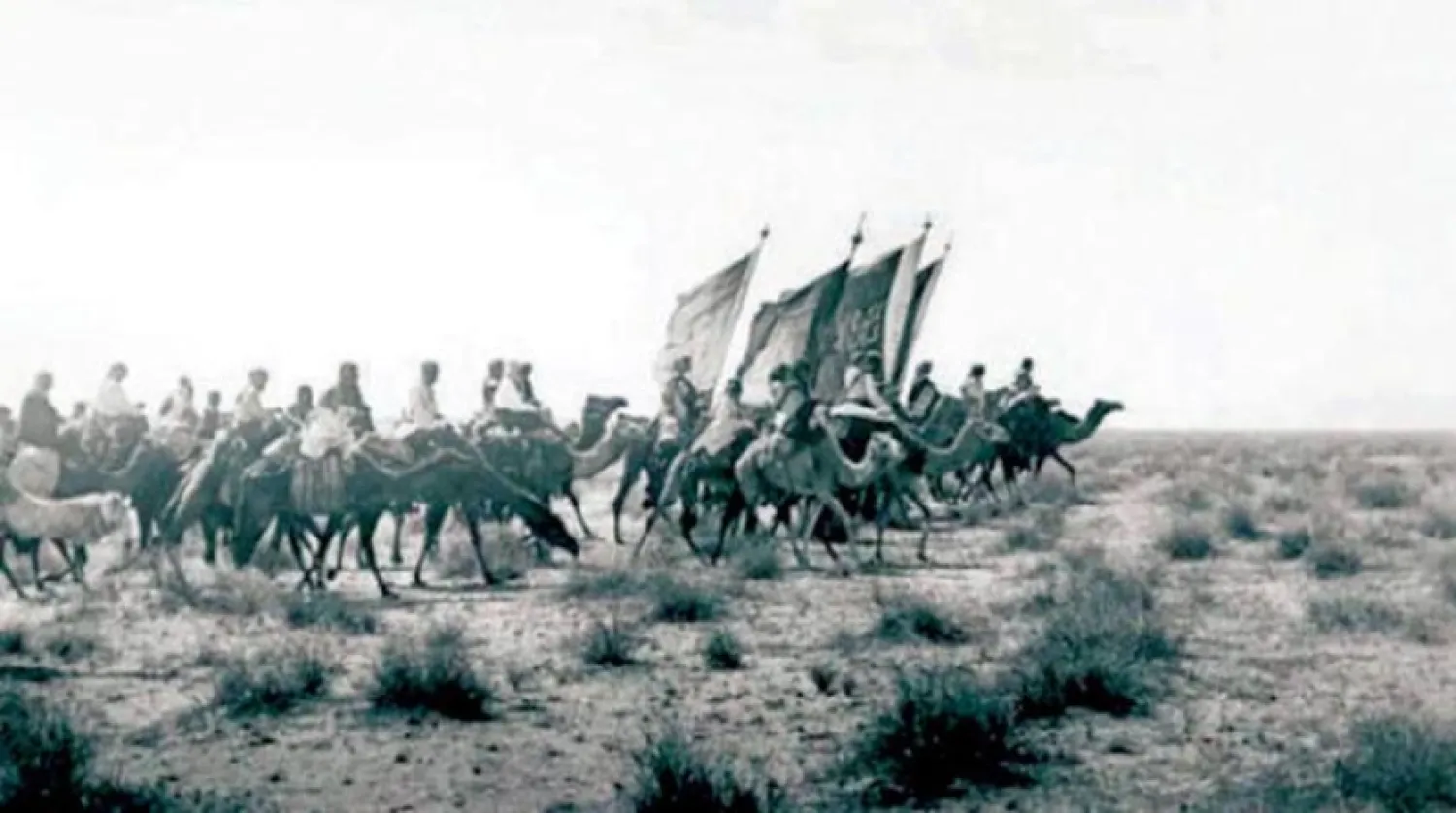

Saudi Arabia's Green National Flag Flutters for 3 Centuries

Saudi soldiers carry the Saudi flag and banners during the reign of King Abdulaziz in 1911. (Photo courtesy of Adnan al-Turaif to Asharq Al-Awsat)
TT

Saudi Arabia's Green National Flag Flutters for 3 Centuries

Saudi soldiers carry the Saudi flag and banners during the reign of King Abdulaziz in 1911. (Photo courtesy of Adnan al-Turaif to Asharq Al-Awsat)

Late historian Abdul Rahman Ruwaished has documented the evolution of the national banner over the centuries, with focus on the history of the Saudi national flag.

He has examined medals and military ranks that he believed were cornerstones of national devotion. He also studied the codes of flags, standards, medals and ranks.

In his book, "History of the Saudi Flag: National Flags, Decorations and Insignia," Ruwaished tackled the "code of ensigns, medals and ranks." He delved in detail into the etymology of the word "flag" in Arabic, saying it has numerous synonyms in the language, all of which denote a piece of colored cloth that is hoisted on a pole.

The flag is usually emblazoned with significant symbols and is carried by soldiers leading a parade. The flag is also hoisted at government buildings and during various occasions.

Saudi Arabia chose green as its national color and the color of its flag. In the center of the flag is the Islamic declaration of faith, Shahada, and below it is an image of a drawn sword.

The flag dates back to the First Saudi State. Ruwaished said the banner went through several transformations before the current form was adopted during the later years of the reign of late King Abdulaziz.

The Saudi flag was first flown in 1727 by founder of the First Saudi State Imam Mohammed bin Saud, who ruled for 40 years.

Journalist Adnan al-Turaif said King Abdulaziz adopted the flag of the first and second Saudi States during the early years of the Kingdom's founding.

He then ordered that a few changes be introduced to the flag, al-Turaif told Asharq Al-Awsat.

He cited Lebanese intellectual Ameen Rihani, who said that during the early years of King Abdulaziz's reign, the flag was square shaped, with the Shahada in the center and two crossed swords above it.

Changes were introduced soon after, with the two crossed swords being replaced by a single one. The sword was moved below the Shahada.

In 1925, King Abdulaziz ordered that a new flag be drawn up. In 1937, the Shura Council approved the dimensions of the flag at 150 cm in length and 100 cm in width. Later that year, a decree was issued over the national flag and over dedicating a flag to each of the king, crown prince, army, air force, internal flag, royal navy and marine trade.

In 1952, the Shura Council approved new measurements and modifications to the flags. In 1973, the government approved the flag code.

During the reign of King Fahd, specifically in 1991, modifications were made to the flag, whose width would be two thirds of its length. The Shahada would remain in the center and the sword just below it. In 1997, the government decreed that the national flag would be raised in the Kingdom from sunrise to sunset on weekends and holidays.



Saudi Arabia Urges Yemen’s STC to 'Urgently’ Withdraw from Hadhramaut and al-Mahra

Saudi Arabia Urges Yemen’s STC to 'Urgently’ Withdraw from Hadhramaut and al-Mahra
TT

Saudi Arabia Urges Yemen’s STC to 'Urgently’ Withdraw from Hadhramaut and al-Mahra

Saudi Arabia Urges Yemen’s STC to 'Urgently’ Withdraw from Hadhramaut and al-Mahra

The Saudi Ministry of Foreign Affairs issued a statement on Thursday expressing concern over the recent military movements witnessed in the governorates of Hadhramaut and al-Mahra.

It noted that “the actions carried out by the Southern Transitional Council were taken unilaterally, without the approval of the Presidential Leadership Council or coordination with the coalition leadership”.

The Kingdom described the moves as an “unjustified escalation” that has harmed the interests of the Yemeni people across all segments of society, undermined the Southern cause, and weakened the coalition’s efforts.

The Kingdom further emphasized that, in recent months, it has focused on maintaining unity and has undertaken intensive efforts to reach peaceful solutions to address the situation in the two governorates, as part of its ongoing endeavors to restore stability.

The statement added that these efforts were “coordinated with the brethren United Arab Emirates, the Chairman of the Presidential Leadership Council, and the Yemeni government to contain the situation”.

It said that a “joint Saudi–Emirati military team was dispatched to coordinate with the Southern Transitional Council in Aden, ensuring the withdrawal of its forces from the two governorates and the handover of camps to the National Shield Forces and local authorities under the coalition’s supervision”.

The Foreign Ministry stressed that efforts are still underway to restore the situation to its previous state, expressing the Kingdom’s hope that the public interest will prevail and that the Southern Transitional Council will take the initiative to de-escalate tensions and urgently and peacefully withdraw its forces from the two governorates.

Saudi Arabia also underscored the importance of cooperation among all Yemeni forces and components, exercising restraint, and avoiding actions that could undermine security and stability.

The Kingdom reiterated its position that the “Southern cause is a just issue with historical and social dimensions and can only be resolved through dialogue that brings all Yemeni parties together at one table, within a comprehensive political process that ensures a lasting solution in Yemen”.

The statement concluded by affirming the Kingdom’s “support for the Chairman and members of the Presidential Leadership Council and the Yemeni government, in a manner that achieves security, stability, development, and peace in the sisterly Republic of Yemen”.


MWL Condemns Attack Targeting Pakistani Police

The Muslim World League (MWL) logo
TT

MWL Condemns Attack Targeting Pakistani Police

The Muslim World League (MWL) logo

The Muslim World League (MWL) strongly condemned the attack targeting police personnel in Pakistan’s Khyber Pakhtunkhwa Province, the Saudi Press Agency reported on Thursday.

In a statement issued by its General Secretariat, MWL Secretary-General and Chairman of the Organization of Muslim Scholars, Sheikh Mohammed Al-Issa, affirmed the League’s solidarity with the Islamic Republic of Pakistan in the face of all threats to its security and stability. He reiterated the MWL’s firm rejection and condemnation of violence and terrorism in all their forms and under any pretext.

He also extended his sincere condolences and sympathies to the families of the victims and to the Pakistani people.


Sultan of Oman Awards Military Order to Royal Saudi Air Force Commander

Commander of the Royal Saudi Air Force (RSAF) Lieutenant General Prince Turki bin Bandar bin Abdulaziz receives the Military Order of Oman (Second Class). (SPA)
TT

Sultan of Oman Awards Military Order to Royal Saudi Air Force Commander

Commander of the Royal Saudi Air Force (RSAF) Lieutenant General Prince Turki bin Bandar bin Abdulaziz receives the Military Order of Oman (Second Class). (SPA)

Oman’s Sultan Haitham bin Tarik awarded on Wednesday the Military Order of Oman (Second Class) to Commander of the Royal Saudi Air Force (RSAF) Lieutenant General Prince Turki bin Bandar bin Abdulaziz in recognition of his efforts and contributions to strengthening military cooperation between the two countries.

The order was presented to the RSAF commander by Omani Deputy Prime Minister for Defense Affairs Shihab bin Tarik Al Said, in the presence of Commander of the Royal Air Force of Oman (RAFO) Air Vice Marshal Khamis Al Ghafri, Saudi Ambassador to Oman Ibrahim bin Saad bin Bishan, and the accompanying delegation.

During the visit, the RSAF commander also met with Minister of the Royal Office of Oman General Sultan bin Mohammed Al Nomani for talks on issues of mutual interest.

Prince Turki bin Bandar bin Abdulaziz arrived in Oman on Tuesday on an official visit during which he met with the commander of RAFO. The discussions addressed issues of common interest, particularly in the field of joint training and exercises.

The visit included a tour of the Air Center for Specialized Training, where the delegation reviewed the advanced capabilities on display, reflecting the level of development achieved by the Royal Air Force of Oman.