


Is AI the Future of Art?

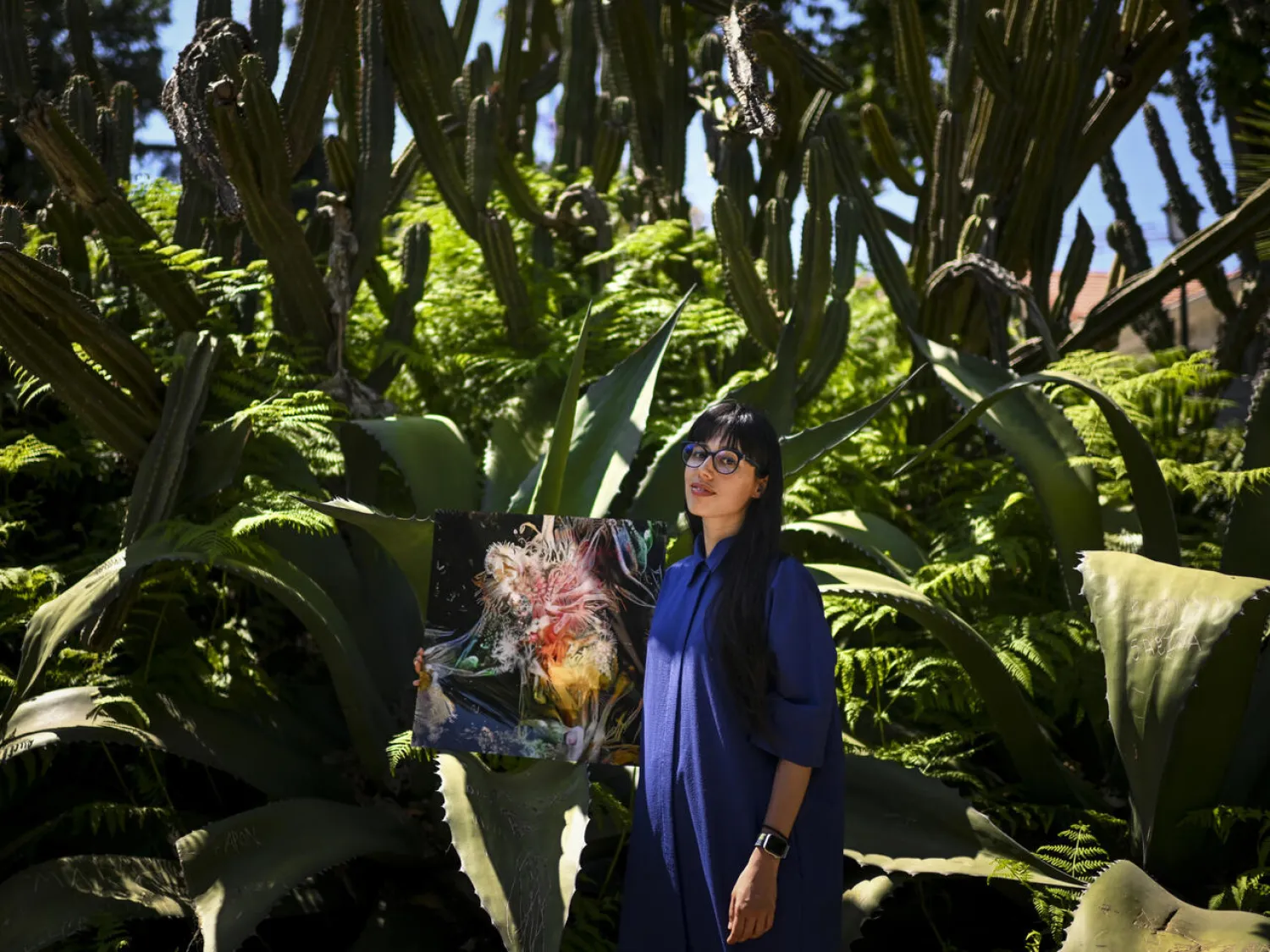
Sofia Crespo is part of the 'generative art' movement, in which humans create rules for computers which then use algorithms to generate new forms, ideas and patterns PATRICIA DE MELO MOREIRA AFP
TT

Is AI the Future of Art?

Sofia Crespo is part of the 'generative art' movement, in which humans create rules for computers which then use algorithms to generate new forms, ideas and patterns PATRICIA DE MELO MOREIRA AFP

To many they are art's next big thing -- digital images of jellyfish pulsing and blurring in a dark pink sea, or dozens of butterflies fusing together into a single organism.

The Argentine artist Sofia Crespo, who created the works with the help of artificial intelligence, is part of the "generative art" movement, where humans create rules for computers which then use algorithms to generate new forms, ideas and patterns.

The field has begun to attract huge interest among art collectors -- and even bigger price tags at auction, said AFP.

US artist and programmer Robbie Barrat -- a prodigy still only 22 years old -- sold a work called "Nude Portrait#7Frame#64" at Sotheby's in March for £630,000 ($821,000).

That came almost four years after French collective Obvious sold a work at Christie's titled "Edmond de Belamy" -- largely based on Barrat's code -- for $432,500.

- A ballet with machines -
Collector Jason Bailey told AFP that generative art was "like a ballet between humans and machines".

But the nascent scene could already be on the verge of a major shake-up, as tech companies begin to release AI tools that can whip up photo-realistic images in seconds.

Artists in Germany and the United States blazed a trail in computer-generated art during the 1960s.

The V&A museum in London keeps a collection going back more than half a century, one of the key works being a 1968 piece by German artist Georg Nees called "Plastik 1".

Nees used a random number generator to create a geometric design for his sculpture.

- 'Babysitting' computers -
Nowadays, digital artists work with supercomputers and systems known as Generative Adversarial Networks (GANs) to create images far more complex than anything Nees could have dreamed of.

GANs are sets of competing AIs –- one generates an image from the instructions it is given, the other acts as a gatekeeper, judging whether the output is accurate.

If it finds fault, it sends the image back for tweaks and the first AI gets back to work for a second try to beat the gamekeeper.

But artists like Crespo and Barrat insist that the artist is still central to the process, even if their working methods are not traditional.

"When I'm working this way, I'm not creating an image. I'm creating a system that can create images," Barrat told AFP.

Crespo said she thought her AI machine would be a true "collaborator", but in reality it is incredibly tough to get even a single line of code to generate satisfactory results.

She said it was more like "babysitting" the machine.

Tech companies are now hoping to bring a slice of this rarefied action to regular consumers.

Google and Open AI are both touting the merits of new tools they say bring photorealism and creativity without the need for coding skills.

- Enter the 'transformers' -
They have replaced GANs with more user-friendly AI models called "transformers" that are adept at converting everyday speech into images.

Google Imagen's webpage is filled with absurdist images generated by instructions such as: "A small cactus wearing a straw hat and neon sunglasses in the Sahara desert."

Open AI boasts that its Dalle-2 tool can offer any scenario in any artistic style from the Flemish masters to Andy Warhol.

Although the arrival of AI has led to fears of humans being replaced by machines in fields from customer care to journalism, artists see the developments more as an opportunity than a threat.

Crespo has tried out Dalle-2 and said it was a "new level in terms of image generation in general" -- though she prefers her GANs.

"I very often don't need a model that is very accurate to generate my work, as I like very much when things look indeterminate and not easily recognizable," she said.

Camille Lenglois of Paris's Pompidou Centre -- Europe's largest collection of contemporary art -- also played down any idea that artists were about to be replaced by machines.

She told AFP that machines did not yet have the "critical and innovative capacity", adding: "The ability to generate realistic images does not make one an artist."



Report: SpaceX Competing to Produce Autonomous Drone Tech for Pentagon 

The SpaceX logo is seen in this illustration taken, March 10, 2025. (Reuters)
TT

Report: SpaceX Competing to Produce Autonomous Drone Tech for Pentagon 

The SpaceX logo is seen in this illustration taken, March 10, 2025. (Reuters)

Elon Musk's SpaceX and its wholly-owned subsidiary xAI are competing in a secret new Pentagon contest to produce voice-controlled, autonomous drone swarming technology, Bloomberg News reported on Monday, citing people familiar with the matter.

SpaceX, xAI and the Pentagon's defense innovation unit did not immediately respond to requests for comment. Reuters could not independently verify the report.

Texas-based SpaceX recently acquired xAI in a deal that combined Musk's major space and defense contractor with the billionaire entrepreneur's artificial intelligence startup. It occurred ahead of SpaceX's planned initial public offering this year.

Musk's companies are reportedly among a select few chosen to participate in the $100 million prize challenge initiated in January, according to the Bloomberg report.

The six-month competition aims to produce advanced swarming technology that can translate voice commands into digital instructions and run multiple drones, the report said.

Musk was among a group of AI and robotics researchers who wrote an open letter in 2015 that advocated a global ban on “offensive autonomous weapons,” arguing against making “new tools for killing people.”

The US also has been seeking safe and cost-effective ways to neutralize drones, particularly around airports and large sporting events - a concern that has become more urgent ahead of the FIFA World Cup and America250 anniversary celebrations this summer.

The US military, along with its allies, is now racing to deploy the so-called “loyal wingman” drones, an AI-powered aircraft designed to integrate with manned aircraft and anti-drone systems to neutralize enemy drones.

In June 2025, US President Donald Trump issued the Executive Order (EO) “Unleashing American Drone Dominance” which accelerated the development and commercialization of drone and AI technologies.


SVC Develops AI Intelligence Platform to Strengthen Private Capital Ecosystem

The platform offers customizable analytical dashboards that deliver frequent updates and predictive insights- SPA
TT

SVC Develops AI Intelligence Platform to Strengthen Private Capital Ecosystem

The platform offers customizable analytical dashboards that deliver frequent updates and predictive insights- SPA

Saudi Venture Capital Company (SVC) announced the launch of its proprietary intelligence platform, Aian, developed in-house using Saudi national expertise to enhance its institutional role in developing the Kingdom’s private capital ecosystem and supporting its mandate as a market maker guided by data-driven growth principles.

According to a press release issued by the SVC today, Aian is a custom-built AI-powered market intelligence capability that transforms SVC’s accumulated institutional expertise and detailed private market data into structured, actionable insights on market dynamics, sector evolution, and capital formation. The platform converts institutional memory into compounding intelligence, enabling decisions that integrate both current market signals and long-term historical trends, SPA reported.

Deputy CEO and Chief Investment Officer Nora Alsarhan stated that as Saudi Arabia’s private capital market expands, clarity, transparency, and data integrity become as critical as capital itself. She noted that Aian represents a new layer of national market infrastructure, strengthening institutional confidence, enabling evidence-based decision-making, and supporting sustainable growth.

By transforming data into actionable intelligence, she said, the platform reinforces the Kingdom’s position as a leading regional private capital hub under Vision 2030.

She added that market making extends beyond capital deployment to shaping the conditions under which capital flows efficiently, emphasizing that the next phase of market development will be driven by intelligence and analytical insight alongside investment.

Through Aian, SVC is building the knowledge backbone of Saudi Arabia’s private capital ecosystem, enabling clearer visibility, greater precision in decision-making, and capital formation guided by insight rather than assumption.

Chief Strategy Officer Athary Almubarak said that in private capital markets, access to reliable insight increasingly represents the primary constraint, particularly in emerging and fast-scaling markets where disclosures vary and institutional knowledge is fragmented.

She explained that for development-focused investment institutions, inconsistent data presents a structural challenge that directly impacts capital allocation efficiency and the ability to crowd in private investment at scale.

She noted that SVC was established to address such market frictions and that, as a government-backed investor with an explicit market-making mandate, its role extends beyond financing to building the enabling environment in which private capital can grow sustainably.

By integrating SVC’s proprietary portfolio data with selected external market sources, Aian enables continuous consolidation and validation of market activity, producing a dynamic representation of capital deployment over time rather than relying solely on static reporting.

The platform offers customizable analytical dashboards that deliver frequent updates and predictive insights, enabling SVC to identify priority market gaps, recalibrate capital allocation, design targeted ecosystem interventions, and anchor policy dialogue in evidence.

The release added that Aian also features predictive analytics capabilities that anticipate upcoming funding activity, including projected investment rounds and estimated ticket sizes. In addition, it incorporates institutional benchmarking tools that enable structured comparisons across peers, sectors, and interventions, supporting more precise, data-driven ecosystem development.


Job Threats, Rogue Bots: Five Hot Issues in AI

A Delhi police officer outside the venue of the 'India AI Impact Summit 2026'. Arun SANKAR / AFP
TT

Job Threats, Rogue Bots: Five Hot Issues in AI

A Delhi police officer outside the venue of the 'India AI Impact Summit 2026'. Arun SANKAR / AFP

As artificial intelligence evolves at a blistering pace, world leaders and thousands of other delegates will discuss how to handle the technology at the AI Impact Summit, which opens Monday in New Delhi.

Here are five big issues on the agenda:

Job loss fears

Generative AI threatens to disrupt myriad industries, from software development and factory work to music and the movies.

India -- with its large customer service and tech support sectors -- could be vulnerable, and shares in the country's outsourcing firms have plunged in recent days, partly due to advances in AI assistant tools.

"Automation, intelligent systems, and data-driven processes are increasingly taking over routine and repetitive tasks, reshaping traditional job structures," the summit's "human capital" working group says.

"While these developments can drive efficiency and innovation, they also risk displacing segments of the workforce," widening socio-economic divides, it warns.

Bad robots

The Delhi summit is the fourth in a series of international AI meetings. The first in 2023 was called the AI Safety Summit, and preventing real-world harm is still a key goal.

In the United States, families of people who have taken their own lives have sued OpenAI, accusing ChatGPT of having contributed to the suicides. The company says it has made efforts to strengthen its safeguards.

Elon Musk's Grok AI tool also recently sparked global outrage and bans in several countries over its ability to create sexualized deepfakes depicting real people, including children, in skimpy clothing.

Other concerns range from copyright violations to scammers using AI tools to produce perfectly spelled phishing emails.

Energy demands

Tech giants are spending hundreds of billions of dollars on AI infrastructure, building data centers packed with cutting-edge microchips, and also, in some cases, nuclear plants to power them.

The International Energy Agency projects that electricity consumption from data centers will double by 2030, fueled by the AI boom.

In 2024, data centers accounted for an estimated 1.5 percent of global electricity consumption, it says.

Alongside concerns over planet-warming carbon emissions are worries about water use to cool the data centers servers, which can lead to shortages on hot days.

Moves to regulate

In South Korea, a wide-ranging law regulating artificial intelligence took effect in January, requiring companies to tell users when products use generative AI.

Many countries are planning similar moves, despite a warning from US Vice President JD Vance last year against "excessive regulation" that could stifle innovation.

The European Union's Artificial Intelligence Act allows regulators to ban AI systems deemed to pose "unacceptable risks" to society.

That could include identifying people in real time in public spaces or evaluating criminal risk based on biometric data alone.

'Everyone dies'

More existential fears have also been expressed by AI insiders who believe the technology is marching towards so-called "Artificial General Intelligence", when machines' abilities match those of humans.

OpenAI and rival startup Anthropic have seen public resignations of staff members who have spoken out about the ethical implications of their technology.

Anthropic warned last week that its latest chatbot models could be nudged towards "knowingly supporting -- in small ways -- efforts toward chemical weapon development and other heinous crimes".

Researcher Eliezer Yudkowsky, author of the 2025 book "If Anyone Builds It, Everyone Dies: Why Superhuman AI Would Kill Us All" has also compared AI to the development of nuclear weapons.