


Afghanistan Quake Kills 1,000 People, Deadliest in Decades

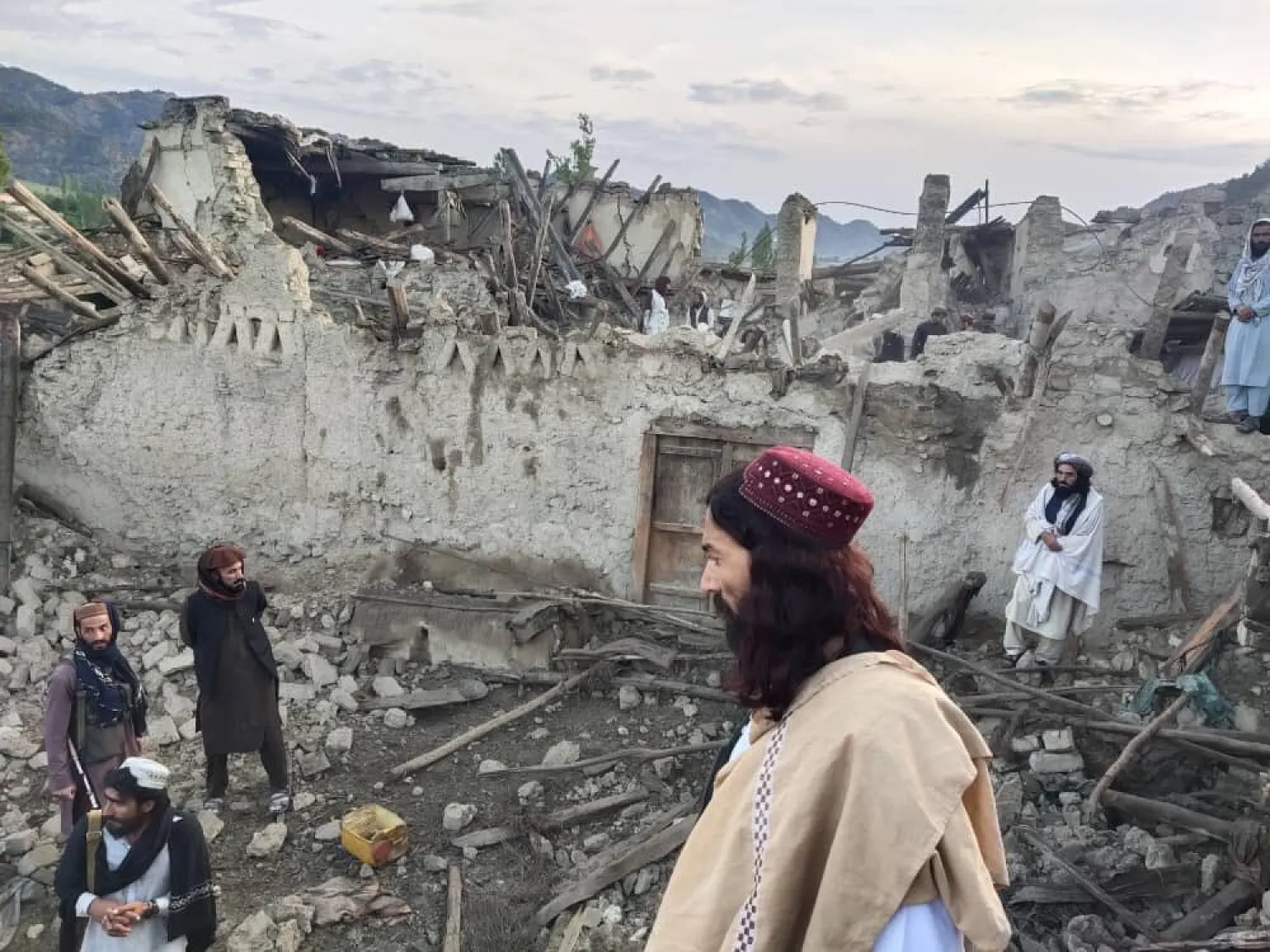
 In this photo released by a set-run news agency Bakhtar, Afghans look at destruction caused by an earthquake in the province of Paktika, eastern Afghanistan, Wednesday, June 22, 2022. (Bakhtar News Agency via AP)
In this photo released by a set-run news agency Bakhtar, Afghans look at destruction caused by an earthquake in the province of Paktika, eastern Afghanistan, Wednesday, June 22, 2022. (Bakhtar News Agency via AP)
TT

Afghanistan Quake Kills 1,000 People, Deadliest in Decades

 In this photo released by a set-run news agency Bakhtar, Afghans look at destruction caused by an earthquake in the province of Paktika, eastern Afghanistan, Wednesday, June 22, 2022. (Bakhtar News Agency via AP)
In this photo released by a set-run news agency Bakhtar, Afghans look at destruction caused by an earthquake in the province of Paktika, eastern Afghanistan, Wednesday, June 22, 2022. (Bakhtar News Agency via AP)

A powerful earthquake struck a rugged, mountainous region of eastern Afghanistan early Wednesday, killing at least 1,000 people and injuring 1,500 more in the country's deadliest quake in two decades, the state-run news agency reported. Officials warned that the already grim toll may still rise.

In the remote area near the Pakistani border, residents searched for survivors and the dead by digging with their bare hands through the rubble of collapsed stone and mudbrick houses, according to footage shown by the news agency Bakhtar. It was not immediately clear if major rescue equipment was being sent - or even if it could reach the area.

The extent of the destruction among the villages tucked among the mountains was still not known. Rutted roads - difficult to pass in the best of times - may have sustained significant damage, and a UNICEF official said landslides from recent rains have made access even more difficult. At least 2,000 homes were destroyed in the region, where on average every home has seven or eight people living in it, the UN Deputy Special Representative to Afghanistan Ramiz Alakbarov told reporters.

The disaster posed a major test for Afghanistan's Taliban government, which seized power nearly 10 months ago as the US and its NATO allies were carrying out their withdrawal from the country and has been largely shunned by the world community since.

Rescuers rushed to the area by helicopter, but the response is likely to be complicated since many international aid agencies left Afghanistan after the Taliban takeover in August. Moreover, most governments are wary of dealing directly with the group, a reluctance that could slow the deployment of emergency aid and teams.

In a rare move, the Taliban's reclusive supreme leader, Haibatullah Akhundzadah, who almost never appears in public, called for "the international community and all humanitarian organizations to help the Afghan people affected by this great tragedy and to spare no effort to help the affected people."

"We ask God to save our poor people from trials and harm," he said in a statement put out by the Taliban spokesman.

But in a sign of the muddled workings between the Taliban and the international community, Alakbarov said the Taliban have not formally requested that the UN mobilize international search and rescue teams. Afghan authorities have deployed a few dozen ambulances and several helicopters but have not asked the UN to obtain any more equipment or machinery from neighboring countries, he added, without elaborating.

The disaster only compounds the woes in Afghanistan, which is already deep in one of the world's worst humanitarian crises, with millions facing increasing hunger and poverty after the cutoff of international financing to the Taliban. That has prompted a massive aid program, but to avoid putting money in the Taliban's hands, the world has funneled funding through the UN and other humanitarian agencies - a system that may be too slow for an emergency response to the quake.

The 6.1 magnitude quake had its epicenter in Paktika province, some 50 kilometers (31 miles) southwest of the city of Khost, according to neighboring Pakistan’s Meteorological Department. Experts put the depth at just 10 kilometers (6 miles) - another factor that could lead to severe destruction.

The European seismological agency said the earthquake’s tremors were felt over 500 kilometers (310 miles) by 119 million people across Afghanistan, Pakistan and India.

Footage from Paktika showed men carrying people in blankets to a waiting helicopter. Others were treated on the ground. One resident could be seen receiving IV fluids while sitting in a plastic chair outside the rubble of his home and still more were sprawled on gurneys. Some images showed residents picking through clay bricks and other rubble from destroyed stone houses. The roofs or walls of others had caved in.

The death toll given by the Bakhtar News Agency was equal to that of a quake in 2002 in northern Afghanistan. Those are the deadliest since 1998, when an earthquake also 6.1 in magnitude and subsequent tremors in the remote northeast killed at least 4,500 people.

In most places in the world, an earthquake of that strength wouldn’t inflict such extensive devastation, said Robert Sanders, a seismologist with the US Geological Survey. But a quake’s death toll more often comes down to geography, building quality and population density.

"Because of the mountainous area, there are rockslides and landslides that we won’t know about until later reporting. Older buildings are likely to crumble and fail," he said. "Due to how condensed the area is in that part of the world, we’ve seen in the past similar earthquakes deal significant damage."

The Taliban are still trying to reconstitute government ministries abandoned by staff loyal to its previous Western-backed government, and it was not clear how officials arrived at the casualty tolls reported by Bakhtar.

But there were concerns that the figure could yet rise.

"The fear is that the victims will increase further, also because many people could be trapped under collapsed buildings," said Stefano Sozza, Afghanistan country director for Italian medical aid group Emergency.

Emergency was one of the organizations already distributing humanitarian help around Afghanistan that rushed resources to villages devastated by the quake. It sent seven ambulances and staff to the areas near the quake zone.

The children's agency UNICEF had health and nutrition teams in the area and sent trucks of blankets, tents and other supplies, Sam Mort, communications chief for UNICEF Afghanistan, told UK broadcaster Sky. Regional hospitals were already overwhelmed with injured, she said.

The quake "will only add to the immense humanitarian needs in Afghanistan, and it really has to be all hands on deck to make sure that we really limit the suffering that families, that women and children are already going through," said Shelley Thakral, the UN World Food Program spokesperson in Kabul.

Pakistan said it would send food, tents, blankets and other essential items as quickly as possible. The Afghan Red Crescent Society sent similar items as well as kitchen kits to the affected area, according to Bakhtar’s director-general, Abdul Wahid Rayan.

In Kabul, Prime Minister Mohammad Hassan Akhund convened an emergency meeting at the presidential palace to coordinate the relief effort.

"When such a big incident happens in any country, there is a need for help from other countries," said Sharafuddin Muslim, deputy minister of state for disaster management. "It is very difficult for us to be able to respond to this huge incident."

That may prove difficult given the renewed international isolation of Afghanistan under the Taliban following their takeover last year, two decades after the US-led invasion toppled the same insurgents in the wake of the 9/11 attacks. The new government has issued a flurry of repressive edicts curtailing the rights of women and girls and the press that hark to the Taliban's harsh rule from the late 1990s, despite promising that would not happen.

"This does add a lot to the daily burden of survival," Alakbarov, of the UN, said. "We are not optimistic today."



Israel Arrests Citizen Suspected of Spying for Iran

Iranians drive past an anti-Israeli billboard carrying a sentence in Persian reading 'We are ready, are you ready?' hanging at Palestine Square in Tehran, Iran, 24 December 2025. (EPA)
TT

Israel Arrests Citizen Suspected of Spying for Iran

Iranians drive past an anti-Israeli billboard carrying a sentence in Persian reading 'We are ready, are you ready?' hanging at Palestine Square in Tehran, Iran, 24 December 2025. (EPA)

Israeli authorities announced on Thursday the arrest of an Israeli man on suspicion of committing security offences under the direction of Iranian intelligence agents, days after Tehran executed an Iranian accused of spying for Israel.

The arrest is the latest in a series of cases in which Israel has charged its own citizens with spying for its arch-foe since the start of the war in Gaza in October 2023.

The suspect, who is in his 40s and lives in the city of Rishon LeZion, was arrested this month in a joint operation by Israeli police and Shin Bet, Israel's domestic intelligence agency.

"The suspect was identified as having conducted photography in the vicinity of the home of former prime minister Naftali Bennett," a joint police and Shin Bet statement said.

"As part of his contact with Iranian handlers, he was instructed to purchase a dash camera in order to carry out the task," it added.

According to the statement, the man transferred photographs taken in his city of residence and other locations in exchange for various sums of money.

In May, Israel announced the arrest of an 18-year-old Israeli for spying on Bennett.

Iran and Israel, long-standing adversaries, have regularly accused each other of espionage.

Last week, Iran said it had executed an Iranian citizen convicted of spying for Israel.

In June, Israel launched strikes on Iranian military and nuclear sites as well as residential areas.

Iran responded with drone and missile strikes on Israel, and later on in war, the United States joined Israel in targeting Iranian nuclear facilities.

During the 12-day conflict, Israeli authorities arrested two citizens suspected of working for Iranian intelligence services.

Iran, which does not recognize Israel, has long accused it of conducting sabotage operations against its nuclear facilities and assassinating its scientists.


In First Christmas Sermon, Pope Leo Decries Conditions for Palestinians in Gaza

 Pope Leo XIV arrives looks on as he performs the Christmas mass at St Peter's Basilica in the Vatican on December 25, 2025. (AFP)
Pope Leo XIV arrives looks on as he performs the Christmas mass at St Peter's Basilica in the Vatican on December 25, 2025. (AFP)
TT

In First Christmas Sermon, Pope Leo Decries Conditions for Palestinians in Gaza

 Pope Leo XIV arrives looks on as he performs the Christmas mass at St Peter's Basilica in the Vatican on December 25, 2025. (AFP)
Pope Leo XIV arrives looks on as he performs the Christmas mass at St Peter's Basilica in the Vatican on December 25, 2025. (AFP)

Pope Leo decried conditions for Palestinians in Gaza in his Christmas sermon on Thursday, in an unusually direct appeal during what is normally a solemn, spiritual service on the day Christians across the globe celebrate the birth of Jesus.

Leo, the first US pope, said the story of Jesus being born in a stable showed that God had "pitched his fragile tent" among the people of the world.

"How, then, can we not think of the ‌tents in ‌Gaza, exposed for weeks to rain, ‌wind ⁠and cold?" he ‌asked.

Leo, celebrating his first Christmas after being elected in May by the world's cardinals to succeed the late Pope Francis, has a more quiet, diplomatic style than his predecessor and usually refrains from making political references in his sermons.

But the new pope has also lamented the conditions for Palestinians in Gaza several ⁠times recently and told journalists last month that the only solution in ‌the decades-long Palestinian-Israeli conflict ‍must include a Palestinian ‍state.

Israel and Hamas agreed to a ceasefire in ‍October after two years of intense bombardment and military operations, but humanitarian agencies say there is still too little aid getting into Gaza, where nearly the entire population is homeless.

In Thursday's service with thousands in St. Peter's Basilica, Leo also lamented conditions for the homeless across the globe and the destruction ⁠caused by the wars roiling the world.

"Fragile is the flesh of defenseless populations, tried by so many wars, ongoing or concluded, leaving behind rubble and open wounds," said the pope.

"Fragile are the minds and lives of young people forced to take up arms, who on the front lines feel the senselessness of what is asked of them and the falsehoods that fill the pompous speeches of those who send them to their deaths," he said.

Later on Thursday the pope will ‌deliver a twice-yearly "Urbi et Orbi" (to the city and the world) message and blessing, which usually addresses global conflicts.


China Accuses US of Trying to Thwart Improved China-India Ties

FILE PHOTO: Chinese and US flags flutter in Shanghai, China July 30, 2019. REUTERS/Aly Song
TT

China Accuses US of Trying to Thwart Improved China-India Ties

FILE PHOTO: Chinese and US flags flutter in Shanghai, China July 30, 2019. REUTERS/Aly Song

China accused the US on Thursday of distorting its defense policy in an effort to thwart an improvement in China-India ties.

Foreign ministry ‌spokesperson Lin ‌Jian was ‌responding ⁠to a question ‌at a press briefing on whether China might exploit a recent easing of tensions with India over disputed border areas to keep ⁠ties between the United States ‌and India from ‍deepening.

China views ‍its ties with ‍India from a strategic and long-term perspective, Lin said, adding that the border issue was a matter between China and India and "we object to ⁠any country passing judgment about this issue".

The Pentagon said in a report on Tuesday that China "probably seeks to capitalize on decreased tension ... to stabilize bilateral relations and prevent the deepening of US-India ties".