

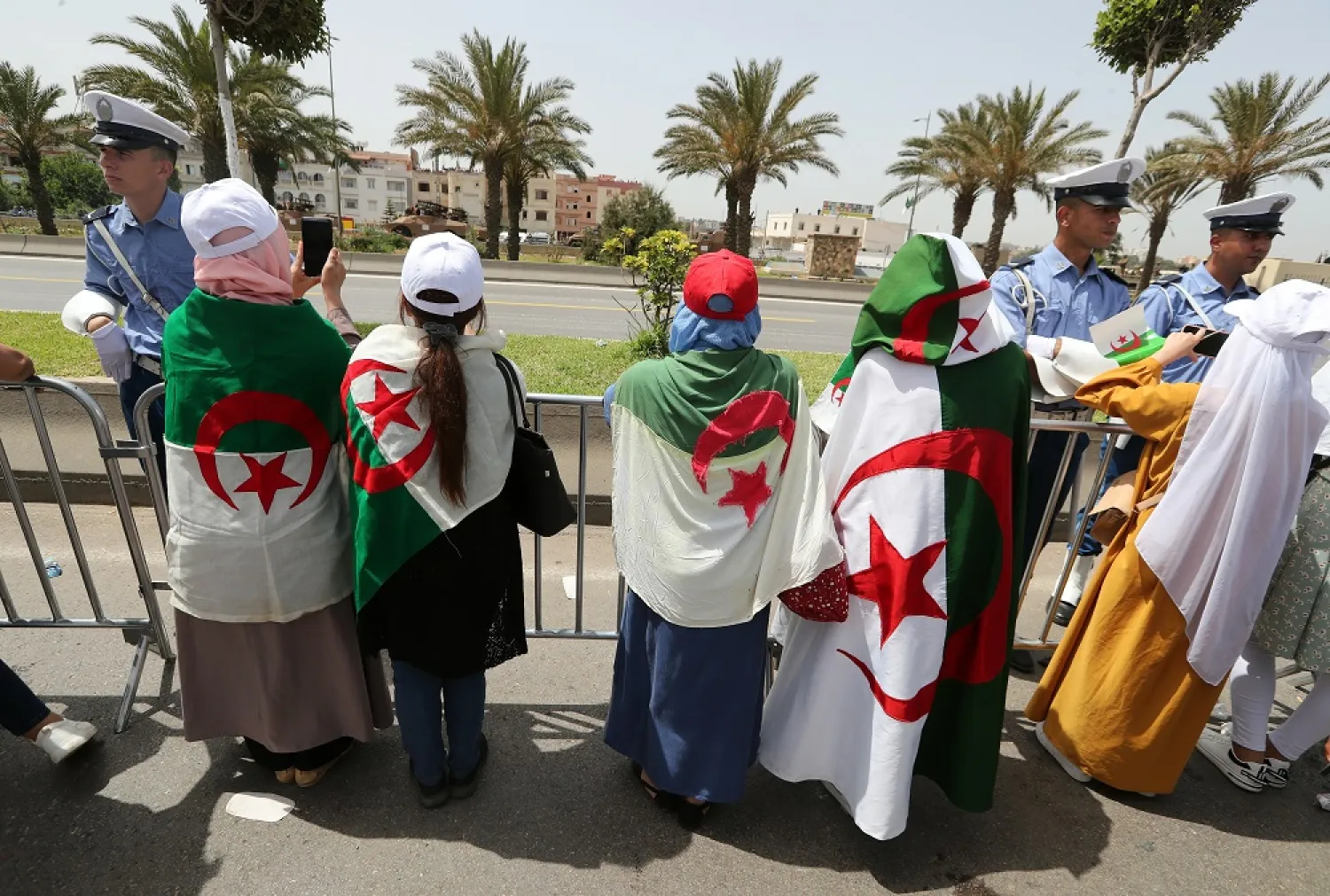

Algeria Marks 60 Years of Independence with Military Parade

Algerians attend celebrations of the 60th anniversary of independence in Algiers, Algeria, 05 July 2022. (EPA)
TT

Algeria Marks 60 Years of Independence with Military Parade

Algerians attend celebrations of the 60th anniversary of independence in Algiers, Algeria, 05 July 2022. (EPA)

Algeria celebrated 60 years of independence from France on Tuesday with nationwide ceremonies, a pardon of 14,000 prisoners and its first military parade in decades.

Opposition figures and pro-democracy activists called the elaborate celebrations an effort to distract attention from Algeria's economic and political troubles by glorifying the army, and called for the release of political prisoners.

The events mark the country’s official declaration of independence on July 5, 1962, after a brutal seven-year war that ended 132 years of colonial rule. The war, which Algerian officials say killed around 1.5 million people, remains a point of tension in relations between Algeria and France.

Russian-made warplanes whizzed overhead, armored vehicles rolled through central Algiers, and warships were decked out in the city harbor. Algerian flags flew from buildings across the country, and patriotic songs rang out from loudspeakers.

"A day of glory for a new era" was the official slogan of the celebration, which includes concerts, sports events, lectures and photo exhibits retracing the horrors of the war.

Previous presidents abandoned holding military parades, but President Abdelmadjid Tebboune revived the tradition for this anniversary, for the first time in 38 years.

Tebboune began the ceremony by laying a wreath at a monument to "martyrs of the revolution," and inaugurated a monument dedicated to foreigners who joined the fight for Algerian independence. He then mounted a military vehicle and greeted representatives of Algeria’s armed forces while waving to crowds who chanted: "One, Two, Three, Long Live Algeria!"

Palestinian President Mahmoud Abbas, the leader of Hamas and the presidents of Tunisia, Niger, Congo and Ethiopia took part in Tuesday’s anniversary events, standing on a platform erected in front of the Grand Mosque of Algiers.

In a speech, Tebboune underlined that "the Algerian army, heir to the National Liberation Army, constitutes the protective shield of Algeria."

Opposition figures, and those involved in 2019 protests that helped overthrow Tebboune's long-serving predecessor Abdelaziz Bouteflika, weren't invited to the ceremonies.

The country's oldest opposition party, FFS, issued a statement saying that, "60 years after independence, we are seeing more disappointments than fulfilled promises. We are facing the same problems of political instability and economic fragility."

Journalist Karim Tabbou, active in the Hirak pro-democracy movement, said Algerians' freedoms "are under constant threat." Tabbou has been repeatedly arrested and is currently under court supervision.

"All the spectacles of illusion, all the cosmetics can't hide the reality of a country eaten away by the corruption of a political system that considers that management by security alone is the only way to govern Algerians," he said on independent broadcaster Radio M.

The president signed decrees Monday announcing pardons for thousands of prisoners, primarily those convicted of common crimes suffering severe illnesses or who are registered for exams aimed at improving their education.

It wasn't immediately clear whether political prisoners would be among those freed.

More than 300 Hirak participants, journalists and political activists are currently held in Algerian prisons, according to the National Committee for Freedom of Detainees, a group of volunteer lawyers campaigning for their release.

The presidential statement announcing the pardons mentioned measures for the benefit of "young people prosecuted and detained for having committed acts of assembly and related actions." The official news agency APS cited a presidential official as saying that included Hirak activists arrested during protests or for posts online deemed as "threatening public order."

The presidential statement also mentions a draft law under development that would allow for the release of political activists or jailed journalists, as a result of Tebboune's outreach consultations in recent months with various political players.

APS said the law would also concern certain Algerian figures in exile, and people in prison since the "black decade" of the 1990s, when security forces fought an extremist insurgency in a conflict that left hundreds of thousands dead. Such a measure could include Islamist figures who have fled Algeria or who are serving prison terms for terrorist crimes committed in the 1990s.

Louisa Kanache, whose journalist husband Mohamed Mouloudj has been detained since September on charges of threatening state security and diffusing fake news on Facebook, said she was excited by the president’s statement, but uncertain whether her husband would be freed.

"Even lawyers don’t know how to read the presidential statement," she said. "I’m torn between hope of seeing the end of the tunnel, and worry."



Syria Secures Assad-Era Mass Grave Revealed by Reuters and Opens Criminal Investigation

A drone view of the mass grave site in the desert near the eastern Syrian town of Dhumair, February 27, 2025. (Reuters)
TT

Syria Secures Assad-Era Mass Grave Revealed by Reuters and Opens Criminal Investigation

A drone view of the mass grave site in the desert near the eastern Syrian town of Dhumair, February 27, 2025. (Reuters)

Syria’s government has ordered soldiers to guard a mass grave created to conceal atrocities under Bashar al-Assad and has opened a criminal investigation, following a Reuters report that revealed a yearslong conspiracy by the fallen dictatorship to hide thousands of bodies on the remote ​desert site.

The site, in the Dhumair desert east of Damascus, was used during Assad’s rule as a military weapons depot, according to a former Syrian army officer with knowledge of the operation.

It was later emptied of personnel in 2018 to ensure secrecy for a plot that involved unearthing the bodies of thousands of victims of the dictatorship buried in a mass grave on the outskirts of Damascus and trucking them an hour’s drive away to Dhumair.

The plot, orchestrated by the dictator’s inner circle, was called “Operation Move Earth.”

Soldiers are stationed at the Dhumair site again, this time by the government that overthrew Assad.

The Dhumair military installation was also reactivated as a barracks and arms depot in November, after seven years of disuse, according to an army officer posted there in early December, a military official and Sheikh Abu Omar Tawwaq, who is the security chief of Dhumair.

The Dhumair site ‌was completely unprotected over ‌the summer, when Reuters journalists made repeated visits after discovering the existence of a mass grave ‌there.

Within ⁠weeks ​of the ‌report in October, the new government created a checkpoint at the entrance to the military installation where the site lies, according to a soldier stationed there who spoke to Reuters in mid-December. Visitors to the site now need access permits from the Defense Ministry.

Satellite images reviewed by Reuters since late November show new vehicle activity around the main base area.

The military official, who spoke on condition of anonymity, said the reactivation of the base is part of efforts to “secure control over the country and prevent hostile parties from exploiting this open strategic area.” The road through the desert connects one of ISIS’ remaining Syrian strongholds with Damascus.

POLICE INVESTIGATION

In November, police opened an investigation into the grave, photographing it, carrying out land surveys and interviewing witnesses, according to Jalal Tabash, head of the ⁠al-Dhumair police station. Among those interviewed by police was Ahmed Ghazal, a key source for the Reuters investigation that exposed the mass grave.

“I told them all the details I told you about the ‌operation and what I witnessed during those years,” said Ghazal, a mechanic who repaired trucks ‍carrying bodies that broke down at the Dhumair grave site.

Ghazal confirmed ‍that during the time of “Operation Move Earth,” the military installation appeared vacant except for the soldiers involved in accompanying the convoys.

Syria’s Information Ministry ‍did not respond to requests for comment about the re-activation of the base or the investigation into the mass grave.

The National Commission for Missing Persons, which was established after Assad’s ouster to investigate the fate of tens of thousands of Syrians who vanished under his rule, told Reuters it is in the process of training personnel and creating laboratories in order to meet international standards for mass grave exhumations.

Exhumations at Syria’s many Assad-era mass graves, including the site at Dhumair, are scheduled for ​2027, the commission told Reuters.

The police have referred their report on Dhumair to the Adra district attorney, Judge Zaman al-Abdullah.

Al-Abdullah told Reuters that information about Assad-era suspects involved in the Dhumair operation, both inside and outside Syria, is being cross-referenced ⁠with documents obtained by security branches after the dictator’s fall in December 2024. He would not describe the suspects, citing the ongoing investigation.

According to military documents reviewed by Reuters and testimony from civilian and military sources, logistics for “Operation Move Earth” were handled by a key man, Col. Mazen Ismander.

Contacted through an intermediary, Ismander declined to comment on the initial Reuters report or the new investigation into the mass grave.

When the conspiracy was hatched in 2018, Assad was verging on victory in the civil war and hoped to reclaim legitimacy in the international community after years of sanctions and allegations of brutality.

He had been accused of detaining and killing Syrians by the thousands, and the location of a mass grave in the Town of Qutayfah, outside Damascus, had been reported by local human rights activists.

So an order came from the presidential palace: Excavate Qutayfah and hide the bodies on the military installation in the Dhumair desert.

For four nights a week for nearly two years, from 2019 to 2021, Ismander oversaw the operation, Reuters found . Trucks hauled corpses and dirt from the exposed mass grave to the vacated military installation in the desert, where trenches were filled with bodies as the Qutayfah site was excavated.

In revealing the conspiracy, Reuters spoke to 13 people with direct ‌knowledge of the two-year effort and analyzed more than 500 satellite images of both mass graves.

Under the guidance of forensic geologists, Reuters used aerial drone photography to create high-resolution composite images that helped corroborate the transfer of bodies by showing
color changes in the disturbed soil around Dhumair’s burial trenches.


Will STC Keep its Gains in Yemen or Prepare for a Major Confrontation?

A supporter of the Southern Transitional Council (STC) stands in the back of a pickup truck in the Khor Maksar district of the second city of Aden on August 29, 2019. (AFP file)
TT

Will STC Keep its Gains in Yemen or Prepare for a Major Confrontation?

A supporter of the Southern Transitional Council (STC) stands in the back of a pickup truck in the Khor Maksar district of the second city of Aden on August 29, 2019. (AFP file)

Yemen's eastern provinces of Hadhramaut and Al-Mahra are passing through a critical phase amid the unprecedented unilateral military escalation carried out by the Southern Transitional Council (STC) that has been met with widespread regional and international condemnation.

Observers have said the STC cannot be allowed to impose a new status quo through the use of force no matter its justifications or claims.

They said the situation is not a passing development that can be ignored by the Saudi-led Arab coalition to restore legitimacy in Yemen and its supporters. Rather, this is a multifaceted political and security test where southern interests, the war against the Houthis and regional peace collide.

At the moment, the STC is opting to maneuver under pressure instead of leading the challenge head-on. In its recent statements, the council has resorted to political claims to justify its actions on the ground, speaking of "coordination" and "understanding concerns", reflecting a growing realization that its room to maneuver is shrinking and that it must take the right decision.

Saudi Arabia has made clear warnings over the situation, starting with a political warning, followed by an airstrike on Hadhramaut. The stern response means that a firm decision has been taken to prevent Hadhramaut and Al-Mahra from being dragged into an internal conflict or becoming an arena where agendas are imposed by force.

The STC is aware that ignoring the warnings puts it in a direct confrontation with a regional heavyweight - Saudi Arabia. The council does not have the political or military means to come out on top, so it has been advised to seriously deal with the warnings and avoid resorting to stalling tactics if it is considering taking the option of minimal losses to the gains it has amassed over the years.

Failing to heed the warning will mean it will have to come to heel through force, which will end in its major defeat.

The observers said the STC has landed itself in an unprecedented crisis. The council has justified its unilateral military actions as aimed at "protecting the southern cause" and that it was meeting the demands of the people. It also claimed that it sought to block Houthi smuggling routes and fight terrorist groups.

Despite everything, it is not too late for the STC to salvage the situation, as stated by Saudi Defense Minister Prince Khalid bin Salman on Saturday. The STC can still end the crisis while taking minimal losses by immediately withdrawing its forces from Hadhramaut and Al-Mahra.

Should it stand its ground, the STC does not have the means to consolidate its presence in the two provinces, especially amid wide popular opposition, notably in Hadhramaut. Moreover, the STC lacks regional cover and international support that is a main condition for creating any security changes in critical areas.

So, it would seem that the best and easiest scenario would be for the STC to withdraw its forces, under such pretexts of "redeployment" or "security arrangements", to minimize its political losses, said the observers.

Should it ignore the warnings and choose to continue to escalate the situation, then the STC will lose its partnership with the legitimate Yemeni authorities, transforming into an obstacle in efforts to restore stability in the country. International sanctions may even be imposed on its leaders.

On the military level, the Arab coalition was clear in stating that it will not allow a new status quo to be imposed by force in eastern Yemen. Any escalation may be met with direct deterrence, meaning casualties on the ground that the STC cannot justify.

On the ground, the STC does not enjoy the support of the people in Hadhramaut and Al-Mahra and the continued escalation will deepen opposition to it in the south. The southern cause will transform from an issue that enjoys consensus to one that causes division.


Syrian Army Enters Latakia, Tartus after Attacks by Regime Remnants

Syrian Security forces stand atop a military vehicle in the city of Latakia, Syria, 28 December 2025. (EPA)
TT

Syrian Army Enters Latakia, Tartus after Attacks by Regime Remnants

Syrian Security forces stand atop a military vehicle in the city of Latakia, Syria, 28 December 2025. (EPA)

The Syrian Defense Ministry announced on Sunday the deployment of military forces in the coastal cities of Latakia and Tartus in wake of an armed attack against security forces and civilians during recent protests.

Syrian television said the deployment was happening after "outlawed groups" carried out attacks against security forces and the people.

The military will work on preserving security and restoring calm in cooperation with the internal security forces, it added.

Earlier, local media reported that three people were killed and 48 wounded when gunmen affiliated with the ousted regime opened fire at civilians and security forces during protests in Latakia and Tartus.

State television said a member of the security forces was killed and others were injured while they were protecting protests in Latakia.

Head of the security forces in the Latakia province Abdulaziz al-Ahmed said the attack was carried out by terrorist members of the former regime.

The protests in Latakia were called for by Ghazal Ghazal.

Al-Ahmed added that masked gunmen were spotted at the protests and they were identified as members of Coastal Shield Brigade and Al-Jawad Brigade terrorist groups, reported the official SANA news agency.

The groups were responsible for bombings on the M1 highway and extrajudicial killings, it added.

A member of the groups was arrested in the Jableh countryside during a security operation, announced the Interior Ministry. Three other members were killed, while explosives and various weapons and ammunition were seized during the operation.

The Al-Jawad Brigade is affiliated with Suheil al-Hassan, a notorious former Syrian military officer.

In a statement, the Interior Ministry said the group was involved in assassinations, bombings and attacks against the Interior Ministry forces and the army.

It was planning attacks on New Year celebrations, it revealed. The detainee also revealed the locations of weapons caches used by the group.