

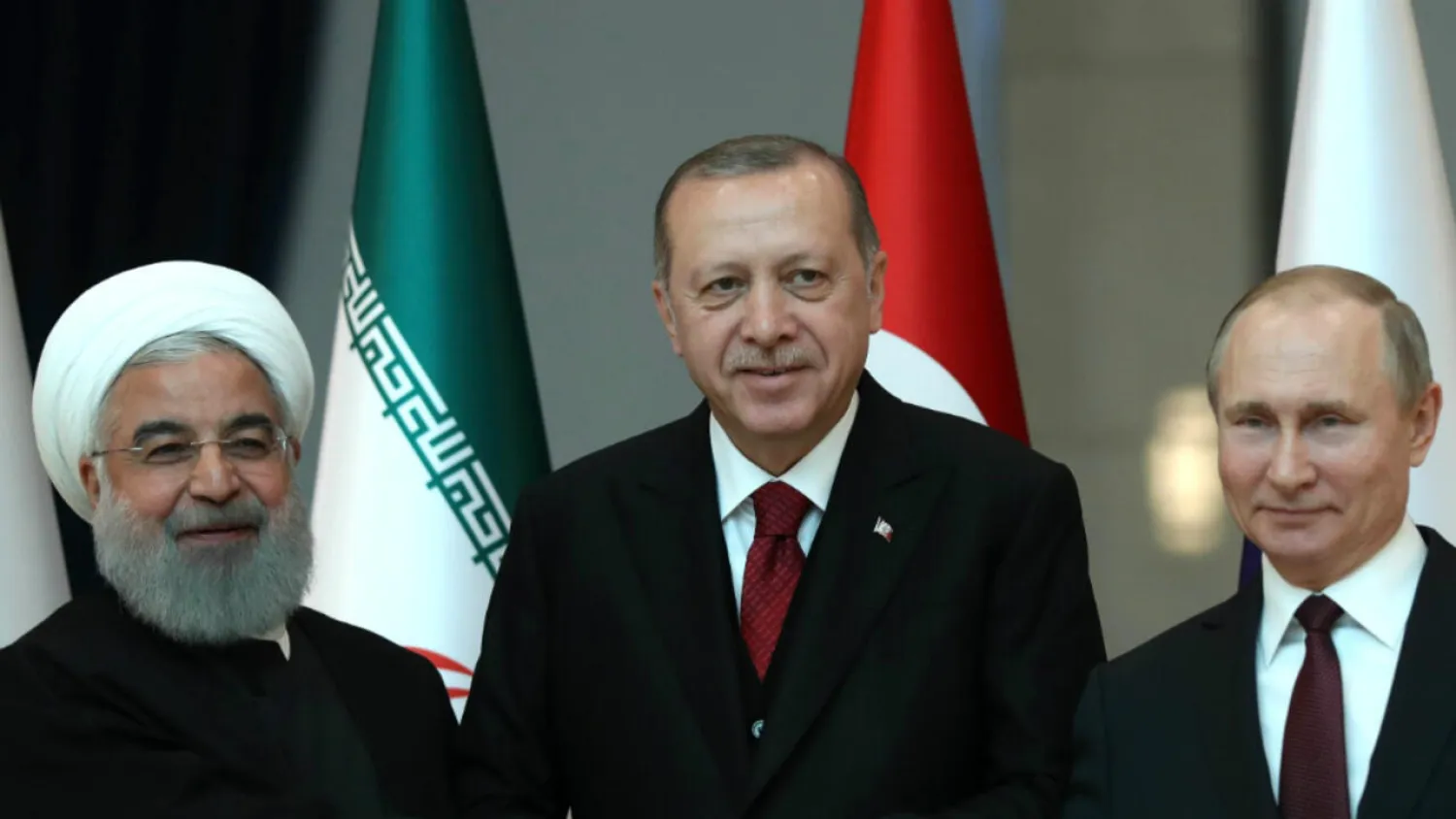

Iran, Russia, Turkey Presidents to Talk Syria War in Tehran

Tolga Bozoglu, AFP archive | Iran's Hassan Rouhani, Turkish President Recep Tayyip Erdogan, Russian President Vladimir Putin and at a tripartite summit in Ankara, Turkey in April 2018.
TT

Iran, Russia, Turkey Presidents to Talk Syria War in Tehran

Tolga Bozoglu, AFP archive | Iran's Hassan Rouhani, Turkish President Recep Tayyip Erdogan, Russian President Vladimir Putin and at a tripartite summit in Ankara, Turkey in April 2018.

With the war in Ukraine still raging, Russian President Vladimir Putin travels Tuesday to Tehran for talks with his Iranian and Turkish counterparts on the Syria conflict.

Russia, Turkey and Iran have in recent years met to discuss Syria as part of the so-called "Astana peace process" to end more than 11 years of conflict in the Arab country.

All three are involved in Syria, with Russia and Iran supporting the Damascus regime against its opponents, and Turkey backing rebels.

Tuesday's summit comes as Turkish President Recep Tayyip Erdogan has threatened to launch a new offensive in northern Syria against Kurdish militants.

Iran, whose President Ebrahim Raisi is hosting the meeting, has already warned that any Turkish military action in Syria could "destabilize the region".

The Tehran summit will also enable Erdogan to hold his first meeting with Putin since Russia invaded Ukraine in February.

The Turkish president has for months been offering to meet the Russian leader in a bid to help resolve heightened global tensions since the war began.

"The timing of this summit is not a coincidence," Russian analyst Vladimir Sotnikov told AFP.

"Turkey wants to conduct a 'special operation' in Syria just as Russia is implementing a 'special operation' in Ukraine," he said.

Turkey has launched waves of attacks on Syria since 2016, targeting Kurdish militias as well as ISIS group extremists and forces loyal to Syrian President Bashar al-Assad.

- Green light? -
Erdogan's planned military offensive targets Kurdish fighters which Ankara regards as "terrorists".

They include the US-backed Kurdish People's Protection Units (YPG), which formed a crucial part of an international coalition against the ISIS group in Syria.

Ankara fears a strong Kurdish presence along its border with Syria will embolden the banned Kurdistan Workers' Party, which for decades has been waging an insurgency against the Turkish state that has claimed tens of thousands of lives.

Syria's government has repeatedly condemned Turkish threats to mount a new incursion.

Sinan Ulgen, a visiting scholar at Carnegie Europe who specializes in Turkish foreign policy, said Ankara wants the blessing of Moscow and Iran before launching its operation.

"It's particularly important because the two potential target regions are under the control of Russia, and Turkey wants to be able to use the airspace... so as to minimize the risks," he said.

Iran "also has an indirect presence in the region through Shiite militias that it controls", said Ulgen.

Ultimately, Erdogan is hoping to get "the green light" from Putin and Raisi, he added.

Russia has already expressed the hope that Turkey would "refrain" from launching an attack on Syria.

Iran, whose foreign minister Hossein Amir-Abdollahian visited both Ankara and Damascus in recent weeks, has also urged caution.

- 'Destabilizing' -
Late last month, Iran's top diplomat said in Ankara that "we understand that... maybe a special operation might be needed".

"Turkey's security concerns must be tackled fully and permanently."

Days later, Amir-Abdollahian said in Damascus that Turkish military action in Syria "would be a destabilizing element in the region".

Mazloum Abdi, chief commander of the YPG-linked Syrian Democratic Forces, has urged Russia and Iran to restrain Turkey.

"We hope (the attacks) will not take place and that the Kurds... will not be forsaken during the talks between the big powers," he said.

The SDF has warned that an invasion by Ankara would undermine efforts to combat ISIS group jihadists in Syria's northeast.

Nicholas Heras of the Newlines Institute said Iran and Russia "want to prevent another Turkish military campaign in Syria".

"Iran is building a presence in and around Aleppo that concerns Turkey, and Russia is for all intents and purposes ceding ground to Iran throughout Syria," he added.

For Iranian political analyst Ahmad Zeidabadi, "new differences" have emerged between Russia, Iran and Turkey following the Ukraine war.

This and an "uncertain future", he said, means the three leaders will try to "coordinate" their views on Syria to avoid further tensions.



OIC-IPHRC Denounces Israeli Violations of Religious Freedom in Occupied Jerusalem

OIC-IPHRC Denounces Israeli Violations of Religious Freedom in Occupied Jerusalem
TT

OIC-IPHRC Denounces Israeli Violations of Religious Freedom in Occupied Jerusalem

OIC-IPHRC Denounces Israeli Violations of Religious Freedom in Occupied Jerusalem

The Independent Permanent Human Rights Commission (IPHRC) of the Organization of Islamic Cooperation (OIC) has unequivocally condemned the continued restrictions imposed by Israel, the occupying power, on the exercise of freedom of religion in occupied Jerusalem.

These measures include the prolonged obstruction imposed on Muslims to pray in the Al-Aqsa Mosque and also denying Christian worshippers access to their holy sites to perform obligatory religious rites.

The commission underscored that freedom of religion, including the right to manifest one’s religion in worship, observance, practice, and teaching, is a non-derogable fundamental human right under international human rights law, SPA reported.

The imposition of arbitrary and discriminatory restrictions on access to places of worship constitutes a serious violation of this right, as well as of the principles of equality and non-discrimination.

Such unjustified restrictions by Israel, the occupying power, violate international human rights law and international humanitarian law and undermine the dignity of individuals and communities by denying them the ability to freely practice their religion.

Any attempt to alter the legal and historical status quo of holy sites or to restrict access constitutes a violation of international legal obligations.

The commission calls upon the international community, including relevant United Nations mechanisms and international human rights bodies, to take appropriate measures to ensure accountability, safeguard the right to freedom of religion, and guarantee unhindered and non-discriminatory access to holy sites for all worshippers.


Indonesia Calls for Investigation into Peacekeeper Deaths in Lebanon

 Wreaths as people visit to offer condolences for Praka Farizal Rhomadhon, a United Nations Interim Force in Lebanon (UNIFIL) peacekeeper killed following an Israeli strike on Sunday in southern Lebanon, in Kulon Progo regency, Yogyakarta, Indonesia, April 1, 2026. (Reuters)
Wreaths as people visit to offer condolences for Praka Farizal Rhomadhon, a United Nations Interim Force in Lebanon (UNIFIL) peacekeeper killed following an Israeli strike on Sunday in southern Lebanon, in Kulon Progo regency, Yogyakarta, Indonesia, April 1, 2026. (Reuters)
TT

Indonesia Calls for Investigation into Peacekeeper Deaths in Lebanon

 Wreaths as people visit to offer condolences for Praka Farizal Rhomadhon, a United Nations Interim Force in Lebanon (UNIFIL) peacekeeper killed following an Israeli strike on Sunday in southern Lebanon, in Kulon Progo regency, Yogyakarta, Indonesia, April 1, 2026. (Reuters)
Wreaths as people visit to offer condolences for Praka Farizal Rhomadhon, a United Nations Interim Force in Lebanon (UNIFIL) peacekeeper killed following an Israeli strike on Sunday in southern Lebanon, in Kulon Progo regency, Yogyakarta, Indonesia, April 1, 2026. (Reuters)

Indonesia has called on the United Nations to investigate the deaths of three of its UNIFIL peacekeepers following Israeli strikes in southern Lebanon, a foreign ministry official said on Wednesday as relatives at home mourned their deaths.

The ministry's UN representative, Umar Hadi, called for the inquiry in a statement during an emergency meeting of the Security Council on Tuesday.

"We demand a direct investigation from the UN, not just Israel's excuses," he said.

Indonesia said earlier this week that ongoing Israeli military operations have ‌placed UN peacekeepers ‌in Lebanon at grave risk.

The Indonesian peacekeepers were ‌killed ⁠in two separate incidents ⁠in southern Lebanon after a bloody weekend in which Lebanese journalists and medics were also killed in Israeli strikes.

PEACEKEEPER'S RELATIVES MOURN

One of the peacekeeping troops, Farizal Rhomadhon, 28, was killed in an attack on Sunday. He is survived by a wife and one child, local media reported.

In his village in the city of ⁠Yogyakarta, his uncle Sumijan, 82, attended a family ‌gathering on Wednesday to pay his respects, ‌though he said his nephew's body had not yet been returned ‌to Indonesia.

"The kid was obedient, hard-working," he told Reuters. "Before he ‌was a soldier, he was in the business of selling songbirds. He was very disciplined."

Indonesian foreign ministry's initial reaction to Farizal's death on Monday drew criticism on social media, with many users complaining that it ‌did not identify the cause of the attack, describing it as "indirect artillery fire".

UN INVESTIGATION BLAMES ROADSIDE ⁠EXPLOSION

A roadside ⁠explosion appeared to strike the convoy of two Indonesian peacekeepers killed in southern Lebanon on Monday, UN peacekeeping chief Jean-Pierre Lacroix said on Tuesday, citing the initial findings of an investigation.

The Israeli military said on Tuesday that its review of an incident involving UNIFIL troops on Monday concluded that Israeli troops had not placed any explosive device in the area and had deployed no troops there.

Indonesia contributes over 2,700 uniformed personnel to UN peacekeeping, among the largest contributors globally, the UN said in 2024.

Indonesia has pledged to contribute troops for potential deployment in Gaza as part of the UN-mandated multinational International Stabilization Force.


Official: Yemen’s Arabian Sea Ports Poised to Become Global Logistics Hubs

Arabian Sea ports poised to become global logistics hubs (Arabian Sea Ports Authority)
TT

Official: Yemen’s Arabian Sea Ports Poised to Become Global Logistics Hubs

Arabian Sea ports poised to become global logistics hubs (Arabian Sea Ports Authority)

A Yemeni maritime official said ports along the Arabian Sea are capable of becoming global logistics hubs, citing their competitive advantages and capacity to handle various types of commercial vessels, particularly container ships and general cargo vessels, as well as dry and liquid bulk carriers.

Dr. Nabil bin Aifan, acting director of maritime affairs in Mukalla in eastern Yemen, told Asharq Al-Awsat that the Port of Mukalla is distinguished by its ability to receive all types of vessels.

He also described Saudi Arabia’s experience in developing the maritime transport and ports sector as “successful” at both regional and global levels, expressing hope that Yemeni ports — particularly Mukalla — would benefit from this experience, as well as from Saudi support for infrastructure projects in the country.

Roadmap

Mohsen al-Amri, Yemen’s transport minister, recently announced a roadmap focused on turning technical and economic studies into tangible projects, particularly regarding the ports in Hadramout, Shabwa and the Socotra archipelago, in addition to the expansion project of the Port of Mukalla, which is considered a key pillar of Yemen’s maritime activity.

Al-Amri pledged to work towards transforming Arabian Sea ports into global logistics hubs, in a move aimed at strengthening Yemen’s position on the international trade map.

Strong potential

Bin Aifan said the Port of Qana in Shabwa governorate has significant potential to become a successful commercial port, particularly in terms of its geographic location, depth, hinterland and the capacity of its berths and yards.

He also referred to a previous study he conducted on the Port of Aden and its strategic importance, noting that the port possesses global competitive advantages and, if properly invested in, could become one of the most prominent ports in the region and among the busiest in cargo handling.

“For example, the port’s geographical location links East and West, and ships need no more than four nautical miles to change direction and reach the pilot station,” he said. “It is also naturally protected from waves and from the northeast and southwest monsoon winds, enabling it to operate year-round without interruption. It lies just 105 nautical miles from the Bab el-Mandeb Strait, through which around 21,000 ships pass annually.”

Sustaining operational capacity

According to a United Nations report cited by bin Aifan, the Port of Aden requires an investment package to maintain its current operational capacity, which has declined due to insufficient maintenance, weak infrastructure and limited institutional capacity.

The report also pointed to the absence of long-term investment plans, the lack of systematic integration of risk management into decision-making processes, as well as weak awareness of health, safety and environmental issues.

Six pillars

Bin Aifan outlined six main pillars for developing Yemeni ports, foremost among them the Port of Aden: infrastructure development, digital transformation, strengthening administrative and logistics systems, developing human capital, meeting safety requirements and protecting the environment, alongside the need for a comprehensive legal framework.

“The role of the private sector in the development process cannot be overlooked, as it is one of the key pillars of successful port operations,” he said, adding that experience has shown that assigning port operations to the private sector helps improve efficiency and enhance competitiveness.

Speaking about Saudi Arabia’s role, bin Aifan said there is a strong direction within the Kingdom to support infrastructure and economic projects in Hadramout in particular and Yemen in general.

“We hope the ports will receive a substantial share of this support, based on the Kingdom’s priorities and its successful experience in this field,” he stated.