


Public Sector Strike Cripples Cash-Strapped Lebanon

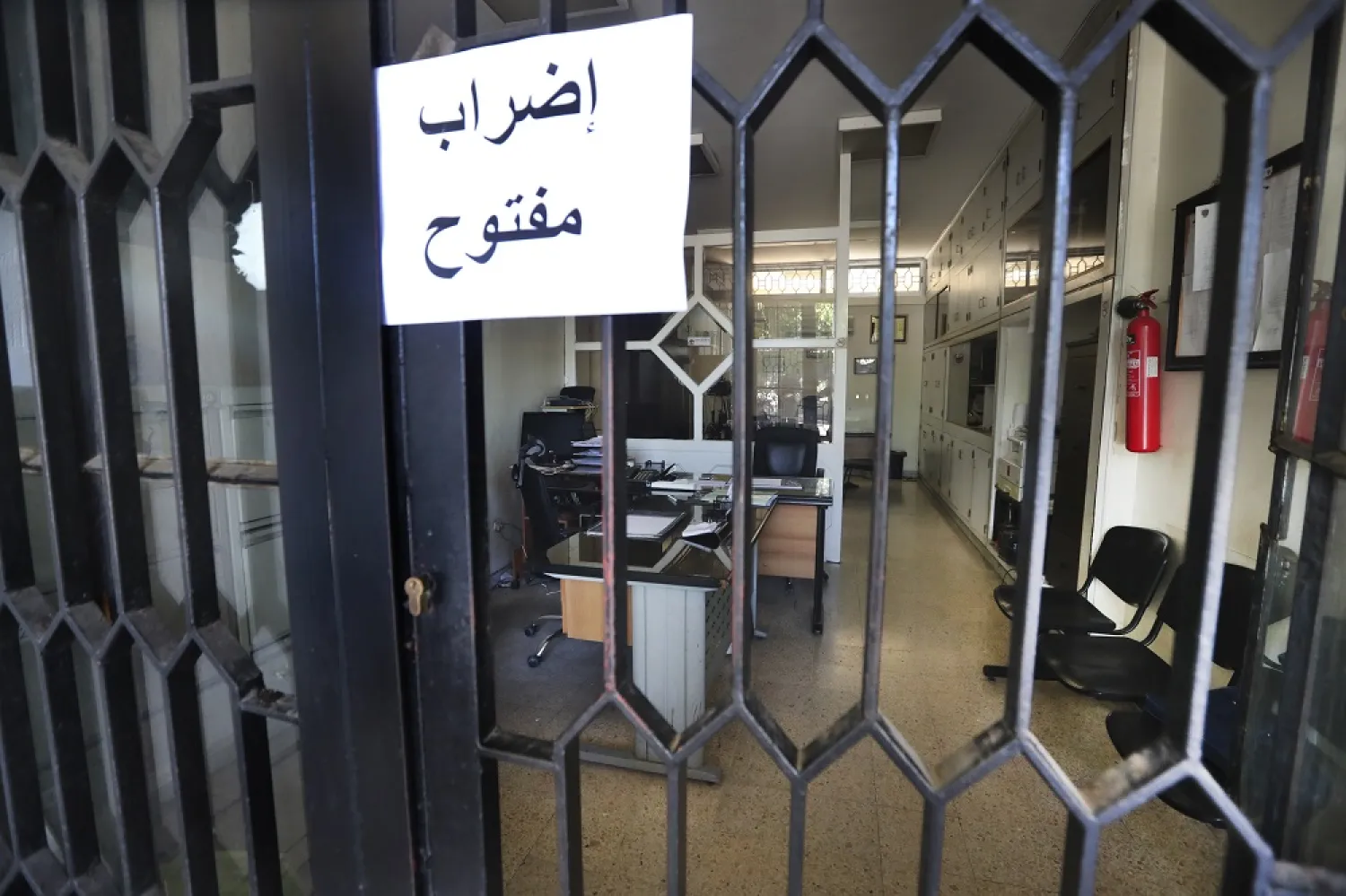
An Arabic placard reads: "Open strike", is posted on a door of an empty municipality office, in Bramiyeh, south Lebanon, July 27, 2022. (AP)
TT

Public Sector Strike Cripples Cash-Strapped Lebanon

An Arabic placard reads: "Open strike", is posted on a door of an empty municipality office, in Bramiyeh, south Lebanon, July 27, 2022. (AP)

Tarek Younes was once solidly middle class and felt he helped contribute to society as an inspector in the Lebanese government’s consumer protection agency. But the country's economic free-fall has eroded his income and civic pride.

In his desperation, Younes has joined tens of thousands of public sector employees across the country in an open-ended strike that has already lasted for six weeks.

The protest of the civil servants who form the backbone of government signals a further erosion of Lebanon’s public institutions, already struggling to afford their most basic operating costs.

The strike gives a bleak preview of how Lebanon could sink even deeper, should officials continue to delay decisive action on key financial and administrative reforms sought by the International Monetary Fund to make Lebanon's comatose economy viable again.

Meanwhile, the protest further disrupted life in Lebanon, with even the most basic government services on hold. Court cases have been delayed. Identity cards, birth certificates and school transcripts are not being issued. Air traffic controllers announced that they would stop working nights in August.

Over the past year, public transportation drivers and public school teachers held unsuccessful sporadic strikes and protests, which they hoped would be a wake-up call for the government.

"I don’t know how we’re thinking about economic recovery, if you have that many people who were once middle class now living in poverty," Younes told The Associated Press. "We are extending our hand and making compromises, but the government needs to do so as well and give us some of our rights."

Many point to decades of corruption and nefarious financial management as a cause for Lebanon’s economic downward spiral, now in its third year. They say a handful of members of Lebanon’s ruling elite caused the world's worst economic crisis since the mid-19th century, with three quarters of the population now considered poor.

The government has not increased wages for public sector workers since the onset of the country’s fiscal crunch in late 2019, during which the Lebanese pound lost over 90% of its value against the dollar. On top of that, food, gasoline and medicine prices are up sharply due to high inflation.

Younes, who heads the Association of Public Administration Employees, said public sector wages once secured a middle class lifestyle at around $1,300 per month. But that value has rapidly plummeted to the equivalent of under $70. In a country of about 6 million people, some 350,000 Lebanese work in the public sector and their salaries account for a huge chunk of the national budget.

Younes says public workers are demanding a small wage increase, better health care and a flexible transportation stipend to keep up with rising gasoline prices. They would still work with a major pay cut but he says it would "at least help us get the bare minimum of a dignified life."

With the onset of the financial crisis, Younes was scrambling as a government inspector to crack down on illegal price hikes and the hoarding of gasoline, wheat and medicine. He and dozens of other inspectors at the consumer protection services division of Lebanon’s Economy Ministry were tasked with monitoring thousands of Lebanese businesses.

Lebanon’s bickering ruling political parties have stalled in putting together an economic recovery plan and reaching a deal with the IMF for a bailout program to restructure its crippled banks and reform its pulverized economy.

The country’s caretaker government under Prime Minister Najib Mikati says it can't afford the workers’ demands but offered temporary cash bonuses and a slightly improved transportation stipend. Some employees have returned to work, but Younes said the majority still have their doors closed.

"What will (the bonuses) do? Will it help you get to work, pay your electricity bill, or your phone bill?" Younes said. "You can do one of these, but then you can’t feed your children, take them to school, or get them health care."

Lebanon’s public sector was weak even before the crisis began in late 2019, said Sami Zoughaib, an economist at Beirut-based think tank The Policy Initiative. He described it as bloated, inefficient and marred by political patronage and corruption.

"The elite used public employment as a tool in their clientelistic practices to garner political support," he said. "A bunch of them are ghost employees who are there only to get their checks but never show up to work."

Trimming the public sector payroll might help make the country’s budget sheet less sore on the eyes, but may cause backlash, impact political loyalty and worsen Lebanon’s already alarming poverty rate. The cash-strapped country has no viable social protection programs to soften the blow.

"If you fire 20 or 30 percent of the workers, how do you make sure they survive? What kind of social protection measures are you using?" Zoughaib said.

Lebanon has stalled on adopting key structural reforms required to reach an agreement with the IMF on a wholesale economic recovery program, with the government instead resorting to stop-gap measures to quell social tensions.

Zoughaib isn’t optimistic this will change.

"They will continue to kick the can down the road without harming themselves politically, with some patchwork," he said. "This is harmful for both the public sector and largely for the Lebanese public, which needs public institutions."

Meanwhile, Younes anxiously shuffles papers at his desk at the consumer protection unit as he takes a phone call. It’s another scuffle at a bread line and it appears that a bakery in Beirut has been illegally hoarding subsidized wheat imports. He calls two inspectors to investigate the situation.

Younes insists his sporadic visits to the office, located just a few floors under the economy minister's, do not signal an end to the strike. He said he still gets involved in some emergencies linked to food security, especially bread.

"Because we see how much people are suffering, and because we’re part of the people, we no doubt choose to remain available on this matter even at the bare minimum," he said.

Younes then prepares for another call with some ministers who have been negotiating with the striking workers. He says their sympathy alone is no longer enough.

"Just like we’re committed to the public administration to continue its work, we hope the rulers do so too," he said. "If there is no public sector, there is no state, no entity."



One Dead as Israeli Forces Open Fire on West Bank Stone-Throwers

Israeli troops during a military operation in the Palestinian village of Qabatiya, near the West Bank city of Jenin, 27 December 2025. (EPA)
TT

One Dead as Israeli Forces Open Fire on West Bank Stone-Throwers

Israeli troops during a military operation in the Palestinian village of Qabatiya, near the West Bank city of Jenin, 27 December 2025. (EPA)

The Israeli military said its forces killed a Palestinian in the occupied West Bank in the early hours on Thursday as they opened fire on people who were throwing stones at soldiers.

Two other people were hit on a main ‌road near the ‌village of Luban ‌al-Sharqiya ⁠in Nablus, ‌the military statement added. It described the people as militants and said the stone-throwing was part of an ambush.

Palestinian authorities in the West Bank said ⁠a 26-year-old man they named as ‌Khattab Al Sarhan was ‍killed and ‍another person wounded.

Israeli forces had ‍closed the main entrance to the village of Luban al-Sharqiya, in Nablus, and blocked several secondary roads on Wednesday, the Palestinian Authority's official news agency WAFA reported.

More ⁠than a thousand Palestinians were killed in the West Bank between October 2023 and October 2025, mostly in operations by security forces and some by settler violence, the UN has said.

Over the same period, 57 Israelis were killed ‌in Palestinian attacks.


UN Chief Condemns Israeli Law Blocking Electricity, Water for UNRWA Facilities

A girl stands in the courtyard of a building of the United Nations Relief and Works Agency for Palestine Refugees (UNRWA) in the Askar camp for Palestinian refugees, east of Nablus in the Israeli-occupied West Bank, on December 31, 2025. (AFP)
TT

UN Chief Condemns Israeli Law Blocking Electricity, Water for UNRWA Facilities

A girl stands in the courtyard of a building of the United Nations Relief and Works Agency for Palestine Refugees (UNRWA) in the Askar camp for Palestinian refugees, east of Nablus in the Israeli-occupied West Bank, on December 31, 2025. (AFP)

United Nations Secretary-General Antonio Guterres condemned on Wednesday a move by Israel to ban electricity or water to facilities owned by the UN Palestinian refugee agency, a UN spokesperson said.

The spokesperson said the move would "further impede" the agency's ability to operate and carry out activities.

"The Convention on the Privileges and Immunities of the United Nations remains applicable to UNRWA (United Nations Relief and Works Agency for Palestine Refugees in the Near East), its property and assets, and to its officials and other personnel. Property used ‌by UNRWA ‌is inviolable," Stephane Dujarric, spokesman for the ‌secretary-general, ⁠said while ‌adding that UNRWA is an "integral" part of the world body.

UNRWA Commissioner General Phillipe Lazzarini also condemned the move, saying that it was part of an ongoing " systematic campaign to discredit UNRWA and thereby obstruct" the role it plays in providing assistance to Palestinian refugees.

In 2024, the Israeli parliament passed a law banning the agency from operating in ⁠the country and prohibiting officials from having contact with the agency.

As a ‌result, UNRWA operates in East Jerusalem, ‍which the UN considers territory occupied ‍by Israel. Israel considers all Jerusalem to be part ‍of the country.

The agency provides education, health and aid to millions of Palestinians in Gaza, the West Bank, Jordan, Lebanon and Syria. It has long had tense relations with Israel, but ties have deteriorated sharply since the start of the war in Gaza and Israel has called repeatedly for UNRWA to ⁠be disbanded, with its responsibilities transferred to other UN agencies.

The prohibition of basic utilities to the UN agency came as Israel also suspended of dozens of international non-governmental organizations working in Gaza due to a failure to meet new rules to vet those groups.

In a joint statement, Canada, Denmark, Finland, France, Iceland, Japan, Norway, Sweden, Switzerland and the United Kingdom said on Tuesday such a move would have a severe impact on the access of essential services, including healthcare. They said one in ‌three healthcare facilities in Gaza would close if international NGO operations stopped.


Israel Says It ‘Will Enforce’ Ban on 37 NGOs in Gaza

The sun sets behind the ruins of destroyed buildings in the Nuseirat refugee camp in the central Gaza Strip on December 31, 2025. (AFP)
TT

Israel Says It ‘Will Enforce’ Ban on 37 NGOs in Gaza

The sun sets behind the ruins of destroyed buildings in the Nuseirat refugee camp in the central Gaza Strip on December 31, 2025. (AFP)

Israel said on Thursday that 37 international NGOs operating in Gaza had not complied with a deadline to meet "security and transparency standards," in particular disclosing information on their Palestinian staff, and that it "will enforce" a ban on their activities. 

The groups will now be required to cease their operations by March 1, which the United Nations has warned will exacerbate the humanitarian crisis in the war-ravaged Palestinian territory. 

"Organizations that have failed to meet required security and transparency standards will have their licenses suspended," the Ministry of Diaspora Affairs and Combating Antisemitism said in a statement on Thursday. 

Several NGOS have said the requirements contravene international humanitarian law or endanger their independence, while Israel has faced international criticism in the run-up to the deadline. 

Israel says the new regulation aims to prevent bodies it accuses of supporting terrorism from operating in the Palestinian territories. 

"The primary failure identified was the refusal to provide complete and verifiable information regarding their employees, a critical requirement designed to prevent the infiltration of terrorist operatives into humanitarian structures," the ministry said. 

In March, Israel gave a ten-month deadline to NGOs to comply with the new rules, which demand the "full disclosure of personnel, funding sources, and operational structures." 

The deadline expired on Wednesday. 

The 37 NGOs "were formally notified that their licenses would be revoked as of January 1, 2026, and that they must complete the cessation of their activities by March 1, 2026," the ministry said Thursday. 

- 'Weaponization of bureaucracy' - 

Minister of Diaspora Affairs and Combating Antisemitism Amichai Chikli said: "The message is clear: humanitarian assistance is welcome - the exploitation of humanitarian frameworks for terrorism is not." 

Numerous prominent humanitarian organizations have been hit by the ban, including Doctors Without Borders (MSF), World Vision International and Oxfam, according to the list provided by the ministry. 

In the case of MSF, Israel accused it of having two employees who were members of Palestinian groups Islamic Jihad and Hamas. 

MSF said earlier this week that the request to share a list of its staff "may be in violation of Israel's obligations under international humanitarian law" and said it "would never knowingly employ people engaging in military activity". 

On Thursday, 18 Israel-based left-wing NGOs denounced the decision to ban their international peers, saying "the new registration framework violates core humanitarian principles of independence and neutrality." 

"This weaponization of bureaucracy institutionalizes barriers to aid and forces vital organizations to suspend operations," they said. 

On Wednesday, United Nations rights chief Volker Turk described Israel's decision as "outrageous", calling on states to urgently insist Israel shift course. 

"Such arbitrary suspensions make an already intolerable situation even worse for the people of Gaza," he said. 

UN Palestinian refugee agency chief Philippe Lazzarini said the move sets a "dangerous precedent". 

"Failing to push back against attempts to control the work of aid organizations will further undermine the basic humanitarian principles of neutrality, independence, impartiality and humanity underpinning aid work across the world," he said on X. 

- 'Catastrophic' - 

On Tuesday, the foreign ministers of 10 countries, including France and the United Kingdom, urged Israel to "guarantee access" to aid in the Gaza Strip, where they said the humanitarian situation remains "catastrophic". 

A fragile ceasefire has been in place in Gaza since October, following a deadly war waged by Israel in response to Hamas's unprecedented attack on Israeli territory on October 7, 2023. 

Conditions for the civilian population in the Gaza Strip remain dire, with nearly 80 percent of buildings destroyed or damaged by the war, according to UN data. 

About 1.5 million of Gaza's more than two million residents have lost their homes, said Amjad Al-Shawa, director of the Palestinian NGO Network in Gaza.