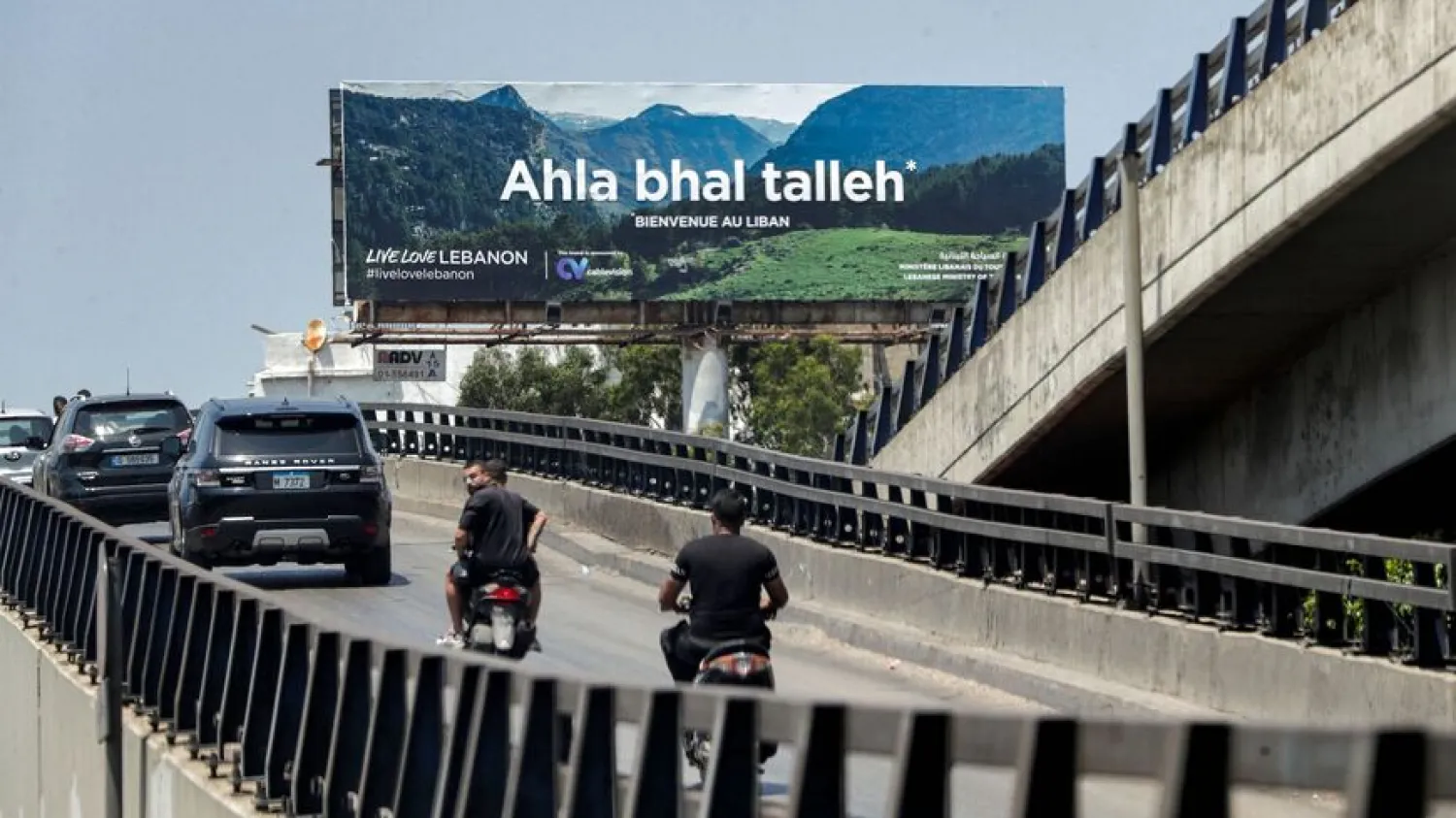
A billboard welcoming tourists is seen along the airport road in Beirut on June 22, 2022. ANWAR AMRO/AFP via Getty Images
Lebanon’s summer season constituted a lifeline for the country that has been stricken by an unprecedented economic and financial collapse since 2019. While reliance on the completion of an agreement with the International Monetary Fund (IMF) would extend the state’s finances by about $3 billion, the tourism sector was able during the past few months to secure around $5 billion to the economic cycle.
Minister of Tourism in the caretaker government Walid Nassar said that more than 1.5 million tourists visited Lebanon during the summer season, which continues until the end of September.
Those brought in around $4.5 billion, while the total amount is likely to reach $5 billion, according to the minister.
“The movement of arrivals is still active during the current month, and we are working to maintain it… during the fall season by supporting many autumn tourism activities,” Nassar told Asharq Al-Awsat.
He noted that the private sector benefited the most from the fresh dollars that entered the country, specifically the tourist establishments and all associated sectors.
In response to a question, Nassar stressed that the billions that have entered the country “do not at all dispense with the need for an agreement with the IMF.”
He explained: “An agreement of this kind is a moral and urgent necessity, as it allows us to deal with the international community.”
The minister continued: “This understanding constitutes a factor of confidence to obtain donors’ aid, especially as we need billions to secure electricity and [rehabilitate] the infrastructure and the public sector.”
Rafik Hariri International Airport recently announced that a further rise in passenger traffic was registered at the end of August. The number of passengers increased by about 35 percent compared to the same month last year, while the total number of passengers from the beginning of 2022 until the end of August rose by 58 percent compared to the same period in 2021.
Chevron Expands Venezuela Bet with $7 Billion Plan to Double Output in Five Years https://english.aawsat.com/business/5313846-chevron-expands-venezuela-bet-7-billion-plan-double-output-five-years
In this file photo taken on Jan. 26, 2022, the Chevron logo is displayed at a gas station in El Segundo, California. (AFP/Getty Images)
TT
TT
Chevron Expands Venezuela Bet with $7 Billion Plan to Double Output in Five Years
In this file photo taken on Jan. 26, 2022, the Chevron logo is displayed at a gas station in El Segundo, California. (AFP/Getty Images)
Chevron will invest more than $7 billion to double its crude output from Venezuela to about 600,000 barrels per day in the next five years, as part of a plan to expand joint ventures with state company PDVSA following an energy reform.
The US oil major's expansion, announced on Wednesday, is the culmination of several months of negotiation conducted separately from Washington's announcement of an unprecedented deal to take majority control of about 65 billion barrels of Venezuela's oil reserves.
Venezuela has the world's largest oil reserves, but years of mismanagement, corruption, under-investment and US sanctions have severely weakened its oil industry.
Production peaked at more than 3 million barrels per day in the late 1990s before declining sharply. In recent months it has been around 1.1 million to 1.2 million bpd.
Chevron's expanded agreement gives it the right over nearly half of that production. Lately, it has produced around 290,000 bpd of crude, all of it exported to the US.
The agreements provide enhanced fiscal, commercial and legal terms and include additional acreage in Venezuela's Orinoco Belt, Chevron said.
US PUSHES ENERGY INVESTMENT
Following the US capture and removal of Venezuelan President Nicolas Maduro from office in January, US President Donald Trump has pushed a $100 billion reconstruction plan for Venezuela's energy sector, urging US oil companies to invest in the country.
While Chevron's Venezuela operations have continued uninterrupted for at least 100 years, fellow oil producers ExxonMobil and ConocoPhillips have remained on the sidelines.
Both companies exited the country in 2007 when their assets were nationalized under the previous government of President Hugo Chavez.
Chevron said the investment would support production growth at its three Venezuelan joint ventures, which have increased output by 15% so far this year. Total costs are expected to remain below $20 per barrel, the company said.
Chevron's Petroindependencia joint venture, in which it holds a 49% stake, received rights to develop two new areas in Venezuela's Orinoco Belt, expanding its operations in the region.
"Chevron's history in Venezuela spans more than a century, and our expanded position reflects our confidence in the country’s deep resource potential and its ability to compete for investment within our portfolio for decades," said Chevron CEO Mike Wirth.
Chevron has operated in Venezuela since 1923 and has three joint ventures in the country. Petroindependencia and Petropiar operate in the Orinoco Belt, while Petroboscan operates in western Zulia state.
The expanded acreage and improved terms give Chevron a larger position in Venezuela as the US oil major seeks to increase production from the country's vast extra-heavy crude resources.
Italy's Eni, India's ONGC, Colombia's GeoPark and US firm GE Vernova are also expected to sign agreements for energy projects in Venezuela this week.
Winter Tests European Energy Security... Algeria Advances to the Forefronthttps://english.aawsat.com/business/5313767-winter-tests-european-energy-security-algeria-advances-forefront
Winter Tests European Energy Security... Algeria Advances to the Forefront
Pipes at the landfall facilities of the “Nord Stream 1” gas pipeline are pictured in Lubmin, Germany, March 8, 2022. (Reuters)
Europe is approaching winter facing a more complex gas equation than in previous years: lower-than-usual inventories, prices that have surged to levels the market has not witnessed in years, and disrupted Qatari supplies due to the war in the Middle East, all while Brussels moves forward with phasing out Russian gas.
At the heart of this equation, Algeria emerges as one of the most critical available alternatives, particularly for European countries bordering the Mediterranean, while Germany is moving more seriously for the first time to secure long-term contracts for Algerian gas.
Europe’s primary concern is not an immediate gas shortage, but a narrow safety margin ahead of the heating season, with EU inventories at approximately 64.7 percent in early September and Germany in a particularly vulnerable position. Simultaneously, the benchmark Dutch TTF gas price climbed to roughly 69.90 euros per megawatt-hour - its highest level since January 2023 - amid rising anxieties over liquefied natural gas (LNG) supplies from the Gulf.
The sensitivity of the situation is heightened because the European market does not only need to fill its storage facilities before winter, but must do so at a time when Asia is competing for the exact same shipments of LNG, making any additional supply shortfall even more costly.
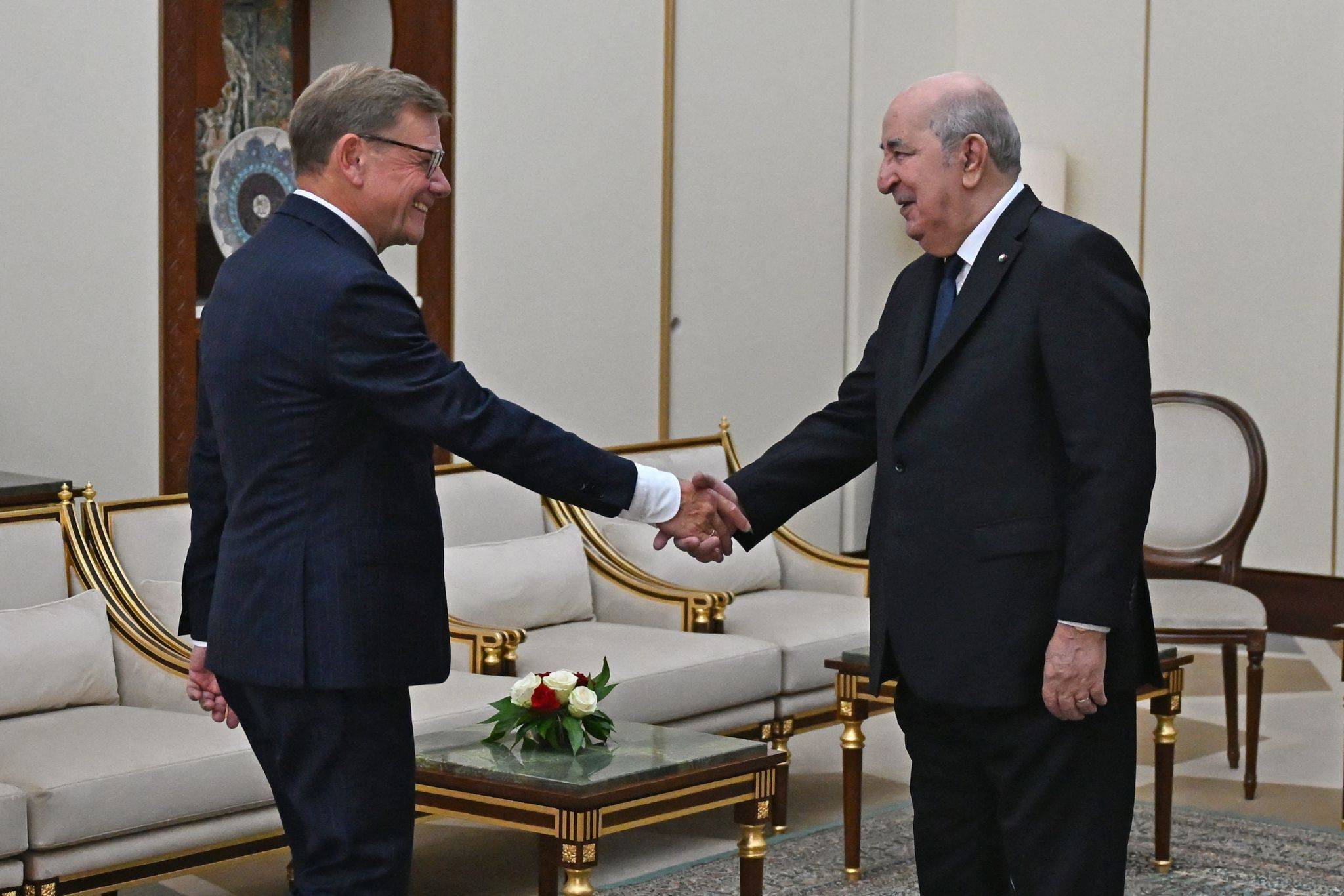
01 September 2026, Algeria, Algier: Johann Wadephul (L), German Foreign Minister, meets with Abdelmadjid Tebboune, President of Algeria. (dpa)
Algeria enters the spotlight
In this scene, Algeria is advancing to the forefront of the European scene as a nearby supplier capable of providing gas through pipelines, alongside LNG shipments.
During his visit to Algeria on Tuesday, German Foreign Minister Johann Wadephul said his country wants to negotiate long-term gas contracts with Algeria, stressing that diversifying supply sources has become a necessity and that Algeria represents a reliable source that can help meet Germany’s needs.
The German move does not come from a vacuum; Germany’s VNG and Algeria’s company Sonatrach signed a new gas supply contract in July, with deliveries scheduled to begin in 2027, as part of expanding and diversifying the German company's portfolio of gas sources.
Germany and Algeria underscored the importance of their energy partnership in July, expressing mutual interest in increasing gas supplies and cooperating on the Southern Hydrogen Corridor project. This collaboration reflects a strategic effort to establish an enduring energy relationship that extends beyond short-term supply security.
Why Algeria?
Algeria is gaining increasing importance in the European energy security equation, not only as a primary supplier of gas but also due to its weight in the oil market as a member of the Organization of the Petroleum Exporting Countries (OPEC) since 1969, producing around one million barrels per day of crude oil, including high-quality Sahara Blend. Alongside its oil wealth, Algeria possesses around 4.5 trillion cubic meters of proven natural gas reserves, cementing its position as the largest gas producer in Africa and providing a resource base capable of supporting its role as a long-term supplier to global markets.
Algeria's importance to Europe is magnified by its geographic proximity to the continent's markets and its existing export infrastructure, which includes pipelines and LNG networks. These advantages allow Algeria to respond to shifts in European demand more rapidly than suppliers that require massive investments and new infrastructure before increasing their deliveries.
The vast scale of the European market reveals both the scope of the opportunity and the challenge facing Algeria simultaneously. European Union natural gas consumption reached around 339 billion cubic meters in 2025, while domestic production did not exceed 33 billion cubic meters, leaving the continent heavily dependent on imports.
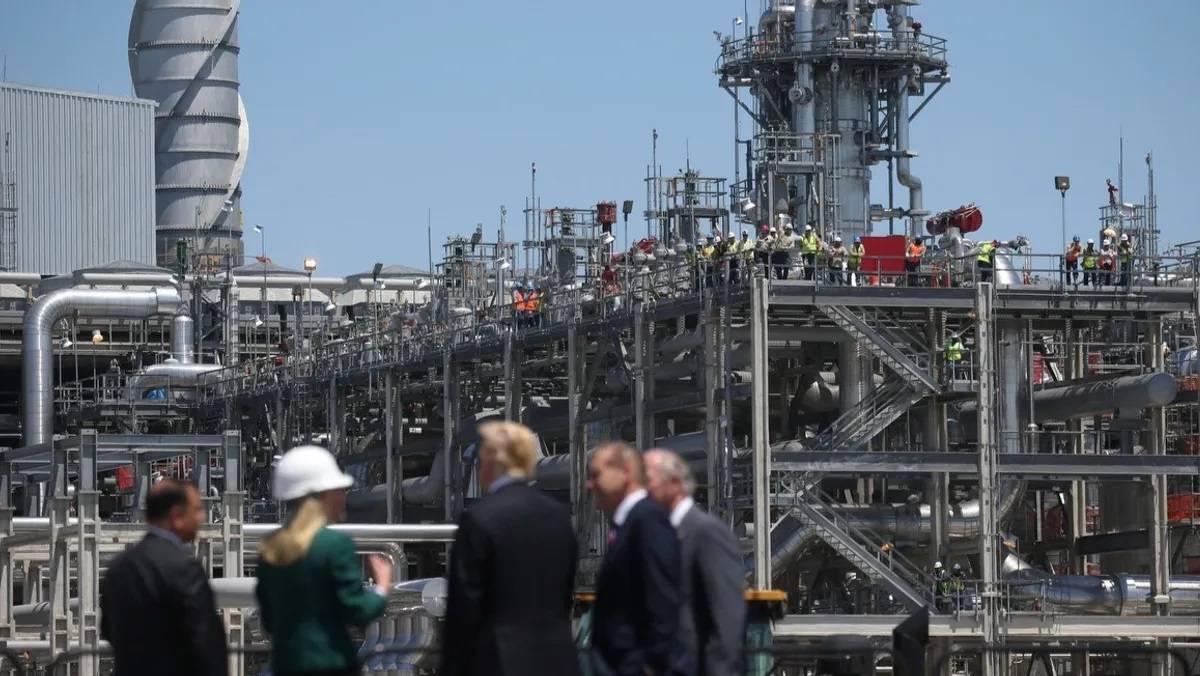
US President Donald Trump during a visit to a liquid natural gas export terminal in Louisiana. (Reuters)
With European demand projected to decline by more than 2 percent in 2026, the primary issue is not consumption growth, but rather securing supplies and diversifying their sources, particularly as Europe continues to reduce its reliance on Russian gas.
Algeria already plays a pivotal role in supplying southern Europe, particularly Italy and Spain, while Germany seeks to secure a share of Algerian supplies as part of its efforts to diversify gas sources and reduce reliance on traditional suppliers. The movement of Algerian flows to Europe reveals flexibility in directing exports according to market needs; while some flows to Italy declined, supplies heading to Spain rose, reinforcing Algeria's role in balancing the European market.
However, this importance does not mean that Algeria is capable on its own of filling the gap left by the decline of Russian supplies or any potential shortfall in Qatari deliveries. The scale of Algerian production and export capacities is insufficient to fully compensate for these supplies. Consequently, the European wager on Algeria is not based on replacing one supplier with another, but rather on a gradual reshaping of the European energy map, diversifying supply sources, and reducing the risks of relying on any single provider.
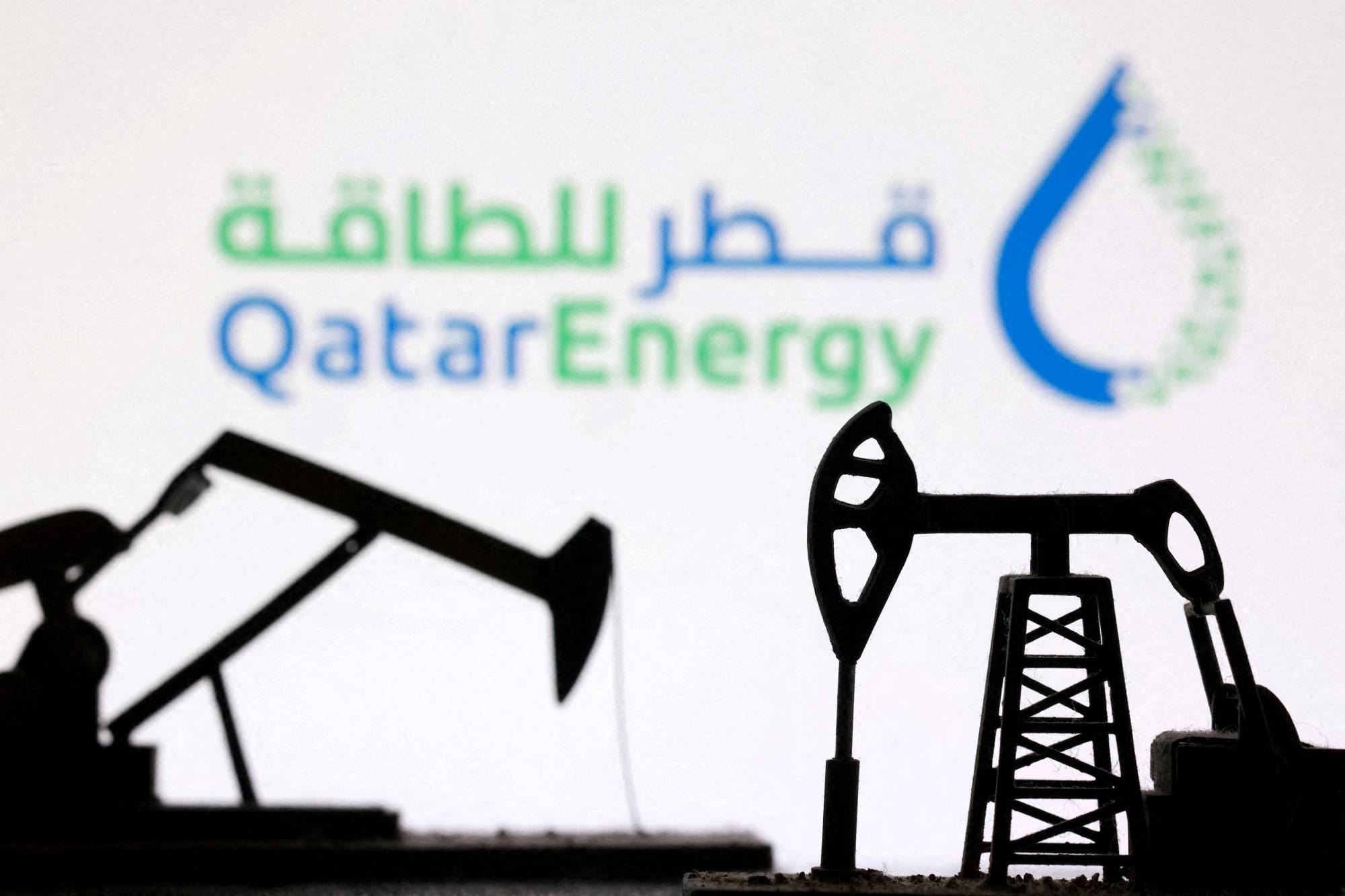
3D-printed oil pump jacks and the QatarEnergy logo appear in this illustration taken March 2, 2026. (Reuters)
Qatar absent at the worst time
The larger issue for Europe is that Qatar, which has been one of the world's most critical sources of LNG, is absent from the market at a time when the continent needs every possible additional shipment.
According to Reuters data, Qatar's LNG exports fell by around 96 percent during the first six months of the US-Israel war on Iran, with the number of shipments leaving Qatar dropping to just 18, compared to 509 during the same period last year.
This is no longer limited to a temporary disruption; QatarEnergy has extended the suspension of gas shipments to Italy’s Edison until early November, resulting in the cancellation of five additional shipments. This brings the total number of suspended shipments to 29, equivalent to around 3.8 billion cubic meters of gas.
Herein lies the paradox: Europe is entering the phase of replenishing its inventories, while one of the world's largest suppliers of LNG is unable to return to the market at full capacity.
Russia leaving the picture but not fast enough for Europe
On the opposing side, Europe is moving forward along the political and legal path to end its reliance on Russian gas. The European Union has adopted a gradual plan to ban Russian gas imports, with a full ban on long-term liquefied natural gas contracts set to begin in January 2027, and pipeline gas contracts facing a ban by September or November 2027 at the latest.
Russian gas remains present in the European market despite EU efforts to reduce reliance on it. EU countries imported over 16 percent more Russian liquefied natural gas during the first half of 2026 compared to the same period last year, totaling approximately 5.96 billion euros (USD$6.9 billion), with France, Belgium, and Spain leading as the top importers according to data from the German non-profit organization Urgewald.
These figures reflect the continued reliance of some European markets on Russian gas during the transitional phase, even as the EU moves toward a gradual phase-out of these imports and the diversification of its supply sources. This reveals the contradiction facing Europe: a political decision to eliminate Russian gas versus an ongoing market need for supplies before alternative options are fully realized.
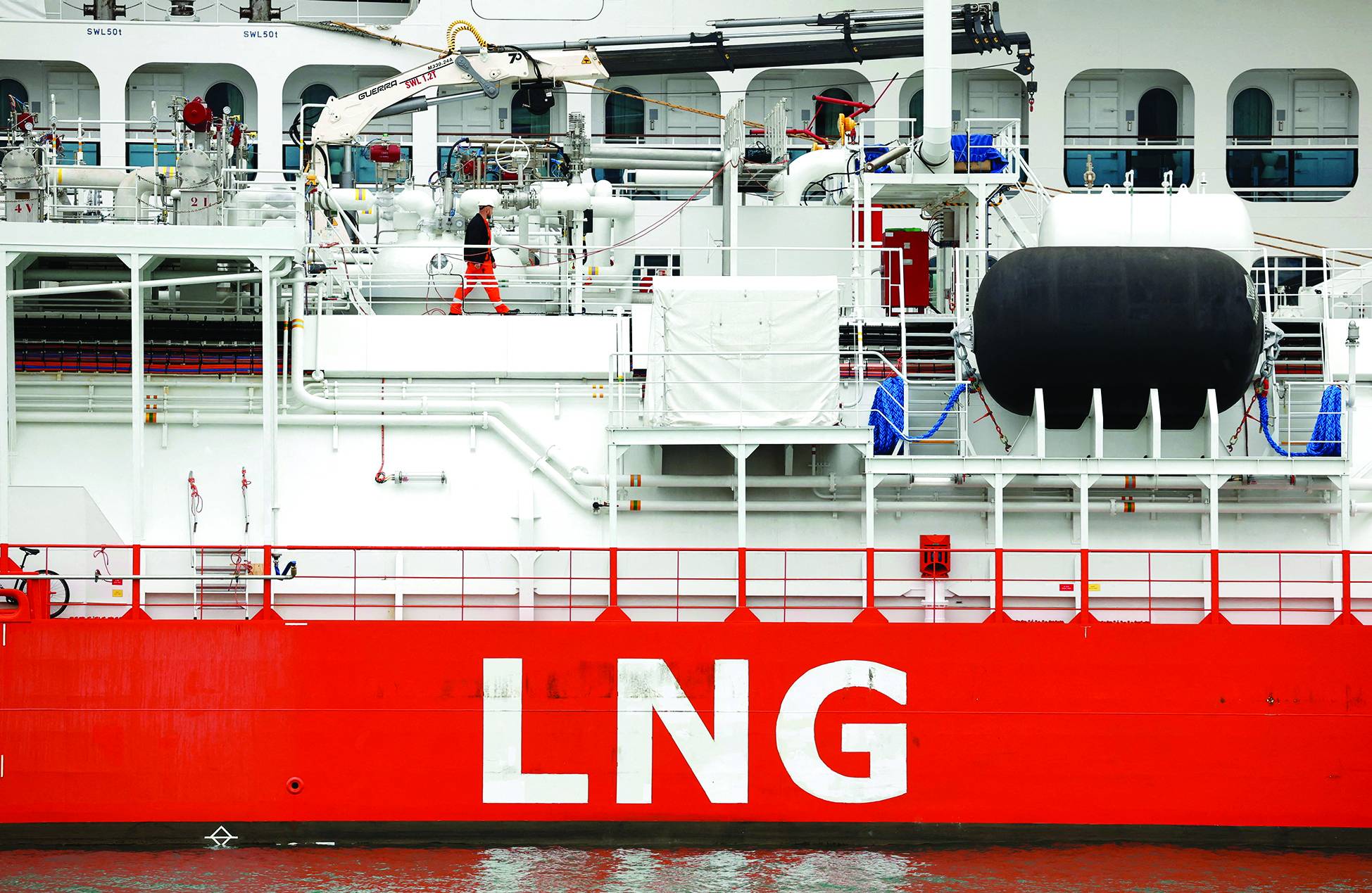
An LNG (Liquefied Natural Gas) ship loads gas to a cruise ship in Barcelona, Spain, January 29, 2024. (Reuters)
Market prices the risk
This equation was directly reflected in prices as the Dutch TTF gas contract rose to approximately 69.90 euros per megawatt-hour on September 1, marking a 4.4 percent increase in a single session. Market data indicates that European gas prices have surged by more than 130 percent since the beginning of the year.
Most importantly, the price curve itself reflects anxiety regarding the winter season, as near-term prices have become higher than some futures contract prices. This phenomenon, known as backwardation, means the price of a commodity for immediate or near-term delivery is higher than its price for future delivery, which weakens the economic incentive for traders to store large quantities of gas now, despite Europe’s need for it ahead of winter.
In the most severe scenario, European gas prices could exceed 100 euros per megawatt-hour if LNG supplies from the Middle East remain limited and competition with Asian buyers intensifies.
Winter is the real test
Therefore, the European question this winter will not be: Is there gas in the market? Rather, it will be: Is there enough gas at a price that Europe can afford?
Europe today possesses more diverse sources than it did during the 2022 crisis, with increased reliance on Norway, the United States, and Algeria, alongside the expansion of infrastructure to receive liquefied natural gas. However, this new flexibility has not eliminated the market's sensitivity to geopolitical shocks.
Europe requires substantial volumes of US LNG to offset a portion of the shortfall, but the US itself faces growing domestic gas demand, particularly with the expansion of data centers and artificial intelligence, while US gas exports cannot be increased indefinitely at a rapid pace. In July, Europe received 4.76 million tons of US gas, compared to 3.32 million tons that went to Asia.
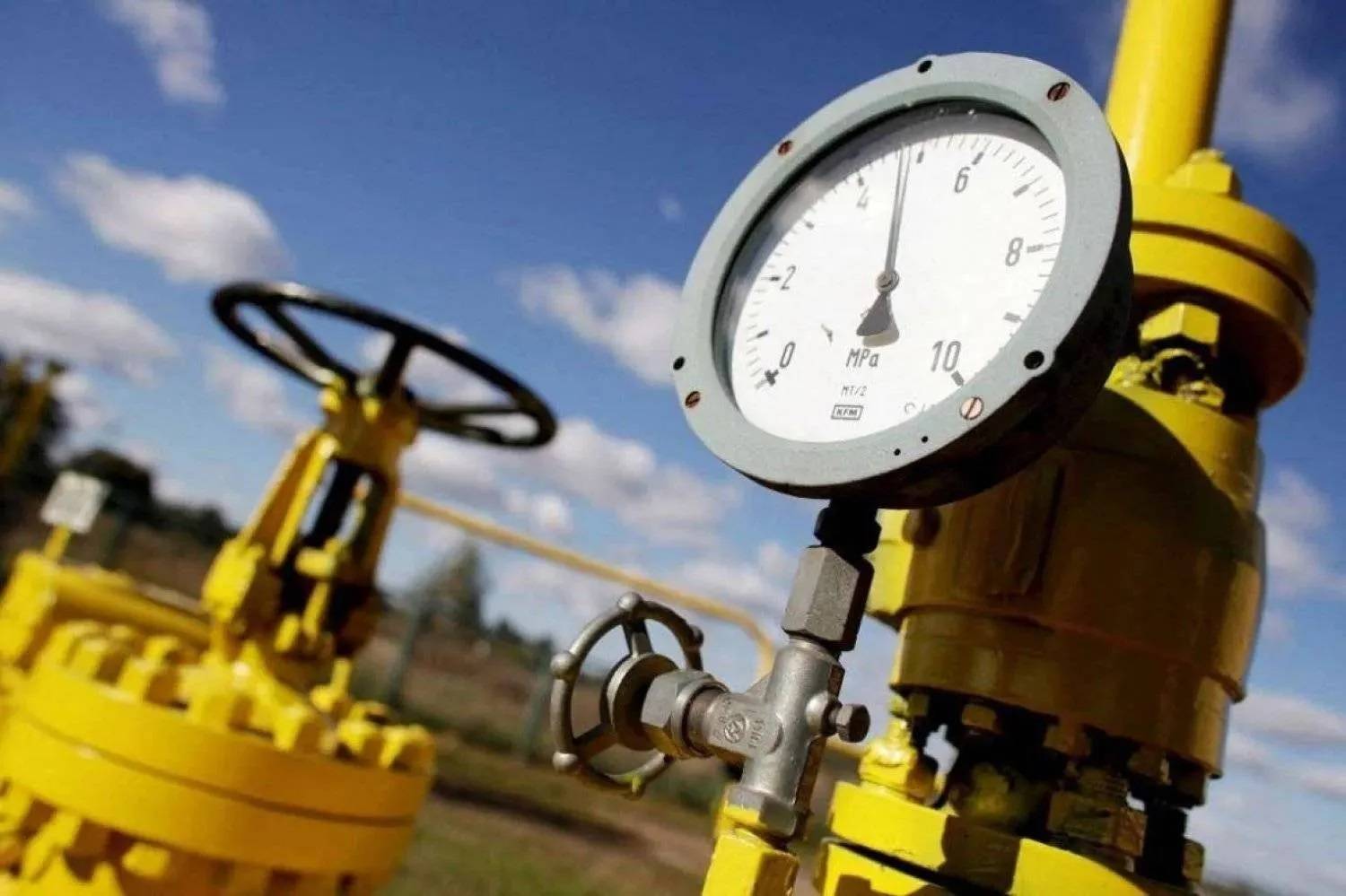
A pressure gauge is pictured at a Gaz-System gas compressor station in Rembelszczyzna outside Warsaw October 13, 2010. (Reuters)
Algeria is an important, not a sole alternative
Algeria is therefore acquiring increasing strategic importance. It is located close to Europe, possesses existing pipelines, and has extensive experience in gas exports, while it has already begun expanding its relations with European companies.
However, the European wager on Algeria does not mean the country can single-handedly fill the supply gap left by Russia and Qatar. New German demand for Algerian gas and emerging contracts reflect a broader strategic shift toward diversifying suppliers and minimizing reliance on any single source.
Ultimately, Europe's ability to safely navigate the winter will be determined by three interconnected factors: the volume of available supplies, the speed of inventory replenishment, and the severity of winter temperatures. If a cold winter coincides with the continued absence of Qatari gas and weak Russian supplies, Europe may find itself forced to pay higher premium prices to attract global shipments, while Algeria, Norway, the US, and other sources become central to the battle to secure every additional unit of gas.
So, the upcoming European gas crisis does not appear to be a mere storage issue, but rather a test of the new system built by Europe following the collapse of the Russian gas model; a system that is more diversified, yet more exposed to global prices, Asian competition, and geopolitical shocks.
Gold Hits Over 3-week Low as Mideast Tensions Fan Rate-hike Fearshttps://english.aawsat.com/business/5313753-gold-hits-over-3-week-low-mideast-tensions-fan-rate-hike-fears
Gold Hits Over 3-week Low as Mideast Tensions Fan Rate-hike Fears
A man walks past a gold shop in Istanbul's Grand Bazaar (AFP)
Gold fell to its lowest in more than three weeks on Wednesday as the escalating Middle East conflict lifted oil prices, stoking inflation and rate-hike fears, while investors focused on upcoming US jobs data.
Spot gold nudged0.2% lower to $4,321.31 per ounce by 0639 GMT, after hitting its lowest since August 7 earlier in the session. Prices were headed for a fourth straight session of decline and remained below the 200-day moving average, a closely watched technical level.
US gold futures for December delivery fell 0.6% to $4,368.50.
The US dollar held firm, making greenback-priced metals costlier for buyers using other currencies.
The US and Iran found themselves back on a war footing after the most significant exchange in weeks. Oil prices rose for a third straight session, while US Treasury yields climbed.
"A rebound in oil prices after renewed US-Iran tensions added to inflation concerns. Pricier crude could continue to tighten monetary policy expectations and drive yields higher, limiting any rebound potential for gold," said Bas Kooijman, CEO and asset manager of DHF Capital S.A.
Gold is seen as a hedge against inflation, but higher interest rates weigh on its appeal as it offers no yield.
Traders are pricing in a 70% chance of a rate hike at the Federal Reserve's policy meeting this month, according to the CME FedWatch Tool.
Fed Governor Michael Barr said if inflation does not cool quickly, it will be time for the central bank to raise rates. Fed Chair Kevin Warshsignaled in his Jackson Hole speech last week that the Fed may need to hike.
Investors are now awaiting the ADP employment report, due later in the day, and the more crucial nonfarm payrolls data on Friday.
"Softer figures could ease the pressure on gold, while stronger data or more hawkish Fed comments may extend the decline," Kooijman said.
Among other metals, spot silver lost 0.5% to $63.96 per ounce, platinum edged 0.2% lower to $1,736.51 and palladium fell 0.4% to $1,305.25.
لم تشترك بعد
انشئ حساباً خاصاً بك لتحصل على أخبار مخصصة لك ولتتمتع بخاصية حفظ المقالات وتتلقى نشراتنا البريدية المتنوعة