

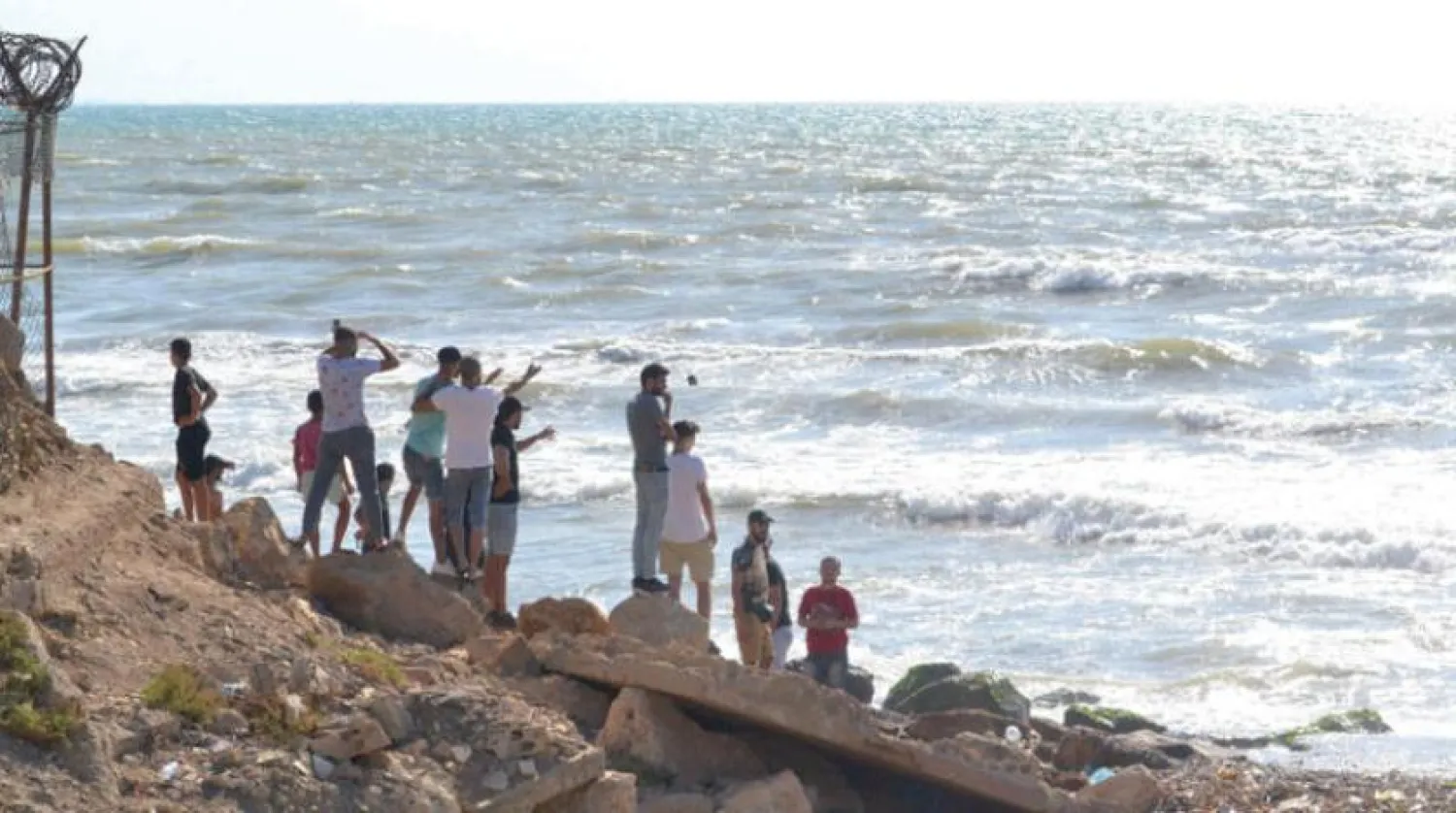

‘Death Boats’ from Lebanon … Journey to the ‘European Dream’ or Bottom of the Sea

Lebanese people await survivors or victims of a boat sinking off the Arida crossing with Syria. (AFP)
TT

‘Death Boats’ from Lebanon … Journey to the ‘European Dream’ or Bottom of the Sea

Lebanese people await survivors or victims of a boat sinking off the Arida crossing with Syria. (AFP)

Lebanon had transformed in the past two years into a platform for the departure of migrants to Europe. Over 85 journeys left the country in 2022 alone.

A Lebanese security source said the smuggling operations existed before the crisis that has been engulfing the country since 2019, but they have risen dramatically since.

Thousands of migrants from Lebanon and Syria and Palestinians have been literally throwing themselves in the sea in a gamble to reach Europe where they dream of leading a better life.

Travelers from 38 boats managed to reach European shores in 2021, while 46 have failed. Tragedy has also struck, taking hundreds of migrants to the bottom of the sea.

The Lebanese army has dedicated a unit to crack down on human traffickers. They collect the testimonies of smugglers and escapees to help them draw the complete picture of how the illicit operations take place along the Lebanese shore.

A Lebanese security source drew a bleak picture of despair to Asharq Al-Awsat. He spoke of how people were willing to risk their lives and that of their children to take the dangerous journey at sea. He also spoke of the greed of smugglers who recklessly risk the lives of people for a handful of dollars, which the migrants often collect by selling everything they own to pay for the perilous journey.

Italy is the destination of all these journeys.

Why Italy?

The source said: “Yes, the journey to Italy is longer, more difficult and more dangerous, compared to Cyprus, which can be seen by the naked eye from Lebanon.”

Lebanon and Cyprus have signed an agreement to prevent the smuggling of people from Lebanon, so that country has been ruled out by traffickers.

Greece, which is also close to Lebanon, has also been ruled out because its authorities have been brutally cracking down on migrant boats.

Italy, however, helps migrants and provides them with essentials, such as food and medical treatment, as soon as they arrive on its shores. Moreover, it does not detain the migrants, but rather allows them to roam the country and enter other parts of Europe until judicial rulings are issued.

The journey to Italy takes around eight to ten days, depending on the weather. It could take even longer if the boat is forced to maneuver around Cypriot or Greek patrols. At times, the boat may be forced to remain moored at sea for days.

Once the boat reaches regional waters, the captain would turn on the GPS and satellite telephones to call for rescue from the Italian coastguard. Once the message is received, the captain then begins to sink the vessel to destroy any evidence that gives away where the trip departed from.

Everyone onboard the boat then jumps into the sea to await the coastguard that takes them to dedicated gathering spots.

The migrants then refuse to present any identification papers, forcing Italian authorities to give them two options: Submit an asylum request in Italy or face a deadline to leave the country.

The second option is often chosen by the majority of the migrants, who have relatives or friends in other European countries, where they would choose to settle down with their help.

Smuggling scenario
The area stretching from Tripoli’s shores to the al-Abde at the border with Syria is chosen arena of the smugglers.

The smuggling operation begins with a “contractor” of sorts who gathers the travelers and agrees with them on the details of the trip and the payment that is made in installments. The first is an advance payment and the last is given to the smuggler in Lebanon through relatives or people trusted by the migrants and smuggler after the travelers reach Europe.

A passenger is charged between 4,000 and 5,000 dollars, but special prices are offered to families and groups. Discounts are offered to children, which only leads to more of them being placed in the boats.

The desperate migrants often sell their homes, gold, or properties to pay for the dangerous journey. If it is a failure, then they are left with nothing.

Passengers revealed that they have had to stay in the town of Bebnin on the eve of their journey. Their stay there is a boon for the residents. The town has become the destination of passengers from Lebanon and Syria as well.

This has led to cooperation between smugglers from Syria and those operating the migrant boats.

Rawan al-Mane, the relative of victim Mustafa Misto, said her cousin was convinced of embarking on the journey by a friend, who turned out to be close to major smuggler, Bilal Nadim Deeb.

Mustafa took out loans to pay 5,000 dollars per migrant and 5,000 dollars for his three children.

In the meantime, the smuggler would have completed the purchase of a fishing boat that will be used for the journey. The cost ranges between 35,000 and 50,000 dollars. The boat that recently sank off Syria’s Tartus cost 36,000 dollars.

The smuggler then transfers the ownership to one of the travelers, who would be granted a discount on the journey. The owner of the vessel is often pursued by judicial authorities once the trip is discovered, therefore allowing the smuggler to “remain out of the picture.”

The boat then leaves the fishing port legally. The necessary documents and identity of the sailor are verified by the security forces. Finding nothing suspicious, such as large amounts of fuel, life jackets and food, the vessel is allowed to leave.

The necessities for the journey are loaded later. They are first stored at houses that are located along the shore and their owners, of course, ask for a fee for keeping them.

The migrants are gathered in small boats dotted off the shore to avoid raising suspicions. They often do not carry any luggage, just a few bags or backpacks, meaning they could pass as regular boat passengers.

Once the migrant boat arrives, the surprises eventually begin to arise. The number of passengers often exceeds the capacity of the boat.

A boat usually has the capacity to hold 20 people, while an agreement would have been reached to load it with 50. But once the migrants are collected, the number would have crossed that figure by miles. The ill-fated boat that sank off Tartus carried over 125 people.

The boat “crew” consists of the captain, his assistant, mechanic and medic. Relatives and friends of the “crew” could take advantage of their connections and also join the journey. Rounding out the numbers are the migrants themselves.

The greater the load in the boat, the greater the danger. The weather only increases the risks and when a storm strikes, so does tragedy. Other factors that jeopardize the journey include the poor experience of the captain and his assistants and the greed of the smugglers.

The Lebanese army has been trying to crack down on smuggling throughout the year despite limited means. The security source said 46 operations were thwarted in 2022, while 38 made the journey. Two boat sinkings were reported. One vessel was rescued after suffering a malfunction at sea.

Lebanese authorities have largely managed to uncover the smuggling networks and are working on breaking them up as much as possible.

Bebnin used to be a fishing town, but the spike in smuggling has shifted the focus of the residents. Entire families are now involved in smuggling and trafficking.

The brother of detained smuggler, Bilal Deeb, also took up smuggling and headed one trafficking network. He embarked on a journey at sea with his family and is now living in Europe.


How Iranians Are Communicating Through Internet Blackout

 People walk past closed shops at the almost empty traditional main bazaar, in Tehran, Iran, Tuesday, March 10, 2026. (AP)
People walk past closed shops at the almost empty traditional main bazaar, in Tehran, Iran, Tuesday, March 10, 2026. (AP)
TT

How Iranians Are Communicating Through Internet Blackout

 People walk past closed shops at the almost empty traditional main bazaar, in Tehran, Iran, Tuesday, March 10, 2026. (AP)
People walk past closed shops at the almost empty traditional main bazaar, in Tehran, Iran, Tuesday, March 10, 2026. (AP)

Iran's latest internet blackout has lasted more than 14 days, connectivity monitor Netblocks said Friday.

The nature of the limits on internet activity shows "this is a government-imposed measure" and not the result of damage from US and Israeli airstrikes, Netblocks research chief Isik Mater told AFP.

"It is a deliberate shutdown imposed by the authorities to suppress the flow of information and prevent further dissent," said Raha Bahreini, Iran researcher at Amnesty International.

Here are some of the ways information is still flowing in and out of Iran.

- Shortwave radio -

Amsterdam-based nonprofit Radio Zamaneh began shortwave broadcasts during the January protests, sending a nightly Farsi news program from 11:00 pm Tehran time.

"It's really difficult for the regime to jam shortwave because it's a long-distance broadcast," executive director Rieneke van Santen told AFP.

"People can just listen on a super cheap, small, simple radio... It's one of those typical emergency fall-back solutions."

Declining to specify where the transmitter is located, she said it is "closer to the Netherlands than to Iran" -- although Tehran "can figure it out" if they choose.

- Phone calls -

Many with ties to Iran are still receiving landline phone calls from inside -- "quite surprising" given the internet blackout, said Mahsa Alimardani of global rights organization Witness.

Fearing the authorities listening in, people often avoid speaking directly about political topics, such as the killing of Ali Khamenei, she added.

"It's not possible to communicate about sensitive issues through these brief phone calls," Amnesty's Bahreini said.

The required prepaid international calling cards are expensive and often fail to provide their face value in minutes.

"You buy a phone card for 60 minutes, but in eight minutes, it's out," van Santen said.

"It's really just phone calls from family members saying, after the bombing, we're still alive."

- VPN or other internet services -

Virtual private networks (VPNs) -- widely-used services that encrypt internet traffic -- can't create an internet connection where none is available.

But even at around one percent of typical levels, Iran's connectivity is "still a large figure in absolute terms", Netblocks' Mater said.

Iranians suspected of using VPNs since the war began have received warning text messages claiming to be from the authorities.

Before the war, millions turned to Toronto-based company Psiphon, which creates specialist tools more capable than typical "off-the-shelf" VPNs.

Offering techniques including disguising users' data as different types of internet traffic, Psiphon "is able to evade detection more successfully", data and insights director Keith McManamen told AFP.

With up to six million unique daily users in Iran before the latest internet shutdown, connections have now tumbled to fewer than 100,000.

Few but the most tech-savvy users can reach Psiphon's network for now.

Nevertheless, "the situation is extremely dynamic. We're seeing changes not just day to day, but hour by hour," McManamen said.

A similar service, US-based Lantern, is also widely used in Iran.

- Satellite broadcasts -

Created by US-based nonprofit NetFreedom Pioneers, Toosheh is a "filecasting" technology using home satellite TV equipment to broadcast encrypted data to people in Iran.

Users record from the Toosheh satellite TV channel onto a USB stick plugged into their set-top box, which they can then decrypt using a special app installed on their phone or computer.

From that initial download, the data can be copied and shared across multiple households.

The group estimated around three million active users in Iran across 2025, with "thousands to hundreds of thousands... since the (internet) shutdown in January," the group's director of projects Emilia James told AFP.

From its usual educational repertoire ranging from English lessons to news, content these days includes more on "personal safety and digital security... helping people to stay safe," she added.

Since people are tuning in to a broadcast signal, there is no way for the government to track them, she added.

- Starlink -

Elon Musk-owned satellite internet service Starlink was used during this year's protests to get information out, while the government attempted to jam its signals.

At around $2,000 on Iran's black market, the terminals are expensive and very rare in poorer regions like Balochistan or Kurdistan that have suffered the most government repression, Alimardani said.

Meanwhile, Amnesty has received reports of "raids on houses... arrests of people who had Starlink devices," Bahreini said.

Charges for those caught communicating with the outside world range from prison sentences to the death penalty, she added.

Starlink did not respond to AFP's request for comment on usage in Iran.


How Iranians Are Communicating Through Internet Blackout

 People walk past closed shops at the almost empty traditional main bazaar, in Tehran, Iran, Tuesday, March 10, 2026. (AP)
People walk past closed shops at the almost empty traditional main bazaar, in Tehran, Iran, Tuesday, March 10, 2026. (AP)
TT

How Iranians Are Communicating Through Internet Blackout

 People walk past closed shops at the almost empty traditional main bazaar, in Tehran, Iran, Tuesday, March 10, 2026. (AP)
People walk past closed shops at the almost empty traditional main bazaar, in Tehran, Iran, Tuesday, March 10, 2026. (AP)

Iran's latest internet blackout has lasted more than 14 days, connectivity monitor Netblocks said Friday.

The nature of the limits on internet activity shows "this is a government-imposed measure" and not the result of damage from US and Israeli airstrikes, Netblocks research chief Isik Mater told AFP.

"It is a deliberate shutdown imposed by the authorities to suppress the flow of information and prevent further dissent," said Raha Bahreini, Iran researcher at Amnesty International.

Here are some of the ways information is still flowing in and out of Iran.

- Shortwave radio -

Amsterdam-based nonprofit Radio Zamaneh began shortwave broadcasts during the January protests, sending a nightly Farsi news program from 11:00 pm Tehran time.

"It's really difficult for the regime to jam shortwave because it's a long-distance broadcast," executive director Rieneke van Santen told AFP.

"People can just listen on a super cheap, small, simple radio... It's one of those typical emergency fall-back solutions."

Declining to specify where the transmitter is located, she said it is "closer to the Netherlands than to Iran" -- although Tehran "can figure it out" if they choose.

- Phone calls -

Many with ties to Iran are still receiving landline phone calls from inside -- "quite surprising" given the internet blackout, said Mahsa Alimardani of global rights organization Witness.

Fearing the authorities listening in, people often avoid speaking directly about political topics, such as the killing of Ali Khamenei, she added.

"It's not possible to communicate about sensitive issues through these brief phone calls," Amnesty's Bahreini said.

The required prepaid international calling cards are expensive and often fail to provide their face value in minutes.

"You buy a phone card for 60 minutes, but in eight minutes, it's out," van Santen said.

"It's really just phone calls from family members saying, after the bombing, we're still alive."

- VPN or other internet services -

Virtual private networks (VPNs) -- widely-used services that encrypt internet traffic -- can't create an internet connection where none is available.

But even at around one percent of typical levels, Iran's connectivity is "still a large figure in absolute terms", Netblocks' Mater said.

Iranians suspected of using VPNs since the war began have received warning text messages claiming to be from the authorities.

Before the war, millions turned to Toronto-based company Psiphon, which creates specialist tools more capable than typical "off-the-shelf" VPNs.

Offering techniques including disguising users' data as different types of internet traffic, Psiphon "is able to evade detection more successfully", data and insights director Keith McManamen told AFP.

With up to six million unique daily users in Iran before the latest internet shutdown, connections have now tumbled to fewer than 100,000.

Few but the most tech-savvy users can reach Psiphon's network for now.

Nevertheless, "the situation is extremely dynamic. We're seeing changes not just day to day, but hour by hour," McManamen said.

A similar service, US-based Lantern, is also widely used in Iran.

- Satellite broadcasts -

Created by US-based nonprofit NetFreedom Pioneers, Toosheh is a "filecasting" technology using home satellite TV equipment to broadcast encrypted data to people in Iran.

Users record from the Toosheh satellite TV channel onto a USB stick plugged into their set-top box, which they can then decrypt using a special app installed on their phone or computer.

From that initial download, the data can be copied and shared across multiple households.

The group estimated around three million active users in Iran across 2025, with "thousands to hundreds of thousands... since the (internet) shutdown in January," the group's director of projects Emilia James told AFP.

From its usual educational repertoire ranging from English lessons to news, content these days includes more on "personal safety and digital security... helping people to stay safe," she added.

Since people are tuning in to a broadcast signal, there is no way for the government to track them, she added.

- Starlink -

Elon Musk-owned satellite internet service Starlink was used during this year's protests to get information out, while the government attempted to jam its signals.

At around $2,000 on Iran's black market, the terminals are expensive and very rare in poorer regions like Balochistan or Kurdistan that have suffered the most government repression, Alimardani said.

Meanwhile, Amnesty has received reports of "raids on houses... arrests of people who had Starlink devices," Bahreini said.

Charges for those caught communicating with the outside world range from prison sentences to the death penalty, she added.

Starlink did not respond to AFP's request for comment on usage in Iran.


Will Ahmadinejad Return to the Political Scene in Iran?

Iranian former President Mahmoud Ahmadinejad. (AFP)
TT

Will Ahmadinejad Return to the Political Scene in Iran?

Iranian former President Mahmoud Ahmadinejad. (AFP)

A report by The Atlantic said the strike that hit a region close to Iranian former President Mahmoud Ahmadinejad’s residence in the first days of the war on Iran has returned to the spotlight a still controversial political figure even though he left office for over a decade ago.

On the first day of the Iran war, the assassination of Supreme Leader Ali Khamenei overshadowed news of a strike near Ahmadinejad’s home, said the report.

“Many who remembered his term in office - marked by Holocaust denial, atom-bomb fetishism, and shoving revolutionary ideology down the throats of a country already weary of it - celebrated his reported assassination,” it added. He was president from 2005 to 2013.

“Among those who have followed Ahmadinejad’s post-presidential career, however, his targeting was more of an enigma. Since leaving office, Ahmadinejad has harshly criticized the Iranian government, and as a result, Iran’s Guardian Council has formally excluded him from running for president,” said the report.

For more than a decade, he has been known more as a regime opponent than as a supporter. “I don’t understand why Israel would want to kill him in the first place,” Meir Javedanfar, who co-wrote a biography of Ahmadinejad, told The Atlantic. “Perhaps to settle scores? It makes no sense.”

Contrary to early reports, Ahmadinejad is alive, his associates revealed, requesting anonymity. “The circumstances of his survival may prove significant as the war drags on. Whatever the intent, Ahmadinejad’s associates say the strike was in effect a jailbreak operation that freed the former president from regime control.”

“Long before the war, the government had posted a small number of bodyguards near Ahmadinejad, nominally to protect a prominent citizen but also to keep tabs on him. The regime has never been sure what to do with him,” said the report.

About a month ago, after the January protests, his freedom of movement was further reduced, his phones confiscated, and the contingent of bodyguards increased from single digits to about 50. The bodyguards were based a few hundred meters from Ahmadinejad’s residence itself, at the entrance to a cul-de-sac in Narmak, in northeast Tehran. They established a checkpoint to monitor the houses and high school on that street.

“A February 28 strike hit not the residence, but the security forces nearby. In the ensuing mayhem, Ahmadinejad and his family evidently escaped their home and went underground. The government believed he had died, and his death was announced by official channels, as well as the reformist daily Sharq.”

“When rumors arose that Ahmadinejad had escaped, regime elements immediately suspected that he had been spirited away to take part in a coup,” said The Atlantic. “Ahmadinejad’s only public statement since the attack has been a brief eulogy for the supreme leader, calculated to show that Ahmadinejad was alive and to dispel speculation that he had declared himself an enemy of the state. His location is unknown to the government.”

In 2018, former Defense Minister Hussein Dehghan likened Ahmadinejad to “the door of the mosque, which can’t be burned or thrown away” without torching the mosque itself.

“Arresting Ahmadinejad could unsettle the regime,” Javedanfar said. “He knows a hell of a lot about it.”

“Ahmadinejad’s fans say that he has popular support, and that any postwar government will want him around to lend that support. If the current regime survives, it will need all the legitimacy it can get. If it does not, the United States might need someone with intimate - if outdated - knowledge of the Iranian state to be involved with what comes next. Ahmadinejad could still be useful,” the report said.