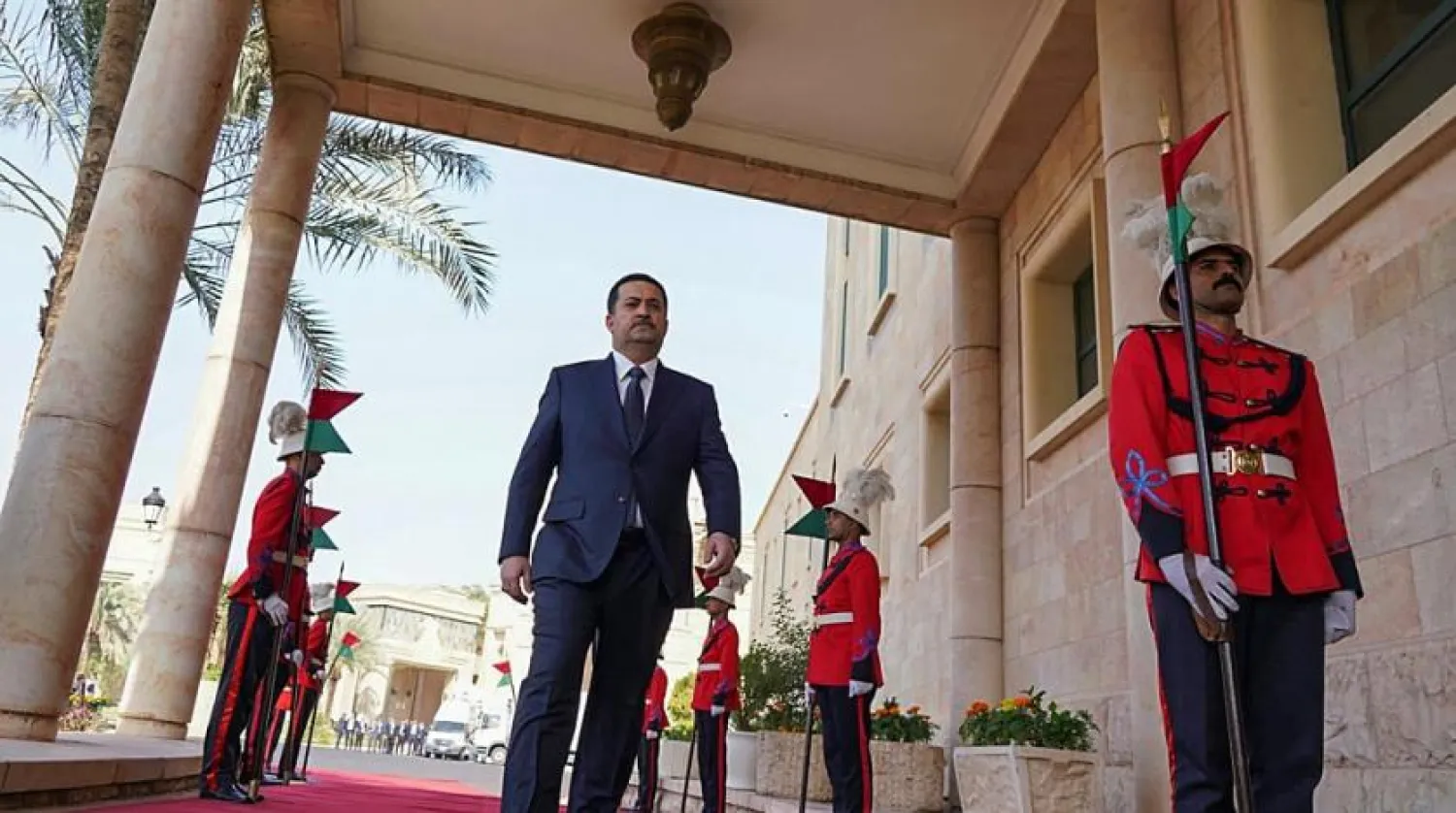
Al-Sudani: Security is a Red Line

File Photo: A handout picture released by Iraq's prime minister's office shows the new Prime Minister Mohamed Shia al-Sudani arriving for the official handover ceremony at the Republican Palace, the government's seat, in Baghdad's green zone. (Iraq's prime minister's office/ AFP)
TT

Al-Sudani: Security is a Red Line

File Photo: A handout picture released by Iraq's prime minister's office shows the new Prime Minister Mohamed Shia al-Sudani arriving for the official handover ceremony at the Republican Palace, the government's seat, in Baghdad's green zone. (Iraq's prime minister's office/ AFP)

Iraqi authorities continue investigations to uncover the circumstances of the killing of an American aid worker in the center of Baghdad on Monday, while Prime Minister Mohammad Al-Sudani warned that his country’s security was a “red line”.

The Iraqi premier, who considered that the “timing of the murder of the US citizen in Baghdad raises question marks,” pledged to pursue the perpetrators.

The leader of the Wisdom Movement, Ammar al-Hakim, warned of the repercussions of the assassination of Stephen Edward Troll on the “safe environment” in Iraq.

“The assassination of American citizen Stephen Troll in central Baghdad is a condemned and deplorable act,” he said on Twitter, expressing “deep regret” for the incident.

Al-Hakim urged the concerned security authorities to uncover the circumstances of the crime and clarify whether its motives were criminal or political, stressing that the assassination should not reflect negatively “on the safe environment that prevails in Iraq or on the country’s foreign relations.”

Washington, which seemed eager to start a new page of relations with the Iraqi government – where the majority of ministers belong to the forces of the Shiite Coordination Framework - has so far acted, according to political observers in Baghdad, with caution and anticipation without any threatening tone.

While these observers believe that it is difficult for any of the forces of the Coordination Framework to be involved in the assassination, suspicions remain about parallel parties who do not want Al-Sudani to go far in the relationship with the United States, especially following a series of recent meetings he held with US ambassador Alina Romanowski.

Meanwhile, Romanowski expressed her thanks to “the Iraqi people for their supportive messages following the brutal murder of Steven Troll last night in Baghdad.”

In a tweet on Tuesday, she said: “He was here in a private capacity doing what he loved – working (with) the Iraqi people. My deepest condolences to his wife and young children.”

A US State Department spokesperson said that US officials “stand ready to provide all appropriate consular assistance” following the incident.

Retired Major General Dr. Imad Aalo, head of the Etimad Center for Security and Strategic Studies, told Asharq Al-Awsat: “The assassination of an American citizen in Baghdad will certainly have repercussions on the prime minister’s handling of the security file in general and the uncontrolled weapons in particular.”

“What happened is a message from parties who do not want to see relations improve between Baghdad and Washington…” he added.


Israel PM Says Hezbollah Rockets, Drones Need Further Military Action

03 March 2020, Israel, Tel Aviv: Israeli Prime Minister Benjamin Netanyahu delivers an address. (dpa)
TT

Israel PM Says Hezbollah Rockets, Drones Need Further Military Action

03 March 2020, Israel, Tel Aviv: Israeli Prime Minister Benjamin Netanyahu delivers an address. (dpa)

Israeli Prime Minister Benjamin Netanyahu on Monday said rockets and drones possessed by Iran-backed Hezbollah group remained a key threat that demanded further military action by Israel's army in Lebanon. 

Israel and Hezbollah have traded blame over violations of the fragile 10-day ceasefire in Lebanon agreed earlier this month, which has since been extended, and attacks by both sides have continued. 

"There are still two central threats from Hezbollah: the 122mm rockets and the drones. This demands a combination of operational and technological activity," Netanyahu said in a statement. 

"They have about 10 percent of the missiles they had at the start of the war. But these still trouble the residents of the north," he added. 

"We are carrying out strikes now, both within the security zone and north of it, and north of the Litani River," he said, reiterating Israel's right to do so under its agreement "with the US and the Lebanese government". 

Hezbollah drew Lebanon into the Middle East war on March 2 by firing rockets towards Israel to avenge the killing of Iranian supreme leader Ali Khamenei in US-Israeli strikes. 

Lebanon and Israel's US ambassadors met twice in Washington over the past weeks, the first meetings of their kind in decades, for discussions that were categorically rejected by Hezbollah. 


Lebanon's Aoun: We Won't Accept Humiliating Deal with Israel...Taking Country to War is 'Treason'

A photograph released by the Lebanese Presidency on April 17, 2026, shows Lebanon's President Joseph Aoun delivering a televised address to the Lebanese people from the Baabda Presidential Palace, east of the capital Beirut.  (Photo by Lebanese Presidency / AFP)
A photograph released by the Lebanese Presidency on April 17, 2026, shows Lebanon's President Joseph Aoun delivering a televised address to the Lebanese people from the Baabda Presidential Palace, east of the capital Beirut. (Photo by Lebanese Presidency / AFP)
TT

Lebanon's Aoun: We Won't Accept Humiliating Deal with Israel...Taking Country to War is 'Treason'

A photograph released by the Lebanese Presidency on April 17, 2026, shows Lebanon's President Joseph Aoun delivering a televised address to the Lebanese people from the Baabda Presidential Palace, east of the capital Beirut.  (Photo by Lebanese Presidency / AFP)
A photograph released by the Lebanese Presidency on April 17, 2026, shows Lebanon's President Joseph Aoun delivering a televised address to the Lebanese people from the Baabda Presidential Palace, east of the capital Beirut. (Photo by Lebanese Presidency / AFP)

Lebanese President Joseph Aoun said Monday that direct negotiations with Israel were aimed at ending the conflict with Hezbollah, while accusing those who drew Lebanon into war of "treason" in an implicit rebuke to the Iran-backed armed group.

"My goal is to reach an end to the state of war with Israel, similar to the armistice agreement" of 1949, Aoun said in a statement, adding that "I assure you that I will not accept reaching a humiliating agreement".

"Those who dragged us into war in Lebanon are now holding us accountable because we made the decision to go to negotiations... What we are doing is not treason. Rather, treason is committed by those who take their country to war to achieve foreign interests," he said.

Earlier on Monday, Hezbollah Secretary-General Naim Qassem reaffirmed his party’s rejection of direct negotiations by the Lebanese authorities with Israel, describing them as a “grave sin,” and warning that such a step would plunge the country into a “cycle of instability.”

In a statement carried by the group’s media outlets, Qassem said: “We categorically reject direct negotiations. Those in power should know that their conduct will not benefit Lebanon, nor will it benefit them.”

He added that it is the authorities’ responsibility “to roll back their grave missteps that place Lebanon in a cycle of instability. They are responsible for halting direct negotiations with the Israeli enemy and adopting indirect ones.”

Qassem added: “These direct negotiations and their outcomes are, to us, as if they do not exist, and they do not concern us in any way.” He stressed: “We will continue our defensive resistance to protect Lebanon and its people... We will respond to Israeli aggression and confront it,” underscoring that “no matter how much the enemy threatens, we will not retreat, bow, or be defeated.”

Following the outbreak of the latest war between Israel and Hezbollah, which began on March 2, the Lebanese and Israeli ambassadors in Washington held two rounds of direct talks, the first between the two countries in decades. After the first round, US President Donald Trump announced a ceasefire that took effect on April 17 for a period of 10 days, before later announcing a three-week extension after the second round of talks.

Lebanese authorities have repeatedly stated that the US-sponsored negotiations aim to end the war, secure Israel’s withdrawal from southern Lebanon, and enable displaced residents to return to their areas, after the fighting displaced more than one million people.

Despite the ceasefire, Israel continues to carry out air and artillery strikes, particularly in southern Lebanon, while its forces conduct widespread demolition and blasting operations in many border towns, where it has announced the establishment of a “yellow line” separating dozens of villages from the rest of Lebanese territory.

At least 2,509 people have been killed and 7,755 injured in Lebanon as a result of Israeli attacks since the start of the war on March 2, according to the Health Ministry.


Israel Defense Minister Says Hezbollah Chief ‘Playing with Fire’ That Will ‘Burn Lebanon’

 People hold up portraits of Hezbollah leader, Naim Qassem, top, and slain Hezbollah leader Hassan Nasrallah as displaced residents drive back to their villages, in Jiyyeh, near Sidon, southern Lebanon, Friday, April 17, 2026, following a ceasefire between Israel and Hezbollah. (AP)
People hold up portraits of Hezbollah leader, Naim Qassem, top, and slain Hezbollah leader Hassan Nasrallah as displaced residents drive back to their villages, in Jiyyeh, near Sidon, southern Lebanon, Friday, April 17, 2026, following a ceasefire between Israel and Hezbollah. (AP)
TT

Israel Defense Minister Says Hezbollah Chief ‘Playing with Fire’ That Will ‘Burn Lebanon’

 People hold up portraits of Hezbollah leader, Naim Qassem, top, and slain Hezbollah leader Hassan Nasrallah as displaced residents drive back to their villages, in Jiyyeh, near Sidon, southern Lebanon, Friday, April 17, 2026, following a ceasefire between Israel and Hezbollah. (AP)
People hold up portraits of Hezbollah leader, Naim Qassem, top, and slain Hezbollah leader Hassan Nasrallah as displaced residents drive back to their villages, in Jiyyeh, near Sidon, southern Lebanon, Friday, April 17, 2026, following a ceasefire between Israel and Hezbollah. (AP)

Israeli Defense Minister Israel Katz warned Monday that Hezbollah's defiance would bring catastrophic consequences for Lebanon, after the group's leader rejected proposed direct talks between Israel and Lebanon. 

"Naim Qassem is playing with fire, and the fire will burn Hezbollah and all of Lebanon... If the Lebanese government continues to take cover under the wing of the Hezbollah terrorist organization -- fire will break out and engulf the cedars of Lebanon," Katz told UN envoy to Lebanon Jeanine Hennis-Plasschaert, according to a statement issued by his office. 

"If the Lebanese government continues to take cover under the wing of the Hezbollah terrorist organization -- fire will break out and engulf the cedars of Lebanon."

Katz said that Lebanese President Joseph Aoun was "gambling with the future of Lebanon", adding that Israel would not accept a situation in which a ceasefire in Lebanon coexists with continued attacks on Israeli forces and communities in northern Israel.

He reiterated that "the Lebanese government must ensure that Hezbollah is disarmed, first of all south of the Litani up to the Blue Line, and afterwards throughout all of Lebanon," referring to the river that cuts through southern Lebanon.

Aoun on Monday said that the direct talks with Israel were aimed at ending the conflict with Hezbollah while accusing those who drew Lebanon into war of "treason", in an implicit rebuke of the Iran-backed armed group.

Hezbollah leader Naim Qassem on Monday rejected Lebanon's planned direct negotiations with Israel, calling them a "grave sin" that will destabilize Lebanon. 

Lebanon and Israel's US ambassadors held two meetings in Washington over the past weeks, the first of their kind in decades. 

The first meeting led to a truce in the Israel-Hezbollah war, while Beirut has been preparing for direct negotiations with the aim of striking a peace deal with Israel. The two countries have officially been at war since 1948. 

"We categorically reject direct negotiations with Israel, and those in power should know that their actions will not benefit Lebanon or themselves," Qassem said in a statement, aired by the group's channel Al-Manar. 

He called on authorities to "back down from their grave sin that is putting Lebanon in a spiral of instability". 

He added that the Lebanese government "cannot continue while it is neglecting Lebanon's rights, giving up land, and confronting its resistant people". 

Lebanese authorities have repeatedly stated that the goal of the US-sponsored negotiations is to stop the war, secure Israel's withdrawal from southern Lebanon, and return displaced people to their homes after the fighting forced more than a million people to flee. 

"These direct negotiations and their outcomes are as if they do not exist for us, and they do not concern us in the slightest," Qassem said. 

"We will continue our defensive resistance for Lebanon and its people," he added. 

"No matter how much the enemy threatens, we will not back down, we will not bow down, and we will not be defeated. 

"We will not give up our weapons... and the Israeli enemy will not remain on a single inch of our occupied land." 

Hezbollah drew Lebanon into the Middle East war on March 2 by firing rockets at Israel to avenge the death of Iran's supreme leader Ali Khamenei in US-Israeli strikes. 

Since the truce went into force on April 17, Israeli strikes have killed at least 36 people, according to an AFP tally of Lebanese health ministry figures. 

Hezbollah has meanwhile claimed several attacks on Israeli troops in southern Lebanon, as well as missile and drone launches at northern Israel, saying it is responding to Israeli "violations". 

According to details of the truce released by the US State Department, which said both Lebanon and Israel agreed to it, Israel reserves the right to continue targeting Hezbollah to prevent "planned, imminent, or ongoing attacks". 

Hezbollah strongly rejects this clause, saying the text of the agreement was not presented to the cabinet, in which the group and its allies are represented. 

"Has the government decided to work alongside the Israeli enemy against its own people?" Qassem said in his speech. 

Israeli attacks on Lebanon killed more than 2,500 people since March 2, according to Lebanese authorities.