
Aid Workers in Syria Fear Cholera Spread If Cross-Border Support Halted

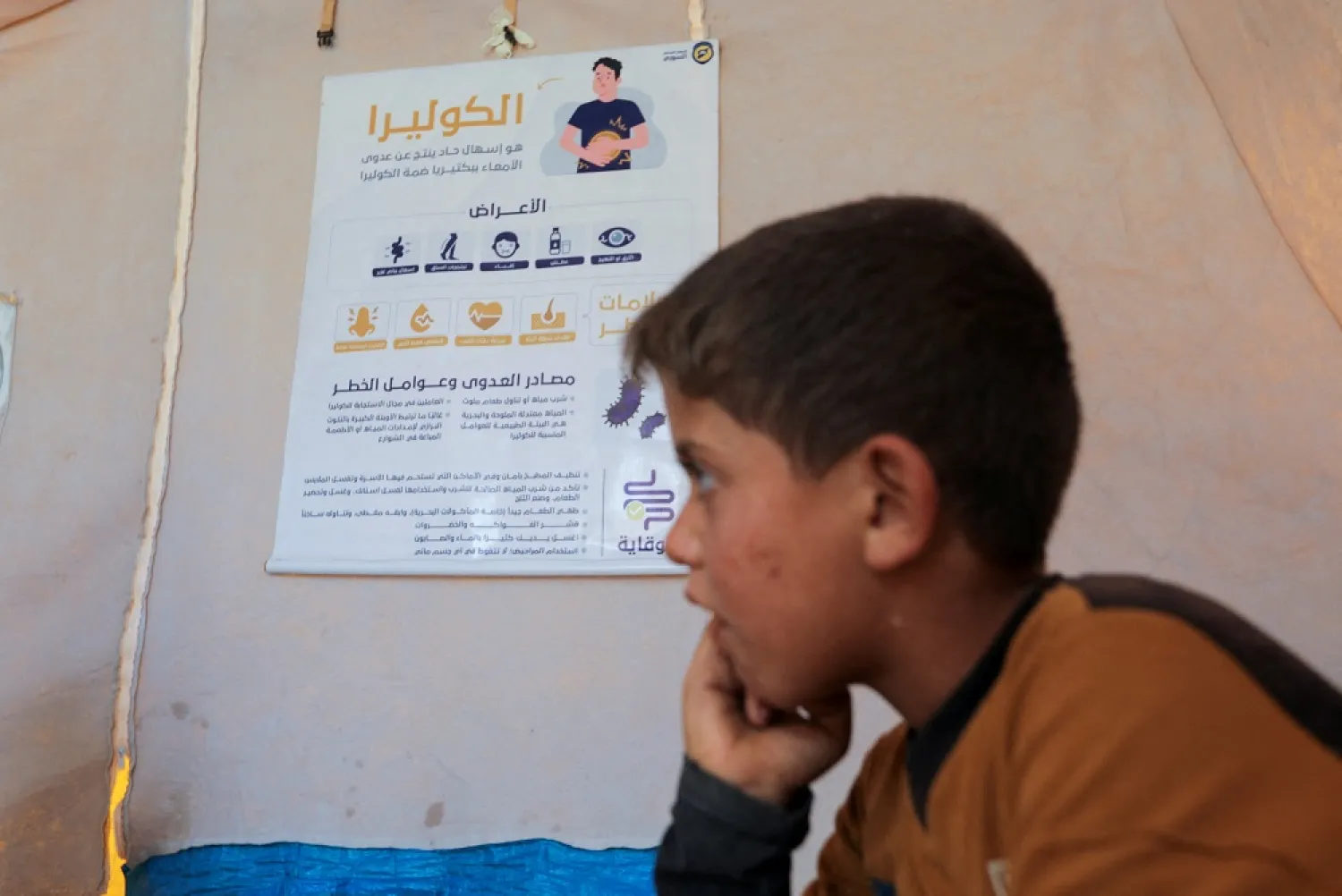
An internally displaced boy listens to civil defense members during a cholera awareness campaign, at a camp in northern opposition-held Idlib, Syria September 24, 2022. (Reuters)
TT

Aid Workers in Syria Fear Cholera Spread If Cross-Border Support Halted

An internally displaced boy listens to civil defense members during a cholera awareness campaign, at a camp in northern opposition-held Idlib, Syria September 24, 2022. (Reuters)

Humanitarian workers operating in the last opposition-held part of Syria fear a cholera outbreak sweeping the region will deepen further if the United Nations is forced to stop aid deliveries across the border from Türkiye. 

The area's 4 million people live in dire conditions and rely heavily on the food and medicine that has been brought across the border since a 2014 UN Security Council resolution allowed such deliveries despite the Syrian government's objections. 

The Security Council is due to vote on Monday, a day before the current authorization expires, on renewing it for a further six months. Health workers in the zone, which comprises most of the province of Idlib and parts of Aleppo province in northwestern Syria, fear the consequences should Syria's ally Russia veto it or place further restrictions on the program. 

"The capabilities of the health sector are already very weak, and we suffer from an acute shortage of medicines, medical supplies and serums," said Dr. Zuhair Al-Qurat, the head of Idlib's health directorate. 

"Stopping cross-border aid will have a multiplier effect on the cholera outbreak in the region," he told Reuters. 

Though diplomats say Russia has indicated it will allow the authorization's renewal, uncertainty remains. 

Russia's deputy UN Ambassador Dmitry Polyanskiy told Reuters the implementation of the current resolution - adopted in July - was "far from our expectations" and a final decision would be made by Moscow on Monday. 

Top UN officials, including aid chief Martin Griffiths, have warned that ending the operation would be "catastrophic". 

Idlib has recorded more than 14,000 suspected cholera cases and Aleppo more than 11,000 since the outbreak began in September, making them the second and fourth worst-hit in Syria respectively. 

They are particularly vulnerable because they rely on water from the Euphrates river to drink and irrigate crops, and because the health sector in opposition-held Syria has been battered by more than a decade of war. 

Clean water 

The UN authorization allows agencies to bring in hygiene kits, chlorine tablets to disinfect water and equipment for eight cholera treatment centers with more than 200 beds. Non-governmental groups also truck safe drinking water to homes. 

Without it, international NGOs would not have international legal cover and could not keep up with the pace and quantities of aid needed, three aid workers told Reuters. 

That is in part because large donor countries trust that aid brought in through the UN will not be politicized, unfairly distributed or seized by hardline armed groups. 

The chlorine used to disinfect water presents a particular challenge. The chemical has been used in Syria as a weapon of war, prompting concerns among donors that would slow down its procurement for cholera treatment by humanitarian organizations other than the UN, the aid workers said. 

"These centers and health facilities would be suspended. Supplies ... transshipped specifically for the cholera pandemic in the northwest would be interrupted – fluid, serums, injections, oral medications," said Mohammad Jasem, the International Rescue Organization's northwest Syria coordinator. 

Even if the resolution is renewed for another six months, health workers have already suffered from short-term renewals, leaving them unable to plan ahead, said Osama Abou el-Ezz, the head of the Syrian-American Medical Society (SAMS) in Aleppo. 


Tunisian Journalists Protest Over Media Crackdown

Protesters chant against President Kais Saied, in Tunis, Tunisia, August 20, 2026, demanding the restoration of democracy and calling for the release of jailed activists and journalists amid a worsening economic and social crisis (Jihed Abidellaoui/Reuters)
TT

Tunisian Journalists Protest Over Media Crackdown

Protesters chant against President Kais Saied, in Tunis, Tunisia, August 20, 2026, demanding the restoration of democracy and calling for the release of jailed activists and journalists amid a worsening economic and social crisis (Jihed Abidellaoui/Reuters)

Tunisian journalists protested on Tuesday to demand the release of prominent journalist Mohamed Yousfi, whose arrest has become a new flashpoint amid accusations that President Kais Saied is cracking down on the country's ‌remaining independent voices.


The protesters, who also included activists, gathered outside a court where a judge was questioning Yousfi over illicit enrichment and money laundering charges, which critics say were fabricated to punish him for his outspoken journalism.


Yousfi, a fierce critic of Saied and the editor-in-chief of investigative news website ⁠Al-Qatiba, was arrested last Friday as he was preparing to enter Express FM Radio to take part in a radio program.


His arrest prompted widespread condemnation of Saied’s government, with rights groups saying the case was aimed at increasing a climate of fear among journalists.


“The situation is dark and difficult. Journalists who disturb the authorities are facing legal persecution and fabricated charges,” Zied Dabbar, the head of journalists' syndicate SNJT, told Reuters.


“Today journalists either end up in exile or in ‌prison... ⁠But we will resist,” he added.


Several media figures have been jailed this year, including Zied Heni, Mourad Zghidi and Borhen Bsaies, while Khaoula Boukrim was sentenced in absentia in June to four years.


Free speech initially flourished following the 2011 uprising that toppled Zine El Abidine ⁠Ben Ali and ignited pro-democracy protests known as the “Arab Spring.”


But critics say Saied's accumulation of power in 2021 and decrees he has issued since then have dismantled democratic safeguards ⁠and enabled the authorities to pursue many journalists.


The leaders of Tunisia's main opposition parties have been jailed in the last three years, along with dozens of ⁠politicians, activists, journalists and businessmen, on charges of conspiring against state security, of money laundering and corruption.


Saied says he will not be a dictator and that freedoms are guaranteed in Tunisia.


Hate Speech and Attacks: What Is Happening to Iraqis in Iran?

A still photo from a widely circulated video showing the attack on Iraqi students in Iran.
TT

Hate Speech and Attacks: What Is Happening to Iraqis in Iran?

A still photo from a widely circulated video showing the attack on Iraqi students in Iran.

Official assurances that attacks on Iraqi students at Iran’s Semnan University have been contained have failed to quell questions over what sparked the violence, and whether growing anti-Iraqi and anti-Arab sentiment in Iran played a role.

The questions center on whether nationalist hostility and anger over financial and economic hardship caused by sanctions and war drove a group of Iranians to attack Iraqi students at their residences.

News outlet Shabaka 964 quoted traders and residents in Iran as saying that “an influential segment of Iranian society can no longer tolerate seeing even the small numbers of Iraqis passing through Iran.”

“An Iranian who supports Supreme Leader Khamenei sees an Iraqi as being under the Trump administration’s control, while an Iranian who supports the overthrow of the supreme leader’s regime sees an Iraqi as a supporter of the Popular Mobilization Forces and the supreme leader, and perhaps as someone involved in killing dissidents,” they added.

Attack begins

The incident began on Sunday when two heavily intoxicated Iranians tried to force their way into the students’ residential building. The students confronted the intruders and removed them from the building to prevent any misconduct and safeguard the premises and its residents.

The situation then escalated rapidly, with about 150 people gathering around and inside the building and attacking the Iraqi students. Several students suffered physical harm and injuries, while their personal property was damaged and the building’s windows were smashed as they tried to repel the attack and shelter themselves inside.

However, the Iraqi cultural attaché in Tehran denied that any students had been injured and described the incident as a “personal” dispute that had not been planned by the Iranian group.

Video testimonies

However, the return of some Iranians to the students’ residence the following day lends weight to unofficial accounts that describe the attack as deliberate and linked to resentment among some Iranians over the presence of Iraqis in the country.

Iraqi students appeared in video testimonies urging fellow students not to leave their residences and to leave Semnan province and its university because the area had “become dangerous and unsafe” for Iraqis.

They also said some Iranians had carried knives to attack Iraqis as they went shopping in nearby markets.

Follow-up committee

After Iraq’s Foreign Ministry faced criticism over its delayed response to appeals posted on social media by some of the students who were attacked, the ministry said on Monday that it had sent a committee to Iran’s Semnan province to follow up on the incident.

The ministry said in a statement that it had “followed with great concern the attack by a number of Iranian citizens on several Iraqi students at their residence in Semnan province in Iran.”

It added that “Foreign Minister Fuad Hussein directed the Iraqi Embassy in Tehran to ascertain the circumstances of the incident. The embassy sent a committee to check on the students, liaise with the relevant Iranian authorities and follow the course of the investigation, stressing the need for legal action against those responsible.”

The statement praised “the measures taken by the Iranian authorities to protect the students and transport them to their university to sit for their examinations.”

One-month leave

Following the Foreign Ministry’s statement, the Iraqi Embassy in Tehran said the crisis involving Iraqi students in Semnan province had been contained and that they had been granted one month’s leave.

The embassy said in a statement that “with the participation of the Iraqi Embassy and the Iraqi cultural mission, a delegation traveled to Semnan province to examine on the ground the circumstances of the crisis involving Iraqi students and directly assess their situation.”

It said the delegation “held meetings with university officials, Semnan provincial officials and the relevant authorities with the aim of addressing the aftermath of the incident and ensuring the safety of Iraqi students.”

“The crisis has been fully contained, and the Iraqi students have been granted one month’s leave to help calm the situation and restore stability to the university environment,” it added.

Iranian judiciary takes action

Mohammad Sadegh Akbari, head of the judiciary in Iran’s Semnan province, said on Monday that two people involved in the attack on Iraqi students had been identified. He said the public prosecutor in the provincial capital had issued orders summoning them before the relevant security authority.

Akbari told Iran’s state news agency IRNA that “two people involved in the clash outside the residence of Iraqi students at Semnan University have been identified. Judicial investigations are continuing to identify all those responsible for the incident, and those involved will be dealt with in accordance with the law.”

Akbari said the provincial judiciary was examining all aspects of the incident thoroughly and that, once the investigation was complete, legal and judicial action would be taken against anyone found to have played a role in the clash and in the disruption of public order and security.

Attack ‘not a coincidence’

Commenting on the attack, journalist Muntazer Nasser, who spent part of his life in Iran, said it “was not a mere coincidence” but the result of “a long series of hate speech on Iranian social media, with no official Iraqi action to counter it.”

Nasser said in a Facebook post that he had been monitoring anti-Iraqi rhetoric on Iranian social media since October 2025, beginning with “an unsubstantiated accusation that an Iraqi student at the University of Hamadan had harassed an Iranian female student, which developed into large demonstrations across the city.”

Nasser said he believed the demonstration was “a form of protest against the Iranian regime, but fear of confronting it led people to vent their anger by protesting against the Iraqi student.”

“Hate speech against Iraqis then resurfaced through a series of widely circulated videos purportedly showing members of the Popular Mobilization Forces entering the country, according to the many accounts that shared them, to suppress popular protests.”

“The rhetoric then intensified alongside images of luxury Iraqi cars driving through Iran with Iraqi license plates, which were contrasted with the poverty endured by Iranian society,” he added.

Nasser also pointed to the kidnapping of a considerable number of Iraqis and, most recently, the beating of seven tourists in the northern Iranian region of Gilan about two weeks earlier by some local residents and in full view of Iranian police, according to his account.

Nasser said the Iraqi Embassy in Tehran “should have monitored the escalation of this rhetoric from an early stage, drawn up a plan to counter it and warned its citizens. If it was unable to protect them, it should have informed the Foreign Ministry so that it could intervene at a higher level.”


Iraq Weighs Moving Factions’ Weapons to Iran for Storage

Prime Minister Ali al-Zaidi attends the Coordination Framework meeting. (INA)
TT

Iraq Weighs Moving Factions’ Weapons to Iran for Storage

Prime Minister Ali al-Zaidi attends the Coordination Framework meeting. (INA)

Iraq’s ruling Shiite coalition is discussing transferring powerful armed factions’ weapons to Iran for storage, informed sources said, omitting the politically sensitive disarmament issue from a statement after its weekly meeting on Monday.

A statement after the meeting, which was attended by Prime Minister Ali al-Zaidi, said participants had discussed the Popular Mobilization Forces law and “the importance of completing its enactment in a manner that regulates its work and strengthens its role within state institutions.”

They also discussed several key pieces of legislation, foremost among them the oil and gas law. On government formation, the Coordination Framework reviewed the ongoing talks and stressed the need to resolve the issue of vacant portfolios. It decided to proceed with naming the remaining ministers “to complete the formation of the government and enable it to carry out its duties.”

Meanwhile, political sources told Asharq Al-Awsat that the omission of the weapons issue from the statement was “linked to the three committees formed by the Coordination Framework to resolve the issue of bringing all weapons under state control.”

The committees prefer to work away from public statements and media attention, the sources said, adding that most political party leaders, both within and outside the Coordination Framework, agree that weapons should be placed exclusively under state control.

The sources attributed the repeated refusal by the three main factions — Kataib Hezbollah, Harakat al-Nujaba and Kataib Sayyid al-Shuhada — to disarm to their desire to secure guarantees that they would not face prosecution or political exclusion.

“The refusal is a negotiating tactic ahead of subsequent talks over what they may face after September 30,” the sources said.

September 30 is the deadline set for the withdrawal of US-led international coalition forces from Iraq and for the factions to lay down their weapons.

The sources said political discussions within the Coordination Framework and its committees had raised the possibility of transferring the weapons to Iran for storage, on the grounds that most of the arsenal belongs to Tehran, which supplied the groups with it.

This applies particularly to some long-range missiles that are not available to the Iraqi armed forces, they added.

The sources said Coordination Framework forces were taking the issue seriously because they feared US sanctions and backlash, with Washington insisting that the matter be resolved fully and without delay or stalling.

Several factions and Coordination Framework figures had previously set a series of conditions for disarmament that were widely regarded as impossible to meet.

They included the complete departure of international coalition forces, the withdrawal of Turkish troops from Iraqi territory, the Iraqi government’s assumption of full control over the country’s airspace and the departure from Iraq of Kurdish opposition parties hostile to Tehran.