


Putin Flaunts Alliance with Xi as ‘Dear Friends’ Meet in Kremlin

Russian President Vladimir Putin (R) shakes hands with Chinese President Xi Jinping (L) during their meeting in Moscow Kremlin in Moscow, Russia, 20 March 2023. (EPA / Sputnik / Kremlin)
TT

Putin Flaunts Alliance with Xi as ‘Dear Friends’ Meet in Kremlin

Russian President Vladimir Putin (R) shakes hands with Chinese President Xi Jinping (L) during their meeting in Moscow Kremlin in Moscow, Russia, 20 March 2023. (EPA / Sputnik / Kremlin)

Vladimir Putin hosted his "dear friend" Xi Jinping for dinner in the Kremlin on Monday, showing off his relationship with his most powerful ally just days after an international court called for the Russian President's arrest for war crimes in Ukraine.

Washington denounced Xi's visit, saying the timing showed Beijing was providing Moscow with "diplomatic cover" to commit further crimes.

It was the first trip abroad for Xi since he obtained an unprecedented third term last month. The Chinese leader has been trying to portray Beijing as a potential peacemaker in Ukraine, even as he deepens economic ties with his closest ally.

Putin and Xi greeted one another as "dear friend" when they met in the Kremlin on Monday afternoon before a dinner, with formal talks due on Tuesday.

Putin told Xi he viewed China's proposals for a resolution of the Ukraine conflict with respect, and was also "slightly envious" of China's "very effective system for developing the economy and strengthening the state".

Xi, for his part, praised Putin and predicted Russians would re-elect him next year.

"Under your strong leadership, Russia has made great strides in its prosperous development," he said.

Such a visit had long been anticipated - Putin publicly invited Xi months ago - but the symbolism was complicated by the International Criminal Court issuing an arrest warrant against Putin last week for deporting children from Ukraine.

Moscow denies illegally deporting children from Ukraine, saying it has taken in orphans to protect them. It opened a criminal case against the court's prosecutor and judges. Beijing said the warrant reflected double standards.

The West says the warrant should make the Russian leader a pariah.

"That President Xi is traveling to Russia days after the International Criminal Court issued an arrest warrant for President Putin suggests that China feels no responsibility to hold the Kremlin accountable for the atrocities committed in Ukraine," US Secretary of State Antony Blinken said.

"Instead of even condemning them it would rather provide diplomatic cover for Russia to continue to commit those grave crimes," he added.

Russia, China and the United States are not among the 123 countries that are ICC members, obliged to arrest Putin if he arrives on their territory.

Xi aims to present China as a peacemaker even as he seeks to strengthen ties with his closest ally Putin. China has released a 12-point proposal to solve the Ukraine crisis, largely dismissed in the West as a ploy to buy Putin more time to regroup his forces and solidify his grip on occupied land.

Washington has said in recent weeks it fears China might provide Russia with weapons, an accusation Beijing has dismissed.

Kyiv cautious

Kyiv, which says the war cannot end until Russia pulls out its troops, has been circumspect. It cautiously welcomed Beijing's peace proposal when it was unveiled last month even though its Western allies were publicly skeptical.

Ukrainian President Volodymyr Zelenskiy has said that China arming Russia could lead to World War Three, but also that he believed Beijing was aware of this risk, implying he thought it was unlikely. He has called for Xi to speak to him.

"We expect Beijing to use its influence on Moscow to make it put an end to the aggressive war against Ukraine," Ukrainian foreign ministry spokesperson Oleg Nikolenko said.

Putin signed a "no limits" partnership with Xi last year shortly before the Kremlin leader ordered the invasion of Ukraine. Putin claims he aims to end a threat to Russia from its neighbor's moves towards the West; Kyiv and the West call it an unprovoked attack to subdue an independent state.

Russia's assault is believed to have killed tens of thousands of Ukrainian civilians and soldiers on both sides, destroyed cities and forced millions to flee. Moscow claims to have annexed nearly a fifth of Ukraine.

The Kremlin said Putin would provide Xi with detailed "clarifications" of Russia's position, without elaborating.

Justice ministers from around the world met in London on Monday to discuss support for the ICC, whose chief prosecutor Karim Khan called on Russia to repatriate the Ukrainian children to prove it is acting in their best interests as it says it is.

Several European Union countries agreed in Brussels to jointly buy one million rounds of 155 mm artillery shells for Ukraine. Both sides fire thousands of rounds every day.

The United States announced its latest military aid package, worth $350 million, including more ammunition for HIMARS rocket launchers, howitzers and Bradley Infantry Fighting Vehicles, plus HARM missiles, anti-tank weapons and river boats.

Fierce fighting continued in the eastern Ukrainian town of Bakhmut where Ukrainian forces have held out since last summer in the longest and bloodiest battle of the war.

Moscow, which has not won a major victory since last August, has launched a massive winter offensive involving hundreds of thousands of freshly called-up reservists and convicts recruited from jails.

Fighting that both sides describe as a meat grinder has scattered the battlefield with bodies, but the front line has barely moved for more than four months.

Ukraine, which recaptured swathes of territory in the second half of 2022, has kept mainly to defense since November, aiming to deplete Russia's attacking forces before launching a planned counteroffensive of its own.

Russian mercenary boss Yevgeny Prigozhin, whose Wagner private army has led the offensive in Bakhmut, wrote in a letter to Defense Minister Sergei Shoigu that Kyiv was planning an offensive as soon as late March or April.

Ukraine would aim to cut Wagner forces off from Russia's regular army, Prigozhin wrote, which could lead to "negative consequences".
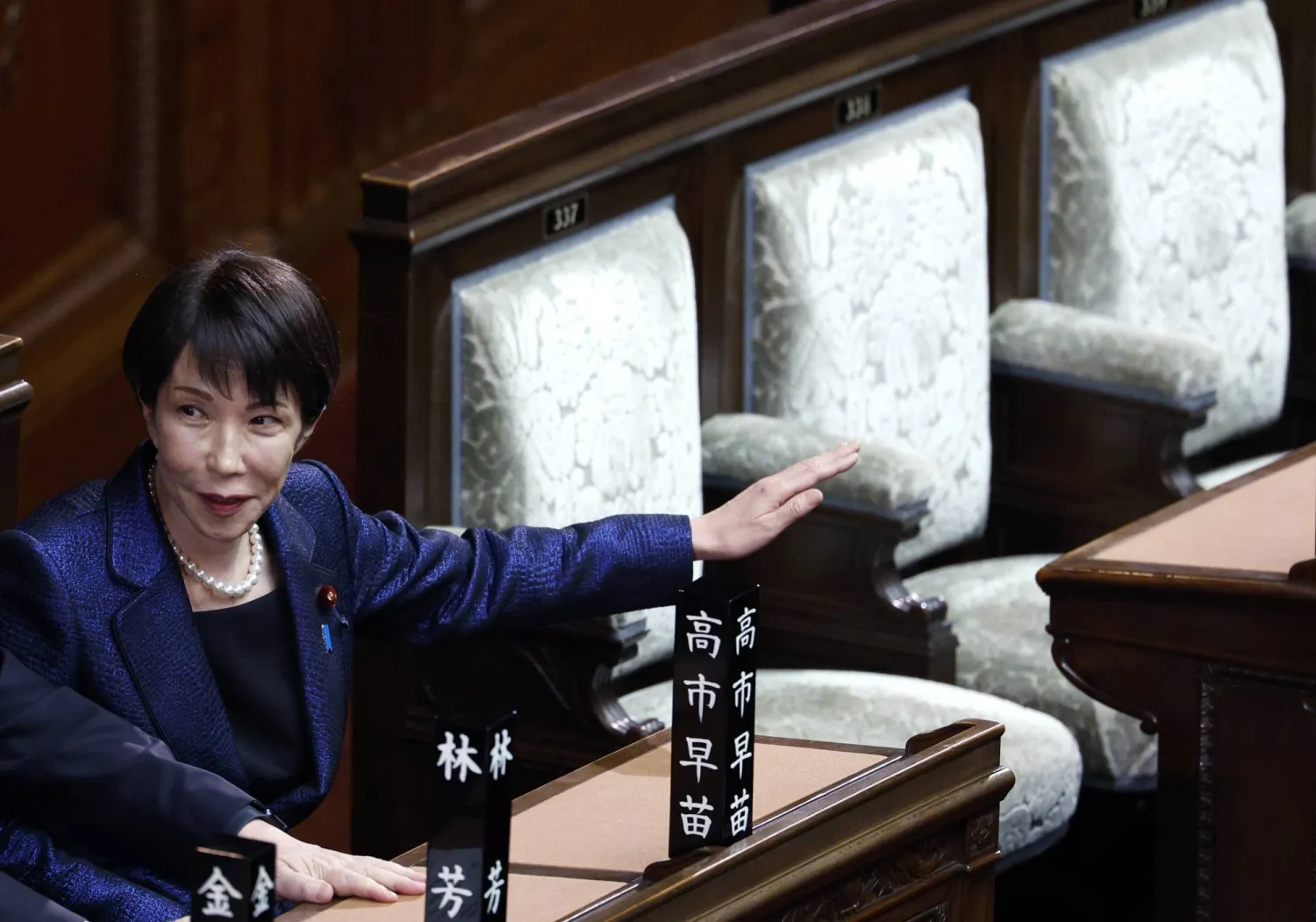



Japan PM Takaichi Reappointed Following Election

Sanae Takaichi gestures at the Lower House of the Parliament in Tokyo, Japan, 18 February 2026. EPA/FRANCK ROBICHON
TT

Japan PM Takaichi Reappointed Following Election

Sanae Takaichi gestures at the Lower House of the Parliament in Tokyo, Japan, 18 February 2026. EPA/FRANCK ROBICHON

Japan's lower house formally reappointed Sanae Takaichi as prime minister on Wednesday, 10 days after her historic landslide election victory.

Takaichi, 64, became Japan's first woman premier in October and won a two-thirds majority for her party in the snap lower house elections on February 8.

She has pledged to bolster Japan's defenses to protect its territory and waters, likely further straining relations with Beijing, and to boost the flagging economy.

Takaichi suggested in November that Japan could intervene militarily if Beijing sought to take Taiwan by force.

China, which regards the democratic island as part of its territory and has not ruled out force to annex it, was furious.

Beijing's top diplomat Wang Yi told the Munich Security Conference on Saturday that forces in Japan were seeking to "revive militarism".

In a policy speech expected for Friday, Takaichi will pledge to update Japan's "Free and Open Indo-Pacific" strategic framework, local media reported.

"Compared with when FOIP was first proposed, the international situation and security environment surrounding Japan have become significantly more severe," chief government spokesman Minoru Kihara said Monday.

In practice this will likely mean strengthening supply chains and promoting free trade through the Trans-Pacific Partnership (CPTPP) that Britain joined in 2024.

Takaichi's government also plans to pass legislation to establish a National Intelligence Agency and to begin concrete discussions towards an anti-espionage law, the reports said.

Takaichi has promised too to tighten rules surrounding immigration, even though Asia's number two economy is struggling with labor shortages and a falling population.

On Friday Takaichi will repeat her campaign pledge to suspend consumption tax on food for two years in order to ease inflationary pressures on households, local media said, according to AFP.

This promise has exacerbated market worries about Japan's colossal debt, with yields on long-dated government bonds hitting record highs last month.

Rahul Anand, the International Monetary Fund chief of mission in Japan, said Wednesday that debt interest payments would double between 2025 and 2031.

"Removing the consumption tax (on food) would weaken the tax revenue base, since the consumption tax is an important way to raise revenues without creating distortions in the economy," Anand said.

To ease such concerns, Takaichi will on Friday repeat her mantra of having a "responsible, proactive" fiscal policy and set a target on reducing government debt, the reports said.

She will also announce the creation of a cross-party "national council" to discuss taxation and how to fund ageing Japan's ballooning social security bill.

But Takaichi's first order of business will be obtaining approval for Japan's budget for the fiscal year beginning on April 1 after the process was delayed by the election.

The ruling coalition also wants to pass legislation that will outlaw destroying the Japanese flag, according to the media reports.

It wants too to accelerate debate on changing the constitution and on revising the imperial family's rules to ease a looming succession crisis.

Takaichi and many within her Liberal Democratic Party (LDP) oppose making it possible for a woman to become emperor, but rules could be changed to "adopt" new male members.


Türkiye: Ocalan Announces ‘Integration Phase’

Members of the Kurdish community take part in a protest calling for the release of convicted Kurdistan Worker's Party (PKK) leader Abdullah Ocalan in Diyarbakir on February 15, 2026. (Photo by Ilyas AKENGIN / AFP)
TT

Türkiye: Ocalan Announces ‘Integration Phase’

Members of the Kurdish community take part in a protest calling for the release of convicted Kurdistan Worker's Party (PKK) leader Abdullah Ocalan in Diyarbakir on February 15, 2026. (Photo by Ilyas AKENGIN / AFP)

The jailed leader of the Kurdistan Workers Party, Abdullah Ocalan, has said that the Ankara-PKK peace process has entered its “second phase,” as the Turkish parliament sets the stage to vote on a draft report proposing legal reforms tied to peace efforts.

A delegation from the pro-Kurdish Peoples' Equality and Democracy Party (DEM Party), including lawmakers Pervin Buldan, Mithat Sancar, and Ocalan’s lawyer Ozgur Faik, met with the jailed PKK leader on Monday on the secluded Imrali island.

Sancar said that the second phase will be focused on democratic integration into
Türkiye’s political system.

According to the lawmaker, the PKK leader considered the first phase the “negative dimension” concerned with ending the decades-old conflict between the armed group and Ankara.

“Now we are facing the positive phase,” Ocalan said, “the integration phase is the positive phase; it is the phase of construction.”

For the second phase to be implemented, Ocalan called on Turkish authorities to provide conditions that would allow him to put his “theoretical and practical capacity” to work.

The 60-page draft report on peace with the PKK was completed by a five-member writing team, which is chaired by Parliament Speaker Numan Kurtulmuş, and is scheduled for a vote on Wednesday.

The report is organized into seven sections.

In July last year, Ocalan said the group's armed struggle against Türkiye has ended and called for a full shift to democratic politics.


Iranians Chant Slogans Against Supreme Leader at Memorials for Slain Protesters

An Iranian man holds the Iranian national flag during a memorial ceremony for those killed in anti-government protests earlier last month, at the Mosalla mosque in Tehran, Iran, 17 February 2026. (EPA)
TT

Iranians Chant Slogans Against Supreme Leader at Memorials for Slain Protesters

An Iranian man holds the Iranian national flag during a memorial ceremony for those killed in anti-government protests earlier last month, at the Mosalla mosque in Tehran, Iran, 17 February 2026. (EPA)

Iranians shouted slogans against Supreme Leader Ali Khamenei on Tuesday as they gathered to commemorate protesters killed in a crackdown on nationwide demonstrations that rights groups said left thousands dead, according to videos verified by AFP.

The country's clerical authorities also staged a commemoration in the capital Tehran to mark the 40th day since the deaths at the peak of the protests on January 8 and 9.

Officials acknowledge more than 3,000 people died during the unrest, but attribute the violence to "terrorist acts", while rights groups say many more thousands of people were killed, shot dead by security forces in a violent crackdown.

The protests, sparked by anger over the rising cost of living before exploding in size and anti-government fervor, subsided after the crackdown, but in recent days Iranians have chanted slogans from the relative safety of homes and rooftops at night.

On Tuesday, videos verified by AFP showed crowds gathering at memorials for some of those killed again shouting slogans against the theocratic government in place since the 1979 revolution.

In videos geolocated by AFP shared on social media, a crowd in Abadan in western Iran holds up flowers and commemorative photos of a young man as they shout "death to Khamenei" and "long live the shah", in support of the ousted monarchy.

Another video from the same city shows people running in panic from the sounds of shots, though it wasn't immediately clear if they were from live fire.

In the northeastern city of Mashhad a crowd in the street chanted, "One person killed, thousands have his back", another verified video showed.

Gatherings also took place in other parts of the country, according to videos shared by rights groups.

- Official commemorations -

At the government-organized memorial in Tehran crowds carried Iranian flags and portraits of those killed as nationalist songs played and chants of "Death to America" and "Death to Israel" echoed through the Khomeini Grand Mosalla mosque.

Iranian President Masoud Pezeshkian attended a similar event at the Imam Reza shrine in Mashhad.

Authorities have accused sworn enemies the United States and Israel of fueling "foreign-instigated riots", saying they hijacked peaceful protests with killings and vandalism.

Senior officials, including First Vice President Mohammad Reza Aref and Revolutionary Guards commander Esmail Qaani, attended the ceremony.

"Those who supported rioters and terrorists are criminals and will face the consequences," Qaani said, according to Tasnim news agency.

International organizations have said evidence shows Iranian security forces targeted protesters with live fire under the cover of an internet blackout.

The US-based Human Rights Activists News Agency (HRANA) has recorded more than 7,000 killings in the crackdown, the vast majority protesters, though rights groups warn the toll is likely far higher.

More than 53,500 people have been arrested in the ongoing crackdown, HRANA added, with rights groups warning protesters could face execution.

Tuesday's gatherings coincided with a second round of nuclear negotiations between Iran and the United States in Geneva, amid heightened tensions after Washington deployed an aircraft carrier group to the Middle East following Iran's crackdown on the protests.