Lebanon’s Rahi, Audeh Slam Politicians for Failing to Elect New President

Maronite Patriarch Beshara al-Rahi during Palm Sunday mass. (Markazia)
TT

Lebanon’s Rahi, Audeh Slam Politicians for Failing to Elect New President

Maronite Patriarch Beshara al-Rahi during Palm Sunday mass. (Markazia)

Lebanon’s Christian religious leaders slammed on Sunday politicians for failing to elect a new president, amid a vacuum that has continued for five months and despite recent attempts to revive efforts to agree on a candidate.

During the Palm Sunday mass, Maronite Patriarch Beshara al-Rahi called on politicians to “destroy the sin of corruption, self-interest and egoism” and to elect a president.

He said the best politicians are those who are committed to telling the truth and realizing that the power entrusted to them is for service.

The true politician is a servant, and when he does not perform his duty, then he is a bad politician, the patriarch stressed.

Rahi said the politicians, especially deputies, “must know that the guarantee of a just policy is the election of a president who possesses these characteristics who can set straight state institutions.”

He announced that the Patriarchate is preparing for a spiritual retreat for Christian MPs in Harissa on April 5 when “they will pray for Lebanon and its salvation from its political, living, economic and financial crises.”

Greek Orthodox Archbishop of Beirut Elias Audeh said during his Sunday sermon that Lebanon is “full of leaders, politicians, deputies, and rulers who only care about their interests, and work only according to their affiliations.”

“They are not ashamed of what they have brought the country to,” he added.

“Institutions are blocked, civil servants are on strike, billions of liras are wasted and they are begging for help. How can they live without conscience and sleep without worry?” he said.

He stressed that Lebanon needs real leaders.

“We need people who think and have a vision of a cause to defend, not politicians who abuse power and the people,” Audeh added.

Lebanon has been without a president since Michel Aoun's term ended on Oct. 31. MPs have not been able to elect a successor even though 11 parliamentary electoral sessions have been held to agree on a candidate.

According to the Lebanese constitution, the 128-member legislature requires a majority of two-thirds (85) to elect a president in the first round, and then in the second round, a candidate can be elected by a simple majority of 65 lawmakers.

During the 11 parliamentary sessions, Hezbollah, Amal and Free Patriotic Movement lawmakers quit the meeting before the second round of voting, leading to a loss of quorum.

Meanwhile, the head of Hezbollah's parliamentary bloc, MP Mohammed Raad, called Sunday on all political forces to prioritize the national interest in order to save the country.

He stressed the need to elect a president without waiting for foreign orders.

“We are not aspiring to take power in this country, but we are keen to see an authority capable of meeting the aspirations of the people. We refuse unilateral decisions in managing people's affairs,” Raad said.

The deputy said Hezbollah is open to dialogue.


War Deepens Lebanon’s Economic Collapse

A displaced young girl who fled with her family Israeli airstrikes in southern Lebanon, eats an apple at a playground school that turned into a shelter in Beirut, Saturday, March 21, 2026. (AP Photo/Hussein Malla)
TT

War Deepens Lebanon’s Economic Collapse

A displaced young girl who fled with her family Israeli airstrikes in southern Lebanon, eats an apple at a playground school that turned into a shelter in Beirut, Saturday, March 21, 2026. (AP Photo/Hussein Malla)

Lebanon’s economy barely catches its breath before another crisis hits, tightening the squeeze and deepening its fragility.

The current war has wiped out efforts to revive it, as the country still reels from the 2019 financial collapse, the coronavirus pandemic, the Beirut port blast, and the 2023-2024 war.

After successive governments failed to resolve its structural crisis, the latest military escalation has further weakened the economy and stalled reform efforts, despite the current government's attempts to lay out recovery plans and legislation.

Since the first week of the war, some businesses have halved employees’ working hours to cut wages, while others have shut down entirely, aside from those destroyed in Beirut’s southern suburbs and the south.

The impact has been immediate, with many workers still earning less than half their pre-2019 salaries.

Losses of $100 million a day

Nicolas Chammas, secretary-general of the Lebanese Economic Organizations and head of the Beirut Traders Association, described the war’s impact as “huge,” compounded by years of strain since 2019.

“In 2025, economic growth reached 5%, but that followed a 7% contraction in 2024,” Chammas told Asharq Al-Awsat. “We had already started this year on a negative footing, and the current war has worsened conditions.”

According to the World Bank, the 2024 war cost $14 billion, or about $225 million a day.

“Using that as a benchmark, the current war is costing roughly $100 million a day,” he said, citing damage to infrastructure, reduced economic activity, and the cost of sheltering and assisting displaced people.

Chammas said tourism and travel were among the hardest-hit sectors, with travel down by more than 80%.

“Hotel occupancy is now below 10%, and declines are also severe in car rentals, furnished apartments, and resorts,” he said. “The industrial and commercial sectors are also affected, with the latter down around 50%.”

If the war continues, he warned, growth could flip into a contraction of up to 10%.

Structural contraction

Economist Jassem Ajaka said the war has shifted the downturn from “monetary” to “structural.”

“Under full dollarization, the shock no longer shows in a currency collapse, but in paralyzed economic activity and higher operating costs,” he told Asharq Al-Awsat.

He put total losses from the previous and current wars at about $15 billion, direct and indirect, based on World Bank estimates and updated research for 2026.

With Brent crude above $115, production and dollarized service costs have risen by more than 40%, eroding companies' profit margins, he said.

The agricultural sector has been the hardest hit geopolitically, with losses of about $2.5 billion due to destroyed land and disrupted supply chains. Tourism revenues have fallen 74% compared with the 2024 season, depriving the economy of a key source of foreign currency.

Ajaka said recent Banque du Liban data showed external assets holding at about $12.07 billion, supported by liquid foreign securities.

But he warned that a prolonged war and high oil prices would gradually drain those assets to cover fuel and essential imports, threatening this “artificial stability” in the second half of the year if reserves fall below safe levels.

Latest figures

Ajaka said 30% of small and medium-sized businesses had shut down permanently by the first quarter of 2026, unable to cover dollarized operating costs amid weak demand.

Those still operating have shifted to “emergency cash flow management,” with some paying half salaries or flat dollar wages worth no more than 40% of previous levels.

Unemployment has surged to between 46% and 48%, driven not only by business closures but also by the inability of productive sectors to absorb labor costs amid rising global energy and input prices.


Iranians Celebrate Nowruz in Iraq’s Kurdistan Despite War

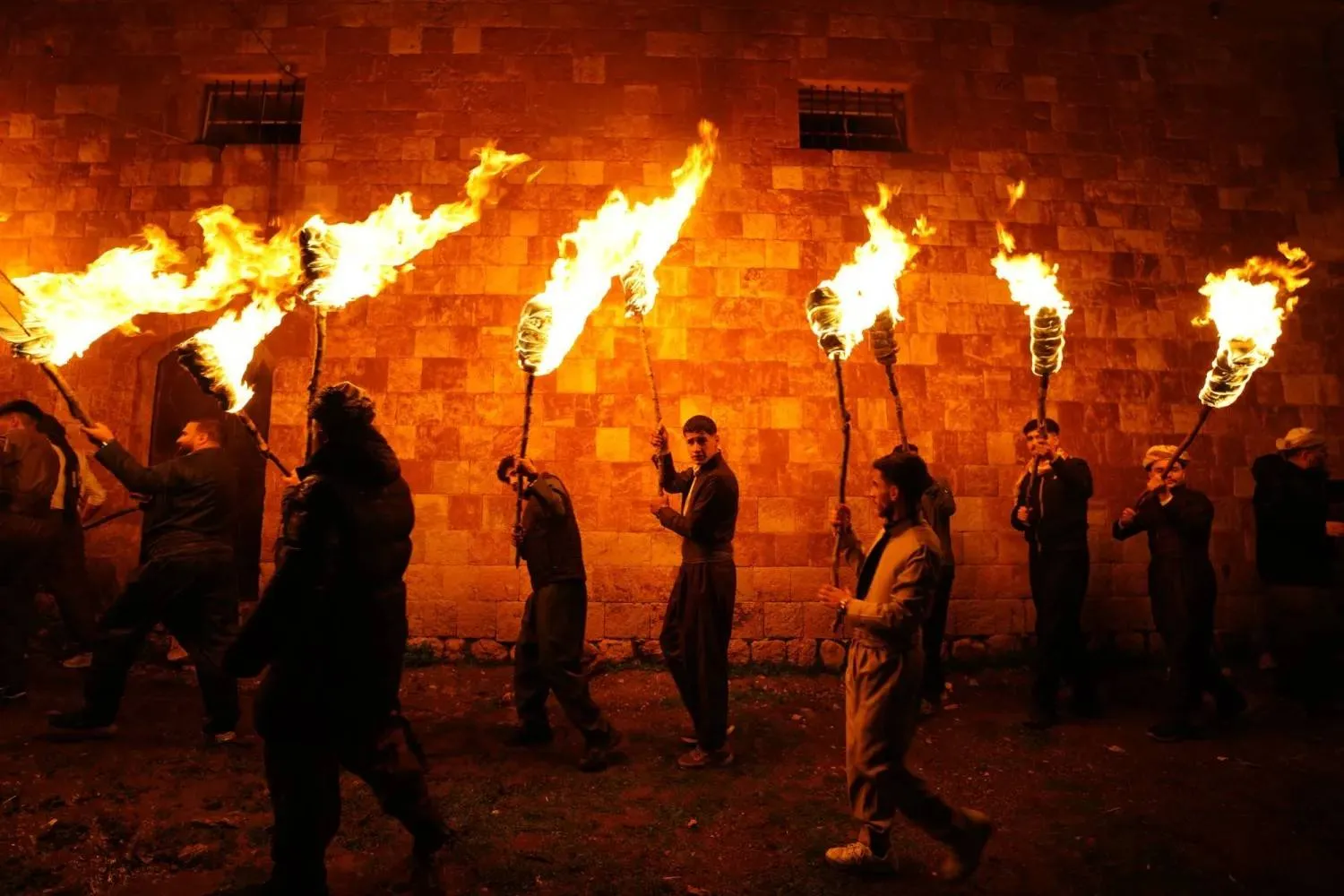
Kurds march with torches during a procession to celebrate the Nowruz New Year festival in the town of Akre in Iraq's northern autonomous Kurdish region (dpa) 
TT

Iranians Celebrate Nowruz in Iraq’s Kurdistan Despite War

Kurds march with torches during a procession to celebrate the Nowruz New Year festival in the town of Akre in Iraq's northern autonomous Kurdish region (dpa) 

In Iraq's northern Kurdistan region, women perform a traditional dance, their long dresses spinning, gold tassels and heavy necklaces catching the firelight, as smaller crowds than usual celebrate Nowruz, overshadowed by the Middle East conflict.

Among them were Iranian Kurds Sirwa Mustafazada and Kwestan Aminpana, who fled their home country as a result of their activism in 2018.

After three weeks of war, they share the same yearning: “Next year we will be back.”

Mustafazada, 32, who fled the city of Mahabad in western Iran, said, “We have lived all this time with this hope.”

Falling on the equinox in March, Nowruz -- the Persian New Year also celebrated by Kurdish communities in Iraq, Syria, Türkiye and Iran -- is typically marked by weeks of anticipation ahead of joyful family feasts and celebrations, according to AFP.

But this year the war, launched by Israel and the US on Iran on February 28, has cast a pall over the ancient festivities.

Security concerns muted celebrations across the autonomous Kurdistan region in Iraq, but crowds still gathered and small bonfires were lit in regional capital Erbil, as well as Sulaimaniyah and Akreh city.

In Sulaimaniyah, the region's second city, the crowd momentarily started when fireworks erupted -- recently, similar blasts have signaled drone strikes.

Attacks attributed to Iran and its proxies have repeatedly targeted armed groups of the Iranian Kurdish opposition, organizations long exiled in Iraq.

“The regime is doing everything it can to save its own skin,” said Mustafazada. “But it has no outside support, and nobody wants it anymore inside.”

Nowruz, long frowned upon by hardliners in Iran, is especially contentious this year.

It falls within the 40-day mourning period after the death of Iran's supreme leader Ali Khamenei, killed on the first day of the war.

Both women accuse the Iranian authorities of attempting to ban the celebration in the past.

But 33-year-old Aminpana said with a grin: “They'll push even harder, and we, in Kurdistan, will push back even more.”

“Nowruz is a symbol of rebirth, resilience, connection with nature, and joy,” said Saad Qazi, a former Kurdish fighter, also from Mahabad.

“It's important to preserve our traditions and our identity, to be able to answer our children when they ask us, 'Who are we?'”

On a coffee table in his living room in Erbil, the traditional seven ingredients of "Haft-Sin" are laid out, the candle burning bright.

Qazi's wife, Parang Jahani, has carefully arranged each item -- all of which begin with “S” in Farsi -- in small bowls: wheat germ, sweet pudding, jujube berries, sumac, garlic, vinegar and apple.

They will remain there for the 13 days of the festival, a promise of strength, vitality, health, and beauty.

And, again, yearning: “Next year, maybe, we'll be back. In any case, we have more hope than last year.”


Fighting in South Lebanon Reaches Close Combat Stage

Israeli tanks are deployed along the northern Israeli border with Lebanon, 21 March 2026. EPA/ATEF SAFADI
TT

Fighting in South Lebanon Reaches Close Combat Stage

Israeli tanks are deployed along the northern Israeli border with Lebanon, 21 March 2026. EPA/ATEF SAFADI

Israeli advances in the border town of Khiam and the coastal village of Naqoura triggered fierce clashes with Hezbollah, which said its fighters battled Israeli forces for four hours in central Khiam, as sustained Israeli shelling pounded the surrounding areas and one-way attack drones entered the fight.

The Israeli push toward the outskirts of Bint Jbeil and the Litani River from the Maroun al-Ras and Taybeh axes slowed, with fighting shifting to Khiam, where Israeli forces are seeking full control after advancing on the western axis facing the Marjayoun plain, the third stage of an offensive toward northern Khiam.

The battle for Khiam

Battlefield sources in Marjayoun told Asharq Al-Awsat that fighting erupted with light and medium machine guns, in one of the rare instances in which such intense clashes have been heard so clearly in the area. Explosions were followed by thick smoke rising over central and western Khiam.

Clashes focused on the Jallahiya neighborhood, one of the last high ground positions in northwestern Khiam and a key link between the city’s center and its eastern and western sectors. Israeli tanks had reached the area days earlier before withdrawing, in what observers described as a probing move to test Hezbollah’s defenses.

The latest incursion followed four days of airstrikes targeting northern and eastern neighborhoods, alongside relentless artillery fire, paving the way for the advance.

Hezbollah said its fighters engaged Israeli forces at close range in Khiam using light and medium weapons and rocket-propelled grenades, with clashes lasting four hours. The group’s media described the fighting as direct contact with enemy forces. It also said the heaviest battles took place in Jallahiya and the city’s eastern quarter.

Rocket fire was reported to target Israeli troop concentrations near the Khiam detention center and the eastern quarter, as well as strikes on the Hadabat al-Ajl site north of Kfar Yuval and two other gatherings in Metula.

A powerful Israeli blast later shook Khiam, shattering shop windows in the nearby town of Qlayaa.

The battle for Naqoura

On the Naqoura coastal axis in southwestern Lebanon, clashes broke out for the first time since the war began on March 2, as Israeli forces advanced from two directions.

One push came from the seafront, an area local sources described as militarily exposed. The other came from the east, expanding from the Labouneh heights and the outskirts of Alma al-Shaab, which Israel pressed Lebanon to fully evacuate last week.

Sources said the advance was relatively easy due to the area’s uninhabited nature, extensive destruction from previous fighting, and subsequent clearing operations by the Lebanese army and UN peacekeepers under the mechanism.

A large stretch between the sea and Alma al-Shaab now functions as a security zone, hosting the main headquarters of the UN peacekeeping force.

They said the first line of defense has shifted to populated parts of Naqoura, where fighting erupted on Saturday. While Israel’s military has not announced operations there, Hezbollah media said its fighters were confronting Israeli attempts to advance toward the town.

Local media reported clashes on Naqoura’s outskirts from the directions of Alma al-Shaab and Labouneh.

Hezbollah said it targeted Israeli soldiers east of Naqoura with rocket barrages and artillery, and that its fighters clashed with a force attempting to infiltrate from the Tabbasin area toward the municipal building using light and medium weapons.

Sustained bombardment

Israeli strikes hit Beirut’s southern suburbs before dawn on Saturday after a two-day lull, following a broad evacuation warning. Two buildings were targeted in Burj al-Barajneh and Ghobeiry.

Israeli bombardment continued across southern Lebanon, hitting the outskirts of Ghandooriyeh, Tayri, Bint Jbeil, Deir Seryan, Mansouri, Jabal al-Rayhan, Shaaitiyeh, areas between Bazouriyeh and Burj al-Shamali, and Haniyeh and Hamoul east of Naqoura. A house in Zawtar al-Sharqiya was also destroyed.

Artillery fire struck Naqoura, Hamoul, Khiam, Taybeh, Markaba, Houla, Shaqra, Burj Qalaouiyeh, Ghandooriyeh, and the Qleileh plain south of Tyre.

Before dawn, Israeli warplanes carried out a heavy strike on a house in Kafra in the Bint Jbeil district, Lebanon’s state news agency said.