MWL Secretary General: No Religion Is Free from Extremist Elementshttps://english.aawsat.com/home/article/1034596/mwl-secretary-general-no-religion-free-extremist-elements
MWL Secretary General: No Religion Is Free from Extremist Elements
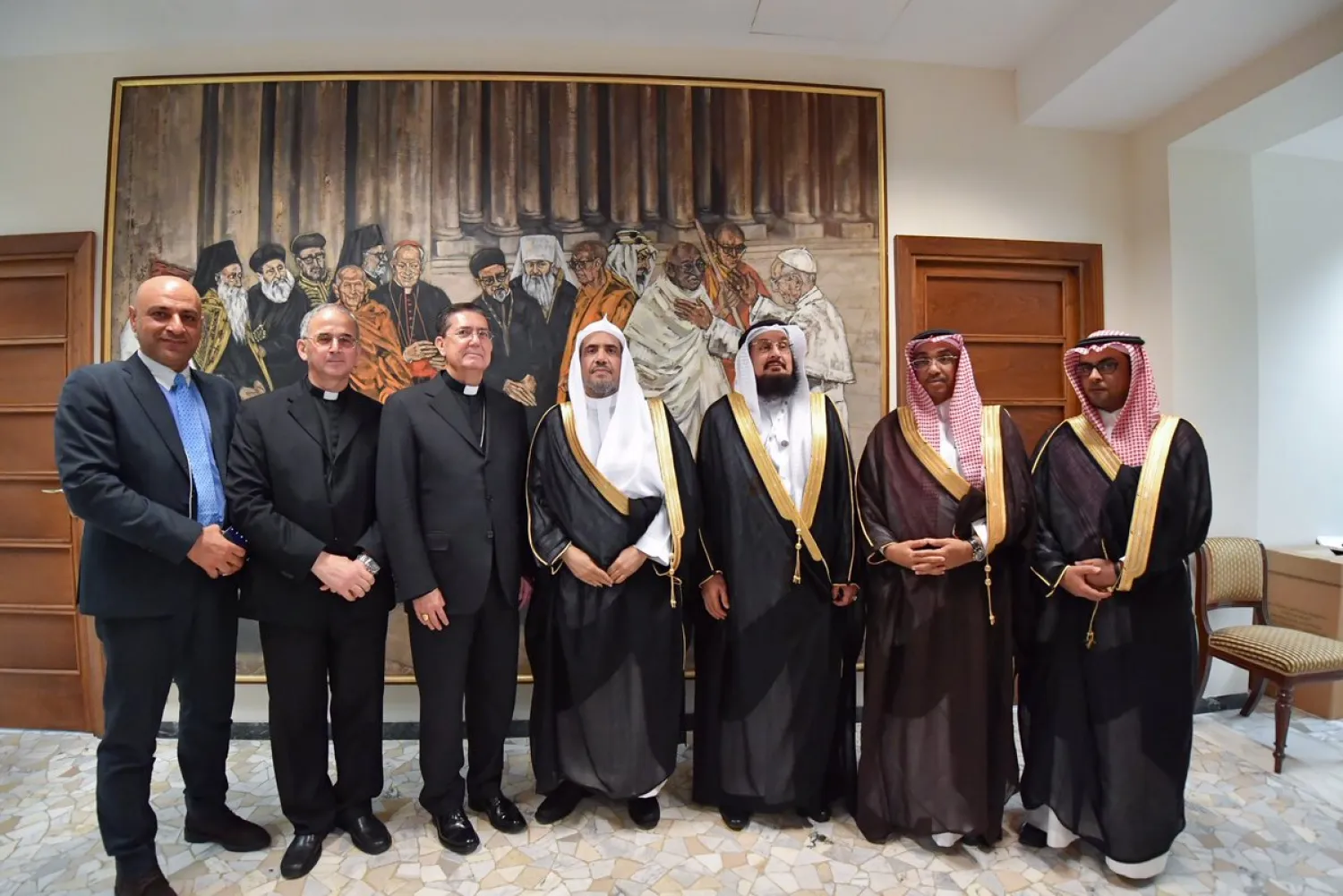
The Pontifical Council in the Vatican meets with MWL Secretary-General Dr. Mohammed Al Issa on many issues and lauds the historical meeting with Pope Francis (PHOTO: MWL official website)
MWL Secretary General: No Religion Is Free from Extremist Elements
The Pontifical Council in the Vatican meets with MWL Secretary-General Dr. Mohammed Al Issa on many issues and lauds the historical meeting with Pope Francis (PHOTO: MWL official website)
Muslim World League (MWL) Secretary-General Mohammed Al-Issa said that while no religion promoted extremism, none was free from extremist elements.
Issa met on Monday with the head of the Pontifical Council of the Vatican, Cardinal Jean-Laurent Tauran, following a meeting earlier this month with Pope Francis.
He noted that the League “welcomes communication and cooperation with the Vatican through the Pontifical Council in all that achieves common goals, in particular, the deployment of peace and harmony.”
Cardinal Tauran, for his part, praised the meeting between Issa and Pope Francis, underlining its importance in opening a new page of friendship and cooperation between the Vatican and the Islamic world, in order to meet the challenges and dangers facing the world.
The MWL secretary general visited the headquarters of the Community of Sant’Egidio, the international Catholic organization based in Rome.
He noted that the MWL was fully ready to cooperate with the organization in all areas that serve cultural communication.
The Saudi Arabian government-supported NGO, MWL, was founded in 1962 to propagate Islam and to improve worldwide understanding of the religion.
Based in the Saudi city of Mecca, the MWL in its mission statement says it rejects violence and fosters “dialogue with people of other cultures.”
File photo of the Heglig oil field in southern Kordofan, Sudan (Reuters)
Sudan’s Oil and Energy Minister Al-Mutasim Ibrahim said the estimated cost of heavy losses and damage inflicted on the oil and energy sector by the war amounts to billions of dollars, blaming the Rapid Support Forces for directly targeting infrastructure across the country.
In exclusive remarks to Asharq Al-Awsat, Ibrahim said the government had fully restarted the Heglig oil field and that “all employees on site are carrying out their duties normally.”
He said the protection and operation of the field are a joint responsibility between Sudan and the Republic of South Sudan, as provided for in previously signed agreements between the two countries.
Ibrahim strongly denied recent reports of a three-way agreement between the governments of Sudan and South Sudan and the Rapid Support Forces regarding the Heglig field, located in the far south of the Kordofan region bordering South Sudan.
Authorities in South Sudan announced a settlement between the Sudanese army and the Rapid Support Forces after the latter took control of the area, stipulating the withdrawal of both sides and assigning the South Sudan army the task of securing oil facilities in Heglig.
Heglig is Sudan’s largest oil field, producing between 40,000 and 80,000 barrels per day of crude. Output fell by about 20,000 to 25,000 barrels per day after the outbreak of war due to the shutdown of many wells and damage to infrastructure.
The field also serves as the central processing facility for South Sudan’s crude, which produces nearly 130,000 barrels per day and is exported through Sudanese ports on the Red Sea coast.
China talks
Meanwhile, the minister said negotiations with the Chinese government were ongoing over its return to operations in Block 6 in the Balila area of West Kordofan. China had announced the termination of its agreement with the Sudanese government due to deteriorating security conditions and the collapse of supply chains caused by the fighting.
“Work at the Balila field is currently suspended, but the Chinese partner has not withdrawn from the country,” Ibrahim said.
“We recently held joint meetings with the Chinese side in Cairo and informed them of our desire to continue the partnership in the field, and we also presented opportunities to invest in other fields.”
He expressed optimism about the continuation of the partnership between Khartoum and Beijing in the sector, pointing to various oil investments expected to flow in after the war ends, particularly in areas under army control, which he said are witnessing significant security stability.
Last December, the Chinese government informed Sudan that it was ending the oil partnership after years of cooperation.
Khartoum refinery
According to the minister, preliminary estimates of heavy losses to the oil and energy sector since the war erupted in mid-April 2023 amount to billions of dollars, with damage assessments still underway.
He said the Rapid Support Forces had deliberately sabotaged infrastructure in both sectors, adding that the government had made progress in rehabilitating them after the army pushed the forces out of many areas across the country.
Ibrahim put losses at the Khartoum oil refinery at around $6 billion, saying it would need to be rebuilt from scratch.
“We have begun preparing the necessary designs and securing requirements to restart it,” he said, noting that several countries had expressed serious interest in investing in refineries in Khartoum, El-Obeid, and Port Sudan.
Before the war, the Al-Jaili refinery north of the capital, Khartoum, met more than 40 percent of the country’s demand for gasoline, diesel, and cooking gas. Still, it halted operations due to severe damage to its processing and refining facilities.
Ibrahim said petroleum products were flowing normally and that their availability had helped stabilize fuel supplies nationwide. He added that most fuel stations in areas without electricity had been equipped with solar power.
World Defense Show Ends in Riyadh with 220 Deals, 60 Arms Contractshttps://english.aawsat.com/gulf/5240224-world-defense-show-ends-riyadh-220-deals-60-arms-contracts
World Defense Show Ends in Riyadh with 220 Deals, 60 Arms Contracts
Governor of the General Authority for Military Industries says show drew 137,000 visitors (World Defense Show)
Engineer Ahmad Al-Ohali, Governor of the General Authority for Military Industries, said the third edition of the World Defense Show was the product of two years of coordinated work by government entities and private sector partners to deliver what he described as a landmark event.
Speaking at a press briefing on Thursday in Malham, north of Riyadh, Al-Ohali said the exhibition was held under the patronage of the Custodian of the Two Holy Mosques, King Salman bin Abdulaziz, with the follow-up and supervision of Crown Prince and Prime Minister Prince Mohammed bin Salman, and inaugurated under the patronage of Minister of Defense Prince Khalid bin Salman.
The authority organizes the show every two years as part of its mandate to build and support the military industries sector, he said, in a drive to boost military readiness, advance self-sufficiency, and meet Saudi Vision 2030’s target of localizing more than 50 percent of military spending by 2030.
Held under the theme “Future of Defense Integration,” the exhibition showcased what Al-Ohali described as a shift toward a fully integrated defense ecosystem rooted in partnerships, innovation, technology transfer, stronger supply chains, and the development of national talent.
This year’s edition, he said, stood out for its local innovations, the Defense Industry Lab, Saudi capabilities and homegrown talent, alongside closer alignment between education, training and sector needs.
Saudi Arabia has made what Al-Ohali called a historic leap in localizing military spending, rising from 4 percent in 2018 to 25 percent by the end of 2024, a fourfold increase in eight years.
The national workforce in the sector grew from 25,000 in 2020 to 34,000, an increase of about 40 percent, with Saudis now accounting for 63 percent of total employees.
He said the gains reflect a structural transformation since the authority’s establishment in 2018, with the sector moving from full dependence on imports to building an integrated and sustainable national industrial base.
“This is still the beginning,” he said, reaffirming the goal of surpassing 50 percent localization and achieving high local content by 2030.
Al-Ohali said 26 government entities backed the preparation and execution of the show. Over five days, the third edition set records, attracting 1,486 local and international exhibitors from 89 countries, including the world’s top 10 defense companies.
The event hosted 513 official delegations representing 121 governments and attracted 137,000 visitors. Exhibition space expanded to more than 272,000 square meters, up 58 percent from the previous edition, with four halls compared with three in earlier editions.
One of the region’s largest specialized aerial and static displays featured 63 static aircraft and 25 aircraft in live air shows, including F-16, F-15, F-35, and Typhoon jets, with participation from the Saudi Falcons and South Korea’s Black Eagles.
The static display area included around 700 military assets. A dedicated naval platform featured participation from 10 countries, alongside an outdoor platform for unmanned systems and a zone for live land demonstrations.
Al-Ohali said the exhibition generated 73 memorandums of understanding and 220 agreements in total, including 93 intergovernmental deals and 127 agreements between companies. Sixty arms procurement contracts were signed, totaling 33 billion riyals, exceeding the totals recorded in the two previous editions.
He said the agreements, memorandums, meetings, and contracts were central to the exhibition’s objectives. The strong turnout, he added, signaled international confidence in Saudi Arabia as a strategic partner and an attractive destination for defense investment, reflecting growing trust in the Kingdom’s investment environment, particularly in military industries.
Planning has already begun for the next edition in 2028, Al-Ohali said, adding that the third edition demonstrated the sector’s ability to deliver results.
The exhibition is no longer just a display space, he said. It has become an active platform to shape the future of defense integration, reinforcing Saudi Arabia’s position as an international hub for integrated defense industries.
He said the Kingdom will continue strengthening its standing among nations that manufacture and develop military technologies, aiming to become a regional and global center in this strategic field.
UNRWA’s Lazzarini Warns Ignoring Gaza Risks New Generation of Angerhttps://english.aawsat.com/gulf/5240212-unrwa%E2%80%99s-lazzarini-warns-ignoring-gaza-risks-new-generation-anger
Philippe Lazzarini, the Commissioner-General of the United Nations Relief and Works Agency for Palestine Refugees in the Near East. Photo: Turky Alagili
UNRWA’s Lazzarini Warns Ignoring Gaza Risks New Generation of Anger
Philippe Lazzarini, the Commissioner-General of the United Nations Relief and Works Agency for Palestine Refugees in the Near East. Photo: Turky Alagili
Philippe Lazzarini, the Commissioner-General of the United Nations Relief and Works Agency for Palestine Refugees in the Near East, says UNRWA’s future cannot remain “hostage indefinitely” to the absence of a political solution, as he prepares to leave his post next month.
In a wide-ranging interview with Asharq Al-Awsat, Lazzarini called for a gradual shift in how services are delivered, allowing Palestinian institutions to eventually build the capacity to take over.
At the same time, he warned that abandoning nearly 2 million people in Gaza, half of them children, to trauma and hopelessness risks sowing the seeds of new generations of anger.
Strong backing from Saudi Arabia
Lazzarini said UNRWA’s cooperation with Saudi Arabia is “strong,” both financially and politically.
Riyadh, he said, is deeply engaged in the political process and works with the EU under the umbrella of the “Global Alliance for the Implementation of the Two-State Solution,” where UNRWA has been invited to be part of the broader discussions.
For Lazzarini, sustainable access to essential services must rest on a clear political framework. Saudi Arabia and other partners in the alliance have helped provide that framework and voiced firm political support for the agency during what he described as a challenging period.
He said the Kingdom’s level of political engagement and the initiatives advanced within the alliance left a strong impression. Inviting a humanitarian-development agency such as UNRWA into discussions about the future of Palestinian institutions, he said, reflects the seriousness of that partnership.
A funding squeeze and a “silent war”
UNRWA is also battling a chronic funding crisis. After a year of austerity, Lazzarini said he was forced weeks ago to cut services by around 20%, including health care and education, affecting beneficiaries directly.
Beyond Gaza, he warned of what he called a “silent war” in the occupied West Bank, overshadowed by events in the enclave.
Over the past two years, developments there have come “close to de facto annexation of the occupied West Bank,” he said. Settlement expansion has accelerated. Settler violence has risen “with little accountability.” Large-scale security operations, especially in Jenin and Tulkarm, have emptied camps and displaced large numbers of residents.
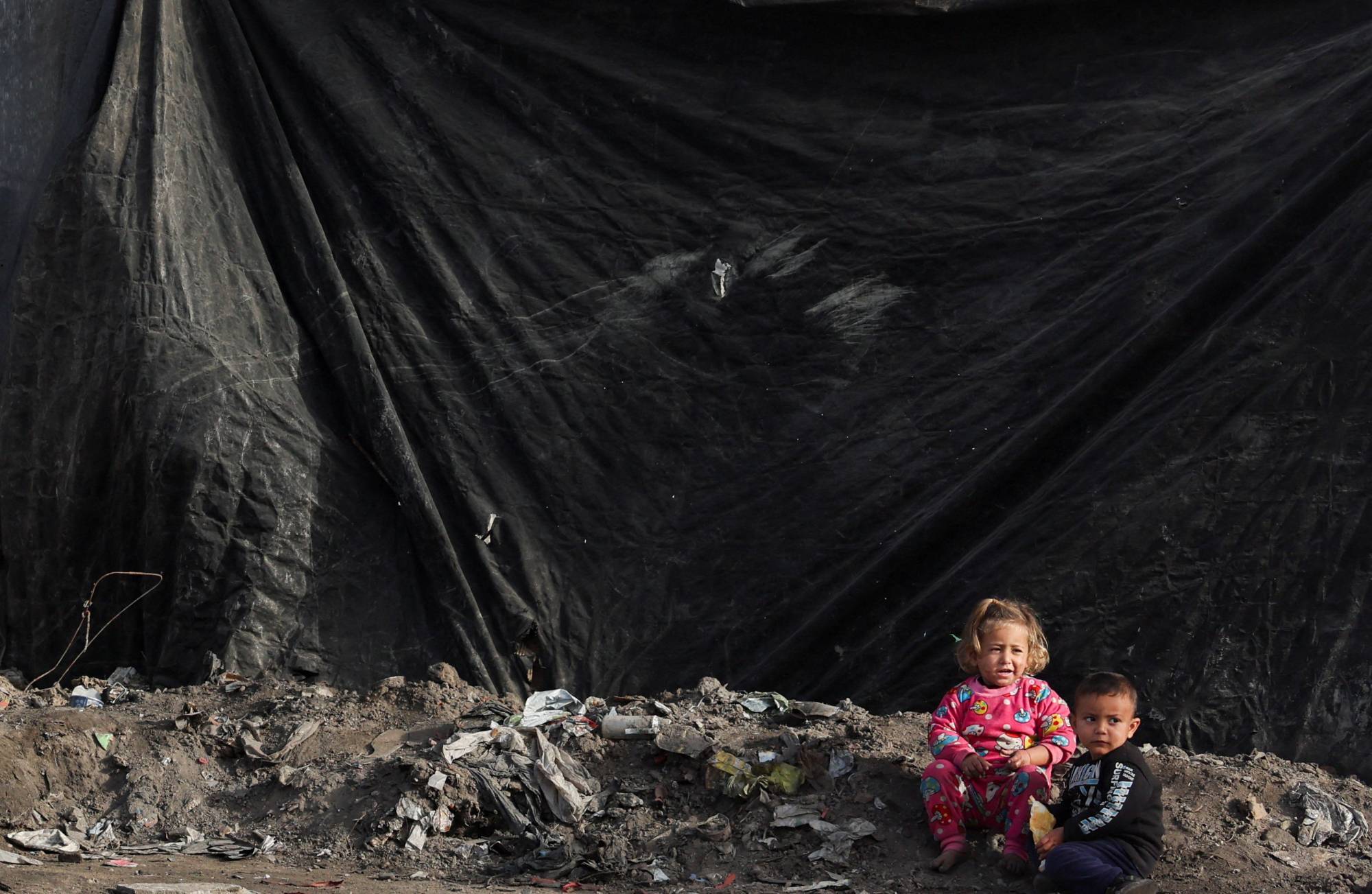
Palestinian refugee children are seen at a camp in Gaza city. Reuters
Gaza pushed beyond the brink
What has happened in Gaza, Lazzarini said, “defies description.” The suffering, he added, is “unbearable.”
Once described as an open-air prison, Gaza has, after more than two years of unrelenting war, become a landscape of daily atrocities carried out almost around the clock, before the eyes of the world.
Between 80% and 90% of the territory has been destroyed, he said, leaving behind a “post-catastrophic” environment. The population is in constant flight. More than 70,000 people have been killed, according to estimates, not counting those still buried beneath the rubble.
He described systematic starvation driven by political decisions and efforts to make life in the enclave untenable, pushing residents toward departure.
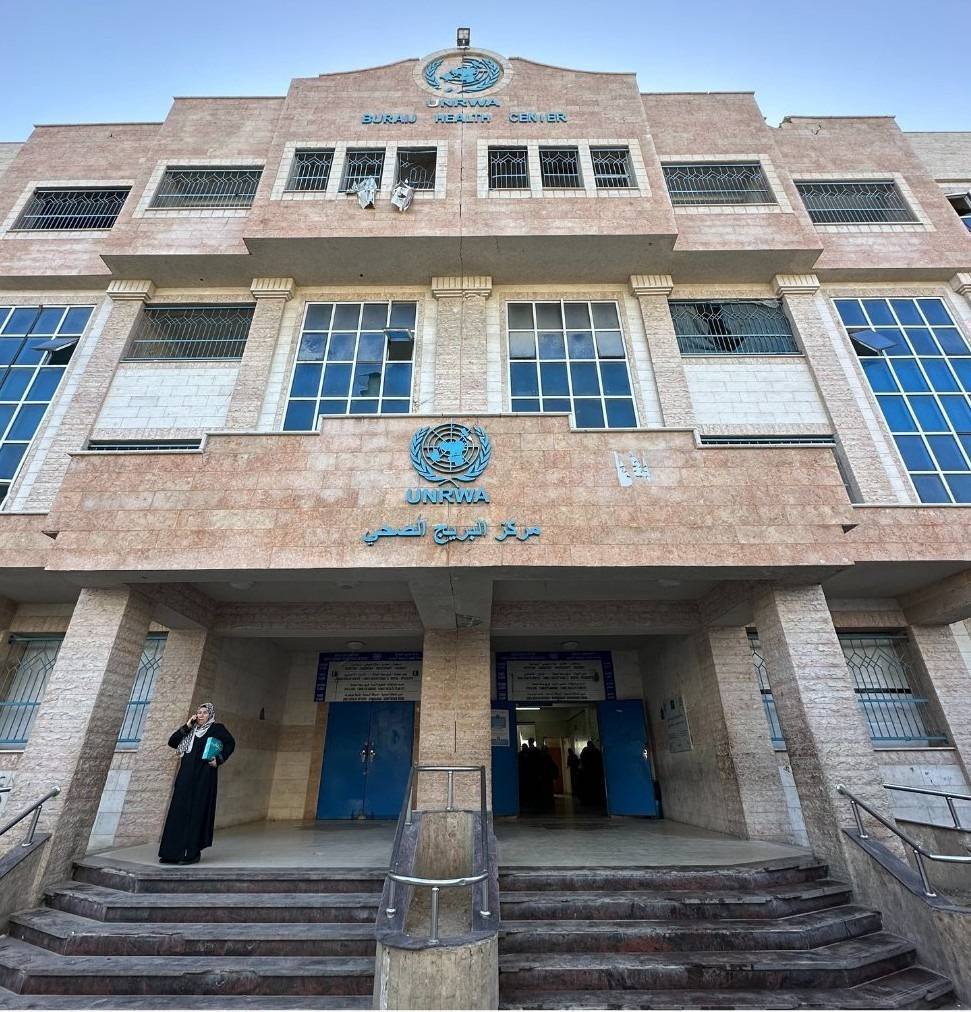
More than 380 UNRWA staff members have been killed, he said. Others were detained and tortured. Agency facilities were struck. The violations of international law, he added, have gone largely unpunished, deepening what he called a climate of impunity.
Political targeting and pressure
Lazzarini said he himself faced “political and diplomatic targeting” during his tenure, tied not to his person but to his office and what UNRWA represents.
After his first visit to Gaza, he was declared persona non grata and barred from returning, with instructions issued not to engage with him.
The targeting was not directed personally as much as at the function and the symbolism of UNRWA, he said. Some Israeli officials, he noted, have openly stated that their objective is to end the agency’s role, seeing it as perpetuating the refugee issue.
UNRWA’s 75-year existence, he argued, does not explain the problem. Instead, it reflects the international community’s failure to reach a just and lasting political solution.
The two-state solution
Lazzarini reaffirmed that the two-state path remains “a fundamental option,” but warned that developments in Gaza and the West Bank are pushing any serious political horizon further out of reach.
The events after Oct. 7, he said, should have been “a wake-up call.” This conflict, he stressed, cannot be left unresolved.
Nearly 2 million people in Gaza, half of them children, are living in profound trauma with no clear future. Ignoring that reality, he warned, means planting anger in a new generation, with consequences for the region’s stability.
He also voiced concern that solidarity and compassion are no longer driving international responses as they once did. In both Gaza and Sudan, he said, he sensed “a great deal of indifference” toward vast humanitarian crises.
Yet he insisted the core lesson is to hold fast to humanitarian values, however bleak the circumstances. The alternative, he warned, is a world stripped of standards and restraint, ruled by the law of the jungle rather than international law.
For Lazzarini, sustainable access to essential services must rest on a clear political framework.
Rethinking UNRWA’s future
Looking ahead, Lazzarini said UNRWA cannot continue indefinitely in its current form.
He called for a phased transition in service delivery, enabling Palestinian institutions to build capacity to assume those responsibilities over time.
The agency must remain the custodian of the refugee cause until a just solution is achieved, he said. But the mechanics of delivering services should not remain frozen, waiting endlessly for a political breakthrough.
لم تشترك بعد
انشئ حساباً خاصاً بك لتحصل على أخبار مخصصة لك ولتتمتع بخاصية حفظ المقالات وتتلقى نشراتنا البريدية المتنوعة