



Egyptian Screen Legend Shadia Passes Away

Egypt’s Shadia acts with Abdul Halim Hafez. (Asharq Al-Awsat)
TT

Egyptian Screen Legend Shadia Passes Away

Egypt’s Shadia acts with Abdul Halim Hafez. (Asharq Al-Awsat)

Iconic Egyptian actress Shadia passed away on Tuesday at the age of 86 after a long battle with illness, leaving behind a glittering acting and singing career.

She passed away at a Cairo hospital after suffering a stroke and falling into a coma.

Egyptian President Abdul Fattah al-Sisi and his wife paid a visit to the hospital upon hearing news of the actress’ deteriorating health.

She started her career of 117 movie roles in 1947 and ended it in 1984. She showed off her acting skills by taking on a wide range of diverse roles, from a desperate women who sells her daughter to feed her family, to an aspiring singer in a rags-to-riches story.

In the mid-1980s and at the height of her career, Shadia shocked her fans by announcing her retirement from singing and acting.

She said at the time that she did not want to play the role of the old woman after viewers had grown accustomed to seeing her as a young lady.

“I do not like people seeing the wrinkles in my face and comparing them to young lady that they used to know,” she remarked.

Despite her retirement however, she remained in the hearts of her fans and her films are constantly aired on television.

Shadia also performed in ten radio shows and the play “Rayya was Skeena”.

It was during that play’s run that she was diagnosed with breast cancer. The news did not deter her and she continued on acting in the show until the end of its run. She then traveled to France to receive treatment.

Soon after, she decided to retire and dedicated the rest of her life to religion and charitable work. Shadia donated her house to be transformed in a cancer research center. She shunned the media spotlight and refused all requests to sit for an interview.

Nobel laureate Najib Mahfouz described Shadia as a “very skilled actress who managed to bring the words of my novels to life.”

No one but her could have translated with such excellence words into cinematic art, he added.

Shadia’s brother Khaled Shaker told Asharq Al-Awsat that doctors did their best in treating the actress, but her health gradually deteriorated.


Huge Fire Rages in Fontainebleau Forest Near Paris

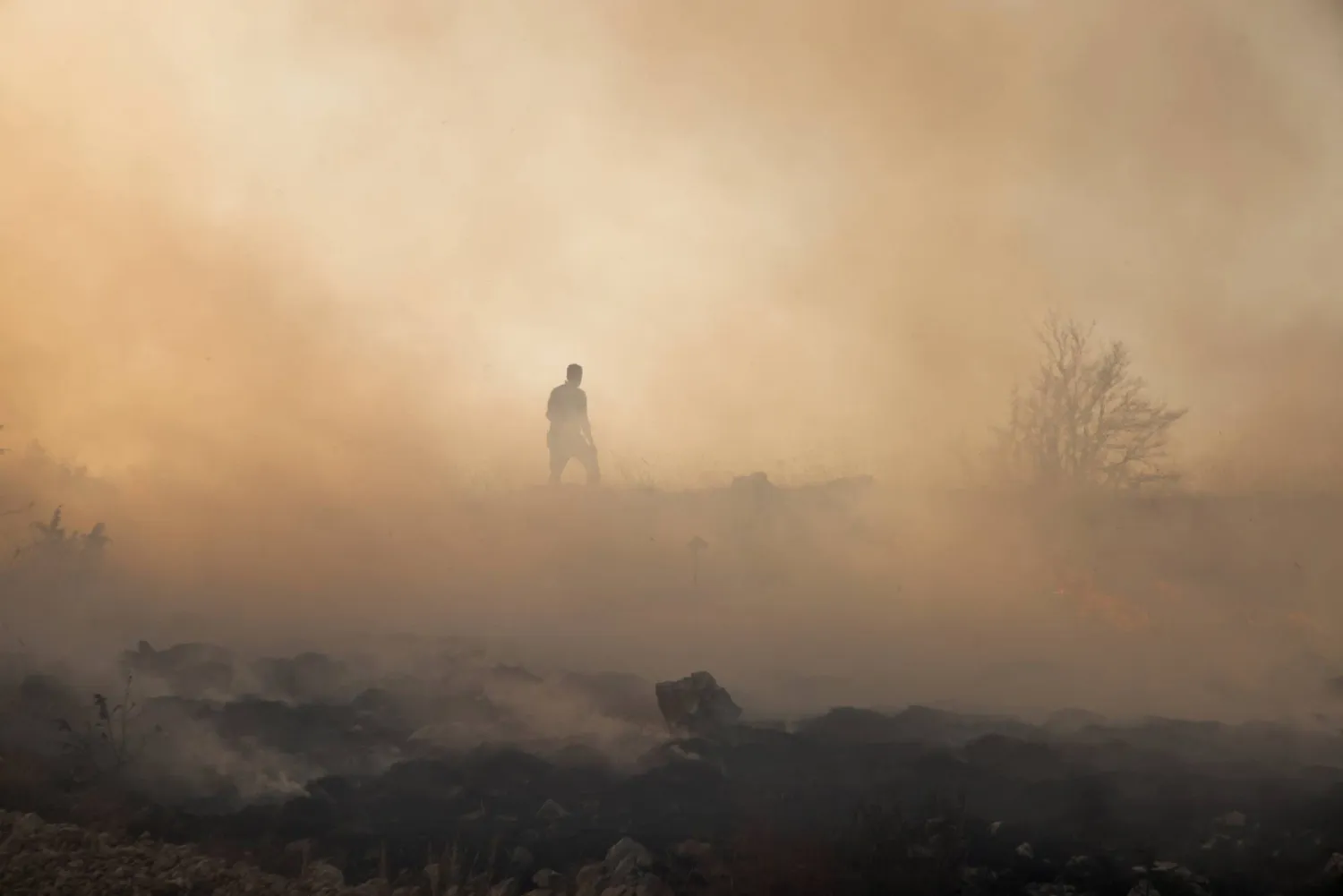
Flames rise in the Fontainebleau Forest after a forestfire broke out late afternoon on July 12, 2026. (Photo by GEOFFROY VAN DER HASSELT / AFP)
TT

Huge Fire Rages in Fontainebleau Forest Near Paris

Flames rise in the Fontainebleau Forest after a forestfire broke out late afternoon on July 12, 2026. (Photo by GEOFFROY VAN DER HASSELT / AFP)

French officials rushed two firefighting planes to the Paris region Sunday, after a fire erupted south of the French capital, disrupting traffic during a busy summer travel weekend and piling more misery on a region sweltering through its latest heatwave.

The fire, which officials described as "very virulent" and of "exceptional scale", began late afternoon in the sprawling Fontainebleau forest about 60 kilometers (40 miles) south-east of the capital, a onetime royal hunting preserve that today is dotted with quiet villages.

It had raced across 800 hectares and was still spreading, officials said early Monday, causing the partial closure of the A6 highway, the country's main north-south artery.

And with nightfall, firefighting aircraft had been forced to suspend their operations.

Around 15 homes had been evacuated in the nearby village of Vaudoue and firefighters were defending several other towns in the area, said the local Seine-et-Marne fire service.

Residents anxiously gathered in the village, watching emergency vehicles race past and making calls to try to find out if their homes were still at risk.

Evacuated residents Valerie and her husband Daniel described the moment authorities and firefighters told them to leave their home.

"We could see the ash falling," Valerie told AFP, sitting outside near the war memorial in Vaudoue, unsure where they would sleep.

"We put the cats and dogs in the car... we could see the fire on both sides," she said.

Without the firefighting planes, other villages would already have been evacuated, said Olivier Compta, who is overseeing the firefighting operation.

Around 400 firefighters worked to contain the flames, which erupted just ahead of the July 14 national holiday and on the first major weekend for departures for the summer holiday season.

Traffic was disrupted along highways in the area, as well as along the high-speed rail line leading to the south-east of the country.

Eric Brocardi, of France's national federation of firemen, said it was the first time fire bomber planes had been sent up from the normally drier and hotter south of the country to extinguish fires in the Paris region.

Two firefighting helicopters and an observation aircraft were also helping to fight the blaze, he added.

"The aim is to save lives and property," he said later, as the fire advanced.

Earlier, firefighters dealt with a fire that had blocked a highway running east from Paris and disrupted a high-speed train line to the south of France.

French rail company SNCF said on Sunday evening there were delays of up to six hours for trains arriving at or leaving from Paris's Gare de Lyon.

At the station, 34-year-old physiotherapist Kelly took the delay in stride.

"It's global warming," she said. "It's the disruption of the seasons...there are political decisions to be taken."

The Paris region -- and large parts of the rest of France -- is currently experiencing the third heatwave since May, increasing the risk of fires.

The three heatwaves have seen temperature records broken in several countries across Europe and have caused thousands of excess deaths, according to estimates in Belgium, Britain, France and Spain.

The June heatwaves would have been "virtually impossible" without climate change, the World Weather Attribution group of scientists said.

Several other European countries have faced record-breaking average temperatures.

In France, the heatwave has also led officials to shut down three of the country's nuclear power stations.

And organizers of the Tour de France cycling race shortened Sunday's stage by 30 kilometers (19 miles) as temperatures on the route approached 40C.

Interior Minister Laurent Nunez, whose office announced he would visit Fontainebleau on Monday, said that forest fires had already consumed 17,000 hectares this year.

Once the figures had all been tallied, that would come to 25,000 hectares -- "twice as much as the same period" in 2025, he added.


South Korea Issues 1st Emergency Heatwave Warning Under New Rating System

A woman uses a fan to shelter from the sun on a street in Seoul on July 12, 2026. (Photo by JADE GAO / AFP)
TT

South Korea Issues 1st Emergency Heatwave Warning Under New Rating System

A woman uses a fan to shelter from the sun on a street in Seoul on July 12, 2026. (Photo by JADE GAO / AFP)

South Korea issued its first-ever emergency heatwave alert on Sunday under a new warning system launched this year, advising people to halt outdoor activities and keep cool.

The new warning system was introduced to better deal with a rising number of heatwaves in South Korea, which have become longer and more intense, officials said.

An emergency alert is issued when areas experiencing a heatwave are forecast to hit perceived temperatures of 38C or an actual temperature of 39C for one day.

"The Korea Meteorological Administration issued an Emergency Heatwave Warning at 10 am today (GMT 0100) for two cities in southern North Gyeongsang Province -- Gyeongsan and Pohang," said agency chief Lee Mi-seon at a press briefing.

"This marks the first time it has been issued since the system took effect," she added, according to AFP.

The affected areas saw temperatures reach the emergency criteria over the weekend.

"An emergency heatwave warning does not simply mean the weather is extremely hot," Lee said.

"It indicates conditions in which even healthy people face a significantly elevated risk of serious harm, including heat-related illness and death."

People engaged in outdoor activities should stop immediately and move to a cool place, and no one, including children or pets, should be left inside a vehicle, she added.

A child plays in a fountain tunnel to cool off at Gwanghwamun Square in Seoul on July 12, 2026. (Photo by JADE GAO / AFP)

Much of the country -- including parts of Seoul -- remained under heatwave warnings, which are issued when the perceived temperature is expected to stay at 35C or higher for two consecutive days.

Such warnings take both temperature and humidity into account, according to the KMA.

Children tried to cool off from the heat on Sunday by running through the water jets at Gwanghwamun Square in central Seoul, an AFP reporter saw.

People also sought refuge in air-conditioned shopping malls.

KMA data show the average annual number of heatwave days in the country has more than doubled to 19 over the past five years, from eight in the 1970s.

The average annual number of tropical nights has also jumped from four to 14 over the same period.

A heatwave day is defined as one with a maximum temperature of at least 33C, while a tropical night is one when the overnight low remains 25C or above.

The new system comes as Europe endures a scorching summer, after a June heatwave shattered temperature records across the continent.

Scientists warn that extreme weather events such as heatwaves are becoming more frequent and intense as a result of human-induced climate change.


In Sicily, Drones at Work to Predict Volcanic Eruptions

Vulcanologists collect data from gas emissions with a drone and a laser during a mission in the crater of La Fossa, on Vulcano Island, one of the seven islands of the Aeolian Archipelago of Sicily, on July 9, 2026. (Photo by Marco Bertorello / AFP)
TT

In Sicily, Drones at Work to Predict Volcanic Eruptions

Vulcanologists collect data from gas emissions with a drone and a laser during a mission in the crater of La Fossa, on Vulcano Island, one of the seven islands of the Aeolian Archipelago of Sicily, on July 9, 2026. (Photo by Marco Bertorello / AFP)

Hovering over the volcano, a buzzing drone pauses in front of a laser beam on the crater's edge, as researchers test whether the devices can measure gases to predict eruptions.

On the Aeolian island of Vulcano, off the coast of Sicily, German researcher Marius Schaab, from the Technical University of Munich (TUM), stands next to a gas sensor mounted on a tripod, waiting for the drone his colleague has just launched to draw closer.

In this remote lunar landscape, where hot volcanic gases and steam smelling of sulphur rise eerily from the earth, the small propeller-driven device catches the eye.

The last eruption of the island's Grand Crater occurred in the late 19th century but the volcano continues to show intense degassing activity -- to the awe of the visitors who are allowed to walk around the rim.

Soon, the drone positions itself along the axis of the sensor, which transmits an invisible laser beam that passes through the volcanic gas emissions before being reflected by the drone, and travelling back.

The sensor works by "sending a laser beam through some gas and then onto some reflector that measures the intensity of the driving light", Schaab said.

The drone can move around and switch angles to take full measurements.

Using a laser allows the sensor to avoid the gas plume, the researcher told AFP.

"Our drone flies behind the plume and also our ground unit is not in the plume," said Schaab, noting that the corrosive nature of the plume would require any sensor inside it to be constantly recalibrated.

Based on the signals sent back to the sensor, an algorithm calculates a map of gas concentration in the 10 or 15 minutes it takes for the drone to follow a predefined path at a distance of up to 60 meters (nearly 200 feet).

Although drones have been used in monitoring volcanoes for about 15 years, scientists are now looking to develop gas measurement tools that are increasingly accurate and risk-free.

Further around the crater, another team of German scientists from the University of Mainz is using sensors carried on a drone to measure concentrations of chemical substances in the air.

"One reason for measuring gases and particles is to better understand the impact of volcanic eruptions and volcanic emissions on the atmosphere," said Tjarda Roberts, a researcher at the National Centre for Scientific Research (CNRS) in Paris, who is collaborating with the Mainz team.

"Another reason is to anticipate volcanic eruptions, because the gas composition can change before an eruption occurs," she said.

The greater the pressure exerted by lava rising from inside the Earth towards the surface, the larger the amount of gas released.

It is the first time the team from TUM has tested its drone system -- which can work at altitudes up to 3,000 meters -- on a volcano.

A checklist in hand, Jonas Krajewski, a student at the Johannes Gutenberg University Mainz, checks that "Tina" -- the name given to the drone -- is ready to fly safely.

Soon, the drone weighing 2.5 kilograms (5.5 pounds) lifts into the air and heads towards the rising gases.

This time, following a predefined flight path lasting up to 40 minutes, the drone flies into the heart of the fumaroles, or vents where the gases and vapor escape and where temperatures range between 100 and 140C.

"Tina" is equipped with a series of sensors measuring gases, particles and halogens, elements like chlorine, bromine and others.

"We have a very constant output of gas... so we can have very reliable sensor data," said Krajewski.

For Roberts, one of the biggest advantages of the drone is its great flexibility and ability to move around more diluted parts of the plume and quickly switch direction if the plume suddenly changes angles.

With the drone, researchers no longer need to carefully enter the area of the gas emissions, a dangerous activity which requires the use of masks and other protection.

"Here we don't have a major risk of an imminent eruption but there are volcanoes where you can't reach the summit on foot," Roberts said.

But with a drone, "you can take measurements... without putting yourself in danger".

Skimming over rocks speckled with yellow sulphur crystals deposited by the fumaroles, "Tina" soon reappears on the horizon.

In the coming days, a new challenge awaits the drone -- Mount Etna, the 3,000-meter-high active volcano in eastern Sicily, where a new eruption has just occurred.