


The Sochi Triple Alliance and Conflicting Visions

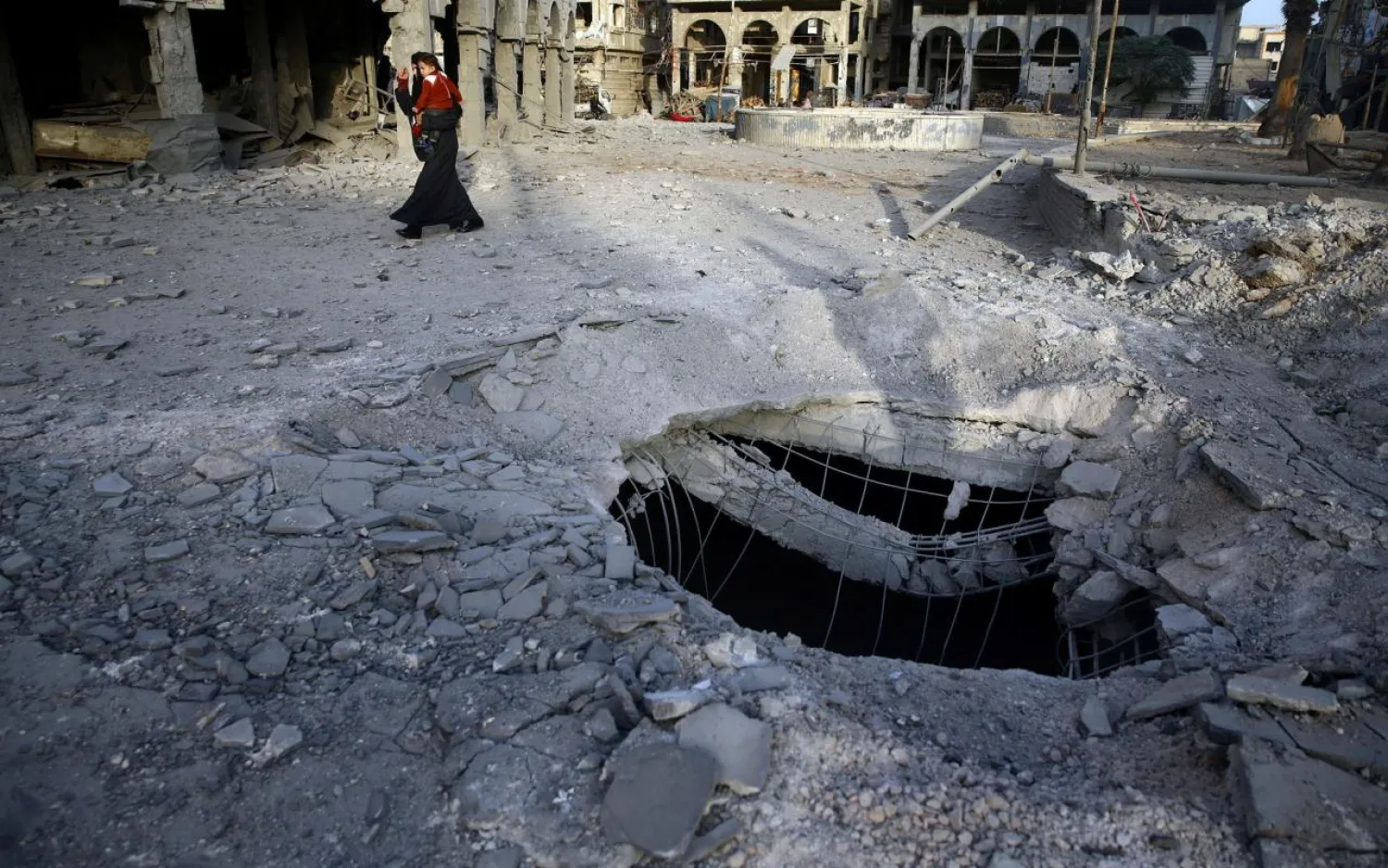
A Syrian woman walks past damaged buildings in Douma, in the eastern Damascus suburb of Ghouta, Syria November 15, 2017. REUTERS/Bassam Khabieh
TT

The Sochi Triple Alliance and Conflicting Visions

A Syrian woman walks past damaged buildings in Douma, in the eastern Damascus suburb of Ghouta, Syria November 15, 2017. REUTERS/Bassam Khabieh

At the start of 2017 it seemed that Iran, Russia and Turkey were heading towards a period of hostility against a background of historical mutual suspicions and misgivings.

Still reeling from the shooting down in Syrian airspace of a Russian fighter jet, Russia and Turkey, traded accusations and insults.

Iran and Turkey were on opposite sides in the Syrian crisis and divided on the fate of Bashar al-Assad, Syria’s phantomatic President holed in Damascus.

Iran also had misgivings about Russia as Moscow delayed the delivery of weapons’ systems purchased and paid for by the Islamic Republic and imposed severe restrictions on Iran’s attempts at promoting its Khomeinist ideology in the Russian Federation.

However, towards the end of the year, a new picture was emerging with Iran, Russia and Turkey cast as members of a new triple alliance to shape the future of the Middle East in the wake of two decades of turmoil, terrorism and war. For the first time, the three nations held a summit in the seaside resorts of Sochi which the Iranian media, always keen on hyperbole, presented as “the new Yalta” after the conference in which the US, Britain and Russia decided the “future of the world” after World War II. More importantly, perhaps, a series of meetings brought the Top Brass of the three nations together for the first time to thrash out a joint strategy.

The upshot of all the comings-and-goings was that Iran, Russia and Turkey seemed to have agreed on a virtual carving of Syria into five “de-escalation zones” with each of them getting one zone and leaving the remaining two to the United States and its Kurdish allies Arab nations represented by Jordan.

There was also implicit agreement to Keep Assad in place in Damascus for a further 18 months during which the Russian plan would be implemented and solidified. Assad would be needed to sign legislations passed by his phantom parliament to bestow a legal veneer on the Russian “carve-out” scheme.

This was put clearly by General Muhammad-Ali Aziz-Jaafari, Commander of The Islamic Revolutionary Guards Corps (IRGC). “We expect President Assad to legalize the presence of popular forces”, meaning the Zaynabioun, Fatimyoun, Hezbollah and other militias created by Iran.

Moscow also needs Assad to push the agreement on leasing parts of the Syrian Mediterranean coast to Russia to set up or expand its aero-naval bases. As for Ankara, Assad is expected to sign a law that would permit Ankara to maintain troops on Syrian soil to separate that country’s Kurdish-majority provinces and take military action against Kurdish groups hostile to Turkey.

Ankara, Moscow and Tehran know that no future Syrian government would be able to ratify the kind of presence that Russia, Iran and Turkey seek in Syria. But once Assad has performed his finals service he would be discarded with few qualms by his protectors.

Ankara, Moscow and Tehran have other reasons to seek a quick end, or at least fudging-up, of the Syrian imbroglio.

Turkish President Recep Tayyib Erdogan is facing a problematic presidential election next year under a new constitution that replaces the parliamentary system with a presidential one concentrating powers in the hands of whoever becomes president. A candidate himself, Erdogan is almost certain of winning. But the question is by what percentage. A feeble turnout and a slim majority would not give him the moral mandate and political authority to embark upon his “grand design” of which we shall speak later. Erdogan needs to win “something big” and for the time being the only chance is to get a bite at the Syrian apple.

Russian President Vladimir Putin is also facing presidential election, perhaps his last, next year. He, too, is almost certain to win. But he is also concerned about the shape and size of his victory. He does not wish to end his 30-year career as a master of Russia’s destiny with the lowest backing from the electorate. With Russian economy in doldrums and the Western powers unwilling to grant Russia equal status as a major power, Putin needs a big victory which today can only come through a clever fudge-up in Syria coupled with grandiose talk of having "defeated Islamist terrorism” on the battlefield.

Putin is also concerned about rumblings among Russian Muslims, some 27 percent of the population according to most accounts. Images of the Russian air force carpet bombing cities, populated by “fellow-Muslims”, have stirred quite a bit of unease throughout the federation’s Muslim communities.

By claiming that he has two major Muslim nations, Turkey representing the Sunnis and Iran speaking for the Shiites, on his side, Putin can reassure Russian Muslims who have always voted for him in a massive way.

Iran has its own reasons to wish an arrangement on Syria.

Presented on 10 December, President Hassan Rouhani’s new budget shows that the Iranian economy faces at least another year of slow growth combined with a record deficit and a double-digit inflation.

Syria is proving too costly a “muta’a” (concubine) to maintain forever, especially since Iran also has other militia “muta’as” to maintain in Lebanon, Palestine, Yemen, Iraq and elsewhere.

At a time that the Islamic Republic cannot pay its own employees’ salaries regularly, spending vast sums on “exporting revaluation” is being criticized even within the usually docile Islamic Majlis. The 12 percent rise in the military budget means tightening the screws in other areas with the risk of rising popular discontent. So, Tehran leadership is also talking of “total victory in Syria” in the hope of reducing is footprint and financial burden there. And that requires Russian military clout and financial contribution.

Tehran also needs Turkey not only to divide the anti-Assad camp in Syria but also to weaken NATO in its eastern wing while jettisoning the Iraqi Kurds, and allowing Iran to consolidate its gains in Iraq.
At a tactical level, the “triple alliance” makes sense.

Russia, Turkey and Iran are all under pressure from the Western powers, for different reasons, and look for ways to break out of the cobweb of isolation they have woven around themselves with aggressive moves on Crimea and Ukraine on the part of Russia, and Iran’s agitations in several Arab countries not to mention Turkey’s sharpening anti-West rhetoric.

It is a strategic level that the “triple alliance” may seem more problematic. Historically, Iran, Russia and Turkey have more often been rivals and enemies than friends and allies. Between the 18th and 20th centuries Russia and Iran were involved in no fewer than six major wars. Russian forces invaded and occupied parts of Iran during both world wars. In the late 1940s, Russia tried to carve major provinces of Iran into satellite Soviet-style republics. During the 18th to 20th century, Russia and Turkey fought eight major wars and wee on opposite sides in the Frist World War. Over the decades the Tsarist Empire annexed more than 1.5 square kilometers of Iranian and Turkish territories, including the Crimea, snatched away from the Ottoman power, and Transcaucasia, taken away from Qajar Persia.

However, it is not history alone that undermines the prospects of the “triple alliance”.

The three powers are also divided on their respective visions of the future.

Putin has built his vision on the concept, some might say the geographic chimera’ of “Eurasia” according to which Russia is at the heart of a continent distinct from both Europe and Asia but representing the best of both, thus meriting the position of its leader. Although” Eurasia” is never fully defined it is assumed to represent large chunks of Central and Eastern Europe up to the Ural Mountains plus Central Asia and Siberia right to the Pacific Ocean. The southern flanks of Eurasia include Transcaucasia and Iran down to the Indian Ocean plus the Arab Levant.

The “Eurasian Grad Design” accords with the old myth of Russia and “The Third Rome”, with its “Manifest Destiny”. It rejects the idea, initially evoked by Peter the Great, to become truly civilized that Russia must be Westernized first. However, the idea appeals to Slavophils who dream of a pan-Slavic "world-space" led by Russia.

If Putin’s vision has a chimeric geographic expression, Erdogan’s comes in the pseudo-historic formula of “neo-Ottomanism” according to which the regions once ruled by the Ottomans can again come together in a new context of “free cooperation” to protect peace and pave the way for prosperity. These regions include North Africa, the Arab Levant, the Balkans, much of the Caucasus, the Caspian rim and the Altaic nations of Central Asia. In most of those areas, Turkey would find itself a rival, if not an adversary of Russia in the name of Islam and, when suitable, pan-Turkism. Russia can counter that in the name of pan-Slavism, where Slaves form a majority, the Russian language, prevalent in the Caucasus and Central Asia, and collective memories of Tsarist and Soviet “coexistence.”

In much of the same area Turkey, claiming leadership of Sunni Muslims will be in direct competition with Iran under its present Khomeinist regime which claims to have discovered the only true version of Islam. Even then, Turkey may have problems with its own Shi’ite minority while its Hanafi brand of Sunnism may not attract others, especially in Egypt, who are Shafeis or Hanbalis.

Playing the religious card would be even harder with the numerous sects that together form the mosaic that is the Arab Levant not to mention Christians in the Balkans and parts of the Caucasus.
While Russia uses a geographic concept and Turkey goes for a historic one, Iran, under its current regime has opted for a pseudo-theological chimera marketed under the brand of “Pure Muhammadan Islam” of which Walayat al-Faqih, rule by a theologian, is the central dogma. History shows that while religious ideas can bring people together the unity they create is always short-lived. Political projects, however, can create more durable entities such as empire or the nation-state. In other words, religion, which cannot admit divergence, almost always ends up dividing people while politics is capable of uniting them if only because it allows some scope for compromise.

Four decades after the mullahs seized power in Tehran there is no evidence that their brand of Islam is making many new recruits in the region they wish to dominate.

However the main problem all three visions, Russian, Turkish and Iranian, face is that none of them enjoys the cultural attraction or the economic resources without which empire buildings are little more than a tempting, but dangerous, fantasy. Why would anyone in Eurasia, the Middle East, the Balkans or anywhere else targeted by the three visions want to be ruled from Ankara, Moscow or Tehran?

The three visions are based on the assumption that the nations living in the regions targeted are looking for outsiders as leaders and that, with the United States abdicating its global leadership and the European Union bogged down in its byzantine problems medium-size powers such as Russia, Turkey and Iran can make put in their bid. However, this assumes that the targeted people, for example, the Arabs or the Central Asians, will always remain weak and divided and unable to develop visions of their own. Such calculations underestimate the resources and the determination of even the smallest and weakest nations to trace their own paths.

As 2017 draws to a close, the three would-be empire builders, Iran, Russia and Turkey, appear to be as thick as thieves. But the real concern is that they may come to blow before the end of the year. They covet the same space and seek the mantle of leadership for themselves. They have no common culture and history of cooperation and alliance. Worse still, they are trying to use 19th-century methods to deal with 21st-century dangers and opportunities. History often repeats itself as caricature. Thus the Sochi summit was a caricature of Yalta, not say of Berlin of 1885 in which the European Powers divided the world among themselves.



Iraq's Political Future in Limbo as Factions Vie for Power

FILED - 02 November 2025, Iraq, Najaf: Iraqi Prime Minister Mohammed Shia' al-Sudani delivers a speech during a campaign rally of his Reconstruction and Development Coalition in Najaf, ahead of the Iraqi parliamentary elections, scheduled to be held on 11 November 2025. Photo: Ameer Al-Mohammedawi/dpa
TT

Iraq's Political Future in Limbo as Factions Vie for Power

FILED - 02 November 2025, Iraq, Najaf: Iraqi Prime Minister Mohammed Shia' al-Sudani delivers a speech during a campaign rally of his Reconstruction and Development Coalition in Najaf, ahead of the Iraqi parliamentary elections, scheduled to be held on 11 November 2025. Photo: Ameer Al-Mohammedawi/dpa

Political factions in Iraq have been maneuvering since the parliamentary election more than a month ago to form alliances that will shape the next government.

The November election didn't produce a bloc with a decisive majority, opening the door to a prolonged period of negotiations, said The Associated Press.

The government that eventually emerges will be inheriting a security situation that has stabilized in recent years, but it will also face a fragmented parliament, growing political influence by armed factions, a fragile economy, and often conflicting international and regional pressures, including the future of Iran-backed armed groups.

Uncertain prospects

Prime Minister Mohammed Shia al-Sudani's party took the largest number of seats in the election. Al-Sudani positioned himself in his first term as a pragmatist focused on improving public services and managed to keep Iraq on the sidelines of regional conflicts.

While his party is nominally part of the Coordination Framework, a coalition of Iran-backed Shiite parties that became the largest parliamentary bloc, observers say it’s unlikely that the Coordination Framework will support al-Sudani’s reelection bid.

“The choice for prime minister has to be someone the Framework believes they can control and doesn't have his own political ambitions,” said Sajad Jiyad, an Iraqi political analyst and fellow at The Century Foundation think tank.

Al-Sudani came to power in 2022 with the backing of the Framework, but Jiyad said that he believes now the coalition “will not give al-Sudani a second term as he has become a powerful competitor.”

The only Iraqi prime minister to serve a second term since 2003 was Nouri al-Maliki, first elected in 2006. His bid for a third term failed after being criticized for monopolizing power and alienating Sunnis and Kurds.

Jiyad said that the Coordination Framework drew a lesson from Maliki “that an ambitious prime minister will seek to consolidate power at the expense of others.”

He said that the figure selected as Iraq's prime minister must generally be seen as acceptable to Iran and the United States — two countries with huge influence over Iraq — and to Iraq’s top Shiite cleric, Grand Ali al-Sistani.

Al-Sudani in a bind

In the election, Shiite alliances and lists — dominated by the Coordination Framework parties — secured 187 seats, Sunni groups 77 seats, Kurdish groups 56 seats, in addition to nine seats reserved for members of minority groups.

The Reconstruction and Development Coalition, led by al-Sudani, dominated in Baghdad, and in several other provinces, winning 46 seats.

Al-Sudani's results, while strong, don't allow him to form a government without the support of a coalition, forcing him to align the Coordination Framework to preserve his political prospects.

Some saw this dynamic at play earlier this month when al-Sudani's government retracted a terror designation that Iraq had imposed on the Lebanese Hezbollah militant group and Yemen’s Houthis— Iran-aligned groups that are allied with Iraqi armed factions — just weeks after imposing the measure, saying it was a mistake.

The Coalition Framework saw its hand strengthened by the absence from the election of the powerful Sadrist movement led by Shiite cleric Muqtada Sadr, which has been boycotting the political system since being unable to form a government after winning the most seats in the 2021 election.

Hamed Al-Sayed, a political activist and official with the National Line Movement, an independent party that boycotted the election, said that Sadr’s absence had a “central impact.”

“It reduced participation in areas that were traditionally within his sphere of influence, such as Baghdad and the southern governorates, leaving an electoral vacuum that was exploited by rival militia groups,” he said, referring to several parties within the Coordination Framework that also have armed wings.

Groups with affiliated armed wings won more than 100 parliamentary seats, the largest showing since 2003.

Other political actors

Sunni forces, meanwhile, sought to reorganize under a new coalition called the National Political Council, aiming to regain influence lost since the 2018 and 2021 elections.

The Kurdish political scene remained dominated by the traditional split between the Kurdistan Democratic Party and Patriotic Union of Kurdistan parties, with ongoing negotiations between the two over the presidency.

By convention, Iraq’s president is always a Kurd, while the more powerful prime minister is Shiite and the parliamentary speaker Sunni.

Parliament is required to elect a speaker within 15 days of the Federal Supreme Court’s ratification of the election result, which occurred on Dec. 14.

The parliament should elect a president within 30 days of its first session, and the prime minister should be appointed within 15 days of the president’s election, with 30 days allotted to form the new government.

Washington steps in

The incoming government will face major economic and political challenges.

They include a high level of public debt — more than 90 trillion Iraqi dinars ($69 billion) — and a state budget that remains reliant on oil for about 90% of revenues, despite attempts to diversify, as well as entrenched corruption.

But perhaps the most delicate question will be the future of the Popular Mobilization Forces, a coalition of militias that formed to fight the ISIS group as it rampaged across Iraq more than a decade ago.

It was formally placed under the control of the Iraqi military in 2016 but in practice still operates with significant autonomy. After the Hamas-led attack in southern Israel on Oct. 7, 2023 sparked the devastating war in Gaza, some armed groups within the PMF launched attacks on US bases in the region in retaliation for Washington’s backing of Israel.

The US has been pushing for Iraq to disarm Iran-backed groups — a difficult proposition, given the political power that many of them hold and Iran’s likely opposition to such a step.

Two senior Iraqi political officials, who spoke on condition of anonymity because they weren't authorized to comment publicly, said that the United States had warned against selecting any candidate for prime minister who controls an armed faction and also cautioned against letting figures associated with militias control key ministries or hold significant security posts.

“The biggest issue will be how to deal with the pro-Iran parties with armed wings, particularly those... which have been designated by the United States as terrorist entities,” Jiyad said.


What Egypt’s Red Lines Mean for Sudan’s War

Egyptian President Abdel Fattah al-Sisi holds talks with Sudan’s army chief Abdel Fattah al-Burhan in Cairo on Thursday (Egyptian Presidency)
TT

What Egypt’s Red Lines Mean for Sudan’s War

Egyptian President Abdel Fattah al-Sisi holds talks with Sudan’s army chief Abdel Fattah al-Burhan in Cairo on Thursday (Egyptian Presidency)

In unusually blunt language, and following a visit by Sudan’s Sovereignty Council Chairman and army chief Abdel Fattah al-Burhan to Cairo, the Egyptian presidency issued a statement on the war in Sudan outlining three points it described as red lines.

It said Egypt would not allow any of them to be crossed or compromised, as they directly affect Egypt’s national security, which it said is inseparable from Sudan’s national security.

The reference to activating the joint defense agreement between the two countries was seen as a signal that Egypt could bring its military, political, and diplomatic weight to bear in support of the Sudanese army.

Joint defense agreement

In March 2021, Egypt signed a military cooperation agreement with Sudan that covers training, border security, and the confrontation of shared threats. That agreement followed a joint defense pact signed in 1976 during the presidencies of Sudan’s Gaafar Nimeiry and Egypt’s Anwar Sadat.

Articles One and Two of the pact stipulate that any attack on one party is considered an attack on the other, and require immediate consultation, including the use of armed force to repel aggression. The agreement also commits both sides to coordinating their defense and military policies on matters related to their national security.

After the fall of Nimeiry’s regime in the 1985 popular uprising, then Prime Minister Sadiq al-Mahdi informed the Egyptian leadership of his desire to cancel the joint defense agreement. Instead, the two sides signed what became known as the Brotherhood Charter in 1987. While it did not explicitly cancel the 1976 agreement, its mechanisms have not been discussed or activated since then.

Regional and international messages

Sudanese journalist Osman Mirghani, editor-in-chief of Al-Tayar newspaper, said the Egyptian statements amounted to regional and international messages linked to recent developments and what he described as serious security threats facing Sudan.

He pointed to the expansion of the Rapid Support Forces in the Darfur and Kordofan regions in a way that threatens shared Sudanese and Egyptian national security, warning of risks of geographic fragmentation that could endanger Sudan’s unity.

Speaking to Asharq Al-Awsat, Mirghani said Egypt was, for the first time, using direct and tough language and signaling the possibility of intervention under international law in Sudan’s conflict. He said this reflected the level of Egyptian concern over the situation in Sudan.

Mirghani added that the reference to red lines was a message directed at all parties, noting that there are many influential players in Sudan.

The red lines

The first red line cited by Cairo was the preservation of Sudan’s unity and territorial integrity, preventing any tampering with its resources or those of the Sudanese people, and rejecting the secession of any part of the country. Egypt reiterated its categorical refusal to the establishment or recognition of any parallel entities, saying such moves would undermine Sudan’s unity and territorial integrity.

The statement also stressed the need to preserve Sudanese state institutions and prevent any harm to them. Egypt affirmed its full right to take all necessary measures permitted under international law, including activating the joint defense agreement between the two brotherly countries, to ensure these red lines are not crossed.

Timing of the visit

Former Sudanese Foreign Minister Ali Youssef noted the timing of Burhan’s visit to Cairo, stating that it occurred after his trip to Saudi Arabia earlier this week and following a visit by Saudi Crown Prince Mohammed bin Salman to the United States.

Youssef said the trip was part of efforts to end the war in Sudan through the Quartet mechanism, which includes Saudi Arabia, the United Arab Emirates, Egypt, and the United States.

Speaking to Asharq Al-Awsat, Youssef said Burhan briefed Egyptian President Abdel Fattah al-Sisi on the outcomes of his Saudi visit and the latest developments in Sudan.

He stated that the visit did not follow the usual ceremonial protocol and was a result of developments in the war, noting that Egypt’s security is linked to Sudan’s security. He added that Egypt is part of the Quartet, which seeks to end a war that is approaching its third year.

Military implications

Sudanese military expert Al-Muatasim Abdel Qader said activating the joint agreement would imply Egyptian intervention in various forms, including supplying weapons and ammunition or direct military involvement.

He said the provisions of the agreement obligate each army to defend the other, adding that the red lines outlined by the Egyptian presidency represented a significant step and carried major implications for the Sudanese state.

In remarks to Asharq Al-Awsat, Abdel Qader described mutual protection between the two countries as a historically rooted matter, dating back to wars Egypt fought in the last century in which Sudanese armed forces took part.

Rapid Support Forces response

Basha Tabiq, an adviser to the commander of the Rapid Support Forces, said in posts on X that Egypt’s position amounted to blatant interference, bias toward one party, and a colonial mindset that views Sudan as a backyard.

Another source aligned with the RSF said accusations against Egypt of backing the Sudanese army have persisted since the early days of the war. The source pointed to the presence of Egyptian forces at Merowe air base in northern Sudan at the start of the conflict, when several Egyptian soldiers and officers were captured before later being handed over to Cairo.

The source also cited accusations by RSF leader Mohamed Hamdan Dagalo, known as Hemedti, who said in October 2024 that the Egyptian army had carried out air strikes against his forces and supplied the Sudanese army with drones and training.

He said Hemedti renewed those accusations last June, alleging that Cairo supported the Sudanese army with aircraft flown by Egyptian pilots that bombed areas under his forces’ control, and supplied weapons and aviation fuel. Hemedti described this as a blatant aggression against the Sudanese people.

The source, who requested anonymity, said Egypt has been intervening in the war from the outset and that activating the joint defense agreement would merely formalize an existing reality.

No time to spare

Sudanese ambassador Al-Sadiq al-Maqli said Egypt is working with Saudi Arabia and the international Quartet, in coordination with the United States, to give fresh momentum to efforts on Sudan.

He said Washington is currently using soft power rather than force, which he described as an option deferred until shuttle diplomacy by US President’s senior adviser Massad Boulos is exhausted.

Speaking to Asharq Al-Awsat, Maqli said the United States fully understands the influence of Saudi Arabia and Egypt and their ability to persuade and soften the stance of Sudan’s government, which has rejected the latest US initiative.

He said Burhan currently has no time to spare, as what is unfolding in Sudan represents the world’s worst humanitarian disaster, according to the international community.

Maqli noted that Egypt, represented by Foreign Minister Badr Abdelatty, has been almost fully dedicated to making the Quartet mechanism succeed, given that the continuation of the current situation in Sudan poses a threat to Egypt’s national security.

He described Burhan’s visits to Riyadh and Cairo as short but necessary steps toward accepting the Quartet initiative, saying the Saudi visit marked a qualitative shift in the Sudanese government’s official position.

He added that Sudan’s foreign ministry later expressed Port Sudan’s readiness to cooperate with President Donald Trump, his secretary of state, and Boulos in efforts to achieve peace in Sudan, predicting imminent developments that could lead to a major breakthrough in the crisis.


Iraq Negotiates New Coalition Under US Pressure

Election workers count ballots as they close a polling station, during the parliamentary elections in Baghdad, Iraq, Nov. 11, 2025. (AP)
TT

Iraq Negotiates New Coalition Under US Pressure

Election workers count ballots as they close a polling station, during the parliamentary elections in Baghdad, Iraq, Nov. 11, 2025. (AP)

More than a month after Iraq's parliamentary elections, the country's top leaders remain locked in talks to form a government while facing pressure from Washington to exclude Tehran-backed armed groups.

Amid seismic changes in the Middle East, where new alliances are forming and old powers waning, Iraqi leaders face a daunting task: navigating relations with US-blacklisted pro-Iranian factions.

The US has held significant sway over Iraqi politics since leading the 2003 invasion that ousted long-time ruler Saddam Hussein.

But another specter also haunts Iraq's halls of power: Washington's arch-foe, Iran.

Iraq has long been caught between the two, with successive governments negotiating a delicate balance.

Now, after November's election, Washington has demanded the eventual government must exclude Iran-backed armed groups and instead move to dismantle them, Iraqi officials and diplomats told AFP.

A State Department spokesperson, speaking on condition of anonymity, said: "Iraqi leaders well know what is and is not compatible with a strong US-Iraq partnership".

Washington, the spokesperson said, "will continue to speak plainly to the urgency of dismantling Iran-backed militias".

But some of these groups have increased their presence in the new chamber and have joined the Coordination Framework, an alliance of Shiite parties with varying ties to Iran and which holds the majority.

For weeks, the Coordination Framework has been embroiled in talks to nominate the next prime minister.

"The US has put conditions that armed factions should not be part of the new government," a senior Iraqi official said. The factions must disarm and "sever ties with Iran's Revolutionary Guard," he added.

In recent tweets, the US special envoy to Iraq, Mark Savaya said that Iraqi leaders are at a "crossroads".

Their decision "will send a clear and unmistakable signal to the United States... that Iraq is ready to claim its rightful place as a stable and respected nation in the new Middle East.

"The alternative is equally clear: economic deterioration, political confusion, and international isolation," Savaya said.

The US has blacklisted as "terrorist organizations" several armed groups from within the pro-Iran Popular Mobilization Forces, a former paramilitary alliance now integrated into the armed forces.

They are also part of the Iran-backed so-called "Axis of Resistance" and have called for the withdrawal of US troops -- deployed in Iraq as part of an anti-ISIS coalition -- and launched attacks against them.

Most of these groups hold seats in parliament and have seen their political and financial clout increase.

The Asaib Ahl al-Haq faction, led by Qais al-Khazali, who is a key figure in the Coordination Framework, won 27 seats in the latest election, making it harder to exclude it from the government.

A potential compromise is to deny it a key portfolio, as in the current government.

"The US has turned a blind eye before, so they might after all engage with the government as a whole but not with ministries held by armed groups," a former Iraqi official said.

Other blacklisted groups are:

+ Kataeb Hezbollah, one of the most powerful armed groups, supports a parliamentary bloc (six seats).

+ Kataeb Sayyid al-Shuhada, Kataeb Imam Ali and Harakat Ansar Allah al-Awfiya.

+ The al-Nujaba movement is the only group that has steered clear of elections.

Iraq has its economic growth to worry about.

After decades of turmoil, it has only begun to regain a sense of normalcy in recent years.

Washington has already imposed sanctions on several Iraqi entities and banks, accusing them of helping Tehran evade sanctions.

But Iraqi leaders hope for greater foreign investments and support partnerships with US companies.

The most striking endorsement came from Khazali, an opponent of the US military presence who now argues that it would be in Baghdad's interest for major US companies to invest.

Since the Israel's war with Hamas in Gaza began in October 2023, Iraq has remained relatively unscathed by the turmoil engulfing the Middle East.

Iraqi armed groups did launch attacks on US troops and largely unsuccessful ones on Israel. Washington responded with heavy strikes, and the attacks have long since halted.

Iraq remained the only close regional ally of Iran to stay out of Israel's crosshairs.

So far, the US has acted as a buffer, helping to prevent an Israeli attack, but Iraqis have been warned of strikes against the armed groups, multiple sources said.

But as the presence of American forces dwindles, fears are growing.