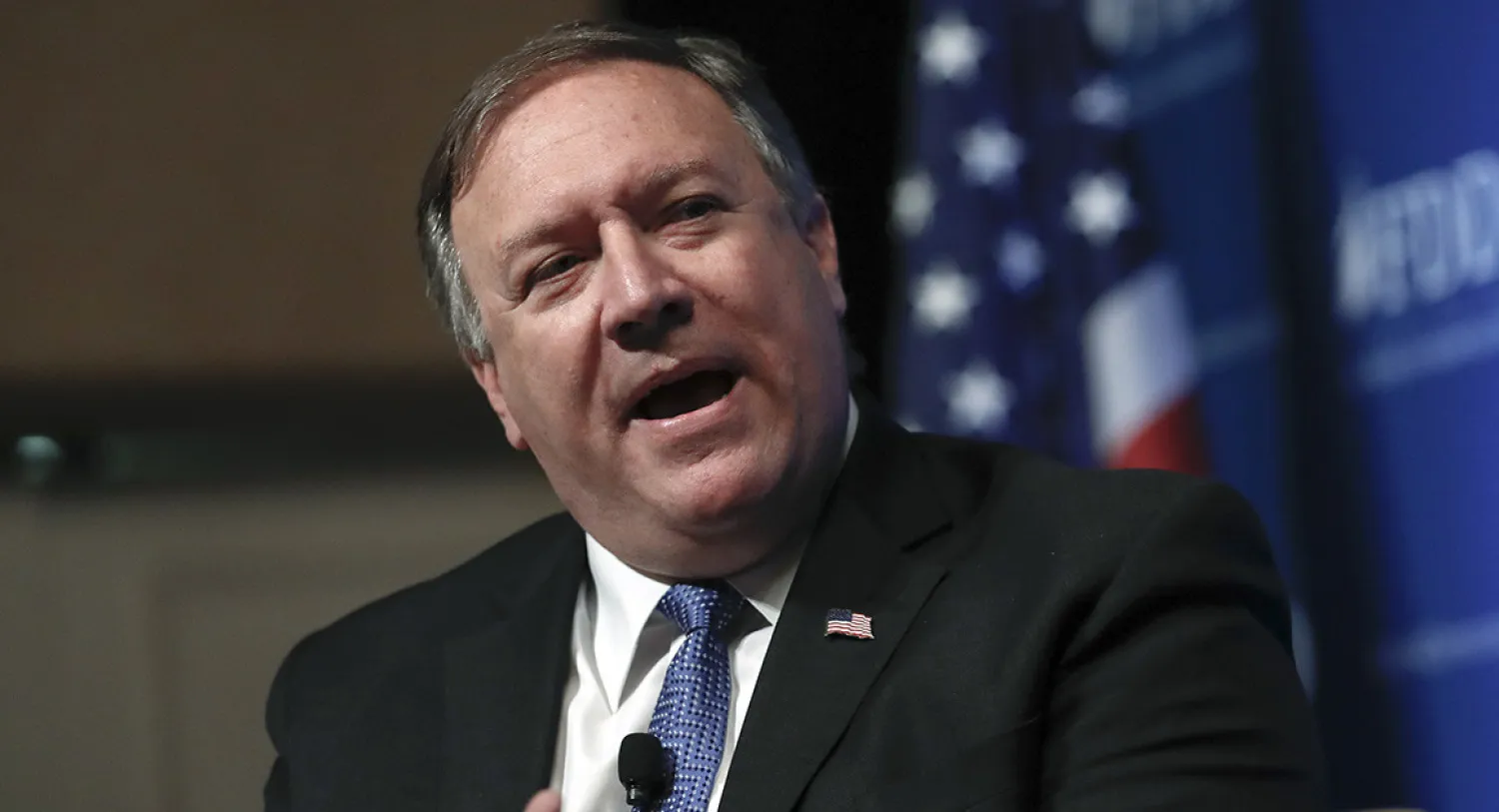
Pompeo Confirmed as New US Secretary of State

New US Secretary of State Mike Pompeo. (AP)
TT

Pompeo Confirmed as New US Secretary of State

New US Secretary of State Mike Pompeo. (AP)

The US Senate voted on Thursday to appoint former CIA chief Mike Pompeo as secretary of state, in time for him to lead the US delegation to NATO foreign minister talks in Brussels this weekend and to arrange a summit between President Donald Trump and North Korean leader Kim Jong Un in the coming months.

Pompeo’s approval came after a bruising battle by Democrats against Trump's nominee. Pompeo, who earned Trump's confidence after a year at the CIA, was accused by Democrats as being too bellicose.

But after barely getting the nomination past the Senate Foreign Relations Committee, Pompeo was easily confirmed by the entire body in a vote of 57-42, with a handful of Democratic senators facing tough re-election battles voting in favor.

Pompeo replaces Rex Tillerson, the former oil executive Trump fired in March after a year of tensions and turmoil in the State Department, where he alienated much of his staff and left the body deeply demoralized.

But where Tillerson was seen as a voice for moderation in the Trump administration, Pompeo is viewed as a hawk who could combine with new White House National Security Advisor John Bolton to back more aggressive posturing by Trump on the world stage.

In the run-up to Pompeo's confirmation, his backers emphasized his resume as a West Point and Harvard Law School graduate and former congressman who enjoys a close relationship with Trump particularly on North Korea. Pompeo, as CIA director, traveled to Pyongyang over Easter after being nominated for secretary of state.

"He's the perfect person to come in at this time and lead those efforts" on North Korea, Senate Foreign Relations Committee Chairman Bob Corker, R-Tenn., said on the Senate floor moments before Pompeo was confirmed.

Pompeo will take the helm at the State Department ahead of Trump's expected decision on May 12 about whether to withdraw from the Iran nuclear deal and re-impose sanctions on Tehran. Pompeo, a staunch Iran critic, has long deplored the 2015 nuclear accord, but has supported Trump's efforts to get European allies to strengthen restrictions on Iran.

"If there's no chance that we can fix it, I will recommend to the president that we work with our allies to achieve a better outcome and to achieve a better deal," Pompeo said in his confirmation hearing earlier this month.


Gunmen Attack Police Near Building Housing Israeli Consulate in Istanbul

A view of the building which houses the Israeli consulate in Istanbul after three gunmen engaged in a shootout with security personnel near the building in Istanbul, Türkiye, 07 April 2026. (EPA)
TT

Gunmen Attack Police Near Building Housing Israeli Consulate in Istanbul

A view of the building which houses the Israeli consulate in Istanbul after three gunmen engaged in a shootout with security personnel near the building in Istanbul, Türkiye, 07 April 2026. (EPA)

Three assailants opened fire at police outside a building housing the Israeli Consulate in Istanbul on Tuesday, sparking a gunfight that left one attacker dead, Turkish officials said. The two other assailants were wounded and captured.

Two police officers sustained slight injuries, Istanbul Gov. Davut Gul told reporters. The assailants were carrying long-barreled weapons.

The consulate is located in a high-rise building in Levent, one of the city’s main business districts. Officials said that there are no Israeli diplomats present in Israeli missions in Türkiye. Israel withdrew its diplomats amid security concerns and deteriorating relations with Türkiye during the war in Gaza.

Interior Minister Mustafa Cifti wrote on X that the attackers had traveled from the city of Izmit, about 100 kilometers (60 miles) east of Istanbul, in a rented car. One of the assailants was linked to a group he described as “exploiting religion,” without naming the organization.

The ISIS group has carried out deadly attacks in Türkiye in the past.

The two wounded assailants are brothers, identified as Onur C. and Enes C. The first has a criminal record related to drugs. Both are being interrogated, according to the Interior Ministry.

Video from the attack showed one assailant carrying what appeared to be an assault rifle, wearing a brown backpack and hiding behind a bus when exchanging fire with police. A police officer falls to the ground, apparently having been shot, and then rolls away to get behind a tree for cover.

One of the police officers was wounded in the leg and the other in the ear, the Interior Ministry said.

Turkish Justice Minister Akin Gurlek said that three prosecutors, including a deputy chief prosecutor, have been assigned to lead an investigation.

Police sealed off the building and blocked several roads, while forensic experts in white protective suits combed the area for evidence.

A witness described seeing officers take cover behind parked cars and communicate with each other during the shooting.

“In general, this is a noisy area, so initially we thought this might be something else. But the gunshots continued,” said Omer Dilki, 34. “We saw the police officers standing behind the cars, take shelter, and call out to each other.”

Ali Rıza Arpacı, who works nearby, described witnessing “serious clashes” happening right in front of him.

“We were almost inside the clashes,” he said, adding that the gunfight lasted for around 10 minutes.

Turkish President Recep Tayyip Erdogan denounced what he said was a “treacherous” attack.

“We will resolutely continue our fight against all forms of terrorism, and we will not allow the climate of security in Türkiye to be harmed by vile and timed provocations like today’s,” he said.

US Ambassador Tom Barrack condemned the assault, praising Turkish authorities for “their swift and decisive response.”

Israel’s Foreign Ministry similarly condemned the attack and commended Turkish security forces for their rapid action in thwarting it.


Russia and China Veto Watered-Down UN Resolution Aimed at Reopening the Strait of Hormuz

United States Ambassador to the United Nations Michael Waltz speaks during a United Nations Security Council meeting at United Nations Headquarters in New York, New York, USA, 07 April 2026. (EPA)
TT

Russia and China Veto Watered-Down UN Resolution Aimed at Reopening the Strait of Hormuz

United States Ambassador to the United Nations Michael Waltz speaks during a United Nations Security Council meeting at United Nations Headquarters in New York, New York, USA, 07 April 2026. (EPA)

Russia and China on Tuesday vetoed a UN Security Council resolution aimed at reopening the Strait of Hormuz that had been repeatedly watered down in hopes those two countries would abstain.

The vote — 11-2, with two abstentions from Pakistan and Colombia— took place just hours before an 8 p.m. Eastern deadline set by US President Donald Trump for Iran to open the strategic waterway or face attacks on its power plants and bridges.

One-fifth of the world’s oil typically passes through the strait, and Iran’s stranglehold during the war has sent energy prices soaring.

“Failing to adopt this resolution sends the wrong signal to the world, to the people of the world,” Abdullatif bin Rashid Al Zayani, Bahrain's foreign minister, said after the vote — “the signal that the threat to international waterways can pass without any decisive action by the international organization responsible for the maintenance of international peace and security.”

It’s doubtful the resolution introduced by Bahrain, even if it had been adopted, would have impacted the war, now in its sixth week, because it has been significantly weakened to try to get Moscow and Beijing to abstain rather than veto it.

The initial Gulf proposal would have authorized countries to use “all necessary means” to ensure transit through the Strait of Hormuz and deter attempts to close it.

The United States, which had supported the draft from its original form, assailed the countries that objected to the resolution.

“No one should tolerate that they are holding the global economy at gunpoint," Mike Waltz, the US ambassador to the UN, said of Iran, “but today, Russia and China did tolerate it.”

He said in his statement: “They sided with a regime that seeks to intimidate the Gulf into submission, even as it brutalizes its own people during a national internet blackout, for daring to imagine dignity or freedom.”

After Russia, China and France, all veto-wielding countries on the 15-member Security Council, expressed opposition to approving the use of force, the resolution was revised to eliminate all references to offensive action. It would have authorized only “all defensive means necessary.” A vote had been expected on Saturday.

But instead, the resolution was further weakened to eliminate any reference to Security Council authorization — which is an order for action — and limit its provisions to the Strait of Hormuz. Previous drafts had included adjacent waters.

The resolution vetoed Tuesday "strongly encourages states interested in the use of commercial maritime routes in the Strait of Hormuz to coordinate efforts, defensive in nature, commensurate with the circumstances, to contribute to ensuring the safety and security of navigation across the Strait of Hormuz.”

This should include escorting merchant and commercial vessels, and deterring attempts to close, obstruct or interfere with international navigation through the strait, it says.

The resolution also demanded that Iran immediately halt attacks on merchant and commercial vessels and stop impeding their freedom of navigation through the Strait of Hormuz and attacking civilian infrastructure.

In response to the US and Israeli attacks beginning on Feb. 28, Iran has targeted hotels, airports, residential buildings and other civilian infrastructure in more than 10 countries, including its own Gulf neighbors, some of the world’s major exporters of oil and natural gas.

Trump on Monday demanded again that Iran reopen the Strait of Hormuz after heaping praise on the US military for the daring rescue of two crewmen of a fighter jet shot down in Iran. The Republican president warned Iran that the "entire country can be taken out in one night, and that might be tomorrow night.”

He repeated the warning on Tuesday, saying a “whole civilization will die tonight” if Tehran does not meet his deadline to agree to a deal that includes reopening the Strait of Hormuz.

Russia’s UN Ambassador Vassily Nebenzia and China’s UN Ambassador Fu Cong have blamed the US and Israel for starting the war and sparking an expanding global crisis. They told the Security Council last week that the most urgent priority now is to end military operations immediately.

In response to Iran’s strikes against its Gulf neighbors, the Security Council adopted a Bahrain-sponsored resolution on March 11 condemning the “egregious attacks” and calling for Tehran to immediately halt its strikes.

That resolution, adopted by a vote of 13-0 with Russia and China abstaining, also condemned Iran’s actions in the Strait of Hormuz as a threat to international peace and security and called for an immediate end to all actions blocking shipping.



Deliberate Attacks on Civilian Targets ‘A War Crime’, Says UN

An Iranian flag lies amidst the rubble of a building of the Sharif University of Technology, which was damaged in a strike, amid the US-Israeli conflict with Iran, in Tehran, Iran, April 7, 2026. Majid Asgaripour/WANA (West Asia News Agency) via Reuters
TT

Deliberate Attacks on Civilian Targets ‘A War Crime’, Says UN

An Iranian flag lies amidst the rubble of a building of the Sharif University of Technology, which was damaged in a strike, amid the US-Israeli conflict with Iran, in Tehran, Iran, April 7, 2026. Majid Asgaripour/WANA (West Asia News Agency) via Reuters

The UN rights chief decried Tuesday the "incendiary rhetoric" in the Middle East war, warning that deliberate attacks on civilians and civilian infrastructure was "a war crime".

"Under international law, deliberately attacking civilians and civilian infrastructure is a war crime," UN high commissioner for human rights Volker Turk said in a statement, insisting that "anyone responsible for international crimes must be held to account by a competent court."

His comment came as US President Donald Trump ramped up his rhetoric against Iran, vowing to carry out the "complete demolition" of critical infrastructure, particularly bridges and power plants if Iran did not agree a deal by late Tuesday.

Hours before the deadline, the Israeli military said it had already completed a broad wave of strikes targeting "infrastructure sites" across Iran.

Writing on Truth Social, Trump stated that "a whole civilization will die tonight, never to be brought back again. I don't want that to happen, but it probably will", if the country does not heed his call for a deal.

Turk did not explicitly mention Trump nor the other countries involved in the conflict that began on February 28. But he said "I deplore the tirade of incendiary rhetoric being used in the Middle East war over the last couple of weeks by all parties."

In particular, he highlighted "the latest threats to annihilate a whole civilization and to target civilian infrastructure".

"This is sickening," he said, warning that "carrying through on such threats amounts to the most serious international crimes".

The UN rights chief stressed that "threats that spread fear and terror among civilians are unacceptable and must cease immediately."

He called on the international community to "take urgent steps to de-escalate the situation and to help protect the lives of all civilians."