Germany Extradites Terrorist Suspect to Tunisia

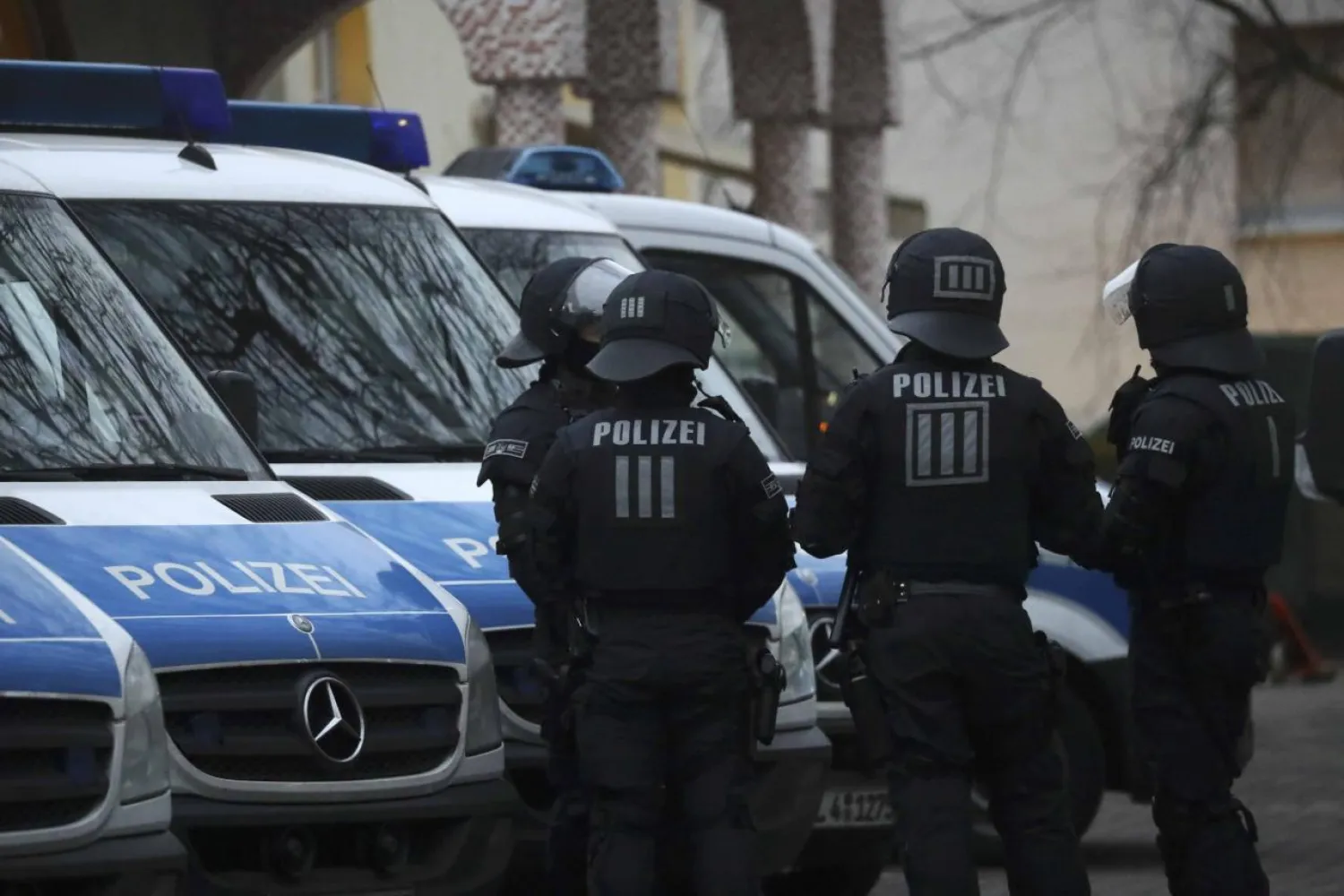
German special police forces stand guard in Frankfurt. Reuters file photo
TT

Germany Extradites Terrorist Suspect to Tunisia

German special police forces stand guard in Frankfurt. Reuters file photo

Court of First Instance Spokesperson Sufian al-Sulaiti confirmed that German authorities on Wednesday handed over to Tunisia terrorist Haikel Saydani.

Saydani, 36, is accused of participating in several terrorist attacks in Tunisia, including the 2015 attack at the National Bardo Museum in the capital that killed 21 foreign tourists and a Tunisian policeman.

Tunisian authorities also accuse him of involvement in the 2016 attack on the border town of Ben Guerdane.

Saydani was arrested in February 2017 in Hesse during an anti-terror raid.

The Federal Constitutional Court said German authorities had obtained sufficient assurances from Tunisia that Saydani wouldn't face the capital punishment in his home country.

His lawyer said, however, that even if there were assurances that Saydani would not receive the death penalty in Tunisia, there were “no guarantees.”

His extradition came after Germany's highest court rejected his appeal on Monday.

On the same day, he lost a last-ditch bid for a stay at the European Court of Human Rights.

Saydani "has been handed over to the authorities there," said Hesse interior minister Peter Beuth.

According to Germany’s Bild newspaper, Saydani left from Frankfurt in a chartered aircraft on Wednesday. Several federal police officers accompanied him on board.


Chad Govt Shuts Sudan Border Until Further Notice 

Children poke their heads and arms through holes in makeshift fabric fences in the strategic opposition-controlled town of Akobo, Jonglei State, on February 12, 2026. (AFP)
TT

Chad Govt Shuts Sudan Border Until Further Notice 

Children poke their heads and arms through holes in makeshift fabric fences in the strategic opposition-controlled town of Akobo, Jonglei State, on February 12, 2026. (AFP)

Chad's government said on Monday it was closing the border with Sudan until further notice, following several clashes between Chadian soldiers and armed groups involved in the civil war across the frontier.

"This decision follows repeated incursions and violations committed by the forces involved in the conflict in Sudan on Chadian territory," Communications Minister Mahamat Gassim Cherif said in a statement, adding that he wanted to halt "any risk of the conflict spreading" to his country.

Sudan's paramilitary Rapid Support Forces have been fighting government troops for almost three years in a conflict that has killed tens of thousands of people and forced 11 million to flee their homes, triggering what the UN says is one of the world's worst humanitarian crises.

The paramilitaries have conducted several operations near the Chad border and at least nine Chadian soldiers have been killed in separate incidents since December.

Monday's statement said Chad "reserves the right to retaliate against any aggression or violation of the inviolability of its territory and its borders".

"Cross-border movements of goods and people are suspended," the text said, adding that "exceptional exemptions" for humanitarian reasons would still be possible.


Report: US Forces to Complete Withdrawal from Syria within a Month 

Men watch as a US military mine-resistant ambush protected (MRAP) armored fighting vehicle moves in a convoy along a highway outside Qamishli in Syria's northeastern Hasakeh province on February 23, 2026. (AFP) 
TT

Report: US Forces to Complete Withdrawal from Syria within a Month 

Men watch as a US military mine-resistant ambush protected (MRAP) armored fighting vehicle moves in a convoy along a highway outside Qamishli in Syria's northeastern Hasakeh province on February 23, 2026. (AFP) 

US forces that led the anti-ISIS coalition in Syria started leaving a major base in the northeast on Monday and should complete their withdrawal from the country within a month, sources told AFP. 

The move comes after Kurdish forces, long backed by Washington in the fight against the ISIS group, ceded territory to Damascus and agreed to integrate into the state. 

American forces have already withdrawn from two other bases in the past two weeks, Al-Tanf in the southeast and Shaddadi in the northeast. 

"Within a month, they will have withdrawn from Syria and there will no longer be any military presence in the bases," a Syrian government official said, with a Kurdish source confirming the timeline. 

A third source, a diplomat, said the withdrawal should be completed within 20 days. 

The United States has about 1,000 troops still deployed in Syria. It began withdrawing on Monday from the Qasrak base in the northeast, which is still under the control of Kurdish forces, a Kurdish official who requested anonymity told AFP. 

An AFP team saw a convoy of dozens of trucks, loaded with armored vehicles and prefabricated structures, on a road linking the Qasrak base in Hasakeh province to the border with Iraq. 

Syria's government recently extended its control to the northeast of the country. 

Washington has drawn close to Syria's new authorities since the fall of Bashar al-Assad in late 2024. 


Israeli Team in Peace Council Reveals Vision for Gaza Reconstruction

A female member of the al-Ghafir family, sits of the debris of the al-Hasayna Mosque as she recites from a copy of the Quran, during the holy month of Ramadan in western Gaza City on February 21, 2026. (Photo by Omar AL-QATTAA / AFP)
TT

Israeli Team in Peace Council Reveals Vision for Gaza Reconstruction

A female member of the al-Ghafir family, sits of the debris of the al-Hasayna Mosque as she recites from a copy of the Quran, during the holy month of Ramadan in western Gaza City on February 21, 2026. (Photo by Omar AL-QATTAA / AFP)

While many observers remain skeptical about the chances of success for President Donald Trump’s comprehensive Middle East peace plan, figures close to the US administration are projecting confidence. Among them are three Israelis selected for key roles in the project, though they do not formally represent the Israeli government.

According to a report in Yedioth Ahronoth, the officials insist the initiative is already underway, with Egypt, Türkiye and Qatar playing influential roles in persuading Hamas to cooperate. Despite skepticism within parts of Israel’s political and military leadership regarding the feasibility of the plan — and the ability of Trump advisers Steve Witkoff and Jared Kushner to implement it — the Peace Council members argue that progress so far is “encouraging.”

The Israeli members of the council are Israeli-Cypriot businessman Yakir Gabay, high-tech entrepreneur Liran Tancman, and Michael Eisenberg, who serves as Prime Minister Benjamin Netanyahu’s representative at the US coordination headquarters in Kiryat Gat.

They contend that Hamas’ agreement to disarm, coupled with reforms to Palestinian school curricula to promote “a culture of peace and tolerance,” would transform Trump’s initiative into “a historic opportunity to turn Gaza into a true Riviera.”

Gabay outlined the first phase: removing 70 million tons of rubble and unexploded ordnance, recycling usable materials, demolishing and sealing hundreds of kilometers of tunnels, and establishing rapid temporary housing in reinforced tents. Parallel efforts would focus on building infrastructure and permanent residential towers.

Plans also include modern hospitals, schools, factories, agricultural zones, road and rail networks, energy and water facilities, data centers, a seaport and an airport. Contractors experienced in constructing millions of housing units across the Middle East would be recruited, with funding reportedly secured. Hundreds of thousands of jobs are expected to be created. In addition to housing and workplaces, 200 hotels are planned.

Tancman, who advises Israel’s national cyber directorate, pledged to introduce advanced technological solutions in cooperation with American, Arab and Palestinian partners. This includes upgrading Gaza’s internet network from 2G to 5G and making access free of charge. Mechanisms for exporting Gaza-made goods are also under development.

A “New Era”?

Officials told Yedioth Ahronoth that reconstruction has effectively begun in Rafah and is expected to take three years. Israel is currently clearing debris, with 100,000 homes slated for construction in the first phase to house 500,000 residents. Infrastructure alone is projected to cost $5 billion. Ultimately, 400,000 homes are planned, with total infrastructure costs estimated at $30 billion, alongside a similar sum for construction.

A senior Peace Council member suggested that if Hamas responds positively, Israel could consider measures such as amnesty for its leaders or even purchasing weapons for cash. “Gaza and its people could enter a new era—connected and open to the world,” he said.

Separately, The Times of Israel cited a US official confirming that funds would not flow before Hamas agrees to disarm, adding that Israel must also act constructively.

An Arab diplomat cautioned that sustained pressure on both sides would be essential to ensure the plan’s success and the establishment of a technocratic administration in Gaza.