

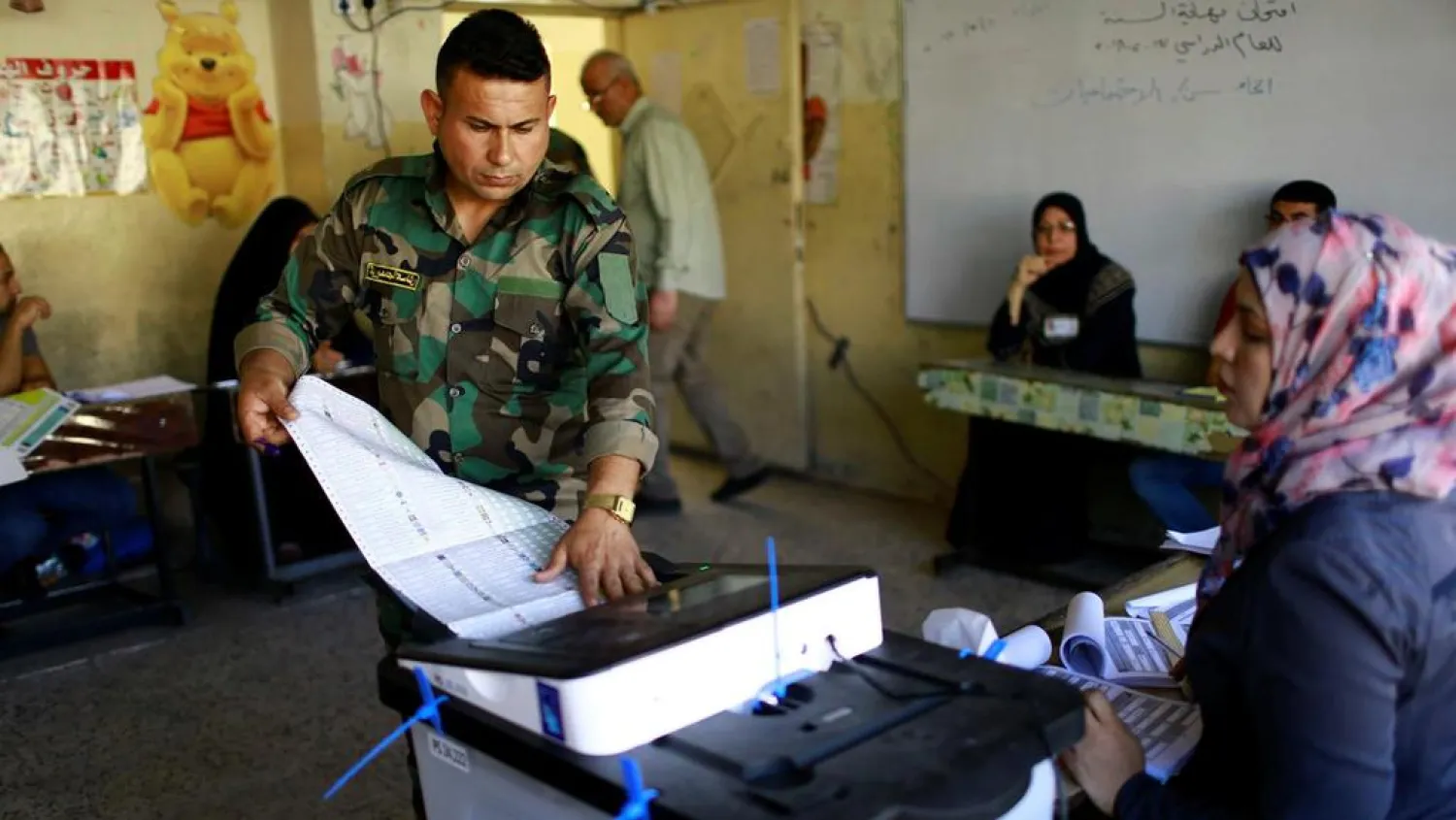

Iraqi Election: Contest between Iran's Challenger and America's Incumbent

An Iraqi security member votes at a polling station in Baghdad. (Reuters)
TT

Iraqi Election: Contest between Iran's Challenger and America's Incumbent

An Iraqi security member votes at a polling station in Baghdad. (Reuters)

Hadi al-Ameri, the stout chief of one of Iraq's most powerful paramilitary groups, had crisscrossed the country ahead of Saturday’s national elections. At one campaign rally after another, he headlined a ticket stocked mostly with men like himself: soldiers who are vying to be the next class of Iraqi statesmen.

On the stump, he constantly resisted the view widely held in Baghdad and Washington that he is Iran's man in Iraq - Tehran's best hope for cementing its influence in a country where it invested heavily in expelling the ISIS terrorist group.

But in fact, for more than three decades, Ameri has fought for and most recently commanded a militia armed and trained by Iran that has been crucial in extending Iranian influence in Iraq.

Ameri and his election coalition, called Fatah, or Conquest, could present the main challenge to Prime Minister Haidar al-Abadi, who has eschewed the traditional rhetoric of sectarianism and Shiite supremacy for a more inclusive Iraqi nationalism.

While Abadi has tried as prime minister to steer a course between US and Iranian interests, he is the favored candidate of US officials, and the election is widely seen by many Iraqi politicians and analysts as a contest pitting the United States' incumbent against Iran's challenger.

In overseeing the battle last year to oust ISIS from Iraqi territory, Abadi relied heavily on American air power and ground forces, while Ameri has commanded forces armed and trained by Iran's Revolutionary Guard Corps. Ameri's Badr Organization was founded in Tehran in the 1980s to fight against then-Iraqi President Saddam Hussein.

How the competing tickets fared at the polls will have a broad impact on how the country deals with its main allies, Iran and the United States, as tensions escalate between the two powers.

Trump's announcement this week that he is pulling the United States out of the Iran nuclear deal has raised concerns that the rivalry between Washington and Tehran will play out in Iraq, destroying what has been four years of nominal cooperation in the fight against ISIS.

The two countries have kept an unusually low profile in Iraq's election, refraining from public statements in support of any candidate. Analysts say the US decision to withdraw from the nuclear deal could push Iran to become more assertive.

"Iran will fight fiercely to control everything in Iraq, markets, economy, oil," said Ghalib al-Shahbandar, a political analyst and former Iraqi politician.

Ameri and others in his election coalition do not deny that they have strong ties to Iran, but they bristle at the notion that they are agents of Tehran. They have shed their military fatigues for business suits and adopted Abadi's centrist rhetoric of a strong and unified Iraq that takes no sides in regional conflicts.

During a recent interview at his well-appointed and heavily guarded house in Baghdad's fortified Green Zone, Ameri was clearly exhausted from campaigning and barely able to keep his eyes open. But they opened wide at the mention of Iran, and he leaned forward in his chair.

"Iran is broke," he said with a smile, suggesting that it did not have enough spare cash to underwrite his campaign. He denied that Iran has been funding his election coalition.

Ameri's coalition has run on a platform of fighting corruption, diversifying Iraq's oil-dependent economy and nourishing the country's private sector. The candidates on his ticket uniformly oppose the presence of US forces in Iraq and have said Abadi is too closely aligned with Washington.

But most of all, they have touted their battlefield victories against ISIS and insisted that the paramilitary group that underpins their influence remain a semi-autonomous part of Iraq's security forces. That group, an umbrella for dozens of militias, musters nearly 150,000 fighters.

Ameri's forces are part of that group, what is called the Popular Mobilization Forces (PMF). The militias that comprise it were deputized by the government to counter ISIS as it overran nearly one-third of Iraq in 2014. Many of these militias are backed by Iran and fought fiercely against American troops after the US invasion of Iraq in 2003.

The militias now have legal status in Iraq and are ostensibly under the command of the prime minister. A representative of the militias sits on Iraq's National Security Council and is not answerable to the Defense Ministry or the Interior Ministry.

Contrary to Abadi's stated policy of not interfering in regional conflicts, some of the militias have sent fighters to Syria who are in combat alongside Iranian and Syrian forces in support of regime head Bashar Assad.

US officials have pushed Abadi to shrink the PMF and subordinate them to Iraq's police and army. But the prime minister has been reluctant to challenge the militia leaders, who are popular because of their role in defeating ISIS.

Ameri is perhaps the most influential of those leaders. In recent weeks, his face has been ubiquitous on election posters plastering Iraq's streets. He has positioned himself as the alternative to Abadi - a decisive, battle-hardened field commander who will eradicate terrorism while elevating Iraq's international prestige.

As a result, the election is in part also a test of Iraqis' appetite for a government with a decidedly military character over a civilian-led one.

Ameri says that building a strong state would defeat what he calls "the Triangle of Death" that has bedeviled Iraq: terrorism, sectarianism and corruption.

The Washington Post


Respiratory Virus Claims Lives in Gaza amid Limited Capacity for Testing

A Palestinian man carries the body of his three-month-old daughter on Tuesday after she died from the cold in Gaza City. (AFP)
TT

Respiratory Virus Claims Lives in Gaza amid Limited Capacity for Testing

A Palestinian man carries the body of his three-month-old daughter on Tuesday after she died from the cold in Gaza City. (AFP)

Gaza resident Yusra al-Hajjar, 32, went through harrowing moments after she was shocked by a sharp rise in the temperature of her five-month-old infant, Nidal, prompting her to rush him to a clinic at the Al-Shifa Medical Complex in Gaza City as his condition worsened.

Initial medical examinations failed to determine the exact cause of the infant’s illness, forcing the medical team to resort to basic measures such as intravenous fluids and fever-reducing medication in an attempt to control the symptoms.

The treatment was temporarily successful, and the baby’s condition improved after several hours.

“We left the clinic in a better condition, but less than a day later, we brought him back after a new deterioration,” al-Hajjar told Asharq Al-Awsat.

“As of this morning, Tuesday, five days have passed since my baby fell ill. I am still trying basic methods, such as cooling his forehead with cold water and giving him some medication to reduce the fever and stop the vomiting and weakness, while doctors have been unable to determine the cause,” she added.

The infant’s case is not the only one. Residents of Gaza have been struggling in recent weeks with what medical officials describe as a widespread outbreak of identical symptoms, particularly among the elderly and children, according to Mohammed Abu Salmiya, director of the Al-Shifa Medical Complex.

Abu Salmiya said that for nearly a month, new deaths have been recorded on an almost daily basis due to the spread of what he described as a dangerous and deadly virus.

He said the virus causes severe pneumonia, leading to fatalities primarily among vulnerable patients with weakened immune systems, and secondarily among individuals with stronger immunity, including some young people whose deaths were recorded in recent days.

No capacity for testing

Abu Salmiya said Gaza’s health system lacks even the most basic laboratory capabilities needed to identify the virus, suggesting it could be a new COVID variant spreading in the world.

Earlier on Tuesday, a seven-month-old infant, Shaza Abu Jarrad, died due to extreme cold and a lack of adequate shelter and heating, raising the number of child deaths from similar conditions to about 10.

Abu Salmiya said the current cold weather has fueled the spread of the virus, contributing to a high number of deaths amid the harsh living conditions in Gaza following the Israeli war.

He said there is a direct link between the war and weakened immunity among Gaza’s population, who have endured repeated bouts of hunger, alongside water contamination.

He added that this comes amid severe shortages of medicines and medical supplies, leaving health authorities unable to mount an effective and rapid response to the current health crisis.

The United Nations Relief and Works Agency for Palestine Refugees, UNRWA, said in a post on X that despite the collapse of Gaza’s health system, it continues to provide primary health care to thousands of people every day, but faces an acute shortage of medicines.

UNRWA accused Israel of preventing its aid supplies stuck in warehouses in Jordan and Egypt from entering Gaza since March 2 last year, stressing the urgent need to allow its assistance into the territory.

It said harsh winter conditions are compounding the suffering of families in Gaza who have been exhausted by war and repeated displacement, calling for large-scale access for humanitarian aid.

Mahmoud Bassal, spokesman for Gaza’s Civil Defense, warned of a rise in deaths, particularly among young children, due to the severe cold wave coinciding with the deterioration of humanitarian conditions in the enclave.

He said field and health conditions are extremely harsh, especially for infants, the sick, and the elderly, as most families live in dilapidated tents that offer little protection from the cold, rain, and other environmental conditions.


Khartoum Markets Back to Life but 'Nothing Like Before'

Men walk along a street past destroyed high-rise building, as efforts to restore the city's infrastructure resumes after nearly three years of devastation caused by war, in the Sudanese capital Khartoum on January 17, 2025. (AFP)
TT

Khartoum Markets Back to Life but 'Nothing Like Before'

Men walk along a street past destroyed high-rise building, as efforts to restore the city's infrastructure resumes after nearly three years of devastation caused by war, in the Sudanese capital Khartoum on January 17, 2025. (AFP)

The hustle and bustle of buyers and sellers has returned to Khartoum's central market, but "it's nothing like before," fruit vendor Hashim Mohamed told AFP, streets away from where war first broke out nearly three years ago.

On April 15, 2023, central Khartoum awoke to battles between the Sudanese army and the paramilitary Rapid Support Forces, who had been allies since 2021, when they ousted civilians from a short-lived transitional government.

Their war has since killed tens of thousands and displaced millions. In greater Khartoum alone, nearly 4 million people -- around half the population -- fled the city when the RSF took over.

Hashim Mohamed did not.

"I had to work discreetly, because there were regular attacks" on businesses, said the fruit seller, who has worked in the sprawling market for 50 years.

Like him, those who stayed in the city report living in constant fear of assaults and robberies from fighters roaming the streets.

Last March, army forces led an offensive through the capital, pushing paramilitary fighters out and revealing the vast looting and destruction left behind.

"The market's not what it used to be, but it's much better than when the RSF was here," said market vendor Adam Haddad, resting in the shade of an awning.

In the market's narrow, dusty alleyways, fruits and vegetables are piled high, on makeshift stalls or tarps spread on the ground.

- Two jobs to survive -

Khartoum, where entire neighborhoods were once under siege, is no longer threatened by the mass starvation that stalks battlefield cities and displacement camps elsewhere in Sudan.

But with the economy a shambles, a good living is still hard to provide.

"People complain about prices, they say it's too expensive. You can find everything, but the costs keep going up: supplies, labor, transportation," said Mohamed.

Sudan has known only triple-digit annual inflation for years. Figures for 2024 stood at 151 percent -- down from a 2021 peak of 358.

The currency has also collapsed, going from trading at 570 Sudanese pounds to the US dollar before the war to 3,500 in 2026, according to the black market rate.

One Sudanese teacher, who only a few years ago could provide comfortably for his two children, told AFP he could no longer pay his rent with a monthly salary of 250,000 Sudanese pounds ($71).

To feed his family, pay for school, and cover healthcare, he "works in the market or anywhere" on his days off.

"You have to have another job to pay for the bare minimum of basic needs," he said, asking for anonymity to protect his privacy.

For Adam Haddad, the road to recovery will be a long one.

"We don't have enough resources or workers or liquidity going through the market," he said, adding that reliable electricity was still a problem.

"The government is striving to restore everything, and God willing, in the near future, the power will return and Khartoum will become what it once was."


Trump Heads into Davos Storm, with an Eye on Home

FILE - President Donald Trump is illuminated by a camera flash as he gestures while walking across the South Lawn of the White House, Nov. 2, 2025, in Washington, after returning from a trip to Florida. (AP Photo/Mark Schiefelbein, File)
TT

Trump Heads into Davos Storm, with an Eye on Home

FILE - President Donald Trump is illuminated by a camera flash as he gestures while walking across the South Lawn of the White House, Nov. 2, 2025, in Washington, after returning from a trip to Florida. (AP Photo/Mark Schiefelbein, File)

Donald Trump returns to the Davos ski resort next week after unleashing yet another avalanche on the global order. But for the US president, his main audience is back home.

Trump's first appearance in six years at the gathering of the world's political and global elite comes amid a spiraling crisis over his quest to acquire Greenland.

Fellow leaders at the mountain retreat will also be eager to talk about other shocks from his first year back in power, from tariffs to Venezuela, Ukraine, Gaza and Iran.

Yet for the Republican president, his keynote speech among the Swiss peaks will largely be aimed at the United States.

US voters are angered by the cost of living despite Trump's promises of a "golden age," and his party could be facing a kicking in crucial midterm elections in November.

That means Trump will spend at least part of his time in luxurious Davos talking about US housing.

A White House official told AFP that Trump would "unveil initiatives to drive down housing costs" and "tout his economic agenda that has propelled the United States to lead the world in economic growth."

The 79-year-old is expected to announce plans allowing prospective homebuyers to dip into their retirement accounts for down payments.

Billionaire Trump is keenly aware that affordability has become his Achilles' heel in his second term. A CNN poll last week found that 58 percent of Americans believe his first year back in the White House has been a failure, particularly on the economy.

Trump's supporters are also increasingly uneasy about the "America First" president's seemingly relentless focus on foreign policy since his return to the Oval Office.

But as he flies into the snowy retreat, Trump will find it impossible to avoid the global storm of events that he has stirred since January 20, 2025.

Trump will be alongside many of the leaders of the same European NATO allies that he has just threatened with tariffs if they don't back his extraordinary quest to take control of Greenland from Denmark.

Those threats have once again called into question the transatlantic alliance that has in many ways underpinned the western economic order celebrated at Davos.

- 'Economic stagnation' -

So have the broader tariffs Trump announced early in his second term, and he is set to add to the pressure on Europe in his speech.

Trump will "emphasize that the United States and Europe must leave behind economic stagnation and the policies that caused it," the White House official said.

The Ukraine war will also be on the cards.

Ukrainian President Volodymyr Zelensky is hoping for a meeting with Trump to sign new security guarantees for a hoped-for ceasefire deal with Russia, as are G7 leaders.

But while the largest-ever US Davos delegation includes Secretary of State Marco Rubio, special envoy Steve Witkoff and son-in-law Jared Kushner, who have all played key roles on Ukraine, no meeting is assured.

"No bilateral meetings have been scheduled for Davos at this time," the White House told AFP.

Trump is meanwhile reportedly considering a first meeting of the so-called "Board of Peace" for war-torn Gaza at Davos, after announcing its first members in recent days.

Questions are also swirling about the future of oil-rich Venezuela following the US military operation to topple its leader Nicolas Maduro, part of Trump's assertive new approach to his country's "backyard."

But Trump may also pause to enjoy his time in the scenic spot he called "beautiful Davos" in his video speech to the meeting a year ago.

The forum has always been an odd fit for the former New York property tycoon and reality TV star, whose brand of populism has long scorned globalist elites.

But at the same time, Trump relishes the company of the rich and successful.

His first Davos appearance in 2018 met occasional boos but he made a forceful return in 2020 when he dismissed the "prophets of doom" on climate and the economy.

A year later he was out of power. Now, Trump returns as a more powerful president than ever, at home and abroad.
