
Report Exposes Israel’s Hiding of Evidence of Arab Expulsion in 1948

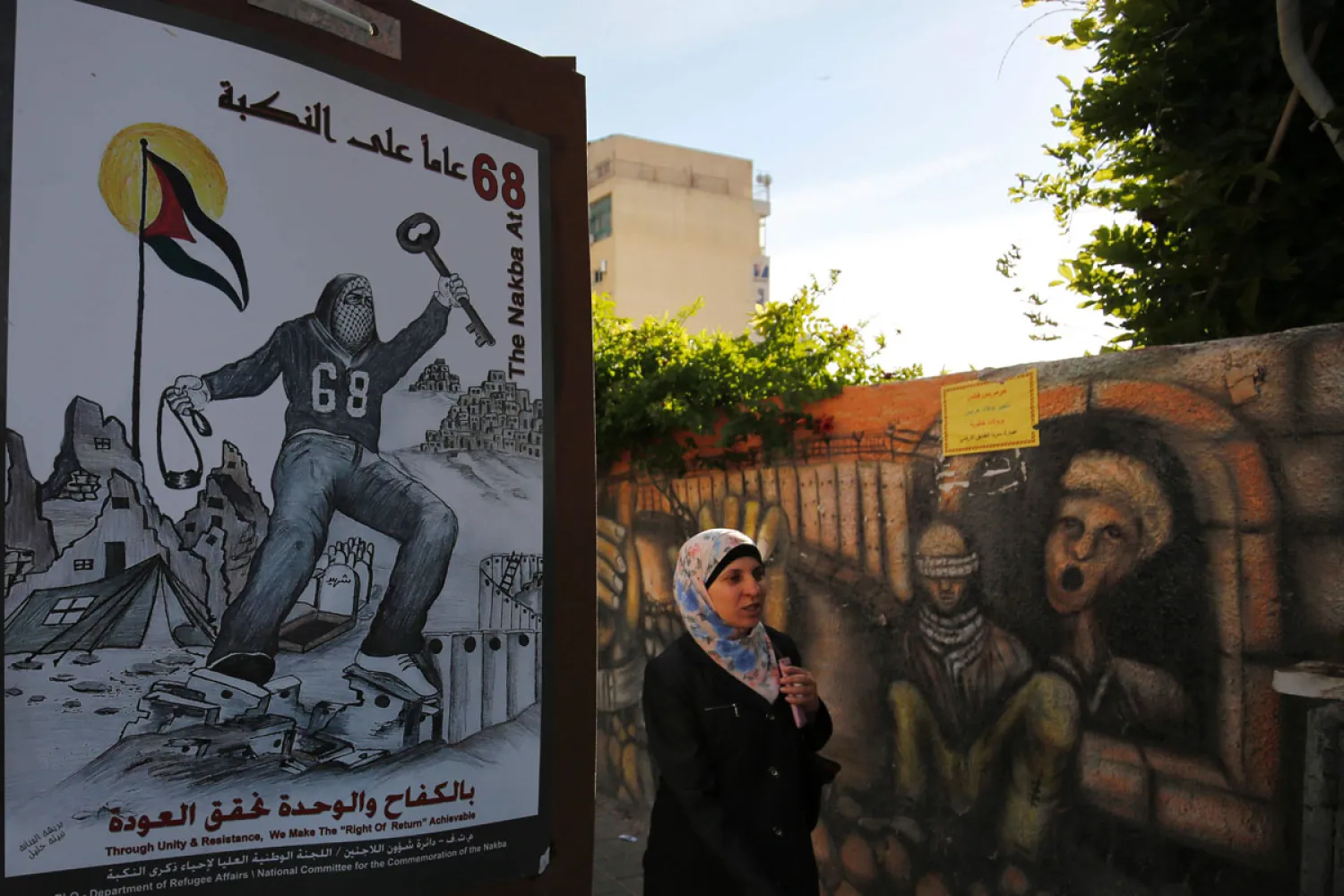
A Palestinian woman walks past a poster depicting a key symbolizing the keys to houses left by Palestinians in 1948, on May 11, 2016, in the West Bank city of Ramallah. (AFP)
TT

Report Exposes Israel’s Hiding of Evidence of Arab Expulsion in 1948

A Palestinian woman walks past a poster depicting a key symbolizing the keys to houses left by Palestinians in 1948, on May 11, 2016, in the West Bank city of Ramallah. (AFP)

A report released by Israel’s Haaretz daily revealed how authorities systematically sought to hide evidence and secret documents that expose atrocities committed by Zionist gangs against Palestinians in 1948.

This includes genocide and racial cleansing, confirming Palestinian narratives of how they were expelled from their homeland and weakening Israeli allegations that the Palestinians were the first to attack Jews.

The report cites historian Tamar Novick, “who four years ago was jolted by a document she found in the file of Yosef Vashitz, from the Arab Department of the left-wing Mapam Party, in the Yad Yaari archive at Givat Haviva. The document, which seemed to describe events that took place during the 1948 war, detailed how 52 Palestinians from the town of Safsaf were massacred by Zionist gangs.

“Women came, begged for mercy. Found bodies of 6 elderly men. There were 61 bodies. 3 cases of rape, one east of from Safed, girl of 14, 4 men shot and killed. From one they cut off his fingers with a knife to take the ring,” read the document, according to Haaretz.

The Upper Galilee village of Safsaf was captured by the Israel defense forces in Operation Hiram toward the end of 1948. Moshav Safsufa was established on its ruins. Allegations were made over the years that the Seventh Brigade committed war crimes in the village. Those charges are supported by the document Novick found, which was not previously known to scholars. It could also constitute additional evidence that the Israeli top brass knew about what was going on in real time, said Haaretz.

Novick decided to consult with other historians about the document. Benny Morris, whose books are basic texts in the study of the Nakba – the “calamity,” as the Palestinians refer to the mass emigration of Arabs from the country during the 1948 war – told her that he, too, had come across similar documentation in the past. He was referring to notes made by Mapam Central Committee member Aharon Cohen on the basis of a briefing given in November 1948 by Israel Galili, the former chief of staff of the Haganah militia, which became the Israeli defense forces. Cohen’s notes in this instance, which Morris published, stated: “Safsaf 52 men tied with a rope. Dropped into a pit and shot. 10 were killed. Women pleaded for mercy. [There were] 3 cases of rape. Caught and released. A girl of 14 was raped. Another 4 were killed. Rings of knives.”

Morris’ footnote (in his seminal “The Birth of the Palestinian Refugee Problem, 1947-1949”) states that this document was also found in the Yad Yaari Archive. But when Novick returned to examine the document, she was surprised to discover that it was no longer there, reported Haaretz.

“At first I thought that maybe Morris hadn’t been accurate in his footnote, that perhaps he had made a mistake,” Novick recalls. “It took me time to consider the possibility that the document had simply disappeared.” When she asked those in charge where the document was, she was told that it had been placed behind lock and key at Yad Yaari – by order of the Ministry of Defense.

Since the start of the last decade, Defense Ministry teams have been scouring Israel’s archives and removing historic documents. But it’s not just papers relating to Israel’s nuclear project or to the country’s foreign relations that are being transferred to vaults: Hundreds of documents have been concealed as part of a systematic effort to hide evidence of the Nakba, said Haaretz.

The phenomenon was first detected by the Akevot Institute for Israeli-Palestinian Conflict Research. According to a report drawn up by the institute, the operation is being spearheaded by Malmab, the Defense Ministry’s secretive security department (the name is a Hebrew acronym for “director of security of the defense establishment”), whose activities and budget are classified. The report asserts that Malmab removed historical documentation illegally and with no authority, and at least in some cases has sealed documents that had previously been cleared for publication by the military censor. Some of the documents that were placed in vaults had already been published.

An investigative report by Haaretz found that Malmab has concealed testimony from Israeli generals about the killing of civilians and the demolition of villages, as well as documentation of the expulsion of Bedouin during the first decade of statehood. Conversations conducted by Haaretz with directors of public and private archives alike revealed that staff of the security department had treated the archives as their property, in some cases threatening the directors themselves.

Yehiel Horev, who headed Malmab for two decades, until 2007, acknowledged to Haaretz that he launched the project, which is still ongoing. Asked what the point is of removing documents that have already been published, he explained that the objective is to undermine the credibility of studies about the history of the “refugee problem”. In Horev’s view, an allegation made by a researcher that's backed up by an original document is not the same as an allegation that cannot be proved or refuted.

One of the most fascinating documents about the origin of the Palestinian refugee problem was written by an officer in Shai, the precursor to the Shin Bet security service. It discusses why the country was emptied of so many of its Arab inhabitants, dwelling on the circumstances of each village. Compiled in late June 1948, it was titled “The Emigration of the Arabs of Palestine.”

This document was the basis for an article that Benny Morris published in 1986. After the article appeared, the document was removed from the archive and rendered inaccessible to researchers. Years later, the Malmab team reexamined the document, and ordered that it remain classified. They could not have known that a few years later researchers from Akevot would find a copy of the text and run it past the military censors – who authorized its publication unconditionally. Now, after years of concealment, the gist of the document is being revealed by Haaretz.

The 25-page document begins with an introduction that unabashedly approves of the evacuation of the Arab villages. According to the author, the month of April “excelled in an increase of emigration,” while May “was blessed with the evacuation of maximum places.” The report then addresses “the causes of the Arab emigration.” According to the Israeli narrative that was disseminated over the years, responsibility for the exodus from Israel rests with Arab politicians who encouraged the population to leave. However, according to the document, 70 percent of the Arabs left as a result of Jewish military operations.

The unnamed author of the text ranks the reasons for the Arabs’ departure in order of importance. The first reason: “Direct Jewish acts of hostility against Arab places of settlement.” The second reason was the impact of those actions on neighboring villages. Third in importance came “operations by the breakaways,” namely the Irgun and Lehi undergrounds. The fourth reason for the Arab exodus was orders issued by Arab institutions and “gangs” (as the document refers to all Arab fighting groups); fifth was “Jewish 'whispering operations' to induce the Arab inhabitants to flee”; and the sixth factor was “evacuation ultimatums.”

The author asserts that, “without a doubt, the hostile operations were the main cause of the movement of the population.” In addition, “Loudspeakers in the Arabic language proved their effectiveness on the occasions when they were utilized properly.” As for Irgun and Lehi operations, the report observes that “many in the villages of central Galilee started to flee following the abduction of the notables of Sheikh Muwannis [a village north of Tel Aviv]. The Arab learned that it is not enough to forge an agreement with the Haganah and that there are other Jews [i.e., the breakaway militias] to beware of.”

The author notes that ultimatums to leave were especially employed in central Galilee, less so in the Mount Gilboa region. “Naturally, the act of this ultimatum, like the effect of the 'friendly advice,' came after a certain preparing of the ground by means of hostile actions in the area.”

An appendix to the document describes the specific causes of the exodus from each of scores of Arab locales: Ein Zeitun – “our destruction of the village”; Qeitiya – “harassment, threat of action”; Almaniya – “our action, many killed”; Tira – “friendly Jewish advice”; Al’Amarir – “after robbery and murder carried out by the breakaways”; Sumsum – “our ultimatum”; Bir Salim – “attack on the orphanage”; and Zarnuga – “conquest and expulsion.”

The Malmab case is only one example of the battle being waged for access to archives in Israel.

A report written by Yaacov Lozowick, the previous chief archivist at the State Archives, upon his retirement, refers to the defense establishment’s grip on the country’s archival materials. In it, he writes, “A democracy must not conceal information because it is liable to embarrass the state. In practice, the security establishment in Israel, and to a certain extent that of foreign relations as well, are interfering with the [public] discussion.”

Advocates of concealment put forward several arguments, Lozowick notes: “The uncovering of the facts could provide our enemies with a battering ram against us and weaken the determination of our friends; it’s liable to stir up the Arab population; it could enfeeble the state’s arguments in courts of law; and what is revealed could be interpreted as Israeli war crimes.” However, he says, “All these arguments must be rejected. This is an attempt to hide part of the historical truth in order to construct a more convenient version.”



Iran Revolutionary Guards Officers Reject Iraqi Calls to Halt Attacks

A man gestures with picture of Iran's slain supreme leader Ali Khamenei next to Iranian and Iraqi flags from a atop a truck during celebrations welcoming the two-week ceasefire between the United States and Iran in Baghdad's central Tahrir Square on April 8, 2026.(AFP)
TT

Iran Revolutionary Guards Officers Reject Iraqi Calls to Halt Attacks

A man gestures with picture of Iran's slain supreme leader Ali Khamenei next to Iranian and Iraqi flags from a atop a truck during celebrations welcoming the two-week ceasefire between the United States and Iran in Baghdad's central Tahrir Square on April 8, 2026.(AFP)

Iraqi sources said officers from Iran’s Revolutionary Guards, who oversee armed factions in Iraq, have rebuffed attempts by Shiite politicians to halt attacks inside the country.

Since the outbreak of the US-Iran war, they have effectively acted as a “shadow military supervisor” in Baghdad, maintaining a “pressure front” against Washington and preparing for a breakdown in negotiations.

Asharq Al-Awsat reported on March 24 that officers from the Quds Force, the foreign arm of the Revolutionary Guards, had deployed to Iraq to run attrition operations and set up an alternative operation room.

According to the sources, Quds Force officers have moved between Iraqi cities to oversee attacks, help factions develop locally made drone munitions, and provide missile-related expertise, with targets updated continuously.

Daily target lists

One source said Revolutionary Guards officers provided Iraqi armed groups with daily lists of targets, munitions volumes, and strike timing.

They oversaw the deployment of specialized cells installing drone launch platforms and surveillance units in safe houses at new locations, avoiding coordinates previously tracked by US aircraft before and during the war.

By the fourth week of the war, one source said, the structure of the “resistance” in Iraq had shifted. Core factions moved to a new model built on semi-independent networks that are difficult to dismantle.

A person close to the factions described a system that distributes roles across specialized field cells operating flexibly in complex security environments.

Iraqi sources said the Revolutionary Guards engineered faction networks to ensure plausible deniability through layered structures that provide deterrence and ambiguity.

Some cells were tasked with cross-border attacks targeting interests in neighboring Arab states, as the indirect confrontation widened across overlapping regional arenas.

An unidentified strike hit a house in Khor al-Zubair in Basra, about 150 km from Kuwait, destroying a radar and a launch platform. Members of a cell, including a commander from Kataib Hezbollah, were killed along with two others.

The Revolutionary Guards denied carrying out attacks on Gulf Arab states on Thursday, but “is capable of using Iraqi groups to carry out this task,” a source close to the factions said.

In the final week of the war, before a temporary ceasefire, Iranian officers ordered the redeployment of faction units that had withdrawn from Nineveh and Kirkuk, telling them to retake positions ceded to other forces under US strikes, revealed the sources.

Revolutionary Guards officer does not answer calls

Two figures from the ruling Coordination Framework and the Iraqi government said leaders of four Shiite parties had held talks in recent weeks with Iranian officials inside Iraq to press for a halt to attacks on US interests, but were ignored.

One influential Quds Force officer in Baghdad “does not answer calls from Iraqi politicians, even allies within the Coordination Framework,” the sources said, adding that he communicates only with operational commanders in armed factions.

The contacts reflect attempts to contain escalation and prevent Iraq from sliding into a broader conflict, as pressure mounts on the government to rein in armed groups. But “local political will is diminishing to an unprecedented level,” an Iraqi official said.

Security officials have voiced frustration over what they described as the “growing dominance” of officers from the Revolutionary Guards.

A senior Iraqi official, speaking at a private security meeting, said: “How is it possible that we cannot stop this man? Who is this ‘Abu so-and-so’? Why can’t we arrest him, or at least stop these attacks?”

Leaders within the Coordination Framework said the issue may largely stem from poor communication, noting that Iranian officials rely on strict security protocols.

‘Military supervisor’

Figures within the Coordination Framework said field officers linked to the Revolutionary Guards are effectively becoming a “military supervisor” running a conflict front with the US from inside Iraq, regardless of Iraqi considerations.

They said Iran’s refusal to halt attacks signals it sees little hope in talks with Washington and that the “front is ready to ignite”.

Iraqi officials said the situation underscores the scale of the challenge facing security institutions in areas beyond the state’s direct control.

The US State Department said Iraqi militias receive government financial, operational, and political cover, and that authorities have failed to curb them or limit their attacks, according to a statement issued on Thursday.

Politicians within the Coordination Framework said the conduct of Revolutionary Guards officers reflects Iran’s intent to keep Iraq as a pressure front against the United States as the Pakistan-mediated negotiation kick off.

But they warned that this risks pushing Iraq’s political system toward chaos, accelerating its regional isolation.


Lebanon Heads to Historic Israel Talks with Few Hopes Except to Staunch Bloodshed

 Protesters wave Hezbollah and Iran's flags during a protest against the Lebanese Prime Minister Nawaf Salam, in front the government palace in Beirut, Lebanon, Friday, April 10, 2026. (AP)
Protesters wave Hezbollah and Iran's flags during a protest against the Lebanese Prime Minister Nawaf Salam, in front the government palace in Beirut, Lebanon, Friday, April 10, 2026. (AP)
TT

Lebanon Heads to Historic Israel Talks with Few Hopes Except to Staunch Bloodshed

 Protesters wave Hezbollah and Iran's flags during a protest against the Lebanese Prime Minister Nawaf Salam, in front the government palace in Beirut, Lebanon, Friday, April 10, 2026. (AP)
Protesters wave Hezbollah and Iran's flags during a protest against the Lebanese Prime Minister Nawaf Salam, in front the government palace in Beirut, Lebanon, Friday, April 10, 2026. (AP)

Lebanon's President Joseph Aoun has called for historic direct talks with longtime foe Israel since war erupted a month ago - a month in which Israel's military has forced more than a million Lebanese to flee, levelled parts of Beirut and triggered sectarian friction.

Now that Israeli Prime Minister Benjamin Netanyahu has finally answered the call to talk peace, Lebanon is in its weakest position to deliver it, experts said.

Armed group Hezbollah, which is locked in clashes with invading Israeli troops in south Lebanon, is opposed to direct negotiations - throwing into question whether it would abide by any ceasefire agreed by the state.

"The talks that will take place between Lebanon and Israel are frankly pointless, because those conducting them in the name of Lebanon have no leverage to negotiate," a Lebanese official close to the group told Reuters on condition of anonymity.

MORE THAN 300 KILLED IN DAY OF STRIKES

Israel intensified air attacks on Lebanon after Hezbollah fired missiles into Israel on March 2, three days into the US-Israeli war on Iran. It has since widened a ground offensive.

Shiite ‌Muslims, the community ‌from which Hezbollah draws its support and which has borne the brunt of Israel's strikes, have told Reuters ‌they ⁠have little faith ⁠in a state they see as failing to defend them.

Netanyahu's instructions to his cabinet to prepare for direct talks came a day after Israeli strikes across Lebanon killed more than 300 people, one of the bloodiest days for Lebanon since its civil war ended in 1990.

Rescuers were still pulling mangled bodies out of the wreckage of pulverized buildings on Friday as families held funerals across Lebanon. Israeli bombardment has destroyed public infrastructure across southern Lebanon and killed several Lebanese state security forces on Friday.

"Israel's brutality does not distinguish between one civilian and another, nor between Muslim and Christian, in this country. We must all stand together to confront this barbarity and this aggression," said Hassan Saleh, a Lebanese man attending a funeral in the southern city of Tyre.

STATE'S STANDING DETERIORATES

Many Lebanese, including two officials ⁠who spoke to Reuters on condition of anonymity, said they saw Netanyahu's belated acceptance of talks as a ‌fig leaf, aimed at generating goodwill in Washington as the US begins talks with Iran ‌this weekend, while ultimately keeping the war in Lebanon going.

"Just because Israel agreed to negotiate with us doesn't mean it's going to be easy. The problem is ‌that we don't have any other option," said Nabil Boumonsef, deputy editor-in-chief of Lebanon's Annahar newspaper.

Lebanon's state has historically been weak, hamstrung by corruption, ‌a sectarian power-sharing system that is frequently deadlocked and cycles of internal fighting and wars between Hezbollah and Israel.

Lebanese have repeated the refrain of "there is no state" for decades, but recent crises have degraded the government's standing even further.

Lebanon's financial system collapsed in 2019 and a 2020 chemical explosion at the Beirut port killed more than 200 people. No one has been held to account for either.

In September 2024, an Arab Barometer survey found that 76% of Lebanese had no trust at all in ‌their government.

The following month, Israel sent troops into Lebanon and escalated its bombing campaign after a year of exchanging fire with Hezbollah. More than 3,700 people were killed in Lebanon.

A HOUSE DIVIDED

Even after ⁠a US-brokered ceasefire in November 2024, Israel ⁠kept troops in Lebanon and continued its strikes against what it said was Hezbollah infrastructure. Those who returned to demolished southern Lebanese towns spent their own savings to rebuild their houses without state help.

Thousands more who could not return home said their own government was at fault for failing to secure Israel's withdrawal through diplomacy. The US and Israel, meanwhile, blamed the Lebanese state and army for failing to fulfil a promise under the 2024 ceasefire deal to fully strip Hezbollah of its arsenal.

Lebanese officials said disarming Hezbollah by force would trigger civil strife and talks to convince the group to abandon its weapons were failing as Israel still occupied Lebanese land.

After Hezbollah entered the regional war on March 2, Lebanon outlawed its military activities. But the army did not stop the group's missile launches, with officials again citing the risk of internal conflict.

Netanyahu has said talks would focus on Hezbollah's disarmament and a historic peace agreement between Israel and Lebanon, who have technically been at war since Israel's founding in 1948.

But both are hard to imagine after such a deadly week.

Lebanon was heading into talks as a house divided, said Michael Young of the Carnegie Endowment's Middle East Center.

Disarming Hezbollah "means entering into a confrontation with the entire Shiite community, which will not accept Hezbollah’s disarmament because they feel they are surrounded by enemies", he said.

"We’re weak because we’re unclear on the terms of reference of negotiations, divided over the question of negotiations, because our demands will be rejected and because we cannot do what we need to do to secure an Israeli withdrawal."


By the Numbers: US Thrashed Military Targets in Iran, but Some Capabilities Remain

 Government supporters walk past a billboard depicting Iran's Supreme Leader Mojtaba Khamenei as they gather to mark the 40th day since the killing of his father, slain Supreme Leader Ali Khamenei, in Tehran, Iran, Thursday, April 9, 2026. (AP)
Government supporters walk past a billboard depicting Iran's Supreme Leader Mojtaba Khamenei as they gather to mark the 40th day since the killing of his father, slain Supreme Leader Ali Khamenei, in Tehran, Iran, Thursday, April 9, 2026. (AP)
TT

By the Numbers: US Thrashed Military Targets in Iran, but Some Capabilities Remain

 Government supporters walk past a billboard depicting Iran's Supreme Leader Mojtaba Khamenei as they gather to mark the 40th day since the killing of his father, slain Supreme Leader Ali Khamenei, in Tehran, Iran, Thursday, April 9, 2026. (AP)
Government supporters walk past a billboard depicting Iran's Supreme Leader Mojtaba Khamenei as they gather to mark the 40th day since the killing of his father, slain Supreme Leader Ali Khamenei, in Tehran, Iran, Thursday, April 9, 2026. (AP)

Since the ceasefire between Iran and the US was announced, leaders in President Donald Trump's administration have been quick to say Iranian military and arms capacity have been all but wiped out during weeks of fighting.

But there is also an acknowledgment that Tehran retains some capabilities, whether to strike back or defend itself.

Gen. Dan Caine, chairman of the Joint Chiefs of Staff, this week said the US military has hit more than 13,000 targets. He listed high percentages for attacks or destruction to Iran's air defenses, navy and weapons factories.

However, the totals stop short of Iran's military capabilities being “decimated” as the Republican president has asserted.

Independent data from Armed Conflict Location & Event Data, a US-based group that tracks conflicts around the world, shows Iranian strikes persisted at a relatively steady and uninterrupted pace since the war began Feb. 28 through Wednesday.

Here's a look at what the US says has been targeted, has been degraded or remains from Iran, by the numbers:

About 80% of Iran's air defense systems 'destroyed'

Caine told reporters Wednesday at the Pentagon that the US has struck more than 1,500 air defense targets, more than 450 ballistic missile storage facilities and 800 one-way attack drone storage facilities. He said, “All of these systems are gone.”

Defense Secretary Pete Hegseth similarly claimed that “Iran no longer has an air defense” and that “we own their skies” before conceding soon afterward that Iran “can still shoot — we know that.”

Hegseth later elaborated, saying that while the Iranians may “have a system here or there,” they no longer had an air defense “system that's capable of defending their skies.”

Neither Caine nor Hegseth said what the remaining 20% of Iran's air defenses looked like or which parts of the country have the ability to carry out the sporadic fire they described.

Caine offered no new details about what kind of weapon the Iranians used to shoot down a US F-15E Strike Eagle last week. It was the first time an American military jet was shot down during the war, showing Tehran's continued ability to hit back despite assertions from the Trump administration.

Trump described it on Monday as a “handheld shoulder missile, heat-seeking missile.”

More than 90% of Iran's regular Navy fleet 'sunk'

White House press secretary Karoline Leavitt told reporters Wednesday that the Iranian navy was “completely annihilated.”

While 150 Iranian ships “are at the bottom of the ocean,” Caine said, only half the paramilitary Revolutionary Guard's small attack boats — ships the government used to swarm and harass warships and merchants in the Strait of Hormuz — have been sunk.

Caine also said that after more than 700 strikes, the military believed it has destroyed more than 95% of Iran's naval mines.

Since the US has not said how large Iran's stockpile was before the war, it's unknown how many naval mines make up the remaining 5%. Semiofficial news agencies in Iran published a chart Thursday suggesting the Revolutionary Guard put sea mines into the Strait of Hormuz, a crucial trade route for oil, during the war.

The message is likely designed to be a pressure tactic as Iran, Israel and the United States head into negotiations this weekend in Pakistan. Independent analysts say they have seen no change in merchant traffic through the strait since the tenuous ceasefire began this week.

About 90% of Iran's weapons factories 'attacked'

Caine said Wednesday that the military “destroyed Iran's defense industrial base” while pointing to the fact that the US and allies attacked “approximately 90% of their weapons factories.”

He also said, “nearly 80% of Iran's nuclear industrial base was hit, further degrading their attempts to attain a nuclear weapon.”

While he noted that Iran was no longer able to produce certain components like solid rocket motors, he stopped short of saying that Iran could not eventually rebuild or get weapons in other ways or that the factories attacked had actually been destroyed or rendered unusable.

Trump acknowledged this possibility when he warned countries against arming Iran.

“A Country supplying Military Weapons to Iran will be immediately tariffed, on any and all goods sold to the United States of America, 50%, effective immediately,” Trump said in a social media post on Wednesday.

More than 90% interception rate in Israel

Meanwhile, Israel's military pointed to how many drones or missiles it has been able to stop from landing. It said it had an interception rate of more than 90% through its aerial defense systems.

Over the decades, Israel has developed a sophisticated system capable of detecting incoming fire and deploying only if a projectile is headed toward a population center or sensitive military or civilian infrastructure.

Israeli leaders say the system isn't 100% guaranteed but credit it with preventing serious damage and countless casualties.