


'King Bibi' Fights for his Political Life in Israeli Election

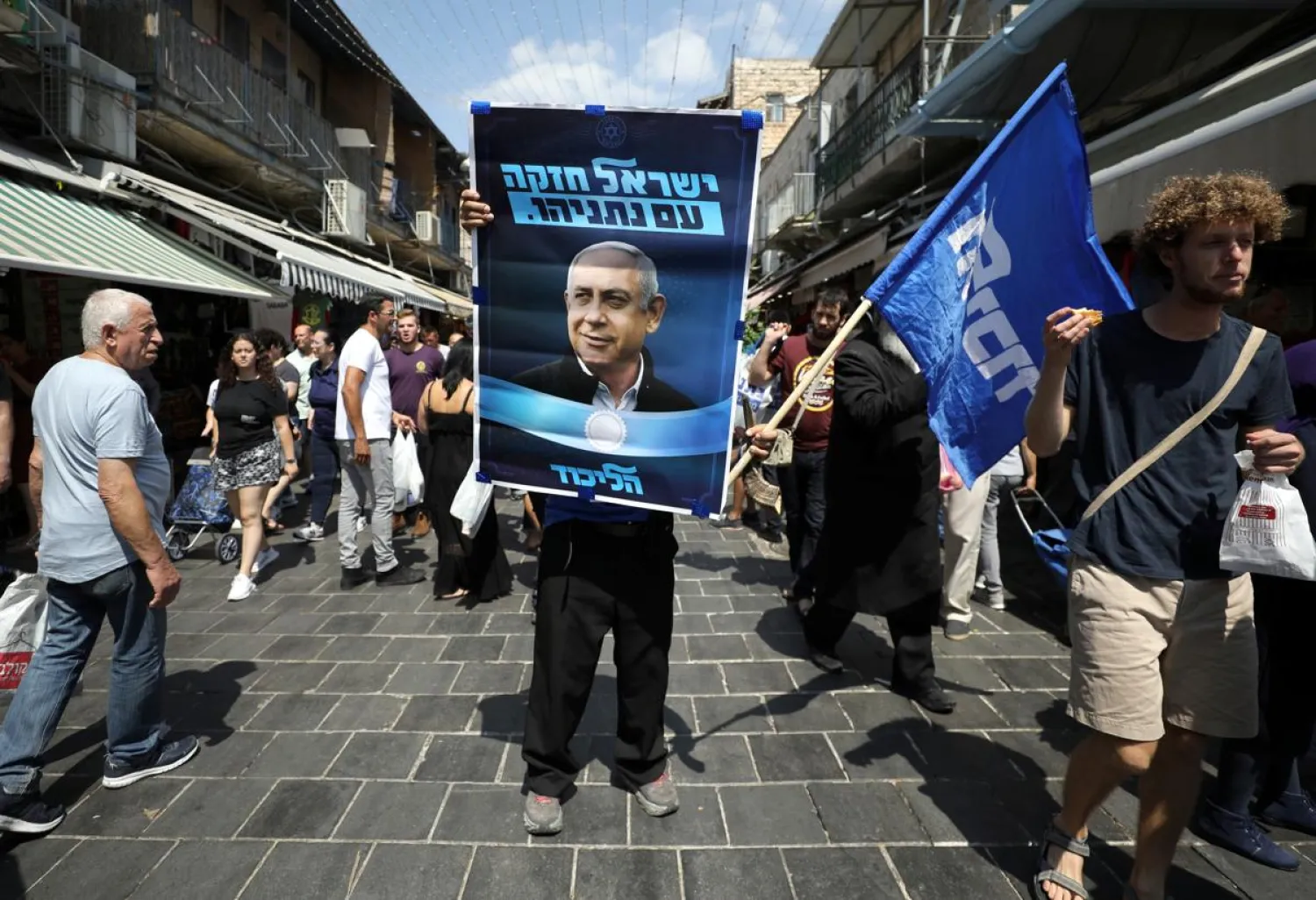
A supporter of the Likud party holds an election campaign poster depicting Israeli Prime Minister Benjamin Netanyahu in Jerusalem, September 13, 2019. (Reuters)
TT

'King Bibi' Fights for his Political Life in Israeli Election

A supporter of the Likud party holds an election campaign poster depicting Israeli Prime Minister Benjamin Netanyahu in Jerusalem, September 13, 2019. (Reuters)

Twenty years after Benjamin Netanyahu’s first term as Israel’s prime minister ended, the man hailed by supporters as “King Bibi” is again fighting for his political survival in a rerun election.

Opinion polls predict a close race when Israel goes to the polls on Tuesday, five months after an inconclusive election in which Netanyahu declared himself the winner but failed to put together a coalition government.

“A Likud victory is possible but it’s hanging by a thread,” said Abraham Diskin, political science professor at Jerusalem’s Hebrew University, referring to Netanyahu’s right-wing party, reported Reuters.

An end to the Netanyahu era after his 10 successive years in power would be unlikely to lead to a dramatic change in Israel’s policy on hotly disputed issues in a peace process with the Palestinians that collapsed five years ago.

Relations with the United States would be likely to remain on track, despite Netanyahu’s close relationship with President Donald Trump.

Likud is running neck-and-neck with the centrist Blue and White party led by former armed forces chief Benny Gantz, who has focused heavily on looming corruption charges Netanyahu faces.

But Netanyahu’s political fate could ultimately end up in the hands of the far-right Yisrael Beitenu headed by former Defense Minister Avigdor Lieberman, a potential kingmaker in the coalition-building certain to follow the vote.

After the election in April, Lieberman blocked Netanyahu’s attempts to form a coalition, citing differences with the prime minister’s ultra-Orthodox allies. Opinion polls indicate Yisrael Beitenu will emerge stronger in the new ballot.

Annexation

Netanyahu has campaigned hard to avoid losing power, as he did in 1999 against then-Labor party leader Ehud Barak, appearing in hours of live video question-and-answer sessions on Facebook in recent weeks and dominating the news in Israel.

In a step this week that alarmed Palestinian and other Arab leaders but delighted his core right-wing constituency, Netanyahu announced his intention to annex the Jordan Valley in the occupied West Bank.

It was, Israeli political commentators said, a clear attempt to draw votes away from far-right parties.

Netanyahu hammered home a get-out-the-vote message: Applying Israeli sovereignty to the valley, which Palestinians want as part of a future state, will happen only if Likud emerges from the election as the biggest party in the Knesset (parliament).

In Israel, votes are cast for a party’s list of Knesset candidates. Since no party has ever won a majority of seats on its own, Israel has always been ruled by coalitions, making post-election political bargaining key to determining the ultimate winner, explained Reuters.

Netanyahu has burnished a statesman’s image during the campaign, visiting Britain last week for talks with Prime Minister Boris Johnson and US Defense Secretary Mark Esper, and meeting President Vladimir Putin in Russia on Thursday.

Netanyahu has also showcased his relationship with Trump, featuring posters in which both are shaking hands. But there has been no sign from Trump of a “grand gesture” that could bolster Netanyahu as a candidate.

Shortly before the last election, with the prime minister at his side, Trump signed a proclamation recognizing Israeli sovereignty over the Golan Heights. Israel captured the strategic area in a 1967 war and annexed it in 1981, moves not accepted by most world powers, who deem it to be occupied Syrian territory.

“National unity”

The line-up of challengers this time is similar to the one Netanyahu faced in the previous election, with Blue and White his biggest threat.

Blue and White has said it would “strengthen the settlement blocs” in the West Bank, with the Jordan Valley as Israel’s “eastern security border”. But that falls short of an outright commitment to annex the valley, and a party spokesman said a Blue and White-led government would “maintain an open channel” for a peace deal with the Palestinians.

Most of the international community regards the Israeli settlements as illegal, a view that Israel disputes.

The spokesman said the party would seek “the return of bipartisanship to Israel-US relations”, a reference to Netanyahu’s close ties with Trump and his Republican party and sharp differences with the Democrats over issues such as Iran’s nuclear program and Middle East peacemaking.

After an election in Israel, its president gauges, following consultations with all political parties that won parliamentary seats, which legislator stands the best chance of forming a government.

Both Netanyahu and Gantz hope to be tapped, but a photo finish would complicate the picture.

A “national unity” government could avoid or resolve a stalemate if a Likud-led right-wing coalition or a Blue and White-led center-left alliance prove impossible.

Gantz has said his party would not join a government with Netanyahu in it, citing the prime minister’s legal troubles.

If a partnership with Gantz is the only way to stay out of the back benches, prominent Likud members could try to topple Netanyahu as party leader, some political analysts have said.

Blue and White tied with Likud on 35 seats in the April election, and Gantz is seen by some voters as “Mr. Clean”.

“His low-key style and relative ineloquence are for many a modest man’s refreshing antithesis to Bibi’s perceived bluster and soloism. Gantz is seen as balanced, cautious and pragmatic,” said Amotz Asa-El, a research fellow at Jerusalem’s Shalom Hartman Institute.

Two weeks after the election, Israel’s attorney-general will hold a pre-trial hearing in which Netanyahu can argue against his announced intention to file fraud and bribery charges against him in the corruption investigations.

Netanyahu, who has denied any wrongdoing, has said he will not quit as prime minister if indicted, and there is no legal obligation to do so. Allies have said they will press parliament to grant Netanyahu, as a member of the body, immunity from prosecution.

After election night, it could all come down to Yisrael Beitenu’s Lieberman, at odds with Netanyahu’s traditional ultra-Orthodox partners over military conscription exemptions for Jewish seminary students.

Lieberman, whose party is projected to double its April Knesset seat tally to 10, has said Yisrael Beitenu will not join up with a Netanyahu administration after Tuesday’s vote if it includes the religious factions.



Iraq Negotiates New Coalition Under US Pressure

Election workers count ballots as they close a polling station, during the parliamentary elections in Baghdad, Iraq, Nov. 11, 2025. (AP)
TT

Iraq Negotiates New Coalition Under US Pressure

Election workers count ballots as they close a polling station, during the parliamentary elections in Baghdad, Iraq, Nov. 11, 2025. (AP)

More than a month after Iraq's parliamentary elections, the country's top leaders remain locked in talks to form a government while facing pressure from Washington to exclude Tehran-backed armed groups.

Amid seismic changes in the Middle East, where new alliances are forming and old powers waning, Iraqi leaders face a daunting task: navigating relations with US-blacklisted pro-Iranian factions.

The US has held significant sway over Iraqi politics since leading the 2003 invasion that ousted long-time ruler Saddam Hussein.

But another specter also haunts Iraq's halls of power: Washington's arch-foe, Iran.

Iraq has long been caught between the two, with successive governments negotiating a delicate balance.

Now, after November's election, Washington has demanded the eventual government must exclude Iran-backed armed groups and instead move to dismantle them, Iraqi officials and diplomats told AFP.

A State Department spokesperson, speaking on condition of anonymity, said: "Iraqi leaders well know what is and is not compatible with a strong US-Iraq partnership".

Washington, the spokesperson said, "will continue to speak plainly to the urgency of dismantling Iran-backed militias".

But some of these groups have increased their presence in the new chamber and have joined the Coordination Framework, an alliance of Shiite parties with varying ties to Iran and which holds the majority.

For weeks, the Coordination Framework has been embroiled in talks to nominate the next prime minister.

"The US has put conditions that armed factions should not be part of the new government," a senior Iraqi official said. The factions must disarm and "sever ties with Iran's Revolutionary Guard," he added.

In recent tweets, the US special envoy to Iraq, Mark Savaya said that Iraqi leaders are at a "crossroads".

Their decision "will send a clear and unmistakable signal to the United States... that Iraq is ready to claim its rightful place as a stable and respected nation in the new Middle East.

"The alternative is equally clear: economic deterioration, political confusion, and international isolation," Savaya said.

The US has blacklisted as "terrorist organizations" several armed groups from within the pro-Iran Popular Mobilization Forces, a former paramilitary alliance now integrated into the armed forces.

They are also part of the Iran-backed so-called "Axis of Resistance" and have called for the withdrawal of US troops -- deployed in Iraq as part of an anti-ISIS coalition -- and launched attacks against them.

Most of these groups hold seats in parliament and have seen their political and financial clout increase.

The Asaib Ahl al-Haq faction, led by Qais al-Khazali, who is a key figure in the Coordination Framework, won 27 seats in the latest election, making it harder to exclude it from the government.

A potential compromise is to deny it a key portfolio, as in the current government.

"The US has turned a blind eye before, so they might after all engage with the government as a whole but not with ministries held by armed groups," a former Iraqi official said.

Other blacklisted groups are:

+ Kataeb Hezbollah, one of the most powerful armed groups, supports a parliamentary bloc (six seats).

+ Kataeb Sayyid al-Shuhada, Kataeb Imam Ali and Harakat Ansar Allah al-Awfiya.

+ The al-Nujaba movement is the only group that has steered clear of elections.

Iraq has its economic growth to worry about.

After decades of turmoil, it has only begun to regain a sense of normalcy in recent years.

Washington has already imposed sanctions on several Iraqi entities and banks, accusing them of helping Tehran evade sanctions.

But Iraqi leaders hope for greater foreign investments and support partnerships with US companies.

The most striking endorsement came from Khazali, an opponent of the US military presence who now argues that it would be in Baghdad's interest for major US companies to invest.

Since the Israel's war with Hamas in Gaza began in October 2023, Iraq has remained relatively unscathed by the turmoil engulfing the Middle East.

Iraqi armed groups did launch attacks on US troops and largely unsuccessful ones on Israel. Washington responded with heavy strikes, and the attacks have long since halted.

Iraq remained the only close regional ally of Iran to stay out of Israel's crosshairs.

So far, the US has acted as a buffer, helping to prevent an Israeli attack, but Iraqis have been warned of strikes against the armed groups, multiple sources said.

But as the presence of American forces dwindles, fears are growing.


Bethlehem Camp's 'Lifeline' Football Field Faces Israeli Demolition

 Displaced Palestinian youths take part in a training session at the Aida Refugee Camp's football pitch, next to the separation wall outside Bethlehem in the occupied West Bank, on December 16, 2025, a few weeks after an Israeli military decision to demolish the field. (AFP)
Displaced Palestinian youths take part in a training session at the Aida Refugee Camp's football pitch, next to the separation wall outside Bethlehem in the occupied West Bank, on December 16, 2025, a few weeks after an Israeli military decision to demolish the field. (AFP)
TT

Bethlehem Camp's 'Lifeline' Football Field Faces Israeli Demolition

 Displaced Palestinian youths take part in a training session at the Aida Refugee Camp's football pitch, next to the separation wall outside Bethlehem in the occupied West Bank, on December 16, 2025, a few weeks after an Israeli military decision to demolish the field. (AFP)
Displaced Palestinian youths take part in a training session at the Aida Refugee Camp's football pitch, next to the separation wall outside Bethlehem in the occupied West Bank, on December 16, 2025, a few weeks after an Israeli military decision to demolish the field. (AFP)

Earlier this month a group of Palestinian boys turned out to train at their local football pitch in the shadow of the wall separating Israel from the West Bank's Aida refugee camp -- and found a note at the gate.

The children took the ominous message from Israeli authorities to Muhannad Abu Srour, sports director at the Aida Youth Center in the camp near Bethlehem, and the news was not good.

"We were shocked to discover that it was a decision to demolish Aida camp's football field," Abu Srour told AFP, adding that more than 500 children regularly train on the field roughly half the size of a regulation soccer pitch.

"The football field is the only open space we have. If the field is taken away, the children's dream is taken away," Abu Srour said.

The planned destruction of the Aida field is one of many points of contention in the occupied West Bank, but it is a particularly painful one for young Palestinians yearning for a better future.

One of the older members, 18-year-old Abdallah al-Ansurur, hopes to make it into the national Palestinian team, and, like many other youth at Aida camp, took his first steps in the game on the pitch flanked by the eight-meter concrete Israeli wall.

"I started when I was about 13 years old. This field gave me a real opportunity to train," said Ansurur, who was born and raised in Aida camp, one of the smallest in the West Bank.

Ansurur, who trains to be a goalkeeper, calls the astroturf-covered piece of land a "lifeline".

"Without this field, I wouldn't have had this chance. If it didn't exist, we'd be playing in the streets -- or not playing at all," he said.

Israel has occupied the West Bank since 1967 and frequently demolishes Palestinian homes or infrastructure, arguing they were built without permits.

AFP was shown the note from COGAT, the Israeli defense ministry body in charge of Palestinian civilian affairs, which says the field was not authorized.

But Anton Salman, who was mayor of adjacent Bethlehem when the field was built in 2021, told AFP the construction was legal.

Salman said his municipality leased the land from the Armenian Church authorities to whom it belongs, before allowing Aida camp's popular committee to manage it for the benefit of residents.

Saeed al-Azzeh, head of the popular committee, confirmed the information, calling the space, "the only breathing space" for camp residents.

"Today, more than 7,000 people live on the same piece of land. Streets are narrow, alleys are cramped -- there is nowhere else," Azzeh said, referring to the camp.

Like other Palestinian refugee camps, Aida was built to accommodate some of the hundreds of thousands of people who either fled their homes or were forced out during the creation of Israel in 1948.

With time, tents gave way to concrete buildings, with the football field representing one of the few open spaces in the camp's dense patchwork.

Abu Srour is proud of what came out of the field, with youth sports delegations able to travel abroad to play, a welcome escape from the West Bank's myriad restrictions.

This is because checkpoints, a fixture of the West Bank since the start of Israel's occupation, have multiplied since the start of the war in Gaza.

Abu Srour mentioned that bringing a local team to Ramallah, a city 20 kilometers (12.5 miles) away as the crow flies, took six hours recently, instead of one hour in the past.

Restricted mobility is a major issue for most Palestinian athletes as it makes it nearly impossible for athletes of similar levels from different cities to train together.

Waseem Abu Sal, who was the first Palestinian boxer to participate in the Olympics, told AFP he frequently sparred with athletes of different levels or weight categories for lack of mobility.

Taking a short break from running a practice for 50 excited five- to 10-year-old boys, coach Mahmud Jandia told AFP he hoped the field would remain.

"Yes, the wall is there -- it feels like a prison -- but despite that, the most important thing is that the field remains and the children keep playing."

"If the field is demolished, all the children's dreams will be demolished with it."


Worn Banknotes, Tobacco Taxes: How Hamas Pays Its Members

Palestinians shop amid the rubble in Khan Younis in southern Gaza, February last year (DPA)
TT

Worn Banknotes, Tobacco Taxes: How Hamas Pays Its Members

Palestinians shop amid the rubble in Khan Younis in southern Gaza, February last year (DPA)

More than two months after a fragile ceasefire between Israel and Hamas took effect in Gaza, the group has steadily reasserted some security control in areas under its authority. Yet for Gaza’s residents, daily economic hardship and deteriorating living conditions show little sign of easing.

Hamas’s popular base, made up of its members, their families, and supporters, remains a key pillar of its strength. Nearly two years of war with Israel have partially disrupted the group’s ability to consistently pay salaries.

During the war, Israel sought to dry up Hamas’s financial network by killing figures responsible for transferring money inside Gaza, as well as raiding currency exchange companies in the occupied West Bank that Israeli authorities said were linked to Palestinian factions.

According to field sources and Hamas officials who spoke to Asharq Al-Awsat, the group faced difficulties and delays in paying salaries regularly at leadership, field and other levels due to security conditions.

It has since resumed partial payments to all its members, including leaders and fighters from the Izz al-Din al-Qassam Brigades, Hamas’s armed wing, while paying lower rates to its preaching and social apparatus, described as civilian elements.

Where does Hamas get its money?

Sources agree that Hamas has managed to preserve some of its financial resources, including commercial activities inside and outside Gaza. One Hamas source said these business revenues generate income for the group alongside funds received from supporting parties such as Iran and others.

They added that such external support fluctuates, sometimes declining, increasing or arriving with delays for reasons related to the donors.

The source said Hamas faces growing difficulties in transferring funds into Gaza, forcing those overseeing salary payments to rely on whatever cash remains accessible in their reserves or to collect revenues from their own commercial sources.

How are salaries paid?

Sources who receive some of these payments told Asharq Al-Awsat, on condition of anonymity, that salaries and stipends were sometimes paid regularly each month but were also delayed by periods ranging from six weeks to two months.

A Hamas source said salary rates varied and did not exceed 80 percent at best, particularly for leaders and operatives in the Qassam Brigades and at the political level.

Lower percentages were paid to the preaching and social apparatus and other bodies, alongside allocations for activities aimed at supporting the population and what the group calls its popular base.

The source said the lowest rates were paid to government employees at both civilian and military levels, reaching 60 percent at most before declining in recent months to around 35 percent.

Several sources said Hamas continues to pay stipends to the families of its members and leaders killed over decades of its activities, as well as to prisoners and wounded fighters.

They added that the group also supports families whose salaries were cut by the Palestinian Authority, continues to provide social assistance and allocates funds to projects aimed at supporting its popular base, including food aid, water provision and communal kitchens, in coordination with foreign institutions.

Asked how salaries are delivered, Hamas sources said payments are made through tight networks and by hand to avoid Israeli monitoring of electronic wallets and banks.

Worn banknotes and tobacco taxes

As Hamas relies on manual delivery, questions remain over how it secures cash under Israel’s blockade. A Hamas source said the process was complex and could not be disclosed for security reasons.

Local sources outside Hamas said the group depends heavily on traders to obtain cash, alongside its existing cash reserves and revenues from businesses it operates.

One source said Hamas often pays worn banknotes to government employees in particular, and to a lesser extent to Qassam fighters and political figures. This forces recipients to manage on their own as most traders refuse to accept damaged or worn currency.

Hamas has encouraged some small traders, especially fruit and vegetable sellers, to accept such notes in exchange for continued support and access to goods at lower prices.

Another source said Hamas has imposed taxes on certain goods, such as tobacco products, to raise funds, noting that most cigarette traders deal in cash rather than electronic wallets, which many Gaza residents now rely on.

Israeli accusations against Iran

On Dec. 7, Israel accused Iran of supporting what it described as a banking network transferring hundreds of thousands of dollars to Hamas. Israel said the network consisted of Gaza-based money changers residing in Türkiye who exploit the country’s financial infrastructure for what it called terrorist purposes.

According to Israel, the network operated in full cooperation with the Iranian regime, transferring funds to Hamas and its leaders and managing wide ranging economic activity involving receiving money from Iran, storing it and transferring it to Hamas via Türkiye.

Israel published the identities of three individuals, including an official in Hamas’s financial apparatus and two money changers from Gaza, claiming they worked under the direction of Khalil al-Hayya.

Sources familiar with the two men told Asharq Al-Awsat they have lived outside Gaza for many years.

One was known to work with various Palestinian factions and had previously smuggled funds for them, including through tunnels along the Egyptian border, while also operating as a businessman in multiple fields beyond currency exchange.

Hamas sources dismissed the accusations as baseless, saying the group has its own methods for transferring funds.

They said Hamas often faces difficulties moving money from abroad into Gaza, a problem that also affects the West Bank due to Israeli pursuit and Palestinian Authority security pressure, though conditions there are better than in Gaza for transferring funds.

Sources from other Palestinian factions said they are also suffering financial crises and difficulties paying salaries and stipends to their members and leaders.

They said they sometimes distribute food aid and other assistance to help their members and families cope with harsh economic conditions, with most of the support coming through institutions backed by Iran or other parties.