
UNICEF: 1-in-3 Young Children Undernourished or Overweight

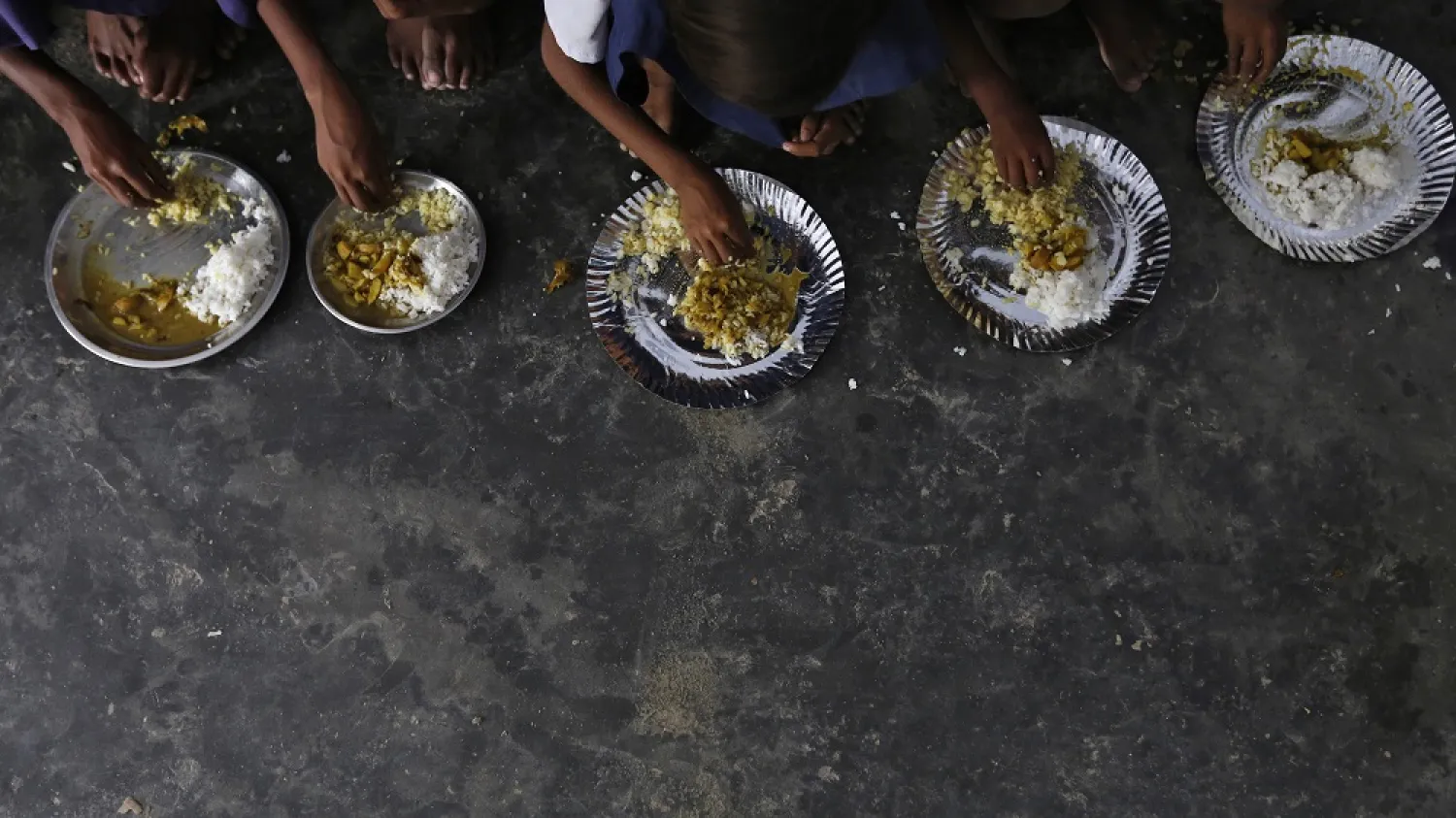
Schoolchildren eat their free mid-day meal, distributed by a government-run primary school at Brahimpur village in Chapra district of the eastern Indian state of Bihar July 19, 2013. (Reuters)
TT

UNICEF: 1-in-3 Young Children Undernourished or Overweight

Schoolchildren eat their free mid-day meal, distributed by a government-run primary school at Brahimpur village in Chapra district of the eastern Indian state of Bihar July 19, 2013. (Reuters)

A third of the world's nearly 700 million children under five years old are undernourished or overweight and face lifelong health problems as a consequence, according to a grim UN assessment of childhood nutrition released Tuesday.

"If children eat poorly, they live poorly," said UNICEF Executive Director Henrietta Fore, unveiling the Fund's first State of the World's Children report since 1999.

"We are losing ground in the fight for healthy diets."

Problems that once existed at opposite ends of the wealth spectrum have today converged in poor and middle-income countries, the report showed.

Despite a nearly 40 percent drop from 1990 to 2015 of stunting in poor countries, 149 million children four or younger are today still too short for their age, a clinical condition that impairs both brain and body development.

Another 50 million are afflicted by wasting, a chronic and debilitating thinness also born of poverty.

At the same time, half of youngsters across the globe under five are not getting essential vitamins and minerals, a long-standing problem UNICEF has dubbed "hidden hunger."

Over the last three decades, however, another form of child malnutrition has surged across the developing world: excess weight.

"This triple burden -- undernutrition, a lack of crucial micro-nutrients, obesity -- is increasingly found in the same country, sometimes in the same neighborhood, and often in the same household," Victor Aguayo, head of UNICEF's nutrition program, told AFP.

"A mother who is overweight or obese can have children who are stunted or wasted."

Across all age groups, more than 800 million people in the world are constantly hungry and another two billion are eating too much of the wrong foods, driving epidemics of obesity, heart disease and diabetes.

'Hidden hunger'

Among children under five, diet during first 1,000 days after conception is the foundation for physical health and mental development.

And yet, only two-in-five infants under six months are exclusively breastfed, as recommended. Sales of milk-based formula have risen worldwide by 40 percent, and in upper middle-income countries such as Brazil, China and Turkey by nearly three-quarters.

Missing vitamins and minerals, meanwhile, can lead to compromised immune systems, poor sight and hearing defects. A lack of iron can cause anemia and reduced IQ.

"It's 'hidden' because you don't notice the impact until it is too late," Brian Keeley, editor-in-chief of report, told AFP.

"You don't notice that the child is running a little slower than everyone else, struggling a bit in school."

The rise of obesity, however, is plain to see.

The problem was virtually non-existent in poor countries 30 years ago, but today at least 10 percent of under five year olds are overweight or obese in three-quarters of low-income nations.

"There needs to be a focus on obesity before it is too late," said Keeley. "Unless you deal with it in a preventative way, you're going to struggle to fix it later on."

Cheap, readily available junk food, often marketed directly to kids, has made the problem much worse.

"Children are eating too much of what they don't need -- salt, sugar and fat," Keeley added.

Progress in fighting undernourishment will also be hampered by climate change, the report warned.

Tax sugary drinks

A single degree Celsius of warming since the late-19th century has amplified droughts responsible for more than 80 percent of damage and losses in agriculture.

Earth's average surface temperature is set to rise another two or three degrees by 2100.

Research by scientists at Harvard University, meanwhile, have shown that the increased concentration of CO2 in the air is sapping staple food crops of those essential nutrients and vitamins, including zinc, iron and vitamin B.

"The impacts of climate change are completely transforming the food that is available and that can be consumed," Aguayo said.

Making sure every child has access to a healthy diet must become a "political priority" if widespread malnutrition is to be conquered, especially in developing countries, the report said.

Taxes on sugary foods and beverages; clear, front-of-package labeling; regulating the sale of breast milk substitutes; limiting the advertising and sale of 'junk food' near schools -- these and other measures could make a difference, it concluded.

"The way we understand and respond to malnutrition needs to change," said Fore.

"It is not just about getting children enough to eat. It is above all about getting them to eat the right food."

The recent rise of awareness about the danger of global warming is instructive, the authors said.

"Just as we have organized a movement around climate change, we need to mobilize civil society," said Aguayo. "If our children are not fed healthy diets, we are putting a huge question mark on the future of our societies."


Spain and Portugal Continue to Battle Storm Leonardo as New Storm Approaches

 A mountain landslide blocks railway tracks during heavy rains, as storm Leonardo hits parts of Spain, in Benaojan, Spain, February 6, 2026. (Reuters)
A mountain landslide blocks railway tracks during heavy rains, as storm Leonardo hits parts of Spain, in Benaojan, Spain, February 6, 2026. (Reuters)
TT

Spain and Portugal Continue to Battle Storm Leonardo as New Storm Approaches

 A mountain landslide blocks railway tracks during heavy rains, as storm Leonardo hits parts of Spain, in Benaojan, Spain, February 6, 2026. (Reuters)
A mountain landslide blocks railway tracks during heavy rains, as storm Leonardo hits parts of Spain, in Benaojan, Spain, February 6, 2026. (Reuters)

Storm Leonardo continued to batter the Iberian Peninsula on Friday, bringing floods and putting rivers at risk of bursting their banks while thousands of people were evacuated from their homes in Spain and Portugal.

In southern Spain's Andalusia region, some 7,000 people have had to leave their homes due to successive storms.

Among them were around 1,500 people ordered to evacuate the mountain village of Grazalema, where Andalusia's regional leader Juan Manuel Moreno warned that aquifers were "full to the brim with water,” and at risk of collapsing.

“It's raining on already saturated ground. The land is unable to drain," Moreno said. “We urge extreme caution. This is not over.”

Spanish police said Friday they had found a body located 1,000 meters (about 0.6 miles) away from where a woman had disappeared Wednesday after she fell into a river in Malaga province while trying to rescue her dog. Police said they had not yet identified the body, but believed it belonged to the 45-year-old woman.

Another storm front, Marta, was expected to arrive Saturday, with Spain's weather agency AEMET saying it would bring even more rain and heavy winds, including to areas already drenched by Storm Leonardo.

Marta is expected to affect Portugal, too.

Of particular concern was southern Spain's Guadalquivir River, which flows through Córdoba and Seville and eventually into the Atlantic Ocean, and whose water levels have dramatically risen in recent days.

Additional rain Saturday could leave many more homes at risk in Córdoba, local authorities warned.

In Portugal, parts of Alcacer do Sal were submerged after the Sado River overflowed, forcing residents to leave the city located 90 kilometers (about 56 miles) south of Lisbon.

Alerts were issued also for regions near the Tagus River due to rising water levels.

A separate storm in late January left a trail of destruction in Portugal, killing several people, according to Portuguese authorities.


AROYA Cruises Debuts Arabian Gulf Voyages for 2026

AROYA offers a curated experience featuring culturally inspired entertainment and diverse dining options - SPA
TT

AROYA Cruises Debuts Arabian Gulf Voyages for 2026

AROYA offers a curated experience featuring culturally inspired entertainment and diverse dining options - SPA

AROYA Cruises, a subsidiary of the PIF-owned Cruise Saudi, has officially launched its inaugural season in the Arabian Gulf.

Running from February 21 to May 8, the season marks a milestone in regional tourism by blending authentic Saudi hospitality with international maritime standards, SPA reported.

AROYA offers a curated experience featuring culturally inspired entertainment and diverse dining options.

The season is designed to provide guests with a dynamic way to explore the Gulf, setting a new benchmark for luxury travel that reflects the Kingdom's heritage on a global stage.


Snowstorm Brings Much of Denmark to a Halt

A car drives in heavy snow at Store Heddinge in South Zealand, Denmark, 05 February 2026.  EPA/Mads Claus Rasmussen
A car drives in heavy snow at Store Heddinge in South Zealand, Denmark, 05 February 2026. EPA/Mads Claus Rasmussen
TT

Snowstorm Brings Much of Denmark to a Halt

A car drives in heavy snow at Store Heddinge in South Zealand, Denmark, 05 February 2026.  EPA/Mads Claus Rasmussen
A car drives in heavy snow at Store Heddinge in South Zealand, Denmark, 05 February 2026. EPA/Mads Claus Rasmussen

Denmark authorities halted public transport, closed schools and cancelled flights on Friday as heavy snowfall blanketed much of the country.

The Nordic country's meteorological institute DMI warned that heavy snow would likely continue until Friday evening in the east, where the capital Copenhagen is located.

Police said people should avoid going outdoors unless necessary and stay indoors in the capital and the surrounding region.

Copenhagen's airport cancelled flights to Paris and Berlin and warned of "delay and cancellation risks because of snowy conditions." Many schools were closed.

In the second-largest city of Aarhus, bus services were cancelled.