
Unfinished Business in the Birthplace of Sudan's Revolution

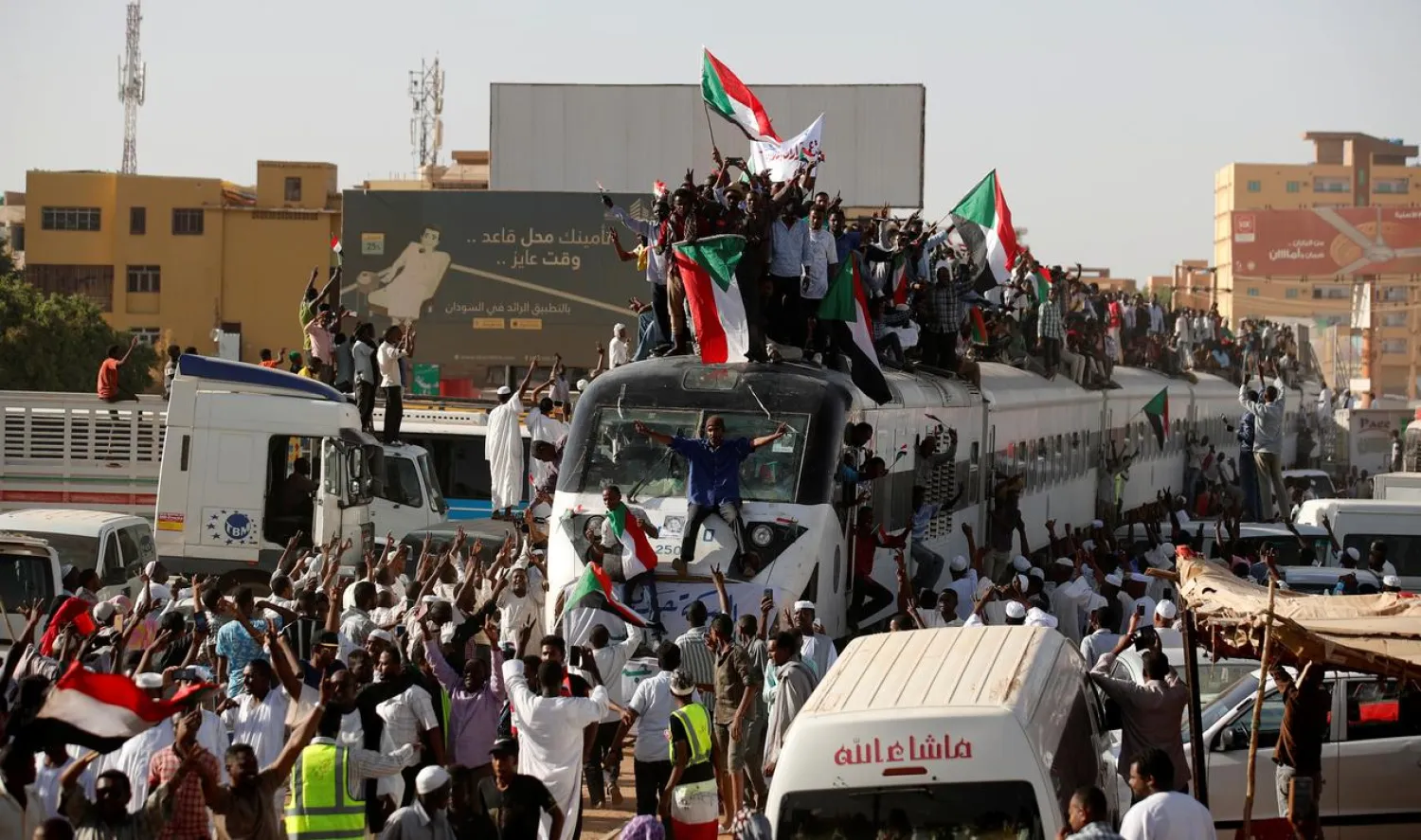
A train carrying protesters from Atbara, the birthplace of an uprising that toppled Sudan's former President Omar al-Bashir, approaches a Khartoum train station to support demonstrators camped at a sit-in outside the defence ministry compound, in Khartoum, Sudan, April 23, 2019. REUTERS/Umit Bektas/File Photo
TT

Unfinished Business in the Birthplace of Sudan's Revolution

A train carrying protesters from Atbara, the birthplace of an uprising that toppled Sudan's former President Omar al-Bashir, approaches a Khartoum train station to support demonstrators camped at a sit-in outside the defence ministry compound, in Khartoum, Sudan, April 23, 2019. REUTERS/Umit Bektas/File Photo

Standing on the platform where he and other protesters packed a train to Khartoum in April to pressure Sudan’s military to share power with civilians, Abdelaziz Abdallah made clear the revolution driven by their city has much further to go.

A veteran railway worker-turned union leader, Abdallah was among the first to take to the streets in this labor stronghold in December, sparking a national uprising that toppled long-time ruler Omar al-Bashir almost four months later.

It took another four months for the military, which had ousted Bashir, to formally agree to a three-year power sharing deal with a civilian-led transitional government.

People in Atbara, a colonial-era railway hub, support the national government in the capital some 350 km (220 miles) to the south, but say some of the main grievances which drove their uprising - poor salaries and unemployment - remain.

“Railway workers have among the lowest state salaries” earning as little as 1,200 Sudanese pounds ($26.67) a month while needing at least 10,000 pounds to get by, said Abdallah, who took over the union after Bashir’s ouster.

They also want funds to revive the railway — once Africa’s longest network but now largely derelict.

They are tough demands for Prime Minister Abdalla Hamdok, who is trying to avert the collapse of an economy wrecked by three decades of mismanagement and US sanctions.

Whether he can meet the expectations of thousands of railway workers will be a test for the whole country, as Atbara has been a hotbed of unrest since independence from Britain in 1956.

RESISTANCE COMMITTEES

The protesters have formed resistance committees, which helped maintain the uprising and now want a say in their city.

Able to meet freely since bans on gatherings were lifted with Bashir’s fall, they discuss issues such as how to create jobs for the youth by trying to find farmland to grow crops.

But they also fume that the city is still run by a military governor. Bashir’s security network has lost some power but its officers remain in Atbara as elsewhere and soldiers, while no longer patrolling the streets, are stationed in nearby barracks.

“Nothing has changed for citizens and the youth. The civil service is still made up of the former regime,” said Adel Sheikh, a senior member of Atbara’s Forces for Freedom and Change coalition, the main umbrella group that negotiated the national power-sharing deal with the generals.

Finding jobs is on many people’s minds.

“I hope to get a job as engineer,” said Mohamed Abdelathim, jobless since 2007. “State jobs under the (old regime) were for regime people,” he said.

COUPS

Atbara, at the junction of the Nile and Atbara rivers, has been a barometer for Sudan since British colonialists established a railway hub here, building dozens of villas to house railway managers which now lie empty.

Maps entitled “Sudan railways” still hang on walls in administrative buildings where receipts printed in English and Sudanese lie on abandoned desks.

Workers here pushed for independence, formed the backbone of a powerful post-independence Communist Party and have risen up against various military rulers ever since, paying the price for their activism with mass dismissals.

Sudan has had only three brief three civilian governments, all toppled by generals who took over after saying that civilians had failed to fix an economy in crisis.

Hamdok is in a similar situation, heading a government shared with military. He wants to increase public salaries and compensate some 4,000 workers fired by Bashir but needs up to $5 billion in donor support for next year alone.

That dilemma gives Atbara’s activists pause.

“Honestly we have fears (of a new coup) if the main issues aren’t solved,” said 70-year Ali Abdallah, a former national head of the railway union imprisoned under Bashir and now a respected figure among the townspeople.

The United States says it hopes to be able to lift sanctions imposed in 1993 over allegations Bashir’s government supported terrorism, so that donor money can flow.

Western countries are wary, but also fear that instability in Sudan will increase migration to Europe and encourage Islamist militants.

It will take time to heal local wounds.

When protests began in December, security forces opened fire, killing, among others, 23-year-old engineering student Tareq Ahmed.

“He was not political person but fed up with the regime and inflation,” said his father driving on pot-holed roads around Atbara to show its neglect.

He could not bring himself to go to the spot where his son got killed but stopped at the university where students have painted his face on a wall to keep memories fresh. There he struggled to hold back his tears.

“He sacrificed himself for a change in Sudan,” he said. “We will never forget.”


Rescue Teams Search for Survivors in Building Collapse that Killed at Least 2 in Northern Lebanon

A Lebanese flag is pictured, in the aftermath of a massive explosion, in Beirut's damaged port area, Lebanon August 17, 2020. REUTERS/Hannah McKay
TT

Rescue Teams Search for Survivors in Building Collapse that Killed at Least 2 in Northern Lebanon

A Lebanese flag is pictured, in the aftermath of a massive explosion, in Beirut's damaged port area, Lebanon August 17, 2020. REUTERS/Hannah McKay

At least two people were killed and four rescued from the rubble of a multistory apartment building that collapsed Sunday in the city of Tripoli in northern Lebanon, state media reported.

Rescue teams were continuing to dig through the rubble. It was not immediately clear how many people were in the building when it fell.

The bodies pulled out were of a child and a woman, the state-run National News Agency reported.

Dozens of people crowded around the site of the crater left by the collapsed building, with some shooting in the air.

The building was in the neighborhood of Bab Tabbaneh, one of the poorest areas in Lebanon’s second largest city, where residents have long complained of government neglect and shoddy infrastructure. Building collapses are not uncommon in Tripoli due to poor building standards, according to The AP news.

Lebanon’s Health Ministry announced that those injured in the collapse would receive treatment at the state’s expense.

The national syndicate for property owners in a statement called the collapse the result of “blatant negligence and shortcomings of the Lebanese state toward the safety of citizens and their housing security,” and said it is “not an isolated incident.”

The syndicate called for the government to launch a comprehensive national survey of buildings at risk of collapse.


Israel to Take More West Bank Powers and Relax Settler Land Buys

A view of Israeli settlement of Maale Adumim, in the West Bank, Sunday, June 18, 2023. (AP)
TT

Israel to Take More West Bank Powers and Relax Settler Land Buys

A view of Israeli settlement of Maale Adumim, in the West Bank, Sunday, June 18, 2023. (AP)

Israel's security cabinet approved a series of steps on Sunday that would make it easier for settlers in the occupied West Bank to buy land while granting Israeli authorities more enforcement powers over Palestinians, Israeli media reported.

The West Bank is among the territories that the Palestinians seek for a future independent state. Much of it is under Israeli military control, with limited Palestinian self-rule in some areas run by the Western-backed Palestinian Authority (PA).

Citing statements by Finance Minister Bezalel Smotrich and Defense Minister Israel Katz, Israeli news sites Ynet and Haaretz said the measures included scrapping decades-old regulations that prevent Jewish private citizens buying land in the West Bank, The AP news reported.

They were also reported to include allowing Israeli authorities to administer some religious sites, and expand supervision and enforcement in areas under PA administration in matters of environmental hazards, water offences and damage to archaeological sites.

Palestinian President Mahmoud Abbas said the new measures were dangerous, illegal and tantamount to de-facto annexation.

The Israeli ministers did not immediately respond to requests for comment.

The new measures come three days before Prime Minister Benjamin Netanyahu is scheduled to meet in Washington with US President Donald Trump.

Trump has ruled out Israeli annexation of the West Bank but his administration has not sought to curb Israel's accelerated settlement building, which the Palestinians say denies them a potential state by eating away at its territory.

Netanyahu, who is facing an election later this year, deems the establishment of any Palestinian state a security threat.

His ruling coalition includes many pro-settler members who want Israel to annex the West Bank, land captured in the 1967 Middle East war to which Israel cites biblical and historical ties.

The United Nations' highest court said in a non-binding advisory opinion in 2024 that Israel's occupation of Palestinian territories and settlements there is illegal and should be ended as soon as possible. Israel disputes this view.


Arab League Condemns Attack on Aid Convoys in Sudan

A general view shows the opening session of the meeting of Arab foreign ministers at the Arab League Headquarters (Reuters)
TT

Arab League Condemns Attack on Aid Convoys in Sudan

A general view shows the opening session of the meeting of Arab foreign ministers at the Arab League Headquarters (Reuters)

Arab League Secretary-General Ahmed Aboul Gheit strongly condemned the attack by the Rapid Support Forces on humanitarian aid convoys and relief workers in North Kordofan State, Sudan.

In a statement reported by SPA, secretary-general's spokesperson Jamal Rushdi quoted Aboul Gheit as saying the attack constitutes a war crime under international humanitarian law, which prohibits the deliberate targeting of civilians and depriving them of their means of survival.

Aboul Gheit stressed the need to hold those responsible accountable, end impunity, and ensure the full protection of civilians, humanitarian workers, and relief facilities in Sudan.