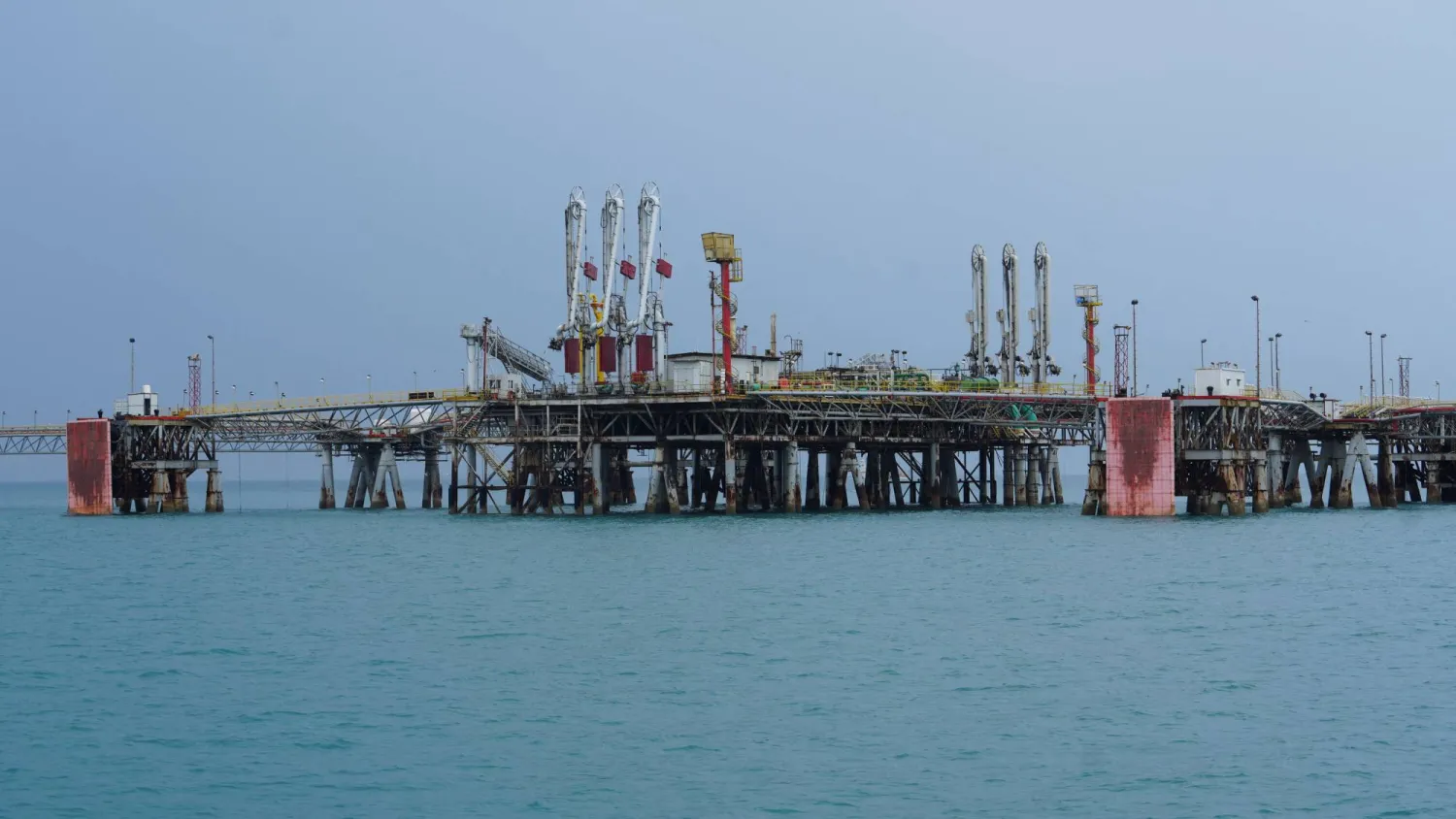
Israel's Leviathan Field Begins Pumping Gas

An aerial view shows the newly arrived foundation platform of Leviathan natural gas field, in the Mediterranean Sea, off the coast of Haifa, Israel January 31, 2019. (Reuters)
TT

Israel's Leviathan Field Begins Pumping Gas

An aerial view shows the newly arrived foundation platform of Leviathan natural gas field, in the Mediterranean Sea, off the coast of Haifa, Israel January 31, 2019. (Reuters)

Israel's offshore Leviathan field started pumping gas on Tuesday in what the operating consortium called "a historic turning point in the history of the Israeli economy."

A joint statement from partners Noble Energy, Delek Drilling, and Ratio said that the start of production was expected to lead to an immediate reduction in domestic electricity prices and the start of exports.

On December 17, Israeli Energy Minister Yuval Steinitz announced approval of sales to Egypt from Leviathan and the smaller Tamar field.

A spokesman for Israeli partner Delek said then that deliveries to Egypt were expected to begin on January 1, reported AFP.

Leviathan was discovered 130 kilometers (81 miles) west of the Mediterranean port city Haifa in 2010.

It is estimated to hold 535 billion cubic meters (18.9 trillion cubic feet) of natural gas, along with 34.1 million barrels of condensate.

Delek and US-based Noble struck a $15 billion 10-year deal last year with Egypt's Dolphinus to supply 64 billion cubic meters (2.26 trillion cubic feet).

It will be the first time Egypt, which in 1979 became the first Arab country to sign a peace accord with Israel, imports gas from its neighbor.

Israel had previously bought gas from Egypt, but land sections of the pipeline were targeted multiple times by Sinai extremists in 2011 and 2012.

Tamar, which began production in 2013, has estimated reserves of up to 238 billion cubic meters (8.4 trillion cubic feet).

Israel's neighbor to the east, Jordan, has been purchasing gas from Tamar on a small scale for nearly three years.

Natural gas is set to replace coal as the main fuel for power generation in Israel.


Iran Attacks Wipe Out 17% of Qatar’s LNG Capacity for Up to Five Years

QatarEnergy's CEO and state minister for energy affairs, Saad al-Kaabi (File/Reuters) 
TT

Iran Attacks Wipe Out 17% of Qatar’s LNG Capacity for Up to Five Years

QatarEnergy's CEO and state minister for energy affairs, Saad al-Kaabi (File/Reuters) 

Iranian attacks ‌have knocked out 17% of Qatar's liquefied natural gas (LNG) export capacity, causing an estimated $20 billion in lost annual revenue and threatening supplies to Europe and Asia, QatarEnergy's CEO and state minister for energy affairs told Reuters on Thursday.

Saad al-Kaabi said two of Qatar's 14 LNG trains and one of its two gas-to-liquids (GTL) facilities were damaged in the unprecedented strikes. The repairs will sideline 12.8 million tons per year of LNG for three to five years, he said in an interview.

“I never in my wildest dreams would have thought that Qatar would be - Qatar and the region - ⁠in such an attack, especially from a brotherly Muslim country in the month of Ramadan, attacking us in this way,” Kaabi said.

Hours earlier Iran had aimed a series of attacks at Gulf oil and gas facilities after Israeli attacks on its own gas infrastructure.

State-owned QatarEnergy will have to declare force majeure on long-term contracts for up to five years for LNG supplies bound for Italy, Belgium, South Korea, and China due to the two damaged trains, Kaabi said.

“I mean, these are long-term contracts that we have to declare force majeure. We already declared, but that was a shorter term. Now it's whatever the period is,” he said.

ExxonMobil Impact and Byproducts

QatarEnergy had declared force majeure on its entire output of LNG, after earlier attacks on its Ras Laffan production hub, which came under fire again on Wednesday.

“For production to restart, first we need hostilities to cease,” he said.

US oil major ExxonMobil is a partner in ‌the damaged ⁠LNG facilities, while Shell is a partner in the damaged GTL facility, which will take up to a year to repair.

Texas-based ExxonMobil holds a 34% stake in LNG train S4 and a 30% stake in train S6, Kaabi said.

Train S4 impacts supplies to Italy's Edison and EDFT in Belgium, while Train S6 impacts South Korea's KOGAS, EDFT and Shell in China.

The scale of the damage from the attacks has set the region back 10 to 20 years, he said.

“And of course, this is a safe ⁠haven for a lot of people, to have a safe place to stay and so on. And that image, I think, has been shaken.”

The fallout extends well beyond LNG. Qatar's exports of condensate will drop by around 24%, while liquefied petroleum gas (LPG) will fall 13%. Helium output will fall 14%, and naphtha and sulphur will both drop ⁠by 6%.

Those losses have implications ranging from LPG used in restaurants in India to South Korea's chipmakers which use helium.

The damaged units cost approximately $26 billion to build, Kaabi said.

No work is currently taking place on Qatar's massive North Field expansion project, which could be delayed for more than a year, he ⁠said.

“If Israel attacked Iran, it's between Iran and Israel. It has nothing to do with us and the region,” he said.

“And so now, in addition to that, I'm saying that everybody in the world, whether it's Israel, whether it's the US, whether it's any other country, everybody should stay away from oil and gas facilities.”

The Ras Laffan Industrial City covers an area of 295 sq. km, roughly one-third the size of New York City.

In addition to LNG processing, it also houses other gas-related facilities, including a gas-to-liquids plant, LNG storage facilities, condensate splitting units, and an oil refinery.

In 2025, the Ras Laffan LNG facility accounted for approximately 19% of global LNG exports, according to ship-tracking data compiled by Bloomberg.

Its shipments also represented more than a fifth of total gas consumption in India, Taiwan, and Pakistan, according to Energy Institute data.


IMF Says it's Updating Assessment of US Economy to Reflect Impact of Iran War

An American Flag on the US Capitol Building is seen in Washington, US, August 31, 2023. REUTERS/Kevin Wurm/File Photo
TT

IMF Says it's Updating Assessment of US Economy to Reflect Impact of Iran War

An American Flag on the US Capitol Building is seen in Washington, US, August 31, 2023. REUTERS/Kevin Wurm/File Photo

The International Monetary Fund on Thursday said it is updating a recently completed review of the US economy to reflect the impact of the Iran war, Reuters reported.

IMF spokeswoman Julie Kozack said the updated assessment would be considered by the IMF's board in coming weeks and then published.


Czech Central Bank Keeping Options open as Iran War Clouds Rate Prospects

People leave the Czech National Bank building in central Prague December 9, 2011. REUTERS/Petr Josek/File Photo
TT

Czech Central Bank Keeping Options open as Iran War Clouds Rate Prospects

People leave the Czech National Bank building in central Prague December 9, 2011. REUTERS/Petr Josek/File Photo

The Czech National Bank (CNB) held interest rates steady as expected on Thursday and said it was keeping options open as it monitors the economic fallout from the conflict in the Middle East.

Since the United States and Israel launched strikes on Iran on February 28, oil prices have jumped above $100 a barrel, raising global risks of higher inflation and an economic hit.

Czech central bank policymakers voted unanimously to keep the main rate steady at 3.50% on Thursday, in line with forecasts from all 17 analysts in a Reuters poll last week.

The poll's median forecast saw interest rates remaining on hold for the rest of the year, although money markets have priced in chances of a hike. Governor Ales Michl said after the decision that the conditions for fighting inflation are now better than during the previous energy and inflation shock following Russia's invasion of Ukraine in 2022, as policy is now tighter and rates are higher than inflation.

He added that inflation expectations remain anchored, and it was important to keep them low.

"We are acting restrictively in the economy," he said. "On the other hand, we are monitoring the situation, we are keeping all options open."

The Czech crown was a touch weaker after the bank's decision but largely steady on the day, at 24.49 to the euro, and around its lowest levels since September after this month's declines.

INFLATION STILL SEEN STAYING LOW

The central bank had discussed a possible rate cut at its last meeting in February, before the Iran war. It last cut rates in May 2025 as part of a 350-basis-point easing cycle.

Inflation in the Czech Republic has fallen below the bank's 2% target, hitting a headline rate of 1.4% year-on-year in February with help from a government measure to ease energy bills. That provides a cushion to potential shock from higher oil prices, and Michl said inflation should stay below 2% this year, according to updated forecasts partly incorporating higher oil prices, even though core inflation should remain elevated in the quarters ahead.

The central bank will be looking at the secondary impacts of a higher oil price to see if it soaks through to other segments.