


Ole Gunnar Solskjær Is Not the Right Manager for Manchester United

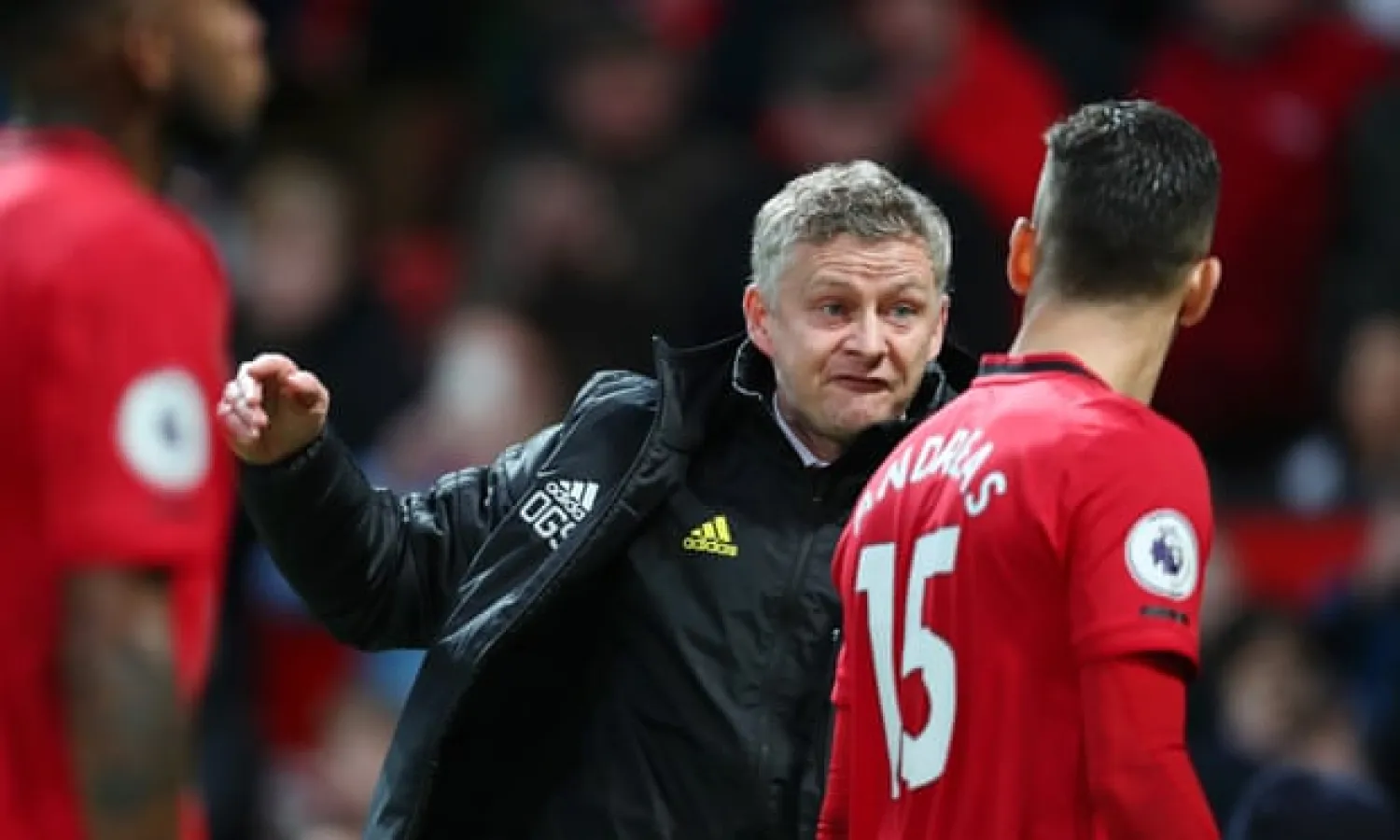
 Ole Gunnar Solskjær was a popular choice as an interim manager at Manchester United but loyalty to a club legend could prove costly. Photograph: Catherine Ivill/Getty Images
Ole Gunnar Solskjær was a popular choice as an interim manager at Manchester United but loyalty to a club legend could prove costly. Photograph: Catherine Ivill/Getty Images
TT

Ole Gunnar Solskjær Is Not the Right Manager for Manchester United

 Ole Gunnar Solskjær was a popular choice as an interim manager at Manchester United but loyalty to a club legend could prove costly. Photograph: Catherine Ivill/Getty Images
Ole Gunnar Solskjær was a popular choice as an interim manager at Manchester United but loyalty to a club legend could prove costly. Photograph: Catherine Ivill/Getty Images

On Friday 5 March 1909, Manchester United went to Burnley for an FA Cup quarter-final. The pitch was frozen, there was heavy snow and with 18 minutes remaining the referee, Herbert Bamlett, decided the match couldn’t go on. For United, the abandonment was fortunate: they had been 1-0 down but won the rearranged game 3-2 and went on, for the first time, to lift the FA Cup.

Bamlett, having refereed the 1914 FA Cup final, turned his hand to management, taking charge of Oldham, Wigan Borough and Middlesbrough, guiding the latter to the verge of promotion when, in April 1927, he was named manager of United.

It was an ill-starred appointment. Two months later, the club’s owner and benefactor, John Henry Davies, died. With money tight United struggled to refresh their squad, leading in 1931 to their relegation and the inevitable decision not to renew Bamlett’s contract. Which perhaps goes to show the folly of appointing a manager on a sentimental whim for something he had done to help the club to a trophy two decades earlier.

That brings us to the present situation. Since he was given the job on a permanent basis in March, no United manager since Bamlett – not Frank O’Farrell, not Wilf McGuinness, not even the hapless Scott Duncan – has a worse win percentage than Ole Gunnar Solskjær’s 36.67%.

It is all very well to speak of youth and promise, to preach the value of patience, but what if in a year or two years or four years, it turns out Solskjær was the wrong man all along? What evidence is there that he is the right man? What if the potential in the squad is squandered as a result? What if, most pressingly, they miss out on appointing somebody of the stature of Mauricio Pochettino as a result of loyalty to the idea of Solskjær?

The idea is appealing. Who wouldn’t want a club legend to return to restore the values he had absorbed as a player at the club? Who doesn’t like to think of their club as unique, as having a soul that only true initiates can understand? It’s why Frank Lampard remains so popular at Chelsea. It’s why Barcelona tried to appoint Xavi. It’s why Sunderland fans, at least until the upturn of a couple of weeks ago, took to singing for Kevin Phillips. It’s why the best football decision Ed Woodward has made as Manchester United CEO was to sack José Mourinho and appoint Solskjær on an interim basis.

He was the ideal man to restore the club’s values, to swill out the toxicity. And it worked. United ran along at 2.46 points per game. They pulled off that hilarious heist in Paris, using nothing more than the folk memory of a famous night in Barcelona 20 years earlier to guide them to an unlikely victory over PSG.

Woodward, ever sensitive to the breezes of public opinion, gave Solskjær the job full-time. Since when United have picked up 1.40 points per game. Bamlett, it may be noted, won six and drew one of his first seven games.

The modern world of football is an impatient place. Demands are habitually excessive. Short‑termism reigns. With today’s mindset, Herbert Chapman at Arsenal, Bill Shankly at Liverpool, Don Revie at Leeds, Brian Clough at Derby and Nottingham Forest and, most pertinently, Alex Ferguson at Manchester United might all have been sacked before achieving success.

But that is a dangerous way of thinking: just because some managers given time were successful doesn’t mean that all would be. As Solskjær approaches his 44th game in charge on Sunday against Liverpool, it is reasonable to ask what, if any, progress has been made.

Mourinho was sacked with a win percentage of 53.8%. Solskjær’s, even if you count those games as interim manager, is 48.8%. United are scoring fractionally more goals under Solskjær than Mourinho – 1.7 per game as opposed to 1.6 – but they are conceding 1.2 per game against 0.9.

In those early sunlit months of Solskjær’s reign, Louis van Gaal observed that United had appointed another counterattacking coach, which prompted widespread derision – but he was right. Whether football is exciting or not is, increasingly, in the eye of the beholder and it’s clear that many found Van Gaal’s focus on possession led to sterile football. But Solskjær’s side look a credible attacking force only against teams who leave space in behind them, whether because they attack United, as Tottenham and Manchester City did in that bizarre week of glory at the beginning of December, or because United have taken the lead, as happened against Norwich, Newcastle and Chelsea.

Modern football at the highest level, though, as Liverpool and Manchester City make clear every time they play, is about structured gambits. Attacking, just as much as defending, is about organisation, about players knowing where to move so that when the chance comes, the play is semi-automatic and too rapid even for packed rearguards to repel. A year on, there has been no sign of Solskjær coming close to achieving that.

One of the reasons Mourinho was ousted was that his football was deemed unbecoming to United’s history. Solskjær has not set his side up in the performatively negative way Mourinho occasionally did – at Anfield the season before last most memorably – but it is remarkable how similar their stats look. Passes per game have gone down under Solskjær, as have successful passes ending in the final third. Goals conceded to fast breaks – an indicator of how effective a team’s press is – are up by a factor of three.

United are a shambles. Their problems will not instantly be solved by replacing Solskjær. He is not some malign presence sapping the life force from the squad. But there is simply no evidence, attractive as the dream may be, that he is equipped, just as all seems lost, once again to turn up to save the day. Other managers are available, but they will not always be. At some point, vague promises of youth and counterattacking are not enough.

The Guardian Sport


Hospital: Vonn Had Surgery on Broken Leg from Olympics Crash

This handout video grab from IOC/OBS shows US Lindsey Vonn crashing during the women's downhill event at the Milano Cortina 2026 Winter Olympic Games on February 8, 2026. (Photo by Handout / various sources / AFP)
TT

Hospital: Vonn Had Surgery on Broken Leg from Olympics Crash

This handout video grab from IOC/OBS shows US Lindsey Vonn crashing during the women's downhill event at the Milano Cortina 2026 Winter Olympic Games on February 8, 2026. (Photo by Handout / various sources / AFP)

Lindsey Vonn had surgery on a fracture of her left leg following the American's heavy fall in the Winter Olympics downhill, the hospital said in a statement given to Italian media on Sunday.

"In the afternoon, (Vonn) underwent orthopedic surgery to stabilize a fracture of the left leg," the Ca' Foncello hospital in Treviso said.

Vonn, 41, was flown to Treviso after she was strapped into a medical stretcher and winched off the sunlit Olimpia delle Tofane piste in Cortina d'Ampezzo.

Vonn, whose battle to reach the start line despite the serious injury to her left knee dominated the opening days of the Milano Cortina Olympics, saw her unlikely quest halted in screaming agony on the snow.

Wearing bib number 13 and with a brace on the left knee she ⁠injured in a crash at Crans Montana on January 30, Vonn looked pumped up at the start gate.

She tapped her ski poles before setting off in typically aggressive fashion down one of her favorite pistes on a mountain that has rewarded her in the past.

The 2010 gold medalist, the second most successful female World Cup skier of all time with 84 wins, appeared to clip the fourth gate with her shoulder, losing control and being launched into the air.

She then barreled off the course at high speed before coming to rest in a crumpled heap.

Vonn could be heard screaming on television coverage as fans and teammates gasped in horror before a shocked hush fell on the packed finish area.

She was quickly surrounded by several medics and officials before a yellow Falco 2 ⁠Alpine rescue helicopter arrived and winched her away on an orange stretcher.


Meloni Condemns 'Enemies of Italy' after Clashes in Olympics Host City Milan

Demonstrators hold smoke flares during a protest against the environmental, economic and social impact of the Milano-Cortina 2026 Winter Olympics in Milan, Italy, February 7, 2026. REUTERS/Kevin Coombs
TT

Meloni Condemns 'Enemies of Italy' after Clashes in Olympics Host City Milan

Demonstrators hold smoke flares during a protest against the environmental, economic and social impact of the Milano-Cortina 2026 Winter Olympics in Milan, Italy, February 7, 2026. REUTERS/Kevin Coombs

Italian Prime Minister Giorgia Meloni has condemned anti-Olympics protesters as "enemies of Italy" after violence on the fringes of a demonstration in Milan on Saturday night and sabotage attacks on the national rail network.

The incidents happened on the first full day of competition in the Winter Games that Milan, Italy's financial capital, is hosting with the Alpine town of Cortina d'Ampezzo.

Meloni praised the thousands of Italians who she said were working to make the Games run smoothly and present a positive face of Italy.

"Then ⁠there are those who are enemies of Italy and Italians, demonstrating 'against the Olympics' and ensuring that these images are broadcast on television screens around the world. After others cut the railway cables to prevent trains from departing," she wrote on Instagram on Sunday.

A group of around 100 protesters ⁠threw firecrackers, smoke bombs and bottles at police after breaking away from the main body of a demonstration in Milan.

An estimated 10,000 people had taken to the city's streets in a protest over housing costs and environmental concerns linked to the Games.

Police used water cannon to restore order and detained six people.

Also on Saturday, authorities said saboteurs had damaged rail infrastructure near the northern Italian city of Bologna, disrupting train journeys.

Police reported three separate ⁠incidents at different locations, which caused delays of up to 2-1/2 hours for high-speed, Intercity and regional services.

No one has claimed responsibility for the damage.

"Once again, solidarity with the police, the city of Milan, and all those who will see their work undermined by these gangs of criminals," added Meloni, who heads a right-wing coalition.

The Italian police have been given new arrest powers after violence last weekend at a protest by the hard-left in the city of Turin, in which more than 100 police officers were injured.


Liverpool New Signing Jacquet Suffers 'Serious' Injury

Soccer Football - Ligue 1 - RC Lens v Stade Rennes - Stade Bollaert-Delelis, Lens, France - February 7, 2026  Stade Rennes' Jeremy Jacquet in action REUTERS/Benoit Tessier
Soccer Football - Ligue 1 - RC Lens v Stade Rennes - Stade Bollaert-Delelis, Lens, France - February 7, 2026 Stade Rennes' Jeremy Jacquet in action REUTERS/Benoit Tessier
TT

Liverpool New Signing Jacquet Suffers 'Serious' Injury

Soccer Football - Ligue 1 - RC Lens v Stade Rennes - Stade Bollaert-Delelis, Lens, France - February 7, 2026  Stade Rennes' Jeremy Jacquet in action REUTERS/Benoit Tessier
Soccer Football - Ligue 1 - RC Lens v Stade Rennes - Stade Bollaert-Delelis, Lens, France - February 7, 2026 Stade Rennes' Jeremy Jacquet in action REUTERS/Benoit Tessier

Liverpool's new signing Jeremy Jacquet suffered a "serious" shoulder injury while playing for Rennes in their 3-1 Ligue 1 defeat at RC Lens on Saturday, casting doubt over the defender’s availability ahead of his summer move to Anfield.

Jacquet fell awkwardly in the second half of the ⁠French league match and appeared in agony as he left the pitch.

"For Jeremy, it's his shoulder, and for Abdelhamid (Ait Boudlal, another Rennes player injured in the ⁠same match) it's muscular," Rennes head coach Habib Beye told reporters after the match.

"We'll have time to see, but it's definitely quite serious for both of them."
Liverpool agreed a 60-million-pound ($80-million) deal for Jacquet on Monday, but the 20-year-old defender will stay with ⁠the French club until the end of the season.

Liverpool, provisionally sixth in the Premier League table, will face Manchester City on Sunday with four defenders - Giovanni Leoni, Joe Gomez, Jeremie Frimpong and Conor Bradley - sidelined due to injuries.
