
SNHR Documents 770 Points of Destruction in Maaret al-Numan

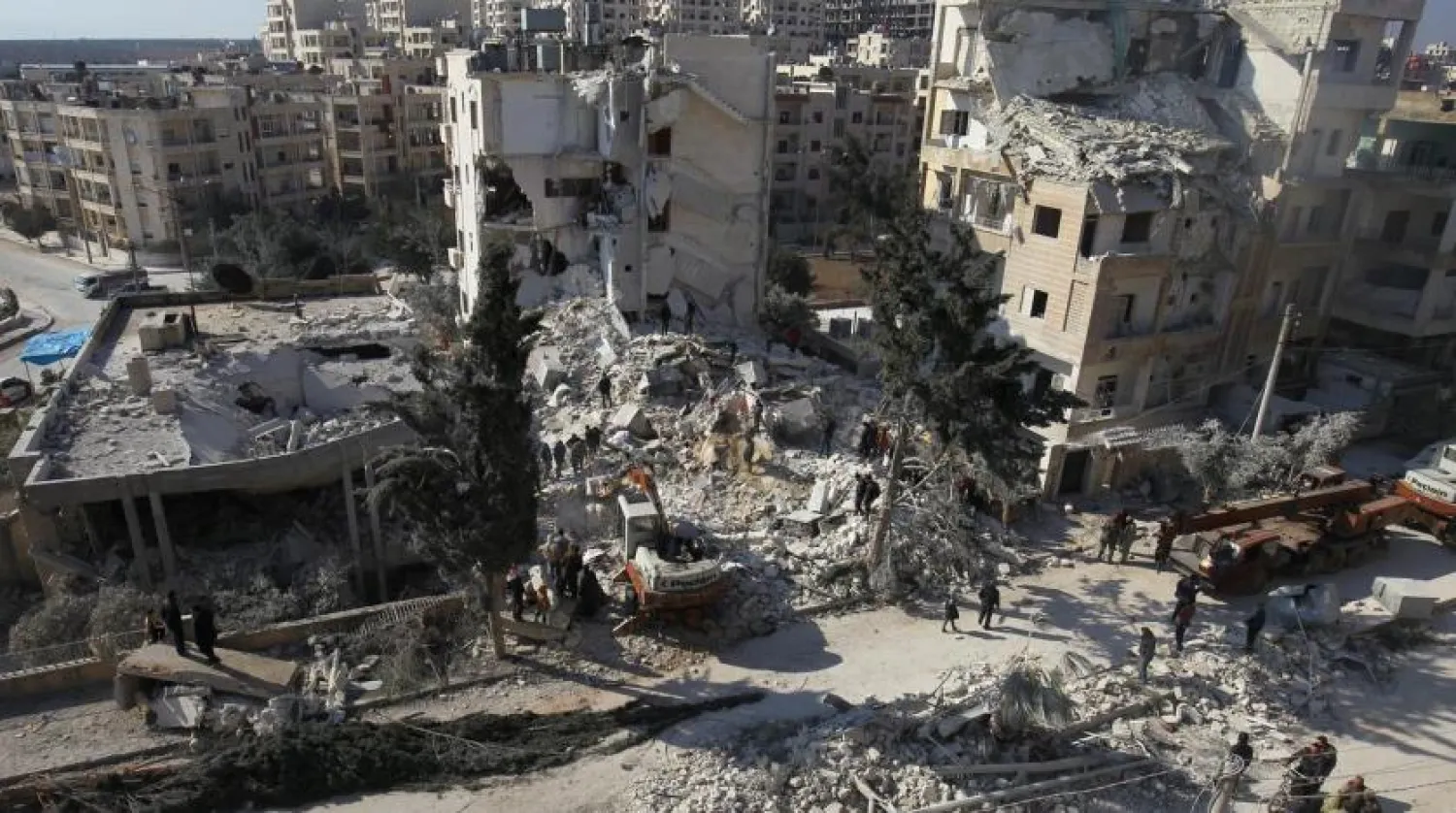
FILE PHOTO: People inspect the damage at a site hit by airstrikes in the rebel-held city of Idlib, Syria February 7, 2017. REUTERS/Ammar Abdullah
TT

SNHR Documents 770 Points of Destruction in Maaret al-Numan

FILE PHOTO: People inspect the damage at a site hit by airstrikes in the rebel-held city of Idlib, Syria February 7, 2017. REUTERS/Ammar Abdullah

The Syrian Network for Human Rights (SNHR) revealed in its latest report that it identified 770 points of destruction in Syria's Maaret al-Numan city, noting that at least 882 attacks targeted Idlib in one year.

SNHR said that destroying Maaret al Numan and Saraqeb cities and displacing their residents is a clear example of the Syrian regime’s tactics in its recent military campaign between early December 2019 and March 2020.

The war monitor said destroying cities and their environs, displacing their people, and seizing their properties is a malicious and criminal tripartite strategy by the Syrian regime intended to punish those demanding or dreaming of political change.

The report highlighted that the regime and its Russian and Iranian allies have by far exceeded the other parties to the conflict in forcible displacement of populations.

It attributed this to several reasons, mainly the use of the air force, violent barbaric shelling and the population’s fear of brutal reprisals, of arrest, torture or illegal conscription into the Syrian regime’s forces.

The report points out that in the first months of the military campaign which began on April 26, 2019, the population of large areas was displaced, before the Syrian regime and its allies intensified their military attacks at the end of 2019 on and around Idlib governorate.

"During this campaign they targeted Maaret al Numan city, Saraqeb and their environs, along with the northwestern suburbs of Aleppo," according to the report.

SNHR said in its report that the region has witnessed five cease-fire agreements; the first of these was declared on August 1, 2019, while the latest one began on March 6, 2020.

"All these ceasefire agreements failed completely to achieve any actual cessation of combat operations."

According to the report, each agreement was followed by a military escalation more violent than its predecessor, which led to the Syrian regime advancing on the ground.

SNHR documented at least 882 attacks by Russian-Syrian alliance forces in and around Idlib since April 26, 2019, up until May 29, 2020, including attacks on 220 places of worship, 218 educational facilities, 93 medical facilities, 86 Civil Defense centers, and 52 markets.

The report cites Maaret al Numan city as a study model to demonstrate the true scope of the destruction that took place in the cities throughout the latest campaign that started in early December 2019. It relies on satellite images taken on February 27, 2020, that is, after the Syrian regime and its allies took control of the city.

SNHR further said that the out of the 770 destructed points, 15 were of completely destroyed buildings, 716 were of of buildings that sustained average damage, while 36 points of buildings sustained minor damage.

The report further says: "According to the calculations conducted by the work team of the ratio of the points of destruction to the area of the inhabited city that the team analyzed, which is approximately 8.5 square kilometers (850 hectares), concluding that each one- square kilometer area contains 90 points that have been destroyed (9 points in every 10 hectares), meaning that at least two percent of the city’s area is completely destroyed, and approximately 40 percent of it is partially destroyed."

SNHR stressed that the displacement of the people of these is organically linked to the process of destruction inflicted in these military operations, noting that "destroying cities and towns has been a deliberate strategic objective of the Syrian regime and its allies in order to force the people towards surrender, displacement, and humiliation."



Why Lebanon, Israel Chose Beaufort Castle as Pilot Zone

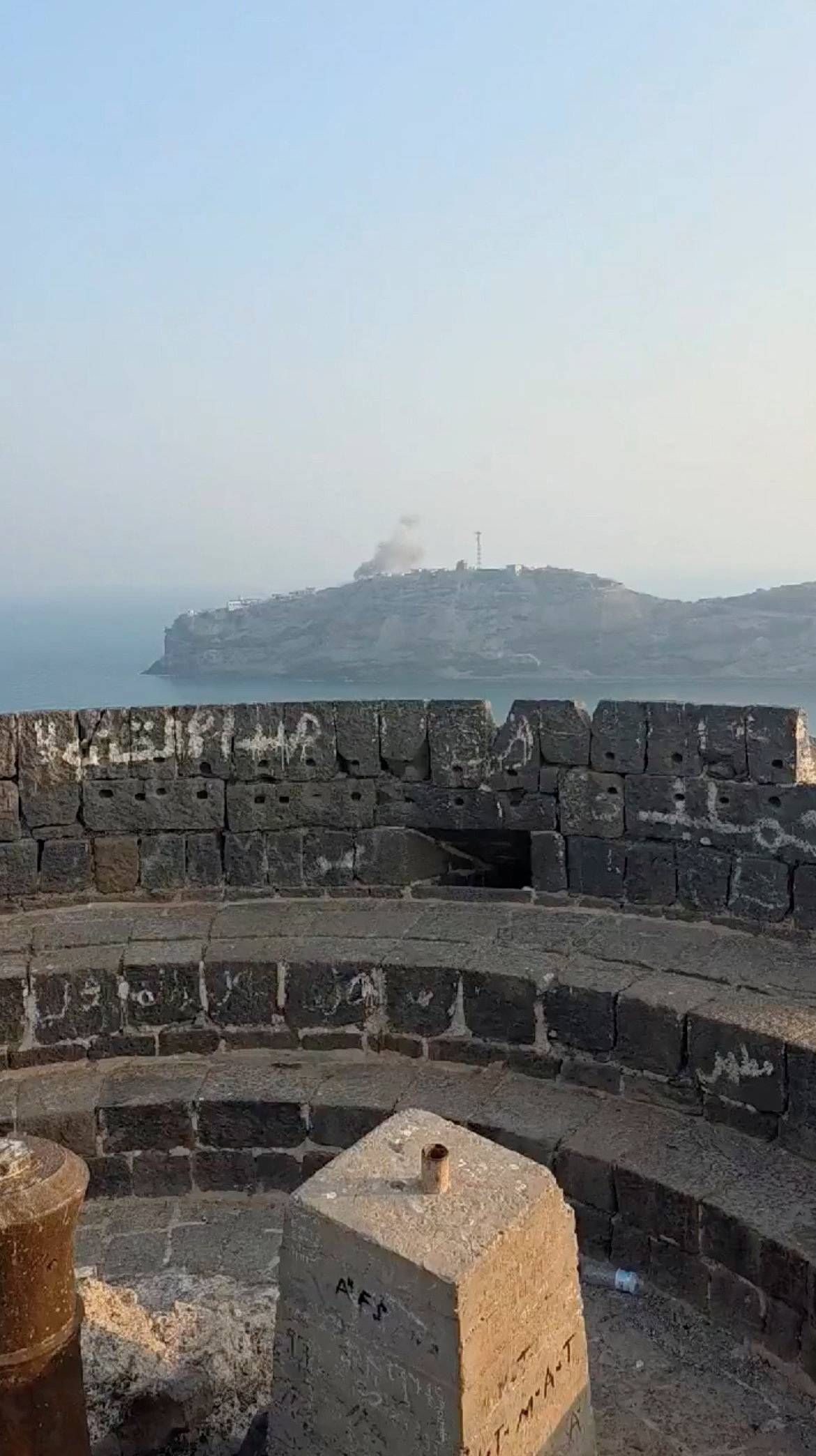
Smoke rises near the Beaufort Castle, as seen from Marjayoun, southern Lebanon, May 29, 2026. REUTERS/Stringer
TT

Why Lebanon, Israel Chose Beaufort Castle as Pilot Zone

Smoke rises near the Beaufort Castle, as seen from Marjayoun, southern Lebanon, May 29, 2026. REUTERS/Stringer

The ceasefire agreement between Lebanon and Israel provides for the creation of “pilot zones” in southern Lebanon, where the Lebanese army would assume exclusive control and ensure Hezbollah fighters are not present, in return for an Israeli military withdrawal from those areas.

Lebanese President Joseph Aoun said Beirut had proposed that the plan begin in the towns of Zawtar al-Sharqiya and Zawtar al-Gharbiya, along with Yohmor and Beaufort Castle, “given the symbolism of this area and its proximity to the city of Nabatieh.”

The zone carries strategic weight for both sides, security sources in southern Lebanon told Asharq Al-Awsat.

For Israel, it would be a test of security for northern towns and settlements. For Lebanon, it would push the Israeli army away from the surrounding areas of Nabatieh.

Israeli forces advanced last week in the area north of the Litani River, taking control of large parts of Zawtar al-Sharqiya and Yohmor.

By Sunday, they had reached the strategic historic site of Beaufort Castle before coming under Hezbollah fire from rockets and explosive drones, according to successive statements by the group. The security sources said Israeli forces carried out demolitions in parts of Yohmor and Zawtar, but did not establish a military position in the area.

The heights are among the most important military and geopolitical points in southern Lebanon. They overlook the Litani River, towns along its eastern bank, the Nabatieh to Marjayoun road to the east, Nabatieh and its suburbs to the west, and towns on both sides of Wadi al-Hujeir to the south.

For Israel, the elevated area forms a key security depth because it overlooks occupied areas in southern Lebanon and northern towns. It lies just 4 kilometers from the settlement of Metula.

Beaufort Castle has long been a focal point of fighting since the 1982 invasion. From the west, it overlooks the area between the Litani and Zahrani rivers and is the highest hill in that sector.

That position gives its holder a major military advantage. From Beaufort Castle and Yohmor, it is possible to overlook Taybeh, Deir Seryan, and Qantara, where the Israeli army is now deployed.

For that reason, “it cannot leave it outside its control, or without security arrangements, if it wants to remain in the area where it is stationed.”

For Lebanon, an Israeli withdrawal from the high ground is a priority for allowing residents to return to Nabatieh and its surroundings. The area overlooks territory to its west as far as the sea, meaning that an Israeli military presence there would leave nearby towns, as well as Nabatieh, exposed to strikes.

The city lies between 3 and 5 kilometers from Beaufort Castle, Yohmor, and Zawtar.

Sources in southern Lebanon say an agreement on the pilot zone would mean the area is demilitarized and falls under the control of the Lebanese army alone.

If the plan succeeds, it could gradually expand to other areas, including zones north of the yellow line in Majdal Zoun and Zebqine in the western sector, towns overlooking Wadi al-Slouqi in the central sector, or those overlooking Wadi al-Hujeir in the eastern sector.


Hezbollah Rejects Latest Ceasefire Agreement as Israeli Strikes Kill 4 in Lebanon

Destroyed buildings resulting from Israeli shelling on Beirut's Southern Suburb, where a Hezbollah flag is raised (EPA)
TT

Hezbollah Rejects Latest Ceasefire Agreement as Israeli Strikes Kill 4 in Lebanon

Destroyed buildings resulting from Israeli shelling on Beirut's Southern Suburb, where a Hezbollah flag is raised (EPA)

Hezbollah on Thursday rejected the latest ceasefire agreement reached between Israel and the Lebanese government, and the militant group demanded a complete Israeli withdrawal from Lebanon as continued fighting there hampered moves to end the Iran war.

The Hezbollah announcement came as Israeli strikes killed at least four people, according to local authorities, and a UN peacekeeper was killed in the crossfire.

Hezbollah leader Naim Kassem, in a written statement read on TV, called the negotiations “absurd, humiliating, and insulting.” He said the agreement’s demand that Hezbollah fighters leave southern Lebanon under fire would mean “surrender, defeat and achieving the enemy’s goals.”

“What we are concerned about is an end to the aggression, ceasefire and Israel’s withdrawal,” he said, underscoring that Hezbollah had not made any commitment to stop fighting. “So long as our villages are not safe and are being bombed and destroyed and our people are killed," he said, northern Israel “will not be safe.”

The fighting in Lebanon, where Israeli forces have seized large swaths of the south, threatens efforts to end the Iran war and reopen the Strait of Hormuz, a key transit point for oil and gas. Its closure has jolted the world economy.

Iran has demanded that any lasting truce extend to Lebanon. Israeli Prime Minister Benjamin Netanyahu, who faces elections later this year, wants to press ahead with Israel’s offensive until Hezbollah no longer poses a threat.

US President Donald Trump, who faced a rare rebuke from Congress on Wednesday, has sought to downplay the diplomatic deadlock and the failure of declared ceasefires to end the fighting. He told reporters that in the Middle East, "a ceasefire is when you’re shooting in a more moderate manner.”

Peacekeeper killed in crossfire A Serbian peacekeeper was killed and two others were wounded when a mortar struck their location near Marjayoun, a Christian-majority town that has seen intense fighting, according to the UN mission, known as UNIFIL, and Serbia's Defense Ministry.

Israel later blamed Hezbollah for the firing that killed the UN peacekeeper, without offering evidence. Hezbollah and the UN did not immediately comment on who launched the shells, according to The AP news.

Lebanon’s state-run National News Agency said a drone strike killed a motorcyclist and wounded four people in the village of Maaroub. It said airstrikes on the village of Sohmor in the Bekaa Valley, in eastern Lebanon, killed three people and wounded others. It also reported airstrikes elsewhere in the south.

There was no immediate comment from the Israeli military, which has warned people not to go into parts of southern Lebanon where it says it is striking Hezbollah facilities.

Fighting has raged despite declared ceasefires Hezbollah resumed rocket fire days after Israel and the United States launched their surprise Feb. 28 attack on Iran, which backs Hezbollah. Before then, Israel had regularly carried out strikes in Lebanon against what it said were militant targets, often killing civilians, despite an earlier truce reached in 2024.

Lt. Gen. Eyal Zamir, the Israeli military’s chief of staff, acknowledged Thursday that the ongoing war was straining northern Israeli towns living under the threat of Hezbollah fire. He said Israel's operations in Iran and Lebanon had “created a new security reality,” by weaking Iran and Hezbollah “to an unprecedented degree.”

After Hezbollah's rocket and drone attacks resumed, Israeli troops seized around a fifth of Lebanon, pushing further into the country's south than at any time since the end of Israel’s 1982-2000 occupation.

In the southern city of Sidon, residents reacted to Wednesday's ceasefire announcement with skepticism, saying previous agreements had failed to stop the violence.

“Every few days a ceasefire is announced, but people keep getting killed,” said Mayada Hijazi.

“It’s all talk and no action,” said Salah Nassab. “We keep going back to our homes, and then we get displaced again, back and forth. We’re very tired."

More than 3,500 people have been killed in Lebanon, and over 1.2 million have been displaced. The fighting has killed 27 Israeli soldiers and three civilians.

The ceasefire came from ongoing Israeli-Lebanese talks The latest declared ceasefire came about through US-brokered talks between Israel and Lebanon's government, which accuses Hezbollah of dragging the country into war and had made efforts to disarm it before the latest hostilities.

The ceasefire agreement calls for Lebanon's armed forces to take control of security zones in Lebanon from which the militants would be banned.

Lebanese President Joseph Aoun on Thursday called the new agreement "the last chance to enter a final and comprehensive ceasefire.” He said Lebanon was ready to implement Wednesday's deal once he receives responses from relevant factions in Lebanon, including Hezbollah. The United States — and Trump himself — would determine how and when the deal is implemented, Aoun told journalists on Thursday.

The agreement terms Hezbollah “an enemy" of Israel, the US and Lebanon and calls for dismantling it. The government has promised to do so in the past but does not have the capabilities to disarm Hezbollah by force.

The latest agreement did not say when Israel would withdraw from southern Lebanon but said the US would support the Lebanese army as it works to assert control in areas where Hezbollah has long wielded power.


Israel Plans Major Settlement Push Across Occupied West Bank

A photograph taken from a land corridor that Israel plans to use for its controversial E1 settlement project, near the Arab town of al-Tur in Israel-annexed east Jerusalem, shows camels belonging to Bedouins gathered on a hill overlooking the Israeli settlement of Maale Adumim (background) on May 31, 2026. (Photo by AHMAD GHARABLI / AFP)
TT

Israel Plans Major Settlement Push Across Occupied West Bank

A photograph taken from a land corridor that Israel plans to use for its controversial E1 settlement project, near the Arab town of al-Tur in Israel-annexed east Jerusalem, shows camels belonging to Bedouins gathered on a hill overlooking the Israeli settlement of Maale Adumim (background) on May 31, 2026. (Photo by AHMAD GHARABLI / AFP)

Israel's hardline finance minister announced on Wednesday a major expansion by more than 2,000 homes of three Jewish settlements in the occupied West Bank that Palestinians hope will be part of a future independent state.

Most nations consider Israeli settlements there to be illegal under international law and a major obstacle to a two-state solution for long-term peace.

Bezalel Smotrich, who holds authority over parts of Israel's civilian administration in the West Bank, said a planning committee approved the construction of 2,162 new Jewish homes.

They include 1,006 units in a new settlement near Jerusalem, 922 near the Palestinian city of Nablus and 234 near ⁠Hebron.

"We are continuing ⁠to build the Land of Israel in practice," said Smotrich, an ultranationalist sanctioned by Britain, France and others who accuse him of inciting violence against Palestinians.

Smotrich has denounced the sanctions against him, saying the measures would not change Israeli policy.

The new homes would "strengthen our hold on the land, reinforce Israel's security, and establish clear facts on the ground that prevent the creation of an Arab terror state ⁠in the heart of the country," Smotrich said in a statement, without specifying when construction would begin.

Since becoming a minister three years ago, Smotrich has sought to tighten Israel's control and presence in the West Bank while advocating against the idea of a Palestinian state.

Prime Minister Benjamin Netanyahu's right-wing government has overseen the significant expansion of Jewish settlements in the West Bank and the establishment of new settlements.

Palestinians want the West Bank as part of a future independent state that includes East Jerusalem and Gaza. Around half a million Israelis live in the West Bank among about 3 million Palestinians.

US President Donald Trump's administration has been ⁠far less critical of ⁠the fast-expanding Israeli settlements.

However, Trump did say last September that he would not allow Israel to annex the West Bank, angering some right-wing Israeli lawmakers.

Condemning Wednesday's announcement, Palestinian President Mahmoud Abbas' office warned that Israel's "provocative" policies were pushing the region towards more rounds of violence and called on the US to stop the Israeli "madness.”

Smotrich on May 19 said he would wage "war" on the Palestinian Authority, which exercises limited civic rule in the West Bank, after he said he was told the International Criminal Court (ICC) prosecutor had sought a confidential arrest warrant against him. The ICC has not confirmed that.