


Russian Paleontologists Create First 3D Virtual Model of Dinosaur Brain

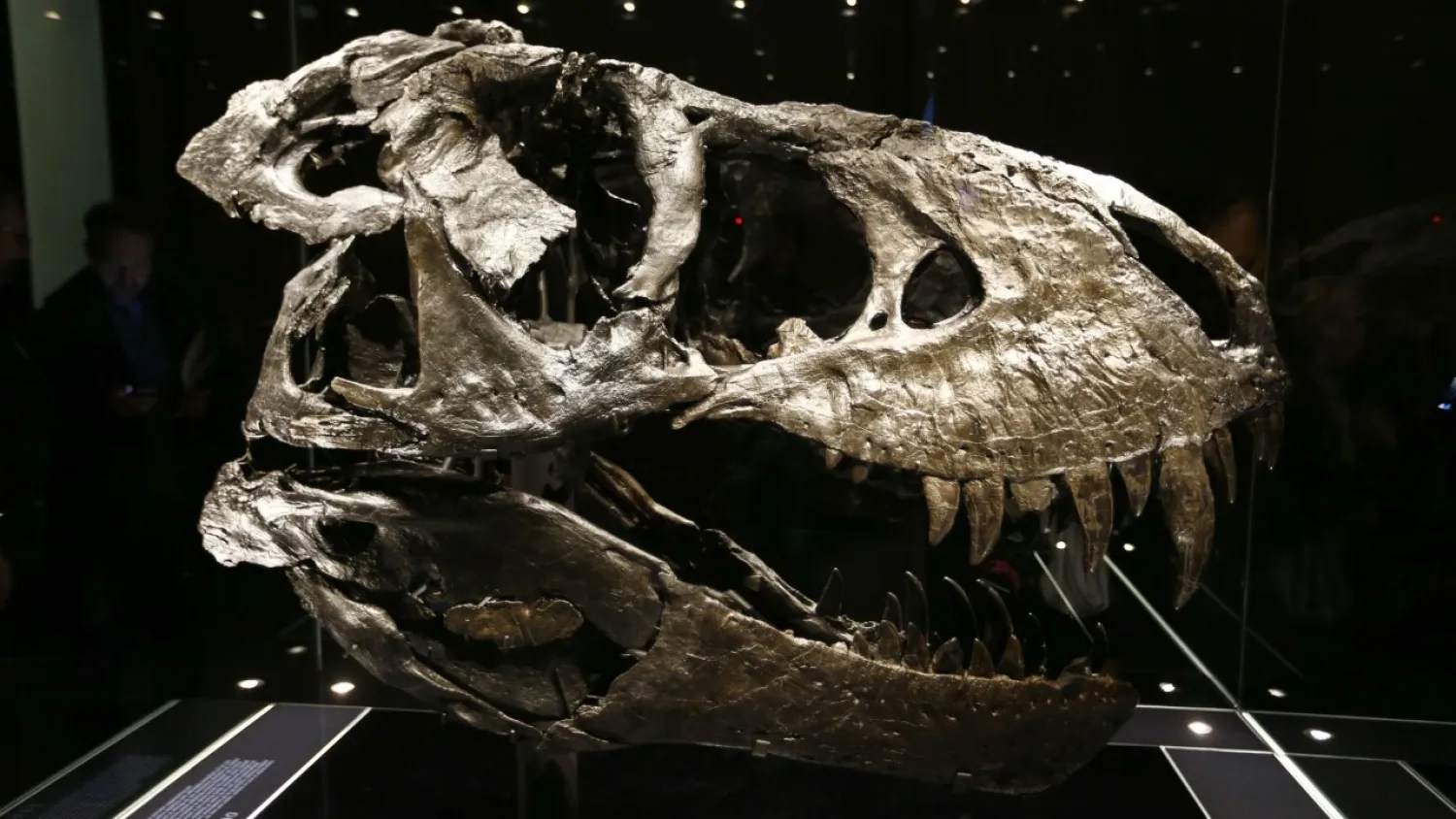
The original skull of a Tyrannosaurus rex skeleton is shown at the Natural History Museum in Berlin, Germany December 16, 2015. (REUTERS/Pawel Kopczynski)
TT

Russian Paleontologists Create First 3D Virtual Model of Dinosaur Brain

The original skull of a Tyrannosaurus rex skeleton is shown at the Natural History Museum in Berlin, Germany December 16, 2015. (REUTERS/Pawel Kopczynski)

Paleontologists at St. Petersburg University in Russia created the most detailed virtual 3D-model of the endocranial cast and blood vessels in the skull of the ankylosaur Bissektipelta archibaldi. It was an herbivorous dinosaur somewhat similar in appearance to a modern armadillo, which currently exist in Southern United States, central and southern America, and Uruguay.

Ankylosaurs appeared on Earth in the middle of the Jurassic, about 160 million years ago, and existed until the end of the dinosaur era, which ended 65 million years ago. Although these fossils have been known for 20 years, and uniquely-preserved in Uzbekistan, paleontologists from St. Petersburg University managed to create the first virtual 3D-model of the endocranial cast of an ankylosaurian. This model enabled them to prove that dinosaurs of this species were capable of cooling their brains, had an extremely developed sense of smell, and heard low-frequency sounds. However, their brain was one and a half times smaller than that of modern animals of the same size.

During the study, the paleontologists examined three fragments of fossil skulls of the ankylosaur Bissektipelta archibaldi, which were found during a series of international expeditions URBAC (Uzbek / Russian / British / American / Canadian Joint Paleontological Expeditions) in the late 1990s and early 2000s in the Central Kyzylkum Desert, Uzbekistan. The study was published in the recent issue of the Biological Communications journal.

A 3D reconstruction of the endocast of its brain cavity was made using CT. It is necessary to study it carefully to understand how big the actual brain was, where its parts were, and how the vessels and nerves were housed. According to a report published on the university's website, after meticulous work that lasted for three years, the scientists found out that a considerable part of the brain of Bissektipelta archibaldi was occupied by olfactory bulbs, neural structure in the brain involved in the sense of smell (represents about 60% of the size of the cerebral hemispheres). Bissektipelta could boast of an extremely developed sense of smell, which probably helped it to look for food, relatives of the opposite sex, and to feel the approach of predators in time.

Co-author Ivan Kuzmin said in the report: "Another interesting skill of the ankylosaur that we learned about is the ability to cool its brains. The network of veins and arteries in its braincase turned out to be very complicated: they did not go in a single direction, but constantly communicated with each other, like a system of railway tracks. The blood could have flown in different directions."



Parisians Will to Get a New Chance of Seine Swimming

People gather on the banks of the Seine River as the sun sets amid a severe heat wave in Paris, France, May 26, 2026. (Reuters)
TT

Parisians Will to Get a New Chance of Seine Swimming

People gather on the banks of the Seine River as the sun sets amid a severe heat wave in Paris, France, May 26, 2026. (Reuters)

Swimmers will for the second year be able to cool off at designated points along the Seine River in Paris this summer, authorities said Friday, as well as along the Marne River in the suburbs.

In Paris, the swimming season was to open at three official bathing sites on July 4, the mayor's office said.

The Seine reopened to swimmers last summer for the first time in a century, after Paris poured more than a billion euros ($1.15 billion) into a years-long effort to making the waters clean enough to use in the 2024 Olympics.

Sites this year will again include the Bras de Grenelle near the Eiffel Tower, the Bras Marie -- a short walk from Notre-Dame -- and Bercy, on the eastern side.

Some 100,000 people last year queued to jump in, the city said, despite a slow start to the season with rain disrupting the water quality.

Some 50,000 swimmers jumped into the Marne River in the eastern suburbs last year.

The bathing spots in Joinville-le-Pont, Champigny-sur-Marne, Saint-Maur-des-Fosses and Maison-Alfort would again welcome swimmers. A fifth spot would be added this year at Neuilly-sur-Marne northeast of Paris.

French authorities warned against swimming in parts of the rivers without lifeguards.


Independent Researcher Exposes Basic Blunder in Scores of Cancer Studies

Researchers at the laboratory. (Cancer Research UK, Cambridge Institute)
TT

Independent Researcher Exposes Basic Blunder in Scores of Cancer Studies

Researchers at the laboratory. (Cancer Research UK, Cambridge Institute)

An independent researcher has uncovered potential blunder in scores of scientific studies, including cancer-related research, as a result of inappropriate antibody use in laboratory experiments, raising questions about the reliability of some of the results published in prestigious scientific journals.

The researcher found that scientists at Cambridge, Oxford, Stanford and other universities appear to have accidentally used the wrong ingredient in their experiments, muddling two proteins with similar names but entirely different sequences and functions.

Several British media outlets said researcher Sholto David reviewed the full text of 334 research papers to determine whether the antibody used in the studies was correctly intended for p16-ARC or incorrectly used to try and bind p16-INK4a.

P16-INK4a acts as a tumor suppressor by halting the cell cycle and is widely studied in cancer biology and is considered a key biomarker of ageing.

He found astonishing result: 95% of these papers have got it wrong.

“The vast majority of researchers who purchased antibodies have tried to use them to investigate p16-INK4a expression. Only 17 used these p16-ARC antibodies correctly,” he said in his research.

David said the implications are not good, to put it mildly.

“And these are not just insignificant papers. There are papers with hundreds of citations in high impact journals claiming to probe for p16-INK4a with antibodies which do not bind p16-INK4a,” he noted.


Indonesia Volcano Erupts, Forcing Airport to Close

Journalists photograph a screen showing the movement of volcanic ash from Mount Lewotobi Laki-laki at the Meteorology, Climatology and Geophysics Agency (BMKG) office in Maumere, East Nusa Tenggara, Indonesia, on June 5, 2026. (AFP)
TT

Indonesia Volcano Erupts, Forcing Airport to Close

Journalists photograph a screen showing the movement of volcanic ash from Mount Lewotobi Laki-laki at the Meteorology, Climatology and Geophysics Agency (BMKG) office in Maumere, East Nusa Tenggara, Indonesia, on June 5, 2026. (AFP)

A highly active volcano in eastern Indonesia erupted several times on Friday, spewing towering ash columns into the sky and forcing a local airport to close, authorities said.

Mount Lewotobi Laki-Laki on Flores Island erupted at 11:15 am (0315 GMT), sending volcanic material 2.5 kilometers (1.6 miles) into the air, the national volcanology agency said in a statement.

It came after several other eruptions earlier on Friday.

Lewotobi Laki-Laki falls under Indonesia's second-highest alert level for volcanic activity, with a five-kilometer exclusion zone in force around its crater.

The volcanology agency said residents near rivers should also remain on alert for hazardous floods of volcanic material, known as lahar, if heavy rain occurs.

Authorities have suspended operations at a local airport in the town of Maumere, about 60 kilometers west of Lewotobi Laki-Laki, affecting five domestic flights, airport head Partahian Panjaitan told AFP.

Laki-Laki means "man" in Indonesian, and the 1,584-meter (5,197-foot) volcano is twinned with a calmer 1,703-meter one named Perempuan after the Indonesian word for "woman".

Last July, Lewotobi Laki-Laki spewed a colossal 18-kilometer tower of ash, forcing the cancellation of 24 flights at the international airport on the resort island of Bali.

Indonesia, a vast archipelago nation, experiences frequent seismic and volcanic activity due to its position on the Pacific "Ring of Fire".