
Community Oven Serves up Meals, and Dignity, in Blast-Hit Beirut

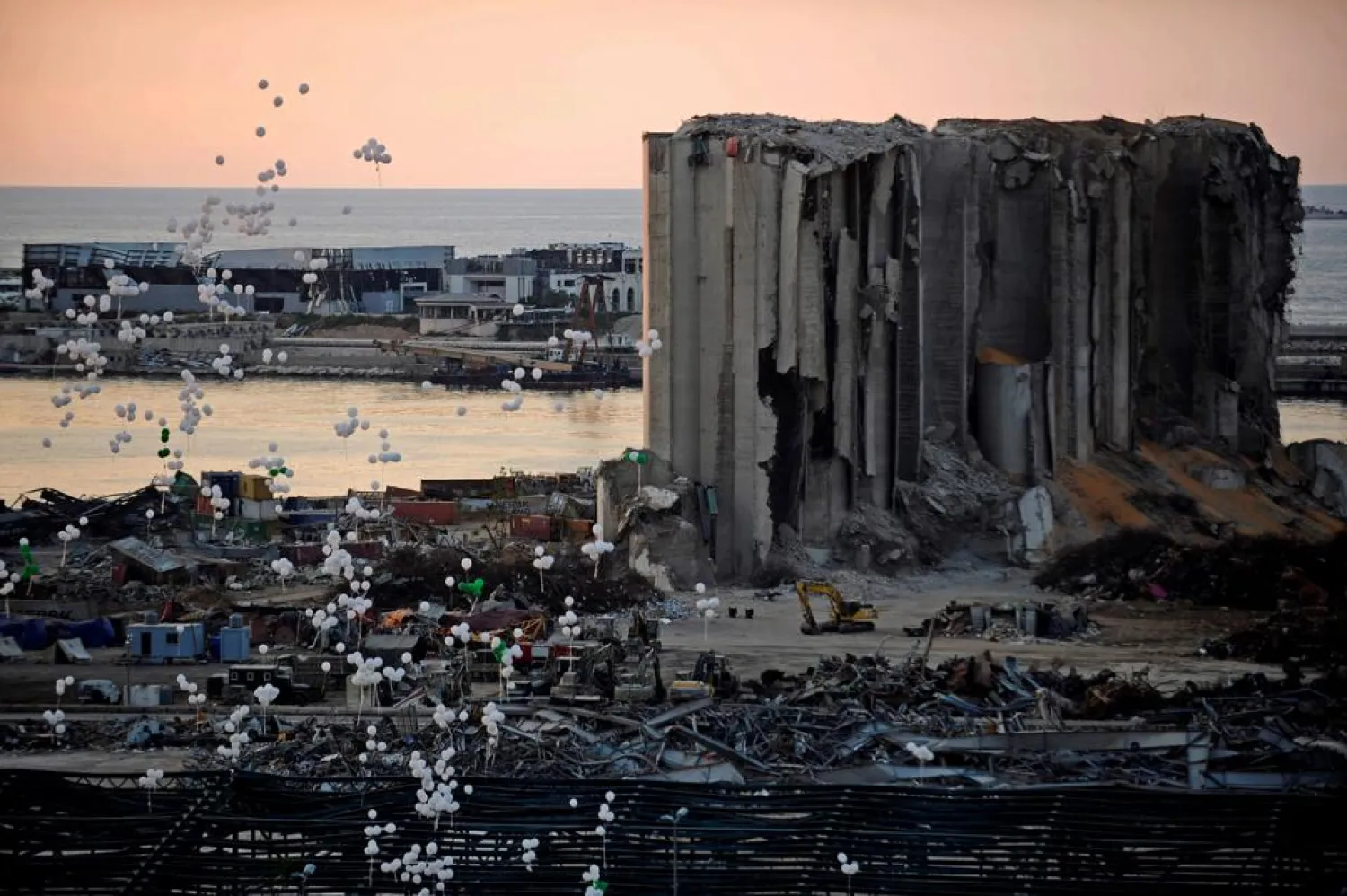
A ceremony to mark the August 4 port explosion in Beirut, Lebanon, on Oct. 4, 2020. (Getty Images)
TT

Community Oven Serves up Meals, and Dignity, in Blast-Hit Beirut

A ceremony to mark the August 4 port explosion in Beirut, Lebanon, on Oct. 4, 2020. (Getty Images)

When a huge blast tore through Beirut on Aug. 4, Rawda Mazloum decided to move the giant oven she was using to cook for refugees in the Bekaa Valley to assist residents of the devastated capital.

Today, the stove that has helped feed thousands of refugees and rehabilitate former fighters as part of a community cooking project, sits in a relief center in Beirut and provides hot meals to people left homeless and destitute by the explosion.

“When the blast happened, I decided to prepare quick meals and pastries. We took boxes of water and masks and went to the site of the blast,” said Mazloum, a refugee from Syria who has been in Lebanon since 2014.

“Beirut has given me so much, I feel it’s personal to me. It felt good to be able to offer them something,” she told the Thomson Reuters Foundation.

Mazloum, 43, had been leading the preparation of meals for about 50 refugee and host community families through the Great Oven project, which encourages marginalized communities to cook together.

The elaborately painted two-ton oven – which requires a crane to be transported – ended up under Mazloum’s stewardship in the eastern Bekaa Valley in March, when the coronavirus dealt another blow to Lebanon’s battered economy.

Launched by Spanish-Irish chef James Gomez Thompson and Lebanese news producer Nour Matraji almost two years ago, the Great Oven initiative set out to help reintegrate former fighters and young militants in the northern city of Tripoli.

Sectarian violence still flares up in and around the city 30 years after the end of Lebanon’s civil war, but the project has brought together old rivals, including former prisoners, to learn new skills and foster community ties.

“We were trying to think of anything creative that they can also develop as a skill,” Matraji said.

“They need to self-sustain… so we came with the oven, we train, we teach. We also link them up with the food donors so we make sure they’re getting a steady flow of free ingredients,” she added.

‘Inherent dignity’

The blast in Beirut port, which killed about 200 people and left 300,000 people homeless, exacerbated Lebanon’s difficulties amid a financial crisis that has sharply devalued its currency and pushed half the population into poverty.

Dozens of other grassroots initiatives have sprung up to help those affected by the explosion, offering aid to rebuild ruined homes and provide emergency shelter and food.

As donor fatigue sets in globally during the COVID-19 pandemic, Thompson said the oven project embraced a more sustainable way of helping people in need.

“(There’s an) inherent dignity in being able to cook for themselves rather than having to constantly depend on handouts and that way they become agents of their own rehabilitation and their own food security,” he said.

Close to where the oven is parked, Thompson and Matraji have set up a makeshift prep kitchen at the Ballroom Blitz, a Beirut nightclub put out of action by the blast.

Where the dancefloor used to be, they prepare meals with dozens of volunteers and some of their project beneficiaries from Tripoli, including a former fighter who is now employed as a full-time chef and artist for the project.

The day’s menu depends on what ingredients arrive in the kitchen from their food donor partners. It could be Thai rice one day, aubergine with pasta another, or their signature mac and cheese.

With four more ovens now in the process of being decorated, the space has morphed into an art hub, with DJs frequently stopping by to play music as the team trains the next cohort of oven painters and cooks.

Until now, the project has been funded by Thompson but will eventually operate through sponsorship, with an endorsement to build and decorate an oven costing about $10,000.

In the meantime, Thompson and Matraji are fundraising to install 10 ovens in the worst-hit areas of the blast radius by the end of the year. Tripoli and Bekaa will also get their ovens back – this time with a view to making them permanent.

Beyond Lebanon, the project is generating interest in Venezuela to help rehabilitate former drug cartel members, Thompson said.

“I could also go to inner city gangs in London, in LA, in New York and say ‘you guys don’t have a community center anymore, well why don’t we build one around a massive oven’,” Thompson said.

“Then we make it beautiful so they take ownership of it and it belongs to them.”


A Timeline of How the Protests in Iran Unfolded and Grew

A general view from a street in Tehran, Iran, 08 January 2026. (EPA)
TT

A Timeline of How the Protests in Iran Unfolded and Grew

A general view from a street in Tehran, Iran, 08 January 2026. (EPA)

Demonstrations broke out in Iran on Dec. 28 and have spread nationwide as protesters vent their increasing discontent over the country's faltering economy and the collapse of its currency.

Dozens of people have been killed and thousands arrested as the daily protests have grown and the government seeks to contain them.

While the initial focus had been on issues like spikes in the prices of food staples and the country's staggering annual inflation rate, protesters have now begun chanting anti-government statements as well.

Here is how the protests developed:

Dec. 28: Protests break out in two major markets in downtown Tehran, after the Iranian rial plunged to 1.42 million to the US dollar, a new record low, compounding inflationary pressure and pushing up the prices of food and other daily necessities. The government had raised prices for nationally subsidized gasoline in early December, increasing discontent.

Dec. 29: Central Bank head Mohammad Reza Farzin resigns as the protests in Tehran spread to other cities. Police fire tear gas to disperse protesters in the capital.

Dec. 30: As protests spread to include more cities, as well as several university campuses, Iranian President Masoud Pezeshkian meets with a group of business leaders to listen to their demands and pledges his administration will “not spare any effort for solving problems” with the economy.

Dec. 31: Iran appoints Abdolnasser Hemmati as the country's new central bank governor. Officials in southern Iran say that protests in the city of Fasa turned violent after crowds broke into the governor's office and injured police officers.

Jan. 1: The protests' first fatalities are officially reported, with authorities saying at least seven people have been killed. The most intense violence appears to be in Azna, a city in Iran’s Lorestan province, where videos posted online purport to show objects in the street ablaze and gunfire echoing as people shouted: “Shameless! Shameless!”

The semiofficial Fars news agency reports three people were killed. Other protesters are reported killed in Bakhtiari and Isfahan provinces while a 21-year-old volunteer in the paramilitary Revolutionary Guard’s Basij force was killed in Lorestan.

Jan. 2: US President Donald Trump raises the stakes, writing on his Truth Social platform that if Iran “violently kills peaceful protesters,” the United States “will come to their rescue.” The warning, only months after American forces bombed Iranian nuclear sites, includes the assertion, without elaboration, that: “We are locked and loaded and ready to go.”

Protests, meantime, expand to reach more than 100 locations in 22 of Iran's 31 provinces, according to the US-based Human Rights Activists News Agency.

Jan. 3: Iran's Supreme Leader Ali Khamenei says “rioters must be put in their place,” in what is seen as a green light for security forces to begin more aggressively putting down the demonstrations. Protests expand to more than 170 locations in 25 provinces, with at least 15 people killed and 580 arrested, HRANA reports.

Jan. 6: Protesters conduct a sit-in at Tehran's Grand Bazaar until security forces disperse them using tear gas. The death toll rises to 36, including two members of Iranian security forces, according to HRANA. Demonstrations have reached over 280 locations in 27 of Iran’s 31 provinces.

Jan. 8 to 9: Following a call from Iran's exiled crown prince, a mass of people shout from their windows and take to the streets in an overnight protest. The government responds by blocking the internet and international telephone calls, in a bid to cut off the country of 85 million from outside influence. HRANA says violence around the demonstrations has killed at least 42 people while more than 2,270 others have been detained.


Why Greenland Is Strategically Important to Arctic Security

Houses covered by snow are seen on the coast of a sea inlet of Nuuk, Greenland, on March 7, 2025. (AP Photo/Evgeniy Maloletka, File)
TT

Why Greenland Is Strategically Important to Arctic Security

Houses covered by snow are seen on the coast of a sea inlet of Nuuk, Greenland, on March 7, 2025. (AP Photo/Evgeniy Maloletka, File)

Location, location, location: Greenland’s position above the Arctic Circle makes the world’s largest island a key part of security strategy.

Increasing international tensions, global warming and the changing world economy have put Greenland at the heart of the debate over global trade and security, and US President Donald Trump wants to make sure his country controls the mineral-rich island that guards the Arctic and North Atlantic approaches to North America.

Greenland is a self-governing territory of Denmark, a longtime US ally that has rejected Trump’s overtures. Greenland’s own government also opposes US designs on the island, saying the people of Greenland will decide their own future.

The island, 80% of which lies above the Arctic Circle, is home to about 56,000 mostly Inuit people who until now have been largely ignored by the rest of the world.

Here’s why Greenland is strategically important to Arctic security:

Greenland’s location is key

Greenland sits off the northeastern coast of Canada, with more than two-thirds of its territory lying within the Arctic Circle. That has made it crucial to the defense of North America since World War II, when the US occupied Greenland to ensure it didn’t fall into the hands of Nazi Germany and to protect crucial North Atlantic shipping lanes.

Following the Cold War, the Arctic was largely an area of international cooperation. But climate change is thinning the Arctic ice, promising to create a northwest passage for international trade and reigniting competition with Russia, China and other countries over access to the region’s mineral resources.

Security threats

In 2018, China declared itself a “near-Arctic state” in an effort to gain more influence in the region. China has also announced plans to build a “Polar Silk Road” as part of its global Belt and Road Initiative, which has created economic links with countries around the world.

Then US Secretary of State Mike Pompeo rejected China’s move, saying: “Do we want the Arctic Ocean to transform into a new South China Sea, fraught with militarization and competing territorial claims?”

Meanwhile, Russia has sought to assert its influence over wide areas of the Arctic in competition with the US, Canada, Denmark and Norway. Moscow has also sought to boost its military presence in the polar region, home to its Northern Fleet and a site where the Soviet Union tested nuclear weapons. Russian military officials have said that the site is ready for resuming the tests, if necessary.

Russia's military has been restoring old Soviet infrastructure in the Arctic and building new facilities. Since 2014, the Russian military has opened several military bases in the Arctic and worked on reconstructing airfields.

European leaders’ concerns have been heightened since Russia launched a war in Ukraine on Feb. 24, 2022.

Last year, Russian President Vladimir Putin noted that Moscow is worried about NATO’s activities in the Arctic and will respond by strengthening the capability of its armed forces there. But he said that Moscow was holding the door open to broader international cooperation in the region.

US military presence

The US Department of Defense operates the remote Pituffik Space Base in northwestern Greenland, which was built after the US and Denmark signed the Defense of Greenland Treaty in 1951. It supports missile warning, missile defense and space surveillance operations for the US and NATO.

Greenland also guards part of what is known as the GIUK (Greenland, Iceland, United Kingdom) Gap, where NATO monitors Russian naval movements in the North Atlantic.

Thomas Crosbie, an associate professor of military operations at the Royal Danish Defense College, said that an American takeover wouldn't improve upon Washington’s current security strategy.

“The United States will gain no advantage if its flag is flying in Nuuk (Greenland's capital) versus the Greenlandic flag,” he told The Associated Press. “There’s no benefits to them because they already enjoy all of the advantages they want.

"If there’s any specific security access that they want to improve American security, they’ll be given it as a matter of course, as a trusted ally. So this has nothing to do with improving national security for the United States.”

Denmark’s parliament approved a bill last June to allow US military bases on Danish soil. It widened a previous military agreement, made in 2023 with the Biden administration, where US troops had broad access to Danish air bases in the Scandinavian country.

Danish Foreign Minister Lars Løkke Rasmussen, in a response to lawmakers’ questions, wrote over the summer that Denmark would be able to terminate the agreement if the US tries to annex all or part of Greenland.

Danish armed forces in Greenland

Denmark is moving to strengthen its military presence around Greenland and in the wider North Atlantic. Last year, the government announced a roughly 14.6 billion-kroner ($2.3 billion) agreement with parties including the governments of Greenland and the Faroe Islands, another self-governing territory of Denmark, to “improve capabilities for surveillance and maintaining sovereignty in the region.”

The plan includes three new Arctic naval vessels, two additional long-range surveillance drones and satellite capacity.

Denmark’s Joint Arctic Command is headquartered in Nuuk, and tasked with the “surveillance, assertion of sovereignty and military defense of Greenland and the Faroe Islands,” according to its website. It has smaller satellite stations across the island.

The Sirius Dog Sled Patrol, an elite Danish naval unit that conducts long-range reconnaissance and enforces Danish sovereignty in the Arctic wilderness, is also stationed in Greenland.

Mineral wealth

Greenland is also a rich source of the so-called rare earth minerals that are a key component of cellphones, computers, batteries and other high-tech gadgets that are expected to power the world’s economy in the coming decades.

That has attracted the interest of the US and other Western powers as they try to ease China’s dominance of the market for these critical minerals.

Development of Greenland’s mineral resources is challenging because of the island’s harsh climate, while strict environmental controls have proved an additional hurdle for potential investors.


Protest-Hit Iran Warily Watches the US After its Raid on Venezuela

Iranians protest a 22-year-old woman Mahsa Amini's death after she was detained by the morality police, in Tehran, Sept. 20, 2022, in this photo taken by an individual not employed by the Associated Press and obtained by the AP outside Iran. (AP Photo/ File)
TT

Protest-Hit Iran Warily Watches the US After its Raid on Venezuela

Iranians protest a 22-year-old woman Mahsa Amini's death after she was detained by the morality police, in Tehran, Sept. 20, 2022, in this photo taken by an individual not employed by the Associated Press and obtained by the AP outside Iran. (AP Photo/ File)

Iran faces a new round of protests challenging the country's theocracy, but it seems like the only thing people there want to talk about is half a world away: Venezuela.

Since the US military seized Venezuelan President Nicolas Maduro, a longtime ally of Tehran, over the weekend, Iranian state media headlines and officials have condemned the operation. In the streets and even in some official conversations, however, there's a growing question over whether a similar mission could target the country's top officials including the supreme leader, 86-year-old Ali Khamenei.

The paranoia feeds into wider worries among Iranians. Many fear that close US ally Israel will target Iran again as it did during the 12-day war it launched against Tehran in June. Israel killed a slew of top military officials and nuclear scientists, and the US bombed Iranian nuclear enrichment sites. Khamenei is believed to have gone into hiding for his protection.

“God bless our leader, we should be careful too," said Saeed Seyyedi, a 57-year-old teacher in Tehran, worried the US could act as it did in Venezuela.

"The US has always been after plots against Iran, especially when issues like oil, Israel are part of the case. In addition, it can be complicated when it is mixed with the Russia-Ukraine war, the Lebanese (group) Hezbollah and drug accusations.”

The US long has accused the Iranian-backed Hezbollah of running drug-smuggling operations to fund its operations, including in Latin America, which the group denies.

‘Please pray’

Immediately after Maduro’s seizure, an analyst on Iranian state television claimed, without offering evidence, that the US and Israel had plans during the war last year to kidnap Iranian officials with a team of dual-national Iranians. Even for conspiracy-minded Iranian television, airing such a claim is unusual.

Then on Sunday night, the prominent cleric Mohammad Ali Javedan warned an audience at prayers in Tehran University that Khamenei's life was in danger.

“Someone said he had a bad dream that the leader’s life is in danger," Javedan said, without elaborating. "Please pray.”

However, Iran is roughly twice the size of Venezuela and has what analysts consider to be a much stronger military and robust security forces. The memory of Operation Eagle Claw, a failed US special forces mission to rescue hostages held after the 1979 US Embassy takeover in Tehran, also haunts Washington.

Then there's the political situation in Iran, with its theocracy protected by hard-liners within the paramilitary Revolutionary Guard, who answer only to Khamenei.

They could launch assassinations, cyberattacks and assaults on shipping in the Middle East, warned Farzin Nadimi, senior fellow at the Washington Institute for Near East Policy who studies Iran’s military.

And crucially, Iran also still has fissile nuclear material.

“In the grand-strategy scheme of things, they need to think about the day after,” Nadimi said of anyone considering a Venezuela-style raid. “Iran is a much more complex political situation. They have to calculate the costs and benefits.”

Not just the Iranians

Others wonder what part of the world the US might take interest in next, while critics have warned about setting a dangerous precedent.

“The regime in Iran should pay close attention to what is happening in Venezuela,” Israeli opposition leader Yair Lapid posted on social media on Saturday.

Israeli Prime Minister Benjamin Netanyahu did not directly link Maduro's detention to Iran but acknowledged the protests sweeping Tehran and other cities, saying: “It is very possible that we are standing at the moment when the Iranian people are taking their fate into their own hands.”

Hours before the US action in Venezuela, US President Donald Trump warned Iran that if Tehran “violently kills peaceful protesters” the US “will come to their rescue.”

On Monday, Iranian Foreign Ministry spokesman Esmail Baghaei denounced the comments by Trump and Netanyahu as an “incitement to violence, terrorism and killing.”

US Rep. Marjorie Taylor Greene, a Republican who had been close to Trump but resigned Monday after a falling-out with the president, directly linked the Venezuela operation to Iran.

“The next obvious observation is that by removing Maduro this is a clear move for control over Venezuelan oil supplies that will ensure stability for the next obvious regime change war in Iran," Greene wrote on social media.

‘Make Iran Great Again’

US Sen. Lindsey Graham, a Republican, put on a “Make Iran Great Again” hat during a Sunday segment on Fox News. He later posted an image showing him and Trump smiling after the president autographed a similar-looking hat.

“I pray and hope that 2026 will be the year that we make Iran great again," Graham said.