


After Another War, Displaced in Gaza Face Familiar Plight

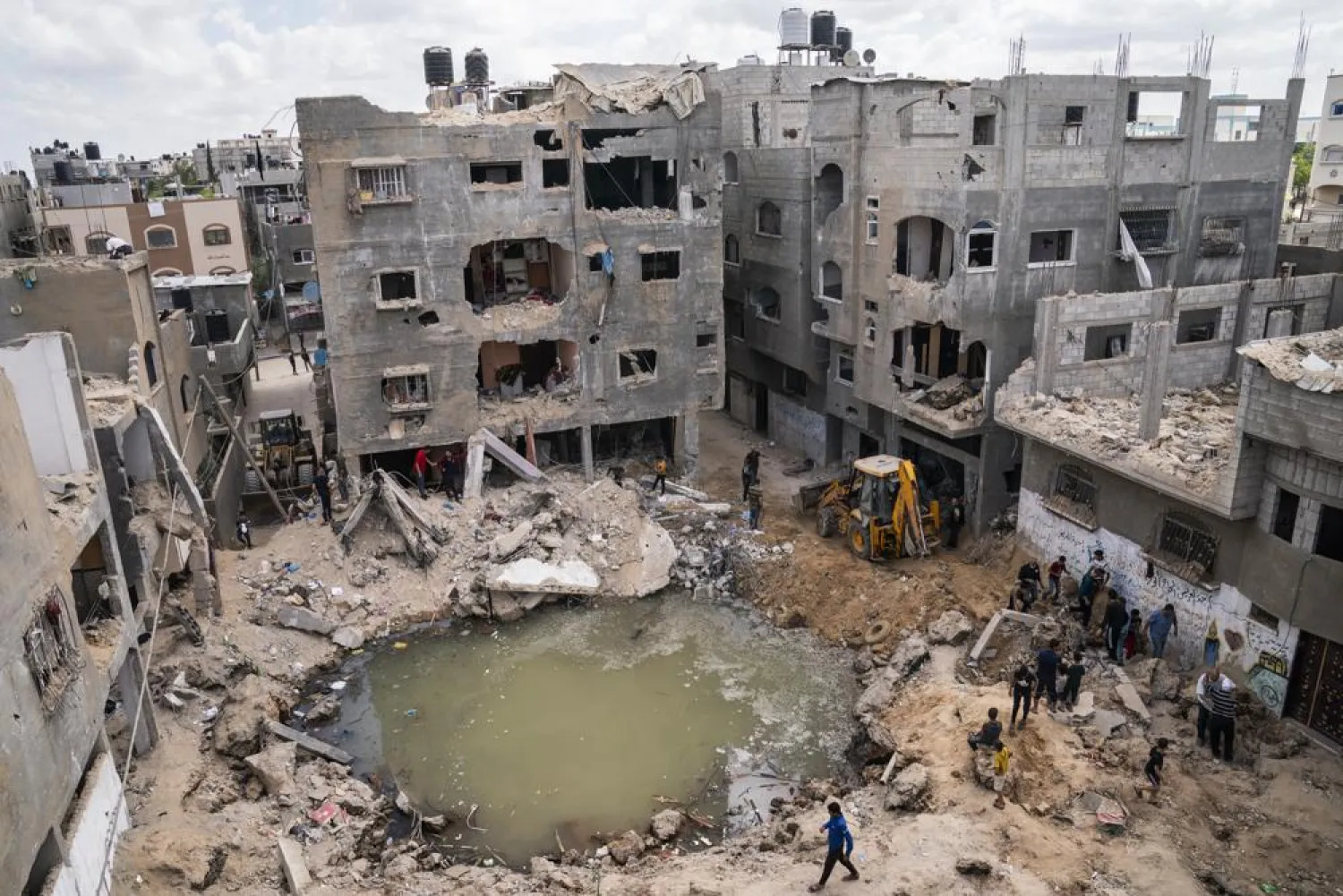
A crater full of water and sewage remains where the home of Ramez al-Masri was destroyed by an air-strike prior to a cease-fire reached after an 11-day war between Gaza's Hamas rulers and Israel, Sunday, May 23, 2021, in Beit Hanoun, the northern Gaza Strip. (AP Photo/John Minchillo)
TT

After Another War, Displaced in Gaza Face Familiar Plight

A crater full of water and sewage remains where the home of Ramez al-Masri was destroyed by an air-strike prior to a cease-fire reached after an 11-day war between Gaza's Hamas rulers and Israel, Sunday, May 23, 2021, in Beit Hanoun, the northern Gaza Strip. (AP Photo/John Minchillo)

It took Ramez al-Masri three years to rebuild his home after it was destroyed in a 2014 Israeli offensive. When war returned to the area last week, it took just a few seconds for the house to be flattened again in an Israeli airstrike.

The despondent al-Masri once again finds himself among the thousands of Gazans left homeless by another war between Israel and the territory’s Islamic militant Hamas rulers. He and the 16 others who lived in the two-story structure are scattered at relatives’ homes, uncertain how long they will remain displaced as they wait with hope for international aid to help them rebuild the home.

“My children are scattered — two there, three here, one there. Things are really very difficult,” he said.

“We live in death every day as long as there is an occupation,” he said, referring to Israel’s rule over Palestinians, including its blockade of Gaza, The Associated Press reported.

The United Nations estimates that about 1,000 homes were destroyed in the 11-day war that ended last Friday. Lynn Hastings, the UN humanitarian coordinator for the region, said hundreds of additional housing units were damaged so badly they are likely uninhabitable.

The destruction is less extensive than in the 50-day war of 2014, in which entire neighborhoods were reduced to rubble and 141,000 homes were either wiped out or damaged.

But following that war, international donors quickly pledged $2.7 billion in reconstruction assistance for the battered enclave. It remains unclear this time around whether the international community, fatigued from the global COVID-19 crisis and years of unsuccessful Mideast diplomacy, will be ready to open its wallet again.

It was 3 a.m. on Wednesday when the phone call from Israel came to a neighbor ordering everyone in the area to evacuate. “Leave your homes, we are going to bomb,” al-Masri says they were told.

The neighborhood is home to members of al-Masri’s extended family. At the time of the warning, he said no one knew which house might be targeted. But he could not believe that the airstrike hit the two-floor home where he lived with his eight children, his brother’s family and their mother.

“If we knew someone was wanted, we would not have stayed here from the outset,” he said. Al-Masri, who owns a small grocery store, said neither he nor his brother have anything to do with militant groups.

The airstrike turned his home into a crater. On Sunday, the massive hole was filled with murky water spewing from broken water and sewage lines.

Seven adjacent homes belonging to relatives were badly damaged. Their walls were blown up, exposing the colorful interior decorations of the living and bedrooms. The blast was so powerful that concrete support beams were weakened and the houses are likely beyond repair.

On Sunday, a mobile pump was deployed to suck the stinky water out as bulldozers worked to reopen streets. City workers were removing damaged power lines. But much of the rubble remained uncleared.

After the 2014 war, al-Masri bounced around between rental homes and “caravans” — small metal huts that dotted hard-hit areas of Gaza like shantytowns. He dreads the thought of returning to the temporary shelters.

“Life was disastrous in the caravans. We were living between two sheets of tin,” he said.

He said he hopes the international community “will stand by us, try to help us so we can rebuild quickly.”

The Israeli military did not immediately respond to a request seeking comment on why the home had been targeted.

Throughout the fighting, it accused Hamas of using residential areas as cover for rocket launches and other militant activity. The army says its system of warnings and evacuation orders is meant to prevent civilians from being harmed.

During the recent fighting, Israel unleashed hundreds of airstrikes across Gaza at what it said were militant targets. Hamas and other armed groups fired more than 4,000 rockets toward Israeli cities, most of which were intercepted or landed in open areas.

The fighting began May 10, when Hamas militants in Gaza fired long-range rockets toward Jerusalem. The barrage came after days of clashes between Palestinian protesters and Israeli police at Al-Aqsa. Heavy-handed police tactics at the compound and the threatened eviction of dozens of Palestinian families by Jewish settlers had inflamed tensions.

The true costs of the war will not be known for some time. Palestinian health officials said 248 Palestinians, including 66 children and 39 women, were killed in the fighting.

Twelve people in Israel, including two children, also died in the fighting.

On Sunday morning, hundreds of municipal workers and volunteers started a one-week campaign to clear rubble from Gaza City’s streets.

Outside a flattened high-rise building, workers loaded rubble into donkey carts and small pickup trucks. Next to a destroyed government building, children collected cables and whatever recyclable leftovers they could sell for a few shekels.

In Beit Hanoun, one of the homes that was struck last week belonged to Nader al-Masri, Ramez’s cousin and a long-distance runner who participated in dozens of international competitions. Since he lost his house in the 2014 war, Nader, 41, has lived in the second of floor of a three-floor home belonging to relatives.

The third and the first floors sustained heavy hits. A room filled with medals and trophies that Nader collected through his 20-year career was damaged. Fortunately, he said, many of his mementos survived.

Nader al-Masri is familiar with loss. Beit Hanoun, situated just along the frontier with Israel, has frequently been the scene of heavy fighting, and his home has been damaged two previous times.

“I had over 150 trophies. In each of the previous wars, I lost one or two or three,” he said. Some 20 glass awards have been shattered over the years. “Each war the number drops,” he said, showing a medal from the 2008 Beijing Summer Olympics.

Nader, now a coach with the Palestinian Athletics Federation, moved his five children to their uncle’s house.

“I’m an athlete and have nothing to do with politics,” he said. “Things are difficult because we cannot build a home every day.”



What to Know about the Protests Shaking Iran as Govt Shuts Down Internet and Phone Networks

Mourners carry coffins during a funeral procession for members of security forces and civilians said to be killed in protests on Sunday, amid evolving anti-government unrest, in Tehran, Iran, in this screengrab from a video released on January 11, 2026.  IRIB/Handout via REUTERS
Mourners carry coffins during a funeral procession for members of security forces and civilians said to be killed in protests on Sunday, amid evolving anti-government unrest, in Tehran, Iran, in this screengrab from a video released on January 11, 2026. IRIB/Handout via REUTERS
TT

What to Know about the Protests Shaking Iran as Govt Shuts Down Internet and Phone Networks

Mourners carry coffins during a funeral procession for members of security forces and civilians said to be killed in protests on Sunday, amid evolving anti-government unrest, in Tehran, Iran, in this screengrab from a video released on January 11, 2026.  IRIB/Handout via REUTERS
Mourners carry coffins during a funeral procession for members of security forces and civilians said to be killed in protests on Sunday, amid evolving anti-government unrest, in Tehran, Iran, in this screengrab from a video released on January 11, 2026. IRIB/Handout via REUTERS

Nationwide protests in Iran sparked by the country’s ailing economy are putting new pressure on its theocracy as it has shut down the internet and telephone networks.

Tehran is still reeling from a 12-day war launched by Israel in June that saw the United States bomb nuclear sites in Iran. Economic pressure, which has intensified since September when the United Nations reimposed sanctions on the country over its atomic program, has sent Iran's rial currency into a free fall, now trading at over 1.4 million to $1.

Meanwhile, Iran's self-described “Axis of Resistance” — a coalition of countries and militant groups backed by Tehran — has been decimated since the start of the Israel-Hamas war in 2023.

A threat by US President Donald Trump warning Iran that if Tehran “violently kills peaceful protesters” the US “will come to their rescue," has taken on new meaning after American troops captured Venezuela's Nicolás Maduro, a longtime ally of Tehran.

“We're watching it very closely,” Trump has warned. “If they start killing people like they have in the past, I think they're going to get hit very hard by the United States.”

Here's what to know about the protests and the challenges facing Iran's government.

How widespread the protests are

More than 500 protests have taken place across all of Iran’s 31 provinces, the US-based Human Rights Activists News Agency reported early Monday. The death toll had reached at least 544, it said, with more than 10,600 arrests. The group relies on an activist network inside of Iran for its reporting and has been accurate in past unrest.

The Iranian government has not offered overall casualty figures for the demonstrations. The Associated Press has been unable to independently assess the toll, given that internet and international phone calls are now blocked in Iran.

Understanding the scale of the protests has been difficult. Iranian state media has provided little information about the demonstrations. Online videos offer only brief, shaky glimpses of people in the streets or the sound of gunfire. Journalists in general in Iran also face limits on reporting such as requiring permission to travel around the country, as well as the threat of harassment or arrest by authorities. The internet shutdown has further complicated the situation.

But the protests do not appear to be stopping, even after Supreme Leader Ali Khamenei said “rioters must be put in their place.”

Why the demonstrations started

The collapse of the rial has led to a widening economic crisis in Iran. Prices are up on meat, rice and other staples of the Iranian dinner table. The nation has been struggling with an annual inflation rate of some 40%.

In December, Iran introduced a new pricing tier for its nationally subsidized gasoline, raising the price of some of the world’s cheapest gas and further pressuring the population. Tehran may seek steeper price increases in the future, as the government now will review prices every three months.

Meanwhile, food prizes are expected to spike after Iran’s Central Bank in recent days ended a preferential, subsidized dollar-rial exchange rate for all products except medicine and wheat.

The protests began in late December with merchants in Tehran before spreading. While initially focused on economic issues, the demonstrations soon saw protesters chanting anti-government statements as well. Anger has been simmering over the years, particularly after the 2022 death of 22-year-old Mahsa Amini in police custody that triggered nationwide demonstrations.

Some have chanted in support of Iran's exiled Crown Prince Reza Pahlavi, who called for protests Thursday and Friday night.

Iran's alliances are weakened

Iran's “Axis of Resistance," which grew in prominence in the years after the 2003 US-led invasion and subsequent occupation of Iraq, is reeling.

Israel has crushed Hamas in the devastating war in the Gaza Strip. Hezbollah, the Shiite militant group in Lebanon, has seen its top leadership killed by Israel and has been struggling since. A lightning offensive in December 2024 overthrew Iran’s longtime stalwart ally and client in Syria, President Bashar Assad, after years of war there. Yemen's Iranian-backed Houthis also have been pounded by Israeli and US airstrikes.

China meanwhile has remained a major buyer of Iranian crude oil, but hasn't provided overt military support. Neither has Russia, which has relied on Iranian drones in its war on Ukraine.

The West worries about Iran’s nuclear program Iran has insisted for decades that its nuclear program is peaceful. However, its officials have increasingly threatened to pursue a nuclear weapon. Iran had been enriching uranium to near weapons-grade levels before the US attack in June, making it the only country in the world without a nuclear weapons program to do so.

Tehran also increasingly cut back its cooperation with the International Atomic Energy Agency, the UN's nuclear watchdog, as tensions increased over its nuclear program in recent years. The IAEA's director-general has warned Iran could build as many as 10 nuclear bombs, should it decide to weaponize its program.

US intelligence agencies have assessed that Iran has yet to begin a weapons program, but has “undertaken activities that better position it to produce a nuclear device, if it chooses to do so.”

Iran recently said it was no longer enriching uranium at any site in the country, trying to signal to the West that it remains open to potential negotiations over its atomic program to ease sanctions. But there's been no significant talks in the months since the June war.

Why relations between Iran and the US are so tense

Iran decades ago was one of the United States’ top allies in the Mideast under Shah Mohammad Reza Pahlavi, who purchased American military weapons and allowed CIA technicians to run secret listening posts monitoring the neighboring Soviet Union. The CIA fomented a 1953 coup that cemented the shah’s rule.

But in January 1979, the shah fled Iran as mass demonstrations swelled against his rule. Then came the Iranian Revolution led by Khomeini, which created Iran’s theocratic government.

Later that year, university students overran the US Embassy in Tehran, seeking the shah’s extradition and sparking the 444-day hostage crisis that saw diplomatic relations between Iran and the US severed.

During the Iran-Iraq war of the 1980s, the US backed Saddam Hussein. During that conflict, the US launched a one-day assault that crippled Iran at sea as part of the so-called “Tanker War,” and later shot down an Iranian commercial airliner that the US military said it mistook for a warplane.

Iran and the US have seesawed between enmity and grudging diplomacy in the years since. Relations peaked with the 2015 nuclear deal, which saw Iran greatly limit its program in exchange for the lifting of sanctions. But Trump unilaterally withdrew America from the accord in 2018, sparking tensions in the Mideast that intensified after Hamas' Oct. 7, 2023, attack on Israel.


How the US Could Take Over Greenland and the Potential Challenges

05 February 2025, Greenland, Nuuk: Greenlandic flags fly in front of the Inatsisartut parliament in the capital Nuuk. (dpa)
TT

How the US Could Take Over Greenland and the Potential Challenges

05 February 2025, Greenland, Nuuk: Greenlandic flags fly in front of the Inatsisartut parliament in the capital Nuuk. (dpa)

US President Donald Trump wants to own Greenland. He has repeatedly said the United States must take control of the strategically located and mineral-rich island, which is a semiautonomous region that's part of NATO ally Denmark.

Officials from Denmark, Greenland and the United States met Thursday in Washington and will meet again next week to discuss a renewed push by the White House, which is considering a range of options, including using military force, to acquire the island.

Trump said Friday he is going to do “something on Greenland, whether they like it or not.”

If it's not done “the easy way, we're going to do it the hard way," he said without elaborating what that could entail. In an interview Thursday, he told The New York Times that he wants to own Greenland because “ownership gives you things and elements that you can’t get from just signing a document.”

Danish Prime Minister Mette Frederiksen has warned that an American takeover of Greenland would mark the end of NATO, and Greenlanders say they don't want to become part of the US.

This is a look at some of the ways the US could take control of Greenland and the potential challenges.

Military action could alter global relations

Trump and his officials have indicated they want to control Greenland to enhance American security and explore business and mining deals. But Imran Bayoumi, an associate director at the Atlantic Council’s Scowcroft Center for Strategy and Security, said the sudden focus on Greenland is also the result of decades of neglect by several US presidents towards Washington's position in the Arctic.

The current fixation is partly down to “the realization we need to increase our presence in the Arctic, and we don’t yet have the right strategy or vision to do so,” he said.

If the US took control of Greenland by force, it would plunge NATO into a crisis, possibly an existential one.

While Greenland is the largest island in the world, it has a population of around 57,000 and doesn't have its own military. Defense is provided by Denmark, whose military is dwarfed by that of the US.

It's unclear how the remaining members of NATO would respond if the US decided to forcibly take control of the island or if they would come to Denmark's aid.

“If the United States chooses to attack another NATO country militarily, then everything stops,” Frederiksen has said.

Trump said he needs control of the island to guarantee American security, citing the threat from Russian and Chinese ships in the region, but “it's not true” said Lin Mortensgaard, an expert on the international politics of the Arctic at the Danish Institute for International Studies, or DIIS.

While there are probably Russian submarines — as there are across the Arctic region — there are no surface vessels, Mortensgaard said. China has research vessels in the Central Arctic Ocean, and while the Chinese and Russian militaries have done joint military exercises in the Arctic, they have taken place closer to Alaska, she said.

Bayoumi, of the Atlantic Council, said he doubted Trump would take control of Greenland by force because it’s unpopular with both Democratic and Republican lawmakers, and would likely “fundamentally alter” US relationships with allies worldwide.

The US already has access to Greenland under a 1951 defense agreement, and Denmark and Greenland would be “quite happy” to accommodate a beefed-up American military presence, Mortensgaard said.

For that reason, “blowing up the NATO alliance” for something Trump has already, doesn’t make sense, said Ulrik Pram Gad, an expert on Greenland at DIIS.

Bilateral agreements may assist effort

US Secretary of State Marco Rubio told a select group of US lawmakers this week that it was the Republican administration’s intention to eventually purchase Greenland, as opposed to using military force. Danish and Greenlandic officials have previously said the island isn't for sale.

It's not clear how much buying the island could cost, or if the US would be buying it from Denmark or Greenland.

Washington also could boost its military presence in Greenland “through cooperation and diplomacy,” without taking it over, Bayoumi said.

One option could be for the US to get a veto over security decisions made by the Greenlandic government, as it has in islands in the Pacific Ocean, Gad said.

Palau, Micronesia and the Marshall Islands have a Compact of Free Association, or COFA, with the US.

That would give Washington the right to operate military bases and make decisions about the islands’ security in exchange for US security guarantees and around $7 billion of yearly economic assistance, according to the Congressional Research Service.

It's not clear how much that would improve upon Washington's current security strategy. The US already operates the remote Pituffik Space Base in northwestern Greenland and can bring as many troops as it wants under existing agreements.

Influence operations expected to fail

Greenlandic politician Aaja Chemnitz told The Associated Press that Greenlanders want more rights, including independence, but don't want to become part of the US.

Gad suggested influence operations to persuade Greenlanders to join the US would likely fail. He said that is because the community on the island is small and the language is “inaccessible.”

Danish Foreign Minister Lars Løkke Rasmussen summoned the top US official in Denmark in August to complain that “foreign actors” were seeking to influence the country’s future. Danish media reported that at least three people with connections to Trump carried out covert influence operations in Greenland.

Even if the US managed to take control of Greenland, it would likely come with a large bill, Gad said. That’s because Greenlanders currently have Danish citizenship and access to the Danish welfare system, including free health care and schooling.

To match that, “Trump would have to build a welfare state for Greenlanders that he doesn’t want for his own citizens,” Gad said.

Disagreement unlikely to be resolved

Since 1945, the American military presence in Greenland has decreased from thousands of soldiers over 17 bases and installations to 200 at the remote Pituffik Space Base in the northwest of the island, Rasmussen said last year. The base supports missile warning, missile defense and space surveillance operations for the US and NATO.

US Vice President JD Vance told Fox News on Thursday that Denmark has neglected its missile defense obligations in Greenland, but Mortensgaard said that it makes “little sense to criticize Denmark,” because the main reason why the US operates the Pituffik base in the north of the island is to provide early detection of missiles.

The best outcome for Denmark would be to update the defense agreement, which allows the US to have a military presence on the island and have Trump sign it with a “gold-plated signature,” Gad said.

But he suggested that's unlikely because Greenland is “handy” to the US president.

When Trump wants to change the news agenda — including distracting from domestic political problems — “he can just say the word ‘Greenland’ and this starts all over again,” Gad said.


US Stance on Iran Protests Balances Threats, Caution

Crowds of Iranian protesters gather in Taleghani Square in Karaj, west of Tehran. (Telegram)
TT

US Stance on Iran Protests Balances Threats, Caution

Crowds of Iranian protesters gather in Taleghani Square in Karaj, west of Tehran. (Telegram)

It may still be premature to say Iran’s ruling system is nearing collapse. Yet the unrest that has gripped the country in recent weeks has pushed Tehran into its most severe internal crisis in years.

Protests triggered by economic freefall and the collapse of the national currency have rapidly spread across regions and social classes, shedding their purely economic character and evolving into a direct challenge to the foundations of the political system.

As strikes have expanded, particularly in the bazaar and the oil sector, popular anger has deepened into a political crisis with existential stakes.

At the heart of these developments, the United States factor stands out as one of the most sensitive and influential elements, not only because of the long history of conflict between Washington and Tehran, but also due to the unprecedented tone adopted by US President Donald Trump, and the political and media reaction within Congress, which has reflected a calibrated division over how to approach the Iranian crisis.

From the early days of the escalating protests, Trump opted to depart from traditional diplomatic language. In a series of interviews and statements, he said he was following events in Iran “very closely,” expressing his belief that the country was “on the verge of collapse.”

More significant than his assessment, however, were his public warnings to the Iranian leadership against continuing to suppress protesters.

Trump spoke bluntly of live fire against unarmed demonstrators, arrests, and executions, describing the situation as “brutal behavior,” and stressing that he had informed Tehran that any bloody escalation would be met with “very severe strikes” from the United States.

This language amounts to an attempt at political and psychological deterrence rather than a declaration of an imminent military plan.

It pressures Iran’s leadership and sends a message of moral support to protesters, while simultaneously preserving ambiguity over the nature of any potential US action.

Vice President JD Vance expressed a similar stance, writing on X that Washington supports anyone exercising their right to peaceful protest, noting that Iran’s system suffers from deep problems.

He reiterated Trump’s call for “real negotiations” over the nuclear program, while leaving future steps to the president’s judgment.

Despite Trump’s clear support for the protests, his administration has so far avoided going further on the question of “the day after.”

This hesitation has been evident in its position on Reza Pahlavi, the son of Iran’s late shah, whose name has resurfaced as a figure of the exiled opposition.

While Trump described him as “a nice person,” he stopped short of holding an official meeting, saying it was still too early to determine who could genuinely represent the will of the Iranian people.

This caution reflects US awareness of the sensitivity of the Iranian scene, in light of past experiences in the region, from Iraq to Libya, where early bets on political alternatives led to disastrous outcomes.

Any overt US backing of a specific opposition figure could also give the Iranian authorities grounds to reinforce their narrative of a “foreign conspiracy,” a line already invoked by Supreme Leader Ali Khamenei and state media.

Alongside political rhetoric, the economic card occupies a central place in US calculations.

Treasury Secretary Scott Bessent has described Iran’s economy as on the edge of collapse, pointing to high inflation and a sharp erosion in living standards due to sanctions and mismanagement.

These remarks were not merely technical assessments, but a political message that Washington sees the economic crisis as a pressure point that could accelerate the erosion of the system’s ability to endure.

The economy is not only the spark that ignited the protests, but also one of the keys to their future. Continued strikes, particularly in the oil sector, threaten the main artery of state revenues, compounding pressure and narrowing room for maneuver.

In this context, Washington appears convinced that time is working against Tehran and that allowing the crisis to play out internally may be more effective than any direct intervention.

Another factor closely watched by US decision-makers is the international stance, notably the silence of Russia and China.

These two countries, which have provided Iran with political and economic cover in recent years, appear unwilling or unable to intervene to rescue the system from its internal crisis.

Their silence gives Washington a wider scope to escalate its rhetoric without fear of a major international confrontation.

At the same time, the US administration is keen to avoid appearing as the driver of regime change in Iran. Its declared support remains confined to an ethical and humanitarian framework, protecting protesters and preventing massacres, rather than shaping an alternative system.

This approach seeks to strike a balance between exploiting an adversary’s weakness and avoiding a slide into chaos.

The US response has not been limited to the White House, extending into Congress, where positions have reflected a disciplined division of opinion. The House Foreign Affairs Committee attacked the Iranian system in a post on X, describing it as a dictator that has stood for decades on the bodies of Iranians demanding change.

Within the Republican camp, alignment behind Trump has been clear.

Senator Lindsey Graham wrote that the president was “absolutely right,” that he “stands with the Iranian people against tyranny,” and called to “make Iran great again.”

Senator Ted Cruz said the protests had exposed the system’s “fatally weakened” status and that Iranians were “not chanting for cosmetic reforms, but for an end to clerical rule.”

Democrats, by contrast, expressed solidarity with protesters in a more cautious tone.

Senator Chris Murphy said Iranians deserve their future in their own hands, not through American bombs, warning that military intervention could undermine the movement.

Bernie Sanders said the United States should stand with human rights, not repeat the mistakes of forcibly changing regimes.

In the House, Representative Yassamin Ansari sparked further debate by voicing support for the Iranian people while warning against empowering the Mujahideen-e-Khalq, which she described as “an extremist group lacking legitimacy.”

Republican lawmakers such as Claudia Tenney and Mario Diaz-Balart adopted a harsher tone, calling for clear support for Iranians, “who are bravely demanding freedom, dignity, and basic human rights.”

This divergence reflects a complex US picture. Republicans see the Iranian moment as an opportunity to validate Trump’s pressure and deterrence strategy, while Democrats fear that verbal support could slide into ill-considered entanglement.

Yet both sides converge on a core point: holding Iran’s system responsible for violence and economic collapse and viewing current events as an unprecedented challenge to its legitimacy.

This relative alignment grants Trump room to maneuver domestically without imposing consensus on intervention.

Washington, as reflected in White House rhetoric and congressional debate, prefers at this stage to watch the fractures within Iran deepen, while keeping all options on the table and awaiting what happens on the streets.