

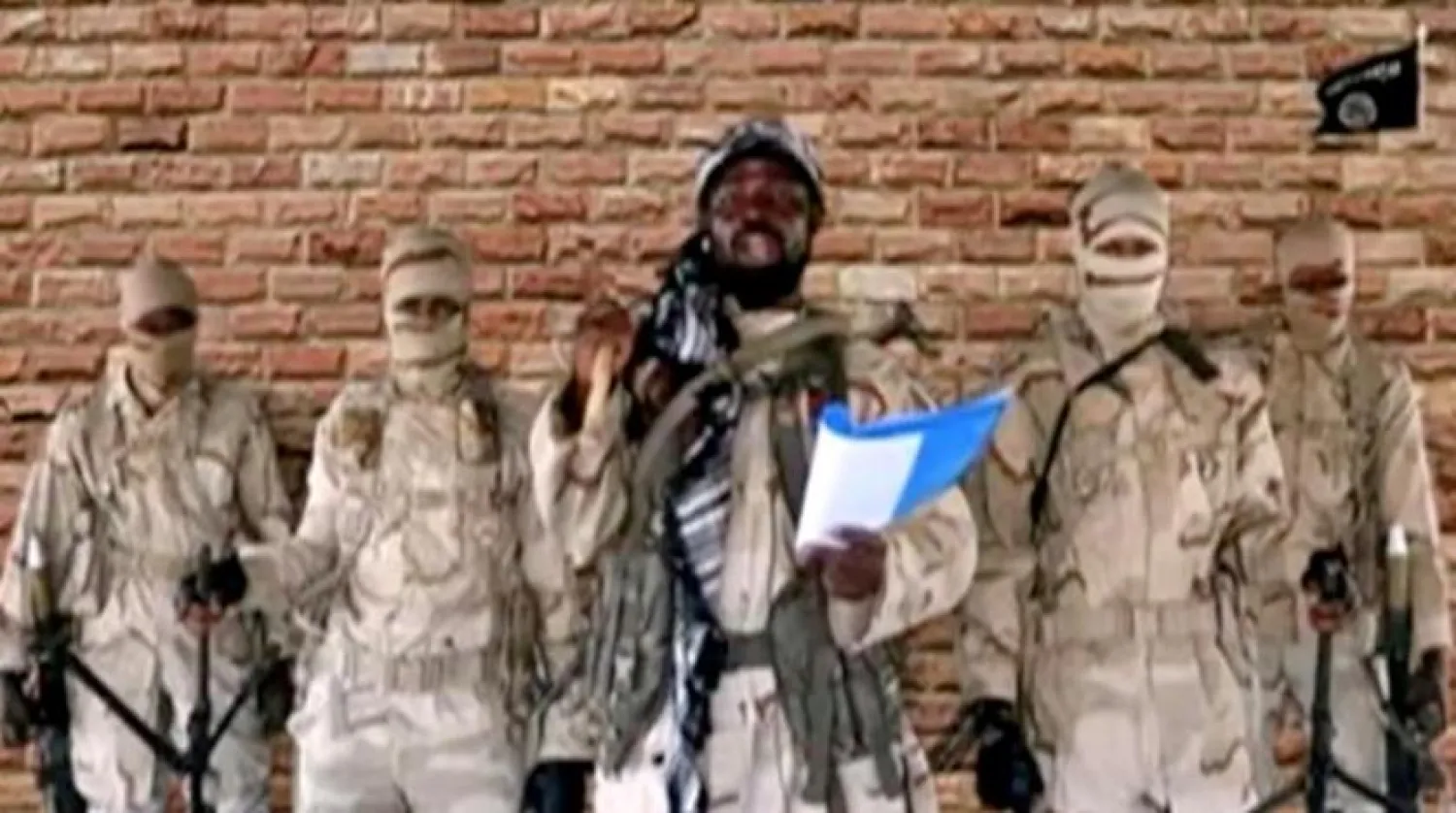

Boko Haram Leader 'Kills Self' in Fight with Rivals

Boko Haram leader Abubakar Shekau. Reuters
TT

Boko Haram Leader 'Kills Self' in Fight with Rivals

Boko Haram leader Abubakar Shekau. Reuters

Boko Haram's leader Abubakar Shekau killed himself in a fight against rival militants from ISIS West Africa Province (ISWAP) according to audio AFP obtained from the group Sunday, two weeks after reports emerged that he had died.

His death marks a major shift in Nigeria's 12-year-old insurgency that has killed more than 40,000 people and displaced around two million in the northeast.

Boko Haram has not yet officially commented on the death of their leader while the Nigerian army said it was investigating the claim.

Shekau “killed himself instantly by detonating an explosive," said a voice resembling that of ISWAP leader Abu Musab Al-Barnawi, speaking in the Kanuri language.

The audio, which was not dated, was given to AFP by the same source who conveyed previous messages from the group.

ISWAP described in the audio how it sent fighters to Boko Haram's enclave in the Sambisa forest, that they found Shekau sitting inside his house and engaged him in a firefight.

"From there he retreated and escaped, ran and roamed the bushes for five days. However, the fighters kept searching and hunting for him before they were able to locate him," the voice said.

After finding him in the bush, ISWAP fighters urged him and his followers to repent, the voice added, but Shekau refused and killed himself.

"We are so happy," the voice said, describing Shekau as "the big troublemaker, persecutor and destructive leader of the nation."

ISWAP split from Boko Haram in 2016, objecting to Shekau's indiscriminate targeting of Muslim civilians and use of women suicide bombers.

"This was someone who committed unimaginable terrorism and atrocities. For how long has he been leading people astray? How many times has he destroyed and abused people?" the voice said.

In the past two years, ISWAP emerged as the more dominant force in the region, carrying out large-scale attacks against the Nigerian military.

As the group now looks to absorb Shekau's fighters and territory, Nigeria's army potentially faces a more unified militant force, analysts say.

But ISWAP may also struggle to control or persuade Boko Haram factions loyal to Shekau outside Sambisa, especially in border areas.

"It may not be over yet," one security source said. "ISWAP will have to subdue or convince these camps to coalesce (them) into its fold to fully consolidate its control."

Militant infighting may present opportunities for Nigeria's army to seize.

But should ISWAP absorb part of Shekau's men and weapons, it might be in a position to cut off roads to and from the Borno state capital Maiduguri, said Peccavi Consulting, a risk group specializing in Africa.

"If ISWAP convinces Shekau's forces to join them, they will be controlling the majority of the enemy forces as well as having a presence in most of the ungoverned spaces in the northeast," it said in a note.

Since 2019, Nigeria's army has pulled out of villages and smaller bases to hunker down in so-called "supercamps", a strategy critics say allows militants to roam free in rural areas.

Following its takeover of Sambisa, ISWAP sent messages to locals in the Lake Chad region, telling them they were welcome to its self-declared "caliphate", said Sallau Arzika, a fisherman from Baga.

Locals were chased out of the lake islands after ISWAP accused them of spying for the military. Al-Barnawi said they could now return for fishing and trading after paying tax, with the assurance they would not be harmed, Arzika said.


Russia: Man Suspected of Shooting Top General Detained in Dubai

An investigator works outside a residential building where the assassination attempt on Russian Lieutenant General Vladimir Alexeyev took place in Moscow, Russia February 6, 2026. REUTERS/Anastasia Barashkova
TT

Russia: Man Suspected of Shooting Top General Detained in Dubai

An investigator works outside a residential building where the assassination attempt on Russian Lieutenant General Vladimir Alexeyev took place in Moscow, Russia February 6, 2026. REUTERS/Anastasia Barashkova

Russia's Federal Security Service (FSB) said on Sunday that the man suspected of shooting top Russian military intelligence officer Vladimir Alexeyev in Moscow has been detained in Dubai and handed over to Russia.

Lieutenant General Vladimir Alexeyev, deputy head of the GRU, ⁠Russia's military intelligence arm, was shot several times in an apartment block in Moscow on Friday, investigators said. He underwent surgery after the shooting, Russian media ⁠said.

The FSB said a Russian citizen named Lyubomir Korba was detained in Dubai on suspicion of carrying out the shooting.

Russian Foreign Minister Sergei Lavrov accused Ukraine of being behind the assassination attempt, which he said was designed to sabotage peace talks. ⁠Ukraine said it had nothing to do with the shooting.

Alexeyev's boss, Admiral Igor Kostyukov, the head of the GRU, has been leading Russia's delegation in negotiations with Ukraine in Abu Dhabi on security-related aspects of a potential peace deal.


Factory Explosion Kills 8 in Northern China

Employees work on an electric vehicle (EV) production line at the Volkswagen Anhui factory in Hefei, Anhui province, China, February 4, 2026. REUTERS/Florence Lo
TT

Factory Explosion Kills 8 in Northern China

Employees work on an electric vehicle (EV) production line at the Volkswagen Anhui factory in Hefei, Anhui province, China, February 4, 2026. REUTERS/Florence Lo

An explosion at a biotech factory in northern China has killed eight people, Chinese state media reported Sunday, increasing the total number of fatalities by one.

State news agency Xinhua had previously reported that seven people died and one person was missing after the Saturday morning explosion at the Jiapeng biotech company in Shanxi province, citing local authorities.

Later, Xinhua said eight were dead, adding that the firm's legal representative had been taken into custody.

The company is located in Shanyin County, about 400 kilometers west of Beijing, AFP reported.

Xinhua said clean-up operations were ongoing, noting that reporters observed dark yellow smoke emanating from the site of the explosion.

Authorities have established a team to investigate the cause of the blast, the report added.

Industrial accidents are common in China due to lax safety standards.
In late January, an explosion at a steel factory in the neighboring province of Inner Mongolia left at least nine people dead.


Iran Warns Will Not Give Up Enrichment Despite US War Threat

Traffic moves through a street in Tehran on February 7, 2026. (Photo by ATTA KENARE / AFP)
TT

Iran Warns Will Not Give Up Enrichment Despite US War Threat

Traffic moves through a street in Tehran on February 7, 2026. (Photo by ATTA KENARE / AFP)

Iran will never surrender the right to enrich uranium, even if war "is imposed on us,” its foreign minister said Sunday, defying pressure from Washington.

"Iran has paid a very heavy price for its peaceful nuclear program and for uranium enrichment," Abbas Araghchi told a forum in Tehran.

"Why do we insist so much on enrichment and refuse to give it up even if a war is imposed on us? Because no one has the right to dictate our behavior," he said, two days after he met US envoy Steve Witkoff in Oman.

The foreign minister also declared that his country was not intimidated by the US naval deployment in the Gulf.

"Their military deployment in the region does not scare us," Araghchi said.
