


Billionaire Richard Branson Reaches Space in his Own Ship

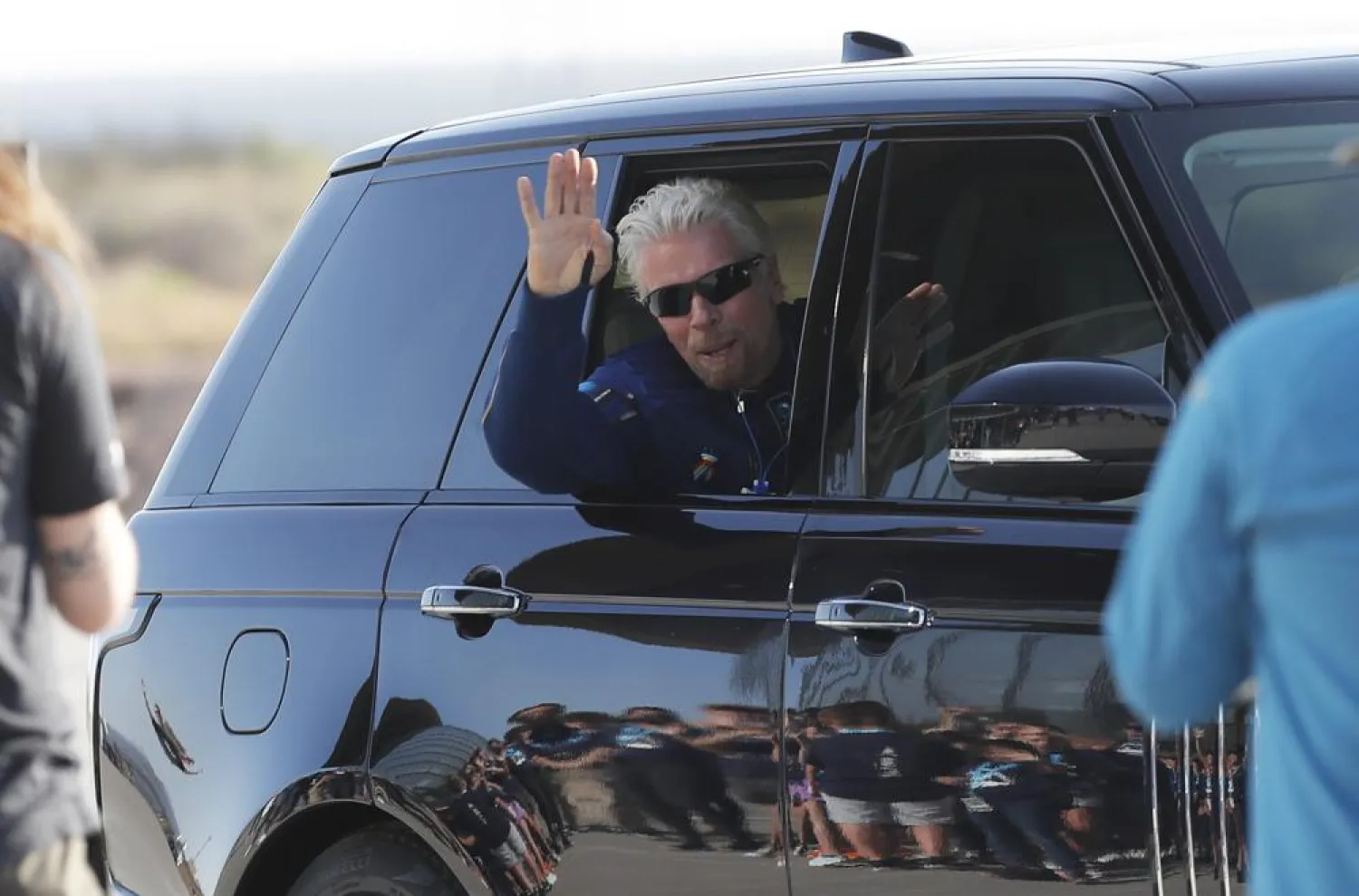
Richard Branson waves good bye while heading to board the rocket plane that will fly him to space from Spaceport America near Truth or Consequences, New Mexico, Sunday, July 11, 2021. (AP)
TT

Billionaire Richard Branson Reaches Space in his Own Ship

Richard Branson waves good bye while heading to board the rocket plane that will fly him to space from Spaceport America near Truth or Consequences, New Mexico, Sunday, July 11, 2021. (AP)

Swashbuckling entrepreneur Richard Branson hurtled into space aboard his own winged rocket ship Sunday in his boldest adventure yet, beating out fellow billionaire Jeff Bezos.

The nearly 71-year-old Branson and five crewmates from his Virgin Galactic space tourism company reached an altitude of about 53 miles (88 kilometers) over the New Mexico desert — enough to experience three to four minutes of weightlessness and see the curvature of the Earth — and then safely glided home to a runway landing.

“Seventeen years of hard work to get us this far,” a jubilant Branson said as he congratulated his team on the trip back aboard the sleek white space plane, named Unity.

He pumped both fists as he stepped out onto the runway and ran toward his family, bear-hugging his wife and children and scooping up his three grandchildren in his arms.

The brief, up-and-down flight — the rocket ship’s portion took only about 15 minutes, or about as long as Alan Shepard’s first US spaceflight in 1961 — was intended as a confidence-boosting plug for Virgin Galactic, which plans to start taking paying customers on joyrides next year.

Branson became the first person to blast off in his own spaceship, beating Bezos by nine days. He also became only the second septuagenarian to depart for space. (Astronaut John Glenn flew on the shuttle at age 77 in 1998.)

With about 500 people watching, including Branson’s family, a twin-fuselage aircraft with his space plane attached underneath took off in the first stage of the flight. The space plane then detached from the mother ship at an altitude of about 8 1/2 miles (13 kilometers) and fired its engine, reaching more than Mach 3, or three times the speed of sound, as it pierced the edge of space.

The crowd cheered and yelled as it touched down on the runway. Some spectators jumped into the air. Others embraced and shared hugs.

“That was an amazing accomplishment,” former Canadian astronaut Chris Hadfield, a one-time commander of the International Space Station, said from the sidelines. “I’m just so delighted at what this open door is going to lead to now. It’s a great moment.”

Virgin Galactic conducted three previous test flights into space with crews of just two or three.

The flamboyant, London-born founder of Virgin Atlantic Airways wasn’t supposed to fly until later this summer. But he assigned himself to an earlier flight after Bezos announced plans to ride his own rocket into space from Texas on July 20, the 52nd anniversary of the Apollo 11 moon landing. Branson denied he was trying to outdo Bezos.

Before climbing aboard, Branson, who has kite-surfed the English Channel and attempted to circle the world in a hot-air balloon, signed the astronaut log book and wisecracked: “The name’s Branson. Sir Richard Branson. Astronaut Double-oh one. License to thrill.”

One of Branson’s chief rivals in the space-tourism race among the world’s richest men, SpaceX’s Elon Musk, arrived in New Mexico to witness the flight, wishing Branson via Twitter, “Godspeed!”

Bezos likewise sent his wishes for a safe and successful flight, though he also took to Twitter to enumerate the ways in which be believes his company’s rides will be better.

Bezos’ Blue Origin company intends to send tourists past the so-called Karman line 62 miles (100 kilometers) above Earth, which is recognized by international aviation and aerospace federations as the threshold of space.

But NASA, the Air Force, the Federal Aviation Administration and some astrophysicists consider the boundary between the atmosphere and space to begin 50 miles (80 kilometers) up.

The risks to Branson and his crew were underscored in 2007, when a rocket motor test in California’s Mojave Desert left three workers dead, and in 2014, when a Virgin Galactic rocket plane broke apart during a test flight, killing one pilot and seriously injuring the other.

Ever the showman, Branson insisted on a global livestream of the Sunday morning flight and invited celebrities and former space station astronauts to the company’s Spaceport America base in New Mexico.

R&B singer Khalid performed his new single “New Normal” — a nod to the dawning of space tourism — while CBS “Late Show” host Stephen Colbert served as the event’s master of ceremonies.

Virgin Galactic already has more than 600 reservations from would-be space tourists, with tickets initially costing $250,000 apiece. Blue Origin is waiting for Bezos’ flight before announcing its ticket prices.

Kerianne Flynn, who signed up in 2011 to fly with Virgin Galactic, had butterflies ahead of the launch Sunday.

“I think there’s going to be nothing like going up there and looking back down on the Earth, which is what I think I’m most excited about,” she said. She added: “Hopefully the next generations will be able to explore what’s up there.”

Musk’s SpaceX, which is already launching astronauts to the International Space Station for NASA and is building moon and Mars ships, is also competing for space tourism dollars. But its capsules will do more than make brief, up-and-down forays; they will go into orbit around the Earth, with seats costing well into the millions. Its first private flight is set for September.

Musk himself has not committed to going into space anytime soon.

“It’s a whole new horizon out there, new opportunities, new destinations,” said former NASA astronaut Chris Ferguson, who commanded the last shuttle flight 10 years ago. He now works for Boeing, which is test-flying its own space capsule.

“This is really sort of like the advent of commercial air travel, only 100 years later,” Ferguson added. “There’s a lot waiting in the wings.”


WWI Soldier's Postcard from Home Helps Unite his Family after a Century

A poppy wreath and a photo next to the grave of Private Thomas Redvers Whitaker during a burial ceremony for six British soldiers of World War I, at the CWGC's Tyne Cot Cemetery in Zonnebeke, Belgium, Wednesday, June 10, 2026. (AP Photo/Virginia Mayo)
TT

WWI Soldier's Postcard from Home Helps Unite his Family after a Century

A poppy wreath and a photo next to the grave of Private Thomas Redvers Whitaker during a burial ceremony for six British soldiers of World War I, at the CWGC's Tyne Cot Cemetery in Zonnebeke, Belgium, Wednesday, June 10, 2026. (AP Photo/Virginia Mayo)

A postcard belonging to a World War I soldier whose body was found with five comrades during an excavation has helped reunite distant descendants more than a century after his death on the Western Front.

Dozens of mourners attended a memorial service in western Belgium on Wednesday during which six new white marble headstones were dedicated to the British soldiers whose remains were recently identified through the use of archival research and DNA analysis, The Associated Press reported.

The six burials at the Tyne Cot Cemetery included that of Pvt. Thomas Whitaker, who died in the trenches carrying a postcard from Bradford, in north east England, where some of his relations still live.

At the ceremony were three members of the Whitaker family. Under sunshine piercing the gray drizzle, Joe Whitaker, 22, read aloud a poem written in honor of his great-great-uncle: “At peace in foreign hills, he finally drifts away to sleep, his mind on Bradford mills.”

The soldier's postcard proved to be a crucial piece of evidence that helped British government researchers establish his identity and ultimately linked Joe's family with another, estranged, branch of the Whitaker family.

Joe said: “The thought that (Thomas) might have been thinking of home, comforted by this postcard that he kept on him from Bradford — we were all quite taken aback by that.”

He said writing a poem “felt like the right thing to do.”

Alexia Clark, a commemorations case worker at the UK Ministry of Defense’s Joint Casualty and Compassionate Centre (JCCC), said the six soldiers were found during an excavation in western Belgium. But the discovery of the postcard on one of them proved to be a crucial “hint.”

She added: “And then actually when we looked at the missing list and went, ‘Oh we have got one from Bradford! Great, there’s a strong chance that he is going to be one of them.‘”

By matching the postcard with other found artifacts, including a Lewis Gun and uniforms, the JCCC researchers — known as “the war detectives” -- were able to zero in on a likely group of men from the more than half a million British soldiers still missing from World War I.

The team contacted potential relatives for DNA samples, and the analysis confirmed the identity not only of Thomas Whitaker, but also privates Horace Frederick Cook, Frederick Martin, Charles Richard Russels, Courtney Darvill Hart and Joseph Turnley -- all members of 2/4 Battalion Queen’s Royal West Surrey Regiment.

Paul Turnley was presented with a British flag folded into a triangle given by the military in honor of the sacrifice of his relation, Pvt. Joseph Turnley.

“Just a privileged to be laying a relative of ours to rest, to watch, to be present and then to be passed the flag... it was the greatest treasure actually,” said Paul, in tribute to his grandfather’s cousin.

As nearby cows, students and bike riders watched along an adjacent farm road, a military musician played a martial lament on a cornet, while prayers were said by the Rev. Adéle Rees.

Then Pvt. Jone Wainile of the Princess of Wales’s Royal Regiment honor guard read the poignant Kohima Epitaph: “When you go home tell them of us and say, ‘For your tomorrow, we gave our today.’”

Paul Whitaker said: “My children, my grandchildren, anyone, can come and know where Thomas is, and that is a lovely thing to have. It’s just a real privilege to have Thomas be one of the ones that has been found.”


The Indian Workers Training AI Robots to Take their Jobs

Indian housewife Nagireddy Sriramyachandra wears a smartphone on her head as she records her actions through motion capture while slicing mangoes at her home in Chennai. R.Satish BABU / AFP
TT

The Indian Workers Training AI Robots to Take their Jobs

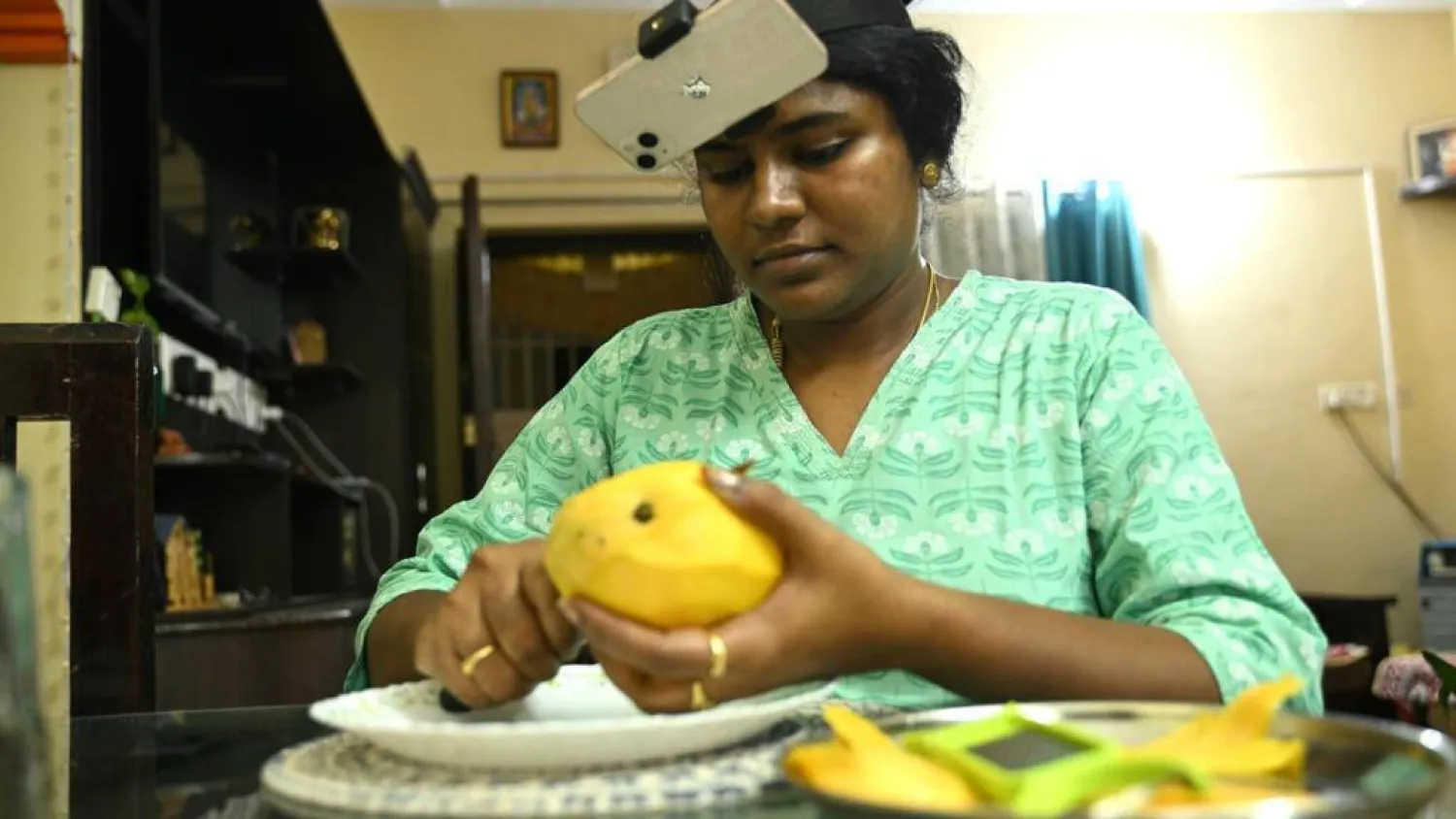
Indian housewife Nagireddy Sriramyachandra wears a smartphone on her head as she records her actions through motion capture while slicing mangoes at her home in Chennai. R.Satish BABU / AFP

With a smartphone strapped to her head, Indian housewife Nagireddy Sriramyachandra films herself slicing mangoes to train AI-powered robots to take on household jobs in the future.

Earning just over two dollars for an hour of video, her mundane recordings are invaluable for global tech companies teaching machines how to move like humans in the real world, said AFP.

The 25-year-old is one of a growing army of thousands of AI system trainers in the world's most populous country.

"Who else will give you 250 rupees an hour just for doing housework?" said Sriramyachandra from her kitchen in Chennai in southern India's Tamil Nadu state.

"I may get a robot myself in the future," she added.

Artificial intelligence chatbots and image generators crunch reams of digital data, but building systems to navigate real-life environments is more challenging.

Developers think feeding first-person footage, called "egocentric data", into specialized AI models will help robots copy humans.

Some AI trainers work at home, others in factories or specialized studios -- using video glasses, head-mounted cameras and motion sensors.

"It blares 'hands not detected' when I'm not recording properly," said Sriramyachandra, who sends recordings via a special app to the AI data company Objectways.

The firm, which has offices in India and the United States, lists Fortune 500 multinationals as clients. It works with Amazon SageMaker, a platform for machine learning models.

- 'Better things' -

The humanoid robot market is booming, with investment bank Morgan Stanley predicting there could be over a billion in use by 2050, mostly for industrial and commercial purposes.

"Folding clothes, coffee making... cooking a very specific thing, sandwich making," Objectways head Ravi Shankar said, listing videos requested by clients.

"Some jobs are supposed to be taken over, so humans can go and do better things."

In India, the emerging field of spatial AI is providing new employment -- for now.

The 50-year-old CEO is US-based, but hires workers from Tamil Nadu, where he grew up, one of India's international technology hubs.

At a Karur textile factory, busy with workers attaching labels to caps and ironing cloth bags, AFP saw eight people wearing head cameras and smart glasses supplied by Objectways.

India has positioned itself as a global middleman for the creation, processing and annotation of AI data.

"It's likely that these data collection services will increase", said digital labor expert Aditi Surie, from the Indian Institute for Human Settlements in Bengaluru.

- Informal workers -

India is aggressively developing its AI industry, but its leaders are aware that, alongside the technology's much-hyped benefits, automation poses risks.

Government think-tank NITI Aayog said that most discussions around artificial intelligence and labor "focus on white-collar professionals and predict an almost certain loss of jobs in the segment" without urgent action.

"Little attention, if any, is paid to how AI can serve India's 490 million informal workers, the very people who form the backbone of our economy," it said in a report released ahead of a global AI summit in India this year.

The think-tank has examined how the technology could help or harm dozens of professions -- from cobblers to sewer cleaners, farmers to tea sellers.

For the last decade, 55-year-old Ponni has sat on a roadside in Bengaluru, the city known as India's Silicon Valley, making flower garlands.

She, too, has been paid to have a phone strapped to her forehead.

"The next generation... who might have to do work similar to mine -- they will face a problem," Ponni said.

- Always wearing a camera -

At an Objectways studio, AI system trainers film themselves performing household tasks in fake, fully furnished apartment rooms.

After several thousand hours of filming, the wallpaper is changed to provide clients with variety.

"Today I sit here, tomorrow I stand there," said engineering graduate Rani N., 21, on a break from filming herself, once again, folding a towel.

Each video lasts about four minutes, and she records around 90 a day -- on nearly every conceivable spot on the bed.

She says the job is "tolerable", but feels like she's always wearing a camera.

In other rooms, colleagues arranged pencil sharpeners, water bottles and crayons in patterns, recording with depth-sensor cameras.

Qanat Consulting Services in Andhra Pradesh, an Objectways subcontractor, supplies about a dozen larger data firms with recordings.

Some of its 2,000 contributors perform tasks with motion-sensor bands on their "wrists, hands and legs", CEO Thaslim Pattan said.

Manish Agarwal of Bengaluru-based Humyn Labs, not related to Objectways, records conversations as well as videos.

Contributors discuss assigned topics -- ranging from politics to entertainment -- for clients wanting to process speech patterns.

Agarwal denies that robots will steal jobs, believing that networks of humans and robots "will work together" one day, he said.

"A welder in India could be managing a welder-robot in Prague," he said.


Scientists Warn of Record Heat, Threats to Climate Monitoring

FILE - Firefighters are silhouetted amid an operation to control the Sandy Fire, May 19, 2026, in Simi Valley, Calif. (AP Photo/Caroline Brehman, File)
TT

Scientists Warn of Record Heat, Threats to Climate Monitoring

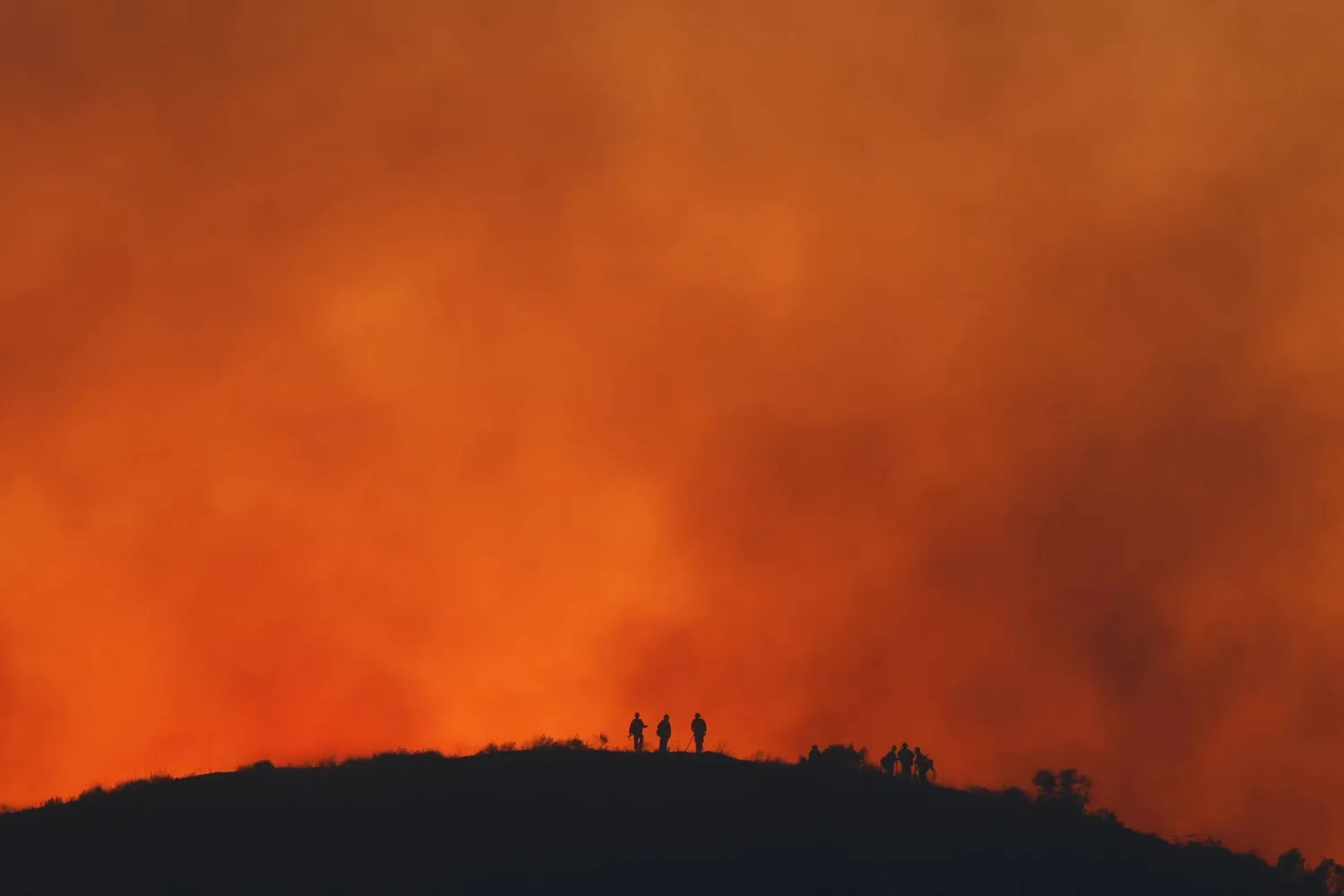
FILE - Firefighters are silhouetted amid an operation to control the Sandy Fire, May 19, 2026, in Simi Valley, Calif. (AP Photo/Caroline Brehman, File)

Planetary heating is intensifying and key climate indicators are deteriorating, top scientists said Thursday, warning that funding decisions affecting Earth observation systems in the United States and other countries threaten efforts to track global warming.

More than 70 scientists -- including contributors to the UN's Intergovernmental Panel on Climate Change (IPCC) -- raised the alarm over record human-induced warming and surging marine heatwaves in an annual study published between major IPCC assessments.

"These indicators represent an essential monitoring of the vitals of a patient exhibiting ever increasingly troubling symptoms," said Peter Thorne, a co-author and physical geography professor at Ireland's Maynooth University.

"They all rest upon a suite of global observation capabilities which are, for the first time in my lifetime, systematically either actively degrading or at risk," said Thorne, who is also deputy chair of the Global Climate Observing System (GCOS), a UN-backed Earth monitoring program.

Global temperatures reached about 1.39C above preindustrial levels in 2025, with nearly all of that warming -- 1.37C -- driven by human activities, according to the study published in the journal Earth System Science Data.

Human-induced warming will reach 1.5C in around 2030, the scientists warned, according to AFP.

Nations agreed under the 2015 Paris climate accord to limit warming to well below 2C -- and preferably 1.5C -- to avoid the worst consequences of climate change.

But the report found the world is accumulating heat at a rapid pace, worsening "Earth's energy imbalance" - the rate at which energy enters and leaves the planet.

"Without human influence, it should be close to zero, but it has been growing since the 1970s and is now at a record high, doubling in recent decades," said the study's lead author, Piers Forster, a physical climate change professor at the University of Leeds in Britain.

The high rate of warming is due to a combination of greenhouse gas emissions reaching an all-time high and the reduction of aerosol pollution, which has weakened a cooling effect as these particles reflect sunlight.

CO2 emissions, however, remain the main driver of global warming and are at a record high.

While scientists said emissions are slowing, the "carbon budget" -- the amount of CO2 that can still be emitted to keep warming under 1.5C -- could be exhausted in around three years.

"Given that greenhouse gas emissions are still on the rise, keeping global warming below this (1.5C) threshold now seems unachievable," said Aurelien Ribes, climate scientist at the French meteorological service.

The sea rose by around 23 cm between 1901 and 2025 -- and it is rising at a faster pace at 3.84 mm per year, due to melting land-based ice and through thermal expansion as the ocean warms.

The number of marine heatwave days -- a new indicator added to this year's report -- has more than tripled since 1991, reaching 65 on average in 2025.

Launched in 2023, the Indicators of Global Climate Change provides an annual update for policymakers on the state of the planet as climate change accelerates. The last IPCC assessment was finalized in 2023 and the next is due in 2028 or 2029.

The annual indicators report relies on around 40 global datasets which come from satellites and an array of land, sea and air instruments, including weather stations, ships, buoys and weather balloons.

But efforts to tackle climate change are increasingly overshadowed by wars in the Middle East and Ukraine, with governments facing a global energy crisis, budget constraints and a climate-sceptic President Donald Trump.

"Future monitoring of these indicators, such as ocean and satellite measurements of the Earth's energy imbalance, are threatened by geopolitical and public funding decisions," the report said.

It noted that funding for the UN's World Meteorological Organization has diminished while the GCOS "is also under threat.”

Several satellite programs are at risk, including in the United States.

The authors pointed to the recent decision by the Trump administration to remove hundreds of deep-sea instruments.

Such instruments are "incredibly critical" to understand how oceans absorb heat and how that affects weather patterns and ocean circulation, said Samantha Burgess, strategic lead for climate at the European Centre for Medium-Range Weather Forecasts (ECMWF).

"We really need these in-situ observations to continue monitoring the climate," she said.

The scientists also cited a decrease in on-site measurements in Africa, the west Pacific and South America.

Burgess said the plane that carries the atmospheric observing system in the UK was recently defunded.

"So it's not just one nation, unfortunately," she said.