


‘Step-for-Step’ Approach Aims to Appease Syrians or Kick Out Iran?

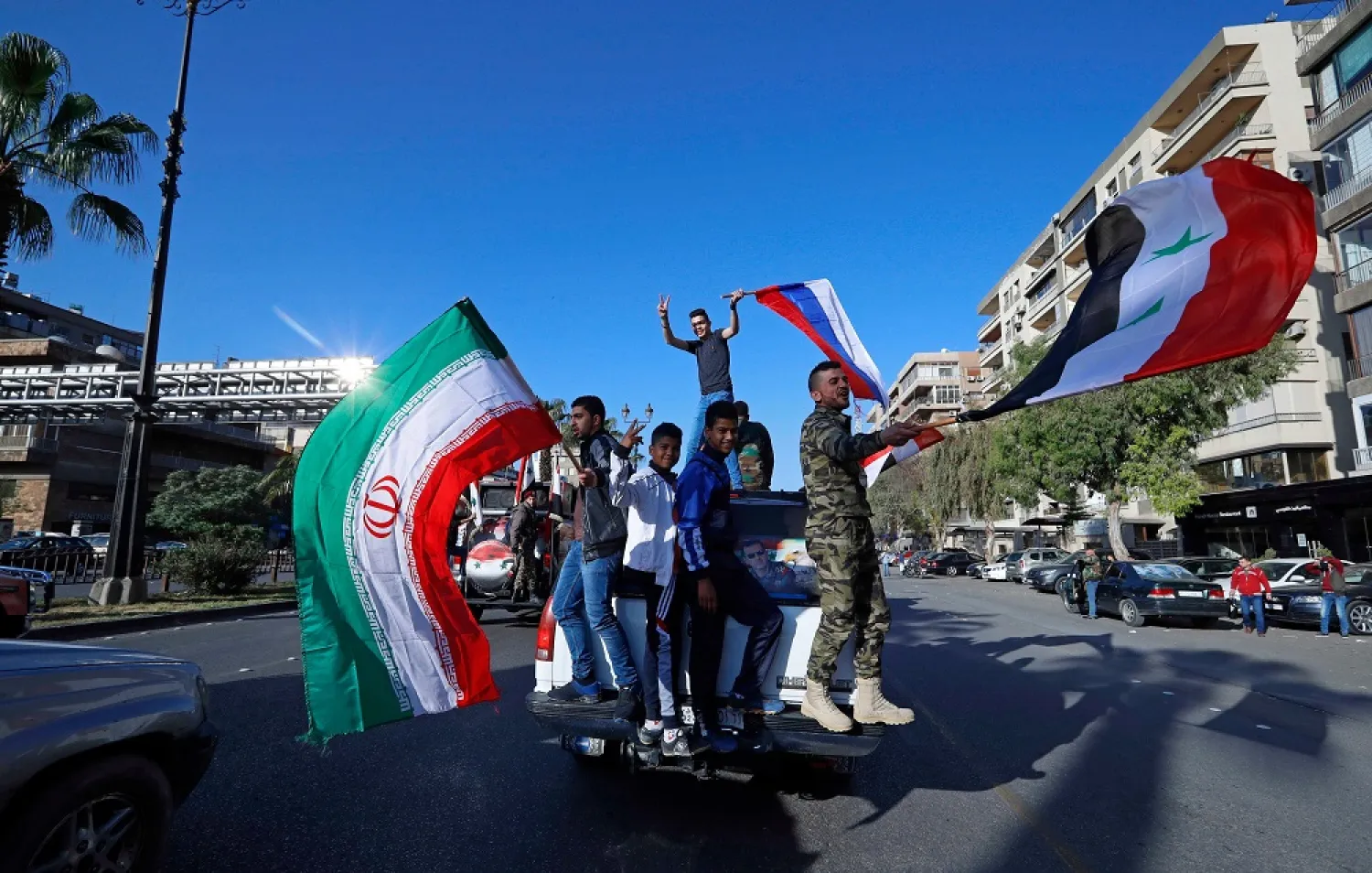
Hundreds of Syrians flash victory signs, honk car horns and wave Syrian, Iranian and Russian flags in Damascus, Syria, April 14, 2018. (AP)
TT

‘Step-for-Step’ Approach Aims to Appease Syrians or Kick Out Iran?

Hundreds of Syrians flash victory signs, honk car horns and wave Syrian, Iranian and Russian flags in Damascus, Syria, April 14, 2018. (AP)

The “humanitarian deal” struck between the aides of US President Joe Biden and Russian President Vladimir Putin on the extension of the cross-border aid resolution in Syria drew parallels with the “step-for-step” approach that was proposed by United Nations officials and mediators. The approach is based on reciprocity between what is “required” of Moscow and its partners and what is “offered” by Washington and its allies. Questions have arisen over the ultimate purpose of this approach: Does it appease the Syrians or ensure Iran’s withdrawal?

Reciprocity
Since the arrival of the Biden administration, experts and former officials have been floating the ideas and results they have reached over the years in behind-the-scenes negotiations between Syrian government and opposition representatives and influential countries.

Among those ideas was a paper by the Carter Center earlier this year that proposed a “phased approach” to resolving the crisis. Among its suggestions was relieving efforts to combat the coronavirus pandemic from sanctions, facilitating the reconstructions of civilian infrastructure, such as hospitals and schools, and the gradual easing of American and European sanctions. The condition was that none of these steps would be taken before concrete results over negotiated issues were felt on the ground.

Damascus, in return, is required to release political prisoners, secure the safe and dignified return of refugees, protect civilians, ensure unimpeded aid is delivered to all regions, destroy its remaining chemical weapons in line with a 2013 agreement, implement political and security reforms and adopt more decentralized governance.

These suggestions had fallen on deaf ears in recent months given that past experience has proven its failure. Undisclosed meetings were held between the Americans and Russians in Vienna and Geneva and openly between the Germans and French on the one hand and the Russians on the other. Moscow “did not offer anything” in return for these proposals. Detractors have meanwhile warned that such an approach signifies the beginning of normalization of relations with Damascus and lifting of sanctions with no concessions in return.

Who takes the first step?
Amid his declared efforts to activate the Constitutional Committee, UN envoy to Syria Geir Pedersen had always banked on two issues: Kicking off the “step-for-step” approach as soon as American-Russian understandings are reached and launching an international contact group that would include the US-led Small Group, Russia-led Astana Group and five permanent Security Council members.

Pedersen had carried out consultations to test whether the rival partis would accept these proposals. During the closed-door ministerial meeting on Syria in Rome on June 28, he presented a detailed vision of his proposal. Asharq Al-Awsat obtained a transcript of his remarks in which the envoy explained three reasons for making his proposal: The 15-month stalemate on frontlines, the economic collapse that has created new pressure and concerns and a new realization that no party can achieve military victory or impose a certain political status quo.

On that last point, he elaborated that the Syrian government cannot “dictate” the outcome of the conflict, neither can the opposition, Russians, Iranians, Americans, and the Astana and Small Groups.

Pedersen stressed that the government is required to change its behavior towards the Syrian people and for the sake of a comprehensive future for Syria. Notably, he did not demand regime change to achieve this goal.

He went on to say that the government has specific demands regarding foreign forces, sanctions and reconstruction. He revealed that meeting these demands comes at a cost, which is why he urged Damascus to clarify the type of reforms it can implement, especially if the other side also took concrete steps on the ground.

Other players
American-Russian cover is necessary to achieve any of the above, but there is also a conviction that support must be provided by other “players”. This in turn will pave the way for achieving the envoy’s proposal to form an international contact group on Syria.

The foreign ministers of major western countries that were meeting in Rome did not appear eager to meet these demands.

An official who took part in the meeting told Asharq Al-Awsat that London, Paris and Berlin were ready to consider new proposals to reach a political resolution and implement Security Council resolution 2254. At the same time, they do not want to relinquish three key elements - reconstructions, normalization and sanctions - in exchange for minor steps that can be easily retracted.

In other words, led by the US, these countries may accept some small steps, such as refraining from imposing new sanctions – an approach so far adopted by the Biden administration – and offering sanctions waivers related to humanitarian issues. Major steps, however, hinge on radical steps from the other side.

Washington still, however, refuses Iran’s participation. This stance is connected to broader regional issues beyond Syria. Moscow, for its part, is committed to the Astana Group, which includes Tehran and Ankara.

Notably, the “humanitarian deal” reached between the US and Russia at the Security Council has helped get the ball rolling. It has returned attention to proposals that have long been forgotten.

The question remains about the ultimate goal of all of these efforts: Is it aimed at going ahead with Moscow’s vision to support the “legitimate government” in Damascus in achieving its plan to return to the pre-2011 situation? Is it aimed at abandoning the demand for “regime change” and making do with a “flexible political solution to implement resolution 2254 under a nationwide political agreement”? Is it aimed at dividing power between the three zones of influence, which are backed by foreign players, under the guise of “decentralization”? Is the goal purely Syrian or geopolitical tied to five armies – Iran, Turkey, Israel, the US and Russia - deployed there?


Trump Keeps Talking About Iran’s ‘Nuclear Dust.’ What Is It?

A satellite imagery taken on February 1, 2026, shows a new roof over a previously destroyed building at Isfahan nuclear site, Iran. 2026 (PLANET LABS PBC/Handout via Reuters/ File photo)
TT

Trump Keeps Talking About Iran’s ‘Nuclear Dust.’ What Is It?

A satellite imagery taken on February 1, 2026, shows a new roof over a previously destroyed building at Isfahan nuclear site, Iran. 2026 (PLANET LABS PBC/Handout via Reuters/ File photo)

Luke Broadwater, David E. Sanger*

In recent weeks, US President Donald Trump has been talking about a substance he says is key to ending the United States’ war against Iran: “nuclear dust.”

In the president’s telling, Iran’s nuclear program was so badly damaged by US bombs last year that all that remains under the rubble is a sort of powdery aftermath.

The phrase “nuclear dust” seemed designed to diminish the importance of what Trump is actually talking about — Iran’s stockpile of near-bomb-grade uranium, which is stored in canisters about the size of large scuba tanks.

The material is not, in fact, “dust.” It is typically a gas when stored inside the canisters, though it becomes a solid at room temperature. It is a volatile and highly toxic substance if it comes into contact with moisture and, if mishandled, can trigger a nuclear reaction.

Trump’s phrase oversimplifies the complex tasks of enriching uranium, to say nothing of negotiating an end to the war. It’s also a phrase nuclear experts say they’ve never heard before.

“I just interpreted it as Trump’s kind of colorful way of talking,” said Matthew Kroenig, the senior director of the Atlantic Council’s Scowcroft Center for Strategy and Security, according to the New York Times.

Here’s a closer look at what Trump means when he talks about “nuclear dust,” and why it’s important for an end to the conflict.

What is ‘nuclear dust’?

Trump is referring chiefly to the uranium Iran has enriched to 60%, near the 90% purity normally used to make a bomb. There is no use for fuel enriched to that level for, say, producing nuclear power.

So it is a warning sign to the international community that Iran could quickly convert the fuel to bomb-grade, even though there would still be many steps to then build a nuclear bomb.

The United States struck three key nuclear sites in June 2025, including a complex outside Isfahan, where much of the near-bomb grade material was believed to be stored.

“It’s not yet bomb-grade, but it’s on the way there, and it was being stored on the nuclear facility at Isfahan,” Kroenig said.

“And so when Isfahan was bombed, that material was presumably entombed there,” he added.

American intelligence officials believe that the Iranians dug down to gain access to the material, though there is no evidence any of it has been moved.

Uranium contains a rare radioactive isotope, called U-235, that can be used to power nuclear reactors at low enrichment levels and to fuel nuclear bombs at much higher levels.

The goal of uranium enrichment is to raise the percentage levels of U-235, which is often done by running it through gas centrifuges, machines that spin at supersonic speeds to increase the purity of the fuel.

Why is it important to ending the war?

Trump has said that Iran had agreed to turn over its nuclear materials to the United States, though Tehran has denied that claim.

“The US will get all nuclear dust,” Trump told a crowd in Arizona last week. “You know what the nuclear dust is? That was that white powdery substance created by our B-2 bombers.”

Iranian enrichment levels have been rising since Trump withdrew the United States from the Obama-era nuclear deal, known as the Joint Comprehensive Plan of Action, or JCPOA, saying the agreement wasn’t tough enough.

Trump then imposed several rounds of American sanctions on Iran. In response, Tehran repeatedly moved beyond the strict limits that the agreement had placed on its uranium enrichment, and began to resume production of nuclear material.

“They were enriching at very low levels before Trump administration withdrew the United States from the JCPOA,” said Justin Logan, the director of defense and foreign policy studies at the Cato Institute, a libertarian-leaning think tank. “So what he is calling ‘nuclear dust’ did not exist inside Iran after the signing or the first several months of the JCPOA”

Can the material be removed during wartime?

Trump acknowledges removing Iran’s enriched uranium would be difficult. On Truth Social, he said this week that “digging it out will be a long and difficult process.”

It could be almost impossible without Iranian agreement.

“This would be a mission that would take a lot of time, and there would be a lot of nerds that aren’t good at killing people that would need to be involved here,” Logan said. “So the idea of doing this while we have our swords drawn strikes me as crazy.”

He said it would be similarly difficult for the Iranians to extract the material during the war.

“Trump is correct to say that we have eyes over the target pretty much all the time, and the Iranians couldn’t just swoop in the middle of the night and spirit it out; it’s an extremely volatile substance,” he said.

“We don’t know the conditions of the underground storage. Those tanks in which it has been stored might not be in great condition. It’s going to require a lot of nerds on the ground. And that’s true for the Iranians as much as it is true for us,” Logan added.

*The New York Times


Khartoum Mines Pose Hidden Threat to Returning Residents

A member of the Danish Refugee Council and Jasmar Human Security Organization uses a metal probe as he searches for land mines in Al-Mogran Park in Khartoum on April 19, 2026. (AFP)
TT

Khartoum Mines Pose Hidden Threat to Returning Residents

A member of the Danish Refugee Council and Jasmar Human Security Organization uses a metal probe as he searches for land mines in Al-Mogran Park in Khartoum on April 19, 2026. (AFP)

Specialized Sudanese army teams are clearing landmines and unexploded ordnance across Khartoum, amid suspicions the Rapid Support Forces had planted explosives in residential neighborhoods when they held large parts of the capital.

The work comes as authorities seek to stabilize security and as more residents return home.

An Asharq Al-Awsat correspondent accompanied a National Mine Action Center team in Al-Mogran, in central Khartoum to observe operations to detect and remove buried explosives.

The center considers Al-Mogran among the most dangerous areas in the capital. Teams began work after the army retook Khartoum in May 2025, uncovering thousands of mines and unexploded remnants.

Field supervisor Jumaa Ibrahim Abu Anja said the team is clearing about 45,000 square meters in Al-Mogran, an area that saw some of the fiercest fighting between the army and RSF.

He said indicators suggest the group planted thousands of mines across central Khartoum, particularly in streets and residential areas.

“We have found more than 300 hazardous items, including mines fitted with smaller charges and highly explosive materials, designed to inflict the highest possible number of casualties upon detonation,” Abu Anja said.

He added that the aim was to slow the army’s advance and inflict losses. Teams have removed multiple types of mines, including anti-vehicle and anti-personnel devices.

A member of the Danish Refugee Council and Jasmar Human Security Organization sweeps a metal detector as he searches for land mines in Al-Mogran Park in Khartoum on April 19, 2026. (AFP)

The team advances along a line marked with white indicators, moving in measured steps before stopping at a point. A member sweeps the ground with a detector to scan for buried objects.

The team halts again at a triangular area known as the “hot line,” signaling a potential minefield. Work pauses to ensure strict safety checks. Before entering the site, all members must wear armored vests, with journalists kept at a safe distance.

A sharp signal breaks the silence. It may indicate a mine or unexploded ordnance, though it may also be only scrap metal. Every alert is treated as a threat. Once confirmed, the team extracts the device with slow, precise steps to avoid detonation. Photos are taken only from a designated safe zone, with no approach allowed during removal.

Teams mark hazards clearly, placing red signs reading “Danger Mines” to warn residents. When a device is located, a green wooden marker is placed to identify the spot before disposal.

Anti-personnel mines are destroyed the same day under controlled procedures.

Alongside fieldwork, the National Mine Action Center runs awareness campaigns, sending text messages urging residents to report suspicious objects and to avoid them. Authorities also warn against burning waste in neighborhoods due to the risk of hidden explosives.

Abu Anja said about 80 percent of Al-Mogran and other parts of Khartoum have been cleared, but risks remain, especially as residents return.

Progress is slowed by limited funding, affecting the pace of clearance and disposal. Abu Anja warned that delays raise the danger, noting that dozens of civilians have been killed or injured by mines and war remnants.


Macron Leaves Future Open as Political Curtain Nears

 24 April 2026, Cyprus, Nikosia: French President Emmanuel Macron arrives at the informal meeting of the EU heads of state and government. (dpa)
24 April 2026, Cyprus, Nikosia: French President Emmanuel Macron arrives at the informal meeting of the EU heads of state and government. (dpa)
TT

Macron Leaves Future Open as Political Curtain Nears

 24 April 2026, Cyprus, Nikosia: French President Emmanuel Macron arrives at the informal meeting of the EU heads of state and government. (dpa)
24 April 2026, Cyprus, Nikosia: French President Emmanuel Macron arrives at the informal meeting of the EU heads of state and government. (dpa)

With just one year left in his second five-year term, French President Emmanuel Macron has said he will quit politics in 2027 -- leaving observers and supporters guessing about his next moves.

"I wasn't in politics before and I'm not going to be after," Macron said Thursday during a visit to a high school in Cyprus.

He added that at this late stage in office, the "hardest thing" was to strike a balance between defending his record and acknowledging what "didn't work out".

France's political and media world is already abuzz as the race for 2027 has "already begun", said Philippe Moreau-Chevrolet, a communications expert at Sciences Po university.

For now, would-be candidates are playing up their softer sides, with far-right National Rally (RN) party chief Jordan Bardella showing off a romance with Princess Maria Carolina of Bourbon-Two Sicilies in glossy magazine Paris Match.

And Gabriel Attal, one of Macron's string of former prime ministers, has offered personal revelations in a book as he shores up his bid to lead the centrist camp into the 2027 vote.

"Now is a good time for the president-- who in any case won't be in charge of much anymore -- to announce and lay the groundwork for his departure," Moreau-Chevrolet said.

"He needs to tell an alternative story while leaving what's next up to speculation."

- Rear-view mirror -

Macron has sought in recent weeks to spruce up public perceptions of his legacy -- even as would-be successors in his own ranks try to distance themselves from a historically unpopular leader.

The 48-year-old may be hoping to mimic the trajectory of Jacques Chirac, president in the late 1990s and 2000s.

Once out of the cut and thrust of daily politics and with his various scandals fading, conservative Chirac's public image recovered and many now look back on his era with nostalgia.

"At some point there'll be a change in perspective, because he won't be a political personality any longer," a person close to Macron said.

"There'll be a re-emergence of some of the key elements and consistency" in his policy, the person added, such as his push for "industrial and European independence in the face of crises."

Macron remains highly visible outside France, standing up to US President Donald Trump over his threats to annex Greenland and criticizing the war against Iran.

His long-vaunted White House relationship has cooled in recent months as Trump becomes a liability even for his supposed political allies in Europe's far right.

"I didn't speak to him in the last few hours because I didn't see a need for it," Macron said dismissively of Trump Monday during a visit to Poland.

The president's "true role has been on the international stage," said Moreau-Chevrolet.

In January, Macron energized the World Economic Forum in Davos with a "defense of European democracies and Gaullist position" of technological and military emancipation from the United States.

Images raced around the internet of the French leader wearing aviator-style sunglasses to protect a broken blood vessel in his eye, as he called for Europe to stiffen its spine.

- #Macron2032? -

Macron's stated intent to leave active politics "doesn't mean that he'll be out of the picture altogether," Moreau-Chevrolet said.

The person close to Macron said that "he was talking about politics in the party-political sense".

Some observers suggest he could seek a post heading an intergovernmental body such as the International Monetary Fund (IMF) or European Commission.

One centrist leader predicted that "he'll start up an outfit of his own after 2027. And there will be people calling for #Macron2032," the next presidential election when he could stand again.

In the meantime, "he's not taking leave of the questions he's passionate about, reindustrialization of France, AI, the defense industry, international affairs. He leaves the rest to the prime minister and doesn't bother about it," one sitting minister said.

As the 2027 campaign progresses, Macron will likely leave the battle up to the centrist candidate to succeed him -- with the subtext that "I have a legacy and you must stand up for it," the minister added.