Hamas Decides to De-Escalate Tensions with Israel

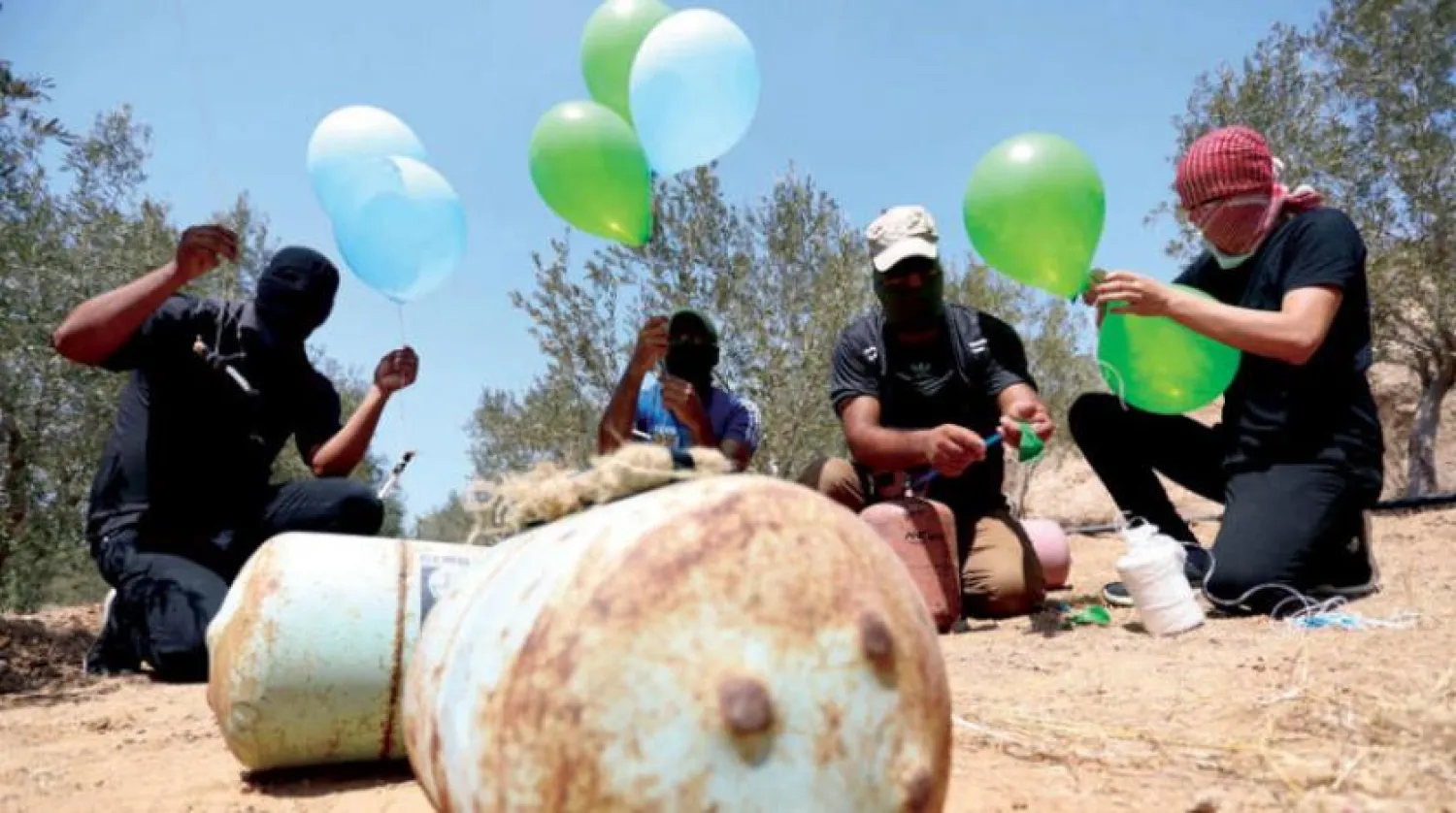
Exploding incendiary balloons are prepared in al-Bureij, Gaza. (dpa)
TT

Hamas Decides to De-Escalate Tensions with Israel

Exploding incendiary balloons are prepared in al-Bureij, Gaza. (dpa)

Hamas has decided to reduce tensions with Israel by stopping clashes with Israeli soldiers on borders and halting the launch of incendiary balloons, informed Palestinian sources told Asharq Al-Awsat.

The group’s decision is part of an effort to avoid sabotaging Egyptian attempts to maintain calm in Gaza.

Sources revealed that Hamas had responded to a request to lower tensions by Egypt, which was enraged by the group’s latest escalation on Saturday.

The agreement between Cairo and Hamas follows Ismail Haniyeh, the group's politburo head, discussing recent Gaza developments with Egyptian officials.

“Haniyeh’s contacts with the brothers in Egypt came to relieve our people and resolve some outstanding issues,” said Hamas spokesman Abdelatif al-Qanou.

For Haniyeh, cooling the atmosphere is vital after Egyptian anger with Hamas’ escalations led to the closure of the Rafah border crossing on Monday. Egyptian authorities did not announce when they would reopen it.

Hamas had angered Egypt by implementing its plan for gradual escalation despite having promised Cairo that the group’s border marches would not lead to more violence.

On Saturday, Hamas kickstarted popular marches on Gaza's borders with Israel. These demonstrations led to confrontations and the two sides exchanging fire.

Israel then bombed Gaza and Hamas launched cross-border incendiary balloons.

The attacks set off fires in southern Israel on Monday and provoked retaliation from the Israeli military, which hit several Hamas targets on Monday evening.

The army said in a statement that “fighter jets struck a Hamas weapons manufacturing site in Khan Yunis, as well as a terrorist tunnel entrance in Jabalia.”

“A Hamas underground rocket launch site that is located adjacent to civilian homes and a school in Shejaiya, was also struck,” it added.

Earlier on Monday, Israel Fire and Rescue Services investigators determined that arson balloons launched from the Gaza Strip caused at least nine fires in southern Israel.


Lebanon: Judicial Warrants Target Suspects in Hezbollah Explosives Case

Lebanon’s Military Court (National News Agency)
TT

Lebanon: Judicial Warrants Target Suspects in Hezbollah Explosives Case

Lebanon’s Military Court (National News Agency)

The investigation into a Hezbollah explosives shipment has widened, with Lebanese authorities issuing search notices for two people who went into hiding after being summoned for questioning.

Lebanese Army intelligence and the Internal Security Forces' Information Branch are also examining data extracted from phones linked to the case. Meanwhile, authorities have been unable to bring in two Hezbollah officials previously ordered to appear for questioning, as the group refuses to hand over wanted members and demands the return of the truck and its cargo.

Search notices issued as new suspects emerge

Judicial authorities have taken further action as preliminary investigations uncover new information.

A judicial source told Asharq Al-Awsat that Judge Claude Ghanem, the government commissioner to the Military Court, had issued search notices for the wife of detainee Haitham Amhaz and the owner of the truck that transported the explosives.

The two were summoned for questioning by the Lebanese Army's Intelligence Directorate but failed to appear and went into hiding, the source said.

The source added that investigators had made progress in identifying additional people suspected of involvement in the shipment.

The move marks a new development in the security investigation, which continues to examine evidence related to the shipment and those involved in transporting it.

It also adds two names to the list of wanted individuals, while orders to bring in two Hezbollah officials known as "Sajed" and "Zulfiqar" remain unenforced.

Hezbollah refuses to hand over suspects, demands explosives returned

Despite developments in the investigation, Hezbollah continues to demand that the Lebanese state return the truck and its cargo of explosives, while refusing to allow wanted officials and members to appear for questioning.

The group has also escalated its challenge to the Lebanese state, declaring that it would treat "any attempt to arrest one of its officials or members as an Israeli act of aggression."

The judicial source said the preliminary investigation was continuing on two parallel tracks, led by Lebanese Army intelligence and the Internal Security Forces' Information Branch, despite the failure of those summoned to appear.

The source stressed that the investigation would continue regardless of whether the wanted individuals were handed over, saying the procedures would run their course.

Investigators examine phones and communications

The source said data extracted from the phones of detainees Ali al-Kurdi and Haitham Amhaz, as well as Amhaz's wife's phone, had yielded information that investigators were verifying and cross-checking against other findings.

The information remains under review, with no final conclusions or decisions on possible further action, the source said.

The examination of phone data has become particularly important because investigators have been unable to question the wanted individuals.

The source said investigators were focusing on the content of communications and the nature of the connections revealed by the data.

"Important information has undoubtedly emerged and is being examined to determine the responsibility of everyone connected in some way to this shipment," the source said.


Baghdad Fears Armed Factions Could Join Potential US-Iran War

Two Iraqi security personnel flash victory signs in Baghdad on September 30 to mark the withdrawal of US forces (EPA)
TT

Baghdad Fears Armed Factions Could Join Potential US-Iran War

Two Iraqi security personnel flash victory signs in Baghdad on September 30 to mark the withdrawal of US forces (EPA)

Iraq's push to bring armed factions under state control faces a critical test as fears mount of renewed war between the United States and Iran, raising the prospect of militia involvement that could drag Baghdad into a regional conflict it is determined to avoid.

The concerns come amid US and Israeli reports of plans to resume strikes on Iran after the November 3 US midterm elections, with efforts to cement a ceasefire at an impasse.

The prospect leaves Prime Minister Ali al-Zaidi's government facing a delicate balancing act: keeping Iraq out of another war while preserving ties with Washington, even as armed factions retain military capabilities and the freedom to act independently of Baghdad, observers say.

Al-Zaidi outlined a phased disarmament plan in a September interview with The New York Times during a visit to New York, setting June 30, 2027, as the new deadline for bringing all weapons under state control. The previous deadline was September 30, 2026.

The plan begins with a 90-day period during which factions would halt attacks on US interests and neighboring countries in return for US forces refraining from targeting them. A gradual handover of weapons would follow over the next six months.

But setting a deadline has done little to settle disputes over how the plan would work. Powerful factions remain unwilling to disarm, with some insisting that foreign troops must leave first. Nor do public pledges to accept state control necessarily amount to binding commitments to surrender heavy weapons, missiles or drones.

Risks of escalation

Talib Mohammed Karim, a political science professor at Mustansiriyah University, said the scale of any US strike and Israel's role in it would largely determine how far Iraqi factions become involved.

Direct Israeli strikes on Iran, he told Asharq Al-Awsat, would make it "more serious" for some factions to shift from attacking US interests and bases in the region to striking deep inside Israel, potentially setting off retaliatory attacks and widening the conflict.

Karim said Baghdad's responsibility went beyond restraining armed factions. It must also prevent Iraqi territory from being drawn into the war and safeguard the country's sovereignty and national interests under the constitution.

Factions tied to Iran's supreme leader

Ghalib al-Daami, a media professor at Mustansiriyah University, expects any initial involvement by Iraqi factions to be indirect, most likely through attacks on US interests.

The factions have already declared their readiness to fight alongside Iran if war resumes, Daami told Asharq Al-Awsat. But openly entering the conflict could leave them in a "predicament," he said.

Abdulrahman al-Jubouri, a specialist in US affairs, said the factions do not necessarily share Baghdad's priorities, pointing to Kataib Hezbollah, whose ideology is directly tied to Iran's supreme leader.

"Al-Zaidi's position is not binding on these groups. Some say they remain committed to the truce, but they have not changed their view of the United States as an enemy," Jubouri said.

No united front among factions

Basil Hussein, head of the Kluadha Center for Political Studies, does not expect Iraqi factions to respond in unison to another US-Iran war.

Groups most closely aligned with Iran's Revolutionary Guards, particularly Kataib Hezbollah and the Nujaba Movement, could follow Tehran's calculations and expand their attacks to US interests and energy facilities across the region, Hussein told Asharq Al-Awsat.

Others, including Asaib Ahl al-Haq and Kataib al-Imam Ali, which have declared their support for bringing weapons under state control, are more likely to stay out of the fighting. But those declarations offer no guarantee of how they would respond if the war spreads, he said.

For al-Zaidi's government, Hussein said, the stakes are especially high. Renewed fighting could hand factions resisting disarmament another reason to keep their weapons while exposing Iraq to US and regional retaliation.

Researcher and academic Abbas Abboud outlined two paths for the factions: honor an agreement with the government to place weapons first under the commander-in-chief of the armed forces and then surrender them in stages, or join attacks on US interests inside or outside Iraq.

The second path could unravel the government's central program, Abboud warned.

If the factions join Iran in a war against the United States, he said, Baghdad could face severe political and security fallout, with Iraq dragged into the fighting "against its will and political decision."

Economic strain and sovereignty

Political researcher Hani Ashour said al-Zaidi's insistence that weapons remain under state control and decisions on war and peace rest with constitutional institutions reflects Baghdad's official determination to avoid another regional conflict.

A renewed US-Iran war could upend the regional landscape, Ashour told Asharq Al-Awsat, as Iraq struggles to shield itself from the fallout while grappling with difficult economic conditions.

Ashour believes the government will not allow factions to join the fighting under any pretext, noting that several have already pledged to place their weapons under state control.

Whether Baghdad can enforce that position, however, depends on turning political pledges into action. Factions remain divided over disarmament, with the timing and terms of any handover still in dispute.

Political researcher Falah al-Mishal said government warnings against those promoting weapons outside state control were in line with al-Zaidi's government program. Under existing laws, he noted, penalties for incitement or terrorist acts can extend to the death penalty.


Aden Governor After Escaping Airport Missile Attack: Hostilities Will Not Deter People of Yemen

Aden Governor Abdulrahman Sheikh tours Aden airport before the Houthi militia attack. (Saba)
TT

Aden Governor After Escaping Airport Missile Attack: Hostilities Will Not Deter People of Yemen

Aden Governor Abdulrahman Sheikh tours Aden airport before the Houthi militia attack. (Saba)

Aden Governor Abdulrahman Sheikh narrowly escaped a ballistic missile strike on Wednesday when it landed near the city's international airport shortly after he left the facility during a routine inspection tour.

Sheikh, who also serves as Yemen's minister of state, had visited Aden International Airport to inspect runway rehabilitation work before continuing to other sites across the city. Shortly after his departure, he learned of the attempt to target him.

Speaking to Asharq Al-Awsat, Sheikh said he had been inspecting the third phase of the airport's rehabilitation project, carried out by the Saudi Development and Reconstruction Program for Yemen. Work on the runway was between 70% and 80% complete, he said.

The attack did not interrupt his schedule.

Sheikh continued his tour, inspecting public service projects and visiting various security departments.

Such threats have become part of daily life for officials in the interim capital, Aden, since the war in 2015 and the Houthi coup, forcing authorities to weigh security risks against the need to maintain services and advance reconstruction.

Sheikh said local authorities take precautions against Houthi drone and ballistic missile attacks, including avoiding prolonged stays at inspection sites and keeping official movements unannounced.

He revealed that security agencies had busted several Houthi sleeper cells in Aden and other provinces as part of efforts to protect the city and its vital facilities.

The governor insisted that attacks would not deter Yemenis from performing their duties or halt efforts to improve conditions in Aden.

Beyond security threats, Aden faces mounting pressure to provide essential services, with shortages of cooking gas, strains on electricity supplies and continued demand for medicines and medical equipment.

Sheikh described the overall situation as reassuring despite difficulties securing some basic necessities.

He attributed the cooking gas shortage to disrupted supplies from Marib province, which have been affected by the war, and rising demand that has outpaced available quantities.

Electricity remains another major challenge, with exceptional circumstances placing further pressure on the sector and threatening services that residents depend on.

Healthcare facilities also require regular deliveries of medicines and medical supplies to sustain operations and meet patients' needs.

Sheikh praised support from the Saudi Development and Reconstruction Program for Yemen, the Joint Forces and the King Salman Humanitarian Aid and Relief Center, highlighting their contributions to the regular supply of medicines and medical equipment.

He said local authorities would continue to oversee development projects and maintain essential services despite security and economic challenges.

For Aden, the missile strike underscored the risks confronting a city struggling to rebuild amid persistent threats.

The attack came moments after the governor left the airport, but his inspection tour went ahead, reflecting the authorities' determination to keep reconstruction and public services moving despite the obstacles posed by the Houthis, stressed Sheikh.