

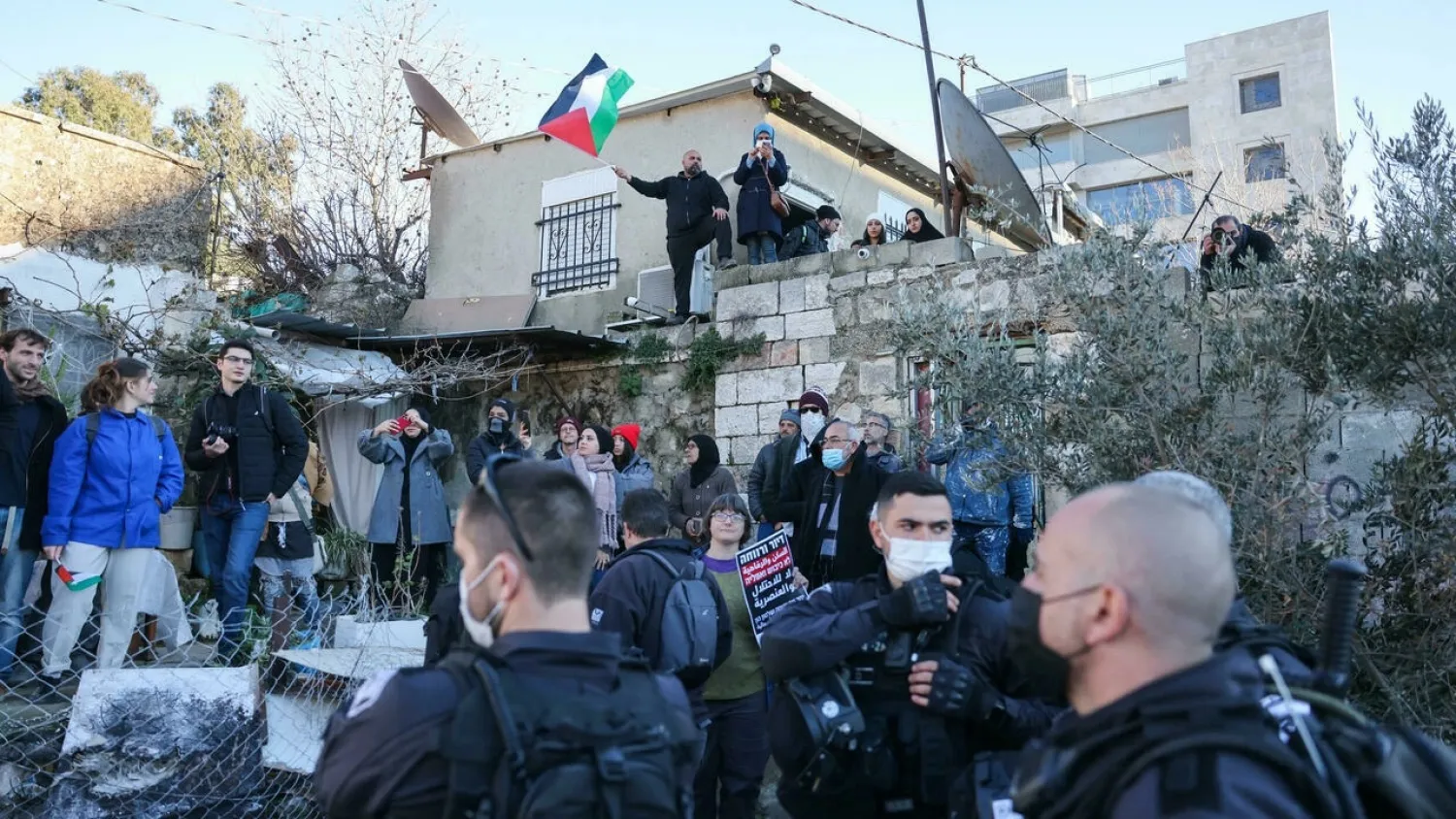

Israel Freezes Palestinian Evictions in East Jerusalem

Sheikh Jarrah has become a symbol of Palestinian resistance against Israeli control of Jerusalem; this photo taken on January 21, 2022 shows Israeli security forces deployed as Palestinian, Israeli, and foreign activists demonstrate. (AFP)
TT

Israel Freezes Palestinian Evictions in East Jerusalem

Sheikh Jarrah has become a symbol of Palestinian resistance against Israeli control of Jerusalem; this photo taken on January 21, 2022 shows Israeli security forces deployed as Palestinian, Israeli, and foreign activists demonstrate. (AFP)

Israel's Supreme Court on Tuesday froze the eviction of four Palestinian families from the flashpoint east Jerusalem neighborhood of Sheikh Jarrah, where Jewish settler groups have sought to seize control.

Justice Isaac Amit, in a ruling by a three-judge panel, wrote the families would be recognized as protected tenants, and would pay a Jewish settler group a symbolic annual rent of 2,400 shekels (about $740) "until a determination of ... land rights".

The four families in annexed east Jerusalem were at the heart of clashes that helped spark the 11-day war last May between Israel and armed groups in the Gaza Strip.

Israel annexed east Jerusalem -- which Palestinians claim as their future capital -- following the 1967 Six-Day War, a move not recognized by most of the international community.

Sheikh Jarrah has become a symbol of Palestinian resistance against Israeli control of Jerusalem.

The Palestinian families had been seeking a right to appeal a lower court decision that Jewish settlers owned the land.

In Tuesday's ruling, two of the three judges granted that right to appeal.

"The decision to allow them to appeal is just a preliminary decision," said advocacy coordinator Gaal Yanovski at Ir Amim, a Jerusalem group opposed to settlements.

"Two of the three judges decided they are freezing the eviction until there will be a land settlement of title."

Tuesday's decision was part of a years-long legal battle waged by Palestinian families, resisting efforts by Jewish Israeli organizations to reclaim property owned by Jews in east Jerusalem prior to Israel's founding in 1948.

The court recounted that Jordanian authorities controlling the area in 1954 built homes for Palestinian families, in exchange for those residents agreeing to relinquish their United Nations refugee status.

However, the land rights of the residents were not recorded by Jordanian authorities before the 1967 conflict.

Jewish groups claimed the property shortly after, using an Israeli law that allows Jews, but not Palestinians, to recover Jerusalem property lost in the 1948 war to create Israel.

In August, the families refused a "compromise" proposed by Israel's top court, in which they would be recognized as protected tenants in exchange for recognizing Israeli ownership of their homes.

The new ruling leaves the final status of the property open to a decision by an office within Israel's Ministry of Justice, Yanovski said.

Sami Irshid, a lawyer representing the Palestinian families, told AFP the decision was "significant".

"The decision of the Supreme Court today cancels the eviction while the issue of ownership is decided," he said.

Pro-settler lawmaker Itamar Ben-Gvir, who has opened a "parliamentary office" beside disputed homes, blasted the ruling as "a dark, illegal decision" and pledged to protest it.

More than 200,000 settlers now live in east Jerusalem, alongside about 300,000 Palestinians. The Jewish settlements there are considered illegal under international law.



Syria to Start Currency Swap on January 1st, Central Bank Governor Says

Syrian pounds are pictured inside an exchange currency shop in Azaz, Syria February 3, 2020. Picture taken February 3, 2020. REUTERS/Khalil Ashawi/File Photo
TT

Syria to Start Currency Swap on January 1st, Central Bank Governor Says

Syrian pounds are pictured inside an exchange currency shop in Azaz, Syria February 3, 2020. Picture taken February 3, 2020. REUTERS/Khalil Ashawi/File Photo

Syria will start swapping old banknotes for new ones under a ​plan to replace Assad-era notes starting from January 1, 2026, Central Bank Governor Abdelkader Husrieh said on Thursday.

Husrieh announced the introduction of the new Syrian currency, saying the decree "sets January ‌1, 2026, ‌as the start date ‌for ⁠the ​exchange ‌process". Sources familiar with the matter told Reuters in August that the country will issue new banknotes, removing two zeros from its currency in an attempt to restore ⁠public confidence in the severely devalued pound.

The ‌step is intended ‍to strengthen ‍the Syrian pound after its purchasing ‍power collapsed to record lows following a 14-year conflict that ended with President Bashar al-Assad's ouster in December.

Husrieh ​said the operation will take place through a smooth and orderly ⁠swap - a move bankers hope will ease fears that the new currency could fuel inflation and further erode the purchasing power of Syrians already reeling from high prices.

He added that a press conference will soon outline the exact regulations and mechanisms.


Türkiye Begins Black Box Analysis of Jet Crash That Killed Libyan Military Chief and 7 Others

Libyan national flags fly at half-mast in Tripoli on December 24, 2025, after the head of Libya's armed forces and his four aides died in a plane crash in Türkiye. (AFP)
TT

Türkiye Begins Black Box Analysis of Jet Crash That Killed Libyan Military Chief and 7 Others

Libyan national flags fly at half-mast in Tripoli on December 24, 2025, after the head of Libya's armed forces and his four aides died in a plane crash in Türkiye. (AFP)

The technical analysis of the recovered black boxes from a jet crash that killed eight people, including western Libya’s military chief, began as the investigation proceeded in cooperation with Libyan authorities, the Turkish Ministry of Defense said Thursday.

The private jet with Gen. Muhammad Ali Ahmad al-Haddad, four other military officials and three crew members crashed on Tuesday after taking off from Türkiye’s capital, Ankara, killing everyone on board. Libyan officials said the cause of the crash was a technical malfunction on the plane.

The high-level Libyan delegation was on its way back to Tripoli after holding defense talks in Ankara aimed at boosting military cooperation between the two countries.

The wreckage was scattered across an area covering 3 square kilometers (more than a square mile), complicating recovery efforts, according to the Turkish Interior Minister Ali Yerlikaya.

A 22-person delegation, including five family members, arrived from Libya early on Wednesday to assist in the investigation.


Lebanese President: We are Determined to Hold Parliamentary Elections on Time

President Joseph Aoun between Prime Minister Nawaf Salam and Speaker Nabih Berri (Lebanese Presidency file photo)
TT

Lebanese President: We are Determined to Hold Parliamentary Elections on Time

President Joseph Aoun between Prime Minister Nawaf Salam and Speaker Nabih Berri (Lebanese Presidency file photo)

Lebanese President Joseph Aoun reiterated on Thursday that the country’s parliamentary elections are a constitutional obligation that must be carried out on time.

Lebanon’s state-run National News Agency quoted Aoun as saying that he, alongside Prime Minister Nawaf Salam and Parliament Speaker Nabih Berri, is determined to hold the elections on schedule.

Aoun also emphasized that diplomatic efforts have continued unabated to keep the specter of war at bay, noting that "things are heading in a positive direction".

The agency also cited Berri reaffirming that the elections will take place as planned, with "no delays, no extensions".

The Lebanese parliamentary elections are scheduled for May next year.